Category Archives: photos

Brews And Dogs (Towne Taproom, Agawam, MA)

Date Of Event: May 4, 2019

Location: Towne Taproom, 378 Walnut St Extension, Agawam, MA

Hours: the event usually starts at 12:00 pm

Cost: Free

Parking: There is parking behind the taproom and there are parking lots in the area.

Handicapped Accessible: Yes

Dog Friendly: Of course!

Website: Towne Taproom (Facebook)

Summary: Towne Tap hosted their monthly “Dogs And Brew” event.  

IMG_7854

Towne Taproom has gone to the dogs.

Locally crafted beer wasn’t the only thing on tap at Towne Taproom earlier this month.

In addition to their musical entertainment, karaoke and trivia nights, Towne Taproom has been holding “Brews and Dogs” events which allow dog mom and dads to bring their furry friends to socialize.  Just make sure they are socialized and leashed.

A food truck from 4 B’s Mac & Cheese was also there and outdoor seating was available.

There were a variety of dogs at the event.  And, as you can tell by what some of the dogs are wearing, the first 50 dogs received a Towne and Taproom bandana.  The event raised funds for Baystate’s Pediatric Palliative Dog Therapy Unit.

Below are some of the visitors to the big event!

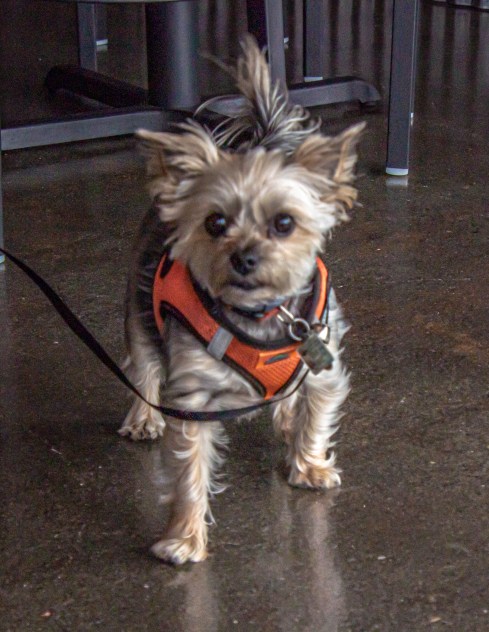
Penny is a 2 year old toy poodle.


IMG_7869-2

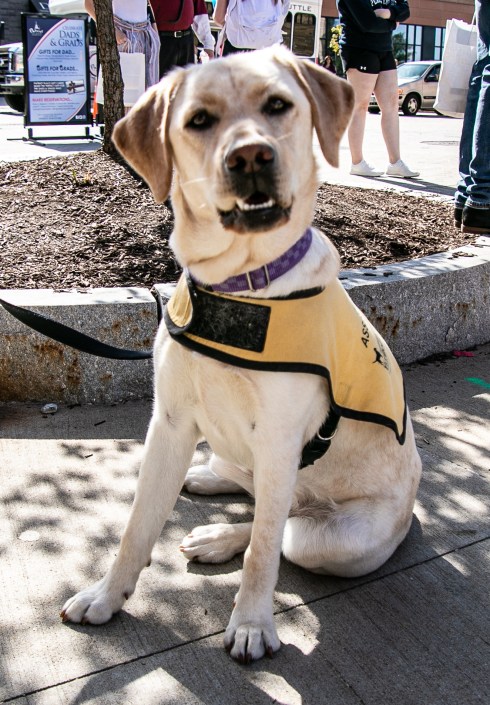
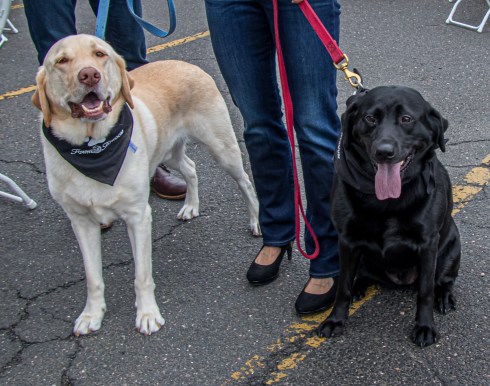
Rhodes and May (from left to right) are 5 year old labs.

IMG_7900

Elliott is a 5 month old Australian Cattle dog mix.


IMG_7923

Missy is a 5 year old Cavalier and Pekingese mix.

IMG_7938-2

Freya is a 2 year old Newfie.

IMG_7954

Mia is a 12 year old Boxer.

IMG_7962

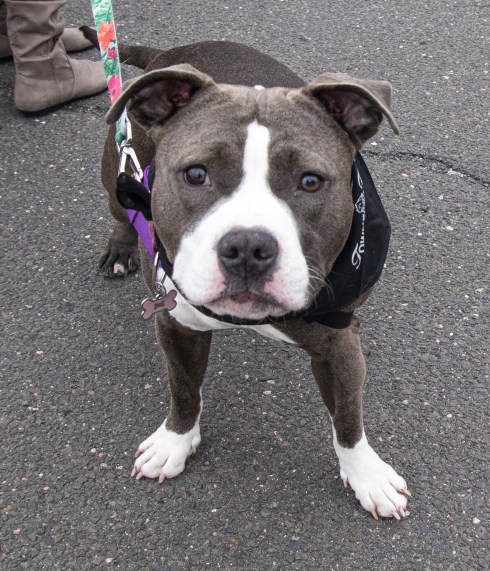
My mom’s dog Holly is a year and a half ptibull mix

IMG_7965

Mia is a 13 year old Boxer.

IMG_7975

Rhino is a 4 year old Great Dane.

IMG_8002

From left to right is Bruno, a 4 year old Cocapoo rescue from Texas and Olive an 11 year old Golden Doodle mix from Boston.

IMG_8014

Towne Taproom plans on having these Brews and Dogs event on a monthly basis.  But they encourage people to visit their Facebook page to find out when they will be held.  See you this summer for a few brews and dogs!


Baby Animals On The Shaker Village (Hancock Shaker Village,Pittsfield, MA)

Date Of Visit: April 13, 2019

Location: Hancock Shaker Village, 1843 West Housatonic St, Pittsfield MA

Cost: Adults    $20 ($18 for Seniors, AAA members, MTA cardholders, and active and retired U.S. Military)
Youth     $8 (ages 13-17)
Children (12 and under) are free

Hours:

Hours mid-April through late-June 10am-4pm

Summer and fall hours July through October 10am-5pm

Parking: There is one average sized parking lot with additional lots for overflow parking

Handicapped Accessible: The Visitor Center, restrooms, galleries, store, cafe, and all meeting spaces are wheelchair accessible. Compact-dirt pathways and boardwalks throughout the Village provide access to the gardens and grounds, as well as the mile-long Farm & Forest Trail, which also features interpretive signage. Some buildings in the historic Village are wheelchair accessible via ramp, including the Round Stone Barn and the Trustees’ Office & Store. Keep in mind, however, that most buildings in the historic Village are NOT wheelchair accessible. Wheelchairs are available free of charge with advance reservation

Pet Friendly: No, but service animals are allowed.

Website: Hancock Shaker Village

Highlights: historic homes, animals, educational tours, demonstrations

Summary: The baby animals have arrived at Hancock Shaker Village.  In addition to the baby animals, there are tours of the historic homes and educational opportunities for visitors at the village.

IMG_7072

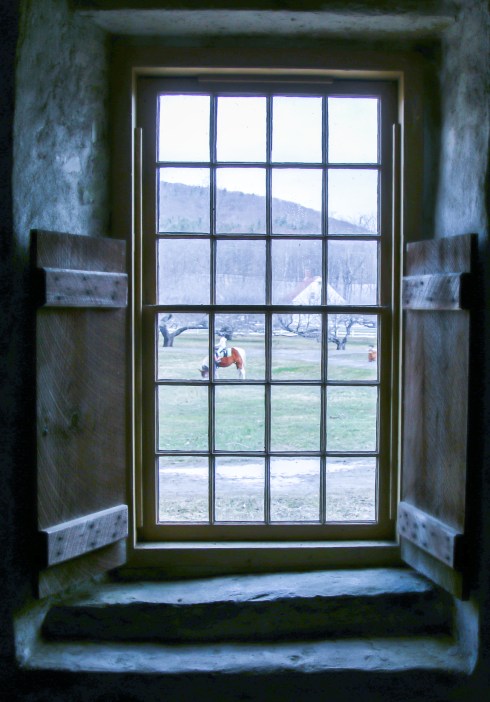
Spring in New England can only mean one thing: baby animals at Shaker Village!

Each year, dozens of animals arrive at the museum for the new season. The animals are housed in the appropriately named Round Stone Barn.  The barn, which was built around 1839, was burned to the ground December 1, 1864.  One hundred tons of hay, ten bushels (roughly 93 gallons) of provender and two adjoining sheds went ablaze during this fire.  It was rebuilt during the mid 1870s.

IMG_6781

IMG_7045

Sheep, goats, pigs, chicken and other animals were present during my visit.  People were encouraged to go into the pens with the animals and pet them or take photos.

But, there weren’t just babies at the village.  Older animals, in some cases the mom and dad of the babies, were also at the museum.

Being located so close to the mountains and countryside of New York (we actually drove through New York for a brief period of time), the views from the farm were beautiful.

The farm also includes historic homes.  The self guided tour has signs with information about each house with background about each place.

One of my favorite buildings is the Blacksmith’s shop.  The Shakers made all of the metalwork used for their buildings.  In the Blacksmith’s shop, which was built in 1874, a blacksmith conducts demonstrations of how they make the hardware they use.  He was the third generation blacksmith in his family and the last.  No one else in his family wanted to continue the blacksmith trade.

There is also a room with tanning vats, a cider press and a turbine.

IMG_6977

But my favorite buildings from that era were the homes, offices and stores.  The Trustees Office and store and family living quarters housed the souvenirs people would buy during their visits.  It was also the place where people on business trips could place orders for goods.

The buildings and sheds on the farm give the premises a very old time feel.

There was also a play area for children where they could play with toys from that era and play with other toys.  There was also face painting, horse rides and a balloon shaping artist.

The only really difficult part of the photography session, besides the animals moving when I took their photos, was photographing the blacksmith.  It had all of the elements of a challenging photo shoot: low light, motion when he used the tools to make the hardware and the fire which was in stark contrast to the low light in the room.  I wanted to show the flame on the stove and the light on the tool he was using.  So, I didn’t want to boost the ISO or aperture too much.  So, what did I do?

The hard part for me is when there is motion and low light.  You want to use a fast shutter speed to photograph motion (500 or higher).  But, when there’s not a lot of light you need to use a slower shutter speed.  I didn’t have my tripod with me (and the museum doesn’t allow tripods on their property).  So, I used a fast shutter speed (500) and lowered my aperture to the lowest setting (3.5).  To make up for the lack of light I boosted my ISO to 2000 which is pretty high.  I knew that I could add noise reduction to address the noise or grainy photo from the high ISO in the editing process (which isn’t without its drawback that I will address in a future post).

It was important to capture the motion without seeing any blur and I wanted to make sure the fire looked as realistic and was an accurate display of what I saw, so I went with a high ISO.  Even if I did have my tripod with me it wouldn’t have been very useful as I needed a fast shutter speed rather than a slow shutter speed to capture the motion of the blacksmith.  You can always adjust the image by using noise reduction and using a higher or lower contrast and exposure setting when you edit in LightRoom or PhotoShop, although you do want to get the best photo as possible in the camera to avoid having to edit it too much.  I did end up using a low exposure in LightRoom to show how dark the room was when I took the photographs and to highlight the light from the fire.

Below are some of the photos of the blacksmith which show how I had to adjust the settings to capture his motion and the light from the fire.  As you can see from the photo, the high ISO (2000) allowed me to capture both the motion of the blacksmith as he used the pulley to add oxygen to the fire to keep it going and you can see the sparks clearly from the fire.  The noise reduction tool unfortunately can take away some of the details.  But it was a give and take.  I used the noise reduction to get rid some of the grain from the high ISO knowing that some of the features (like the background) may be a little dull.

IMG_6962

2000 ISO, 18 mm, 3.5 aperture, 1/500 shutter speed.

IMG_6965

2000 ISO 18 mm 3.5 aperture 1/500 shutter speed

I had to use a fast shutter speed (500) to capture the motion of the tool he was using without getting any blur and I sacrificed my ISO (technically I probably could have used a lower ISO, and I do have some photos of the blacksmith with an ISO of 1250).  I think I was playing it a little too safe with the high ISO

I ran into the same situation photographing the animals.  The barn was not well lit and the animals move around a lot.  I just had to use a high shutter speed (500 or 1000) and a low aperture (3.5 for most shots) and I was able to keep the ISO relatively low (around 400 for most shots) .  Again, I was able to use the settings in LightRoom to add color and bring out some contrast in the photos.

Shooting outside was not too hard, especially since I had some cloud cover which prevented sun glare and other issues you can run into when the sun is bright.  However, I have to fess up that I did have a 640 ISO (I should have bumped it down to 100 or so) because I forgot to adjust it after photographing the animals i the barn.  So, always check your settings when you’re changing locations at a photo shoot!


Easter In The Park (Boston Public Garden, Boston, MA)

Date Of Visit: April 21, 2019

Location: Boston Public Garden, 4 Charles St, Boston, MA

Hours: Open daily sunrise to sunset

Cost: Free

Parking: There are several parking garages in the area and limited street parking

Handicapped Accessible: Yes

Dog Friendly: Yes

Highlights: flowers, sculptures, swan boats, trees, statues

Website: Boston Public Garden

Summary: The Ducklings were dressed in their Sunday bests as people thronged to Boston Public Garden to enjoy an unseasonably warm day at the park.

The Dressing of the Ducklings has become an Easter tradition for some time.

But, they are not only dressed up for the Easter holiday.  The ducklings, which were installed in 1987, have also been seen wearing jerseys of the home sports teams, particularly during the playoffs or other important points of the season.  They are also dressed up for other holidays or days of interest, most notably Mother’s Day.

The book “Make Way For Ducklings” by Robert McCloskey is the inspiration for these sculptures.  In the book a pair of mallards  decide to raise their family on an island in the lagoon in Boston Public Garden. Oh, sorry spoiler alert.

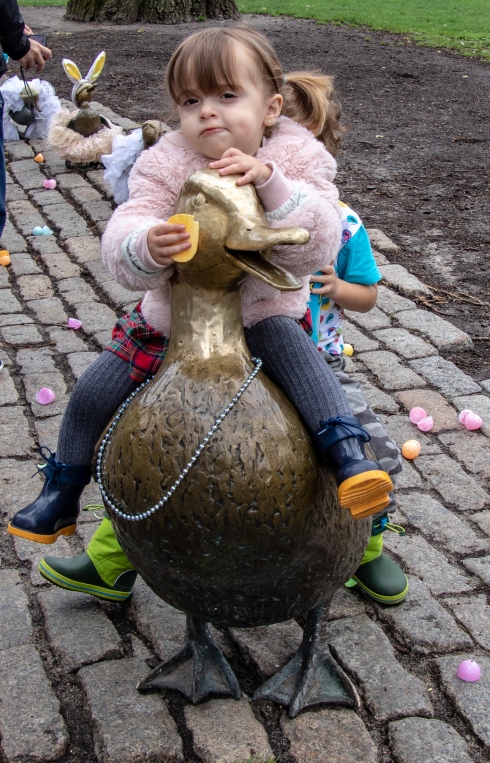
The ducklings are a favorite of the children who like to play with, and sometimes on, the statues.

IMG_7365

The ducklings aren’t the only sculptures at the park.

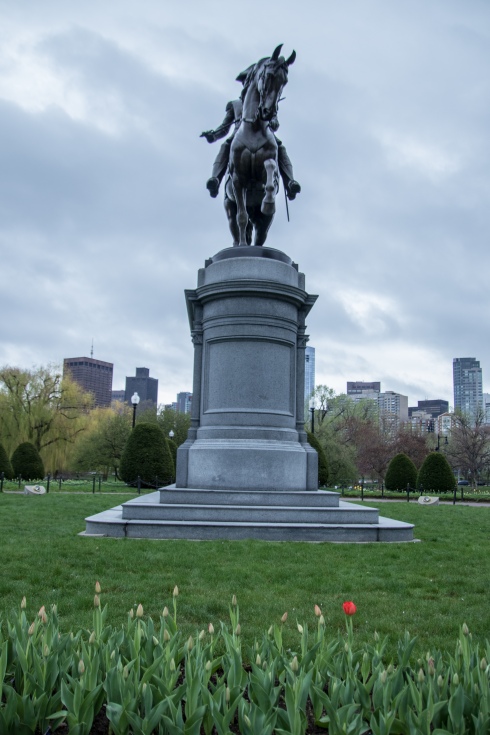
At the Arlington St entrance, there is a larger than life statue of George Washington.  The 22 foot granite statue stands on a 16 foot pedestal making the total height of the statue and pedestal 38 feet.

IMG_7225

Built by Boston painter and musician Thomas Ball, the statue took 4 years to complete.  Because of shortages of bronze casting due to the Civil War, it would not be completed until 1863.

The real beauty of the park is more natural.  Countless trees, flowers and plants adorn the park.

The views at the park are some of the most beautiful in Boston.  You may see the lagoon that I mentioned above where the ducklings are said to have resided.

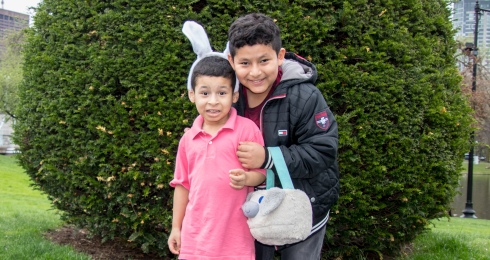
I was surprised at how many people were at the park on what I thought would be a “family holiday” for most.  Seeing all of the people dressed to the hilt, I do think many people came to the park after their morning obligations were completed.  These visitors were having fun celebrating the day.

IMG_7285

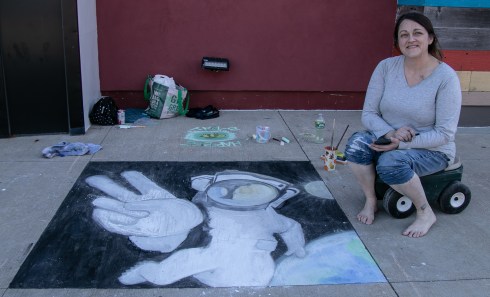
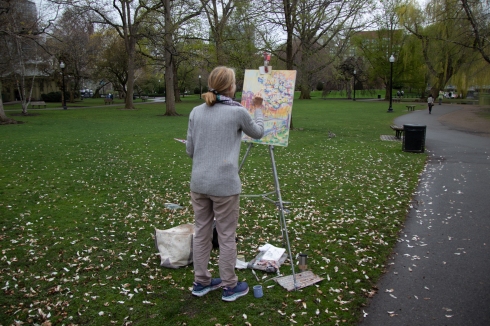
This creative lady took the opportunity to paint at the park.

IMG_7189

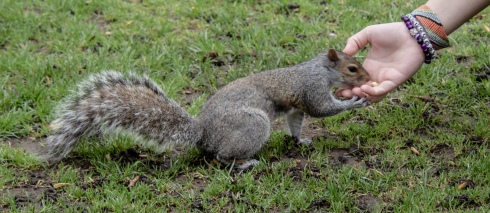
Birds and other wildlife are abundant at the park. Fittingly, I did see a few mallards there.

Some animals are so used to seeing and interacting with humans they will eat from your hand.

IMG_7369

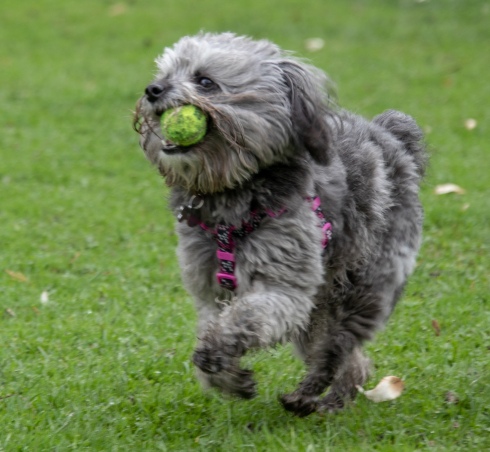
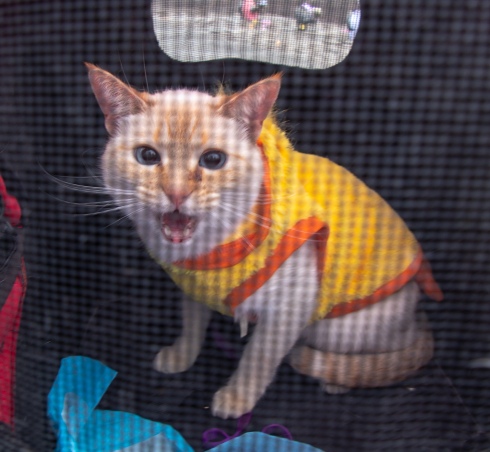
Dogs and even a cat were at the pet friendly park.

IMG_7407

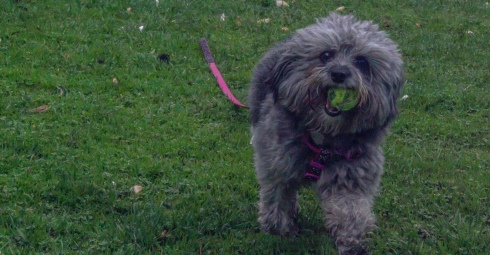
Maggie, an 18 month old Aussiedoodle (Australian Toy Poodle), had fun retrieving a miniature sized ball.

IMG_7445

This brave cat named Blue, a 6 year old Orange and Siamese cat, went to the park with her mom.

Now the fun part.  How did I photograph this place?  Since I left early before the sun was high in the sky and it was overcast for most of my visit, it was easier than on some of the sunnier days,  For the most part, I shot with a 5.6 or 6.3 aperture. I even went down to 3.5 and 4.0 and I kept my ISO at 100 since lighting wasn’t an issue for this shoot.

I usually use the Aperture Value (or Aperture Priority) setting.  So, I didn’t worrying about controlling my shutter speed.  Until I photographed Maggie, of course.  To capture her motion as she rain I used a 320 shutter setting and I probably could have gone to 500 or higher.  The hardest part of photography, especially for us beginners, can be making sure all of the settings are correct before you click.  I can attest to this.  As I went into, gulp, manual mode I made sure to put my shutter speed at 1,000 to photograph Maggie.  But, I forgot to adjust my other settings.  So, I had a few black images in my LCD screen.  Once I made this correction the photos came out better.  This just goes to underscore the importance of looking at your meter and viewing photos in your screen and adjusting as needed as you shoot.

However, I would caution anyone from deleting files from their memory card.  For reasons that are far too technical for me to explain clearly, you can actually damage your memory card if you try to delete images from your card.  Everyone does or has done it, though.  In fact, I did it just the other day out of habit.  Here’s an article that explains it in greater depth: Why you should not delete images on your memory card in your camera

But, another easier way to explain this is to just say you don’t know what you can do to the image in LightRoom or PhotoShop (more on these applications in a future post).  But, take a look at this photo of Maggie, the dog I photographed at Boston Public Garden.

IMG_7395-3

I almost used this photo in my post.  But, I thought the other photo showed better motion and was an overall photo especially since this photo was too dark no matter how much I played with the settings in LightRoom.  But, considering what I had to work with it wasn’t too bad.  This is what the original photo looked like on my memory card before I edited it in LightRoom.

IMG_7395

Yes, that’s what the photo looked like on my card before I edited it.  I was so eager to photograph the cute little doggie that I only adjusted the shutter speed and not the aperture (it was at 22 when I took the photo).  I noticed the error and I adjusted my aperture and shutter speed accordingly (the photo I posted in the blog post above was at 5.6 aperture, 320 shutter speed, 160 ISO and 128 mm).  I should have used a faster shutter speed (500 or 1000) and adjusted the aperture as you can see some blur in her legs and a faster shutter speed would have eliminated this.

The main point of me posting those photos is that virtually any photo is salvageable or at least you can “save” almost any photo, unless, of course, it is blurry.  So, please don’t ever delete in your camera!

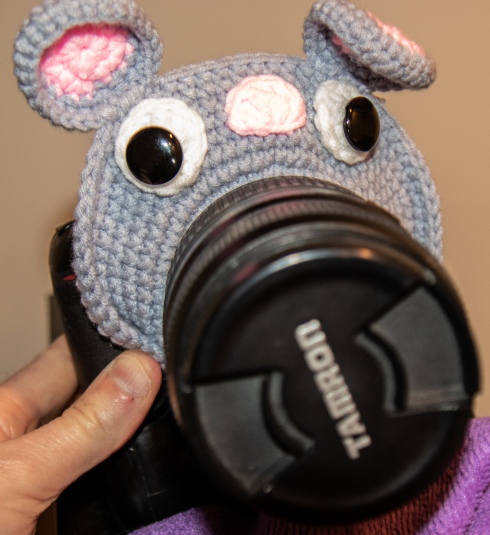
I didn’t use a lens hood or any other device to limit sun glare since it wasn’t a particularly sunny day.  I did, however, use this when I was photographing the child on the goose sculpture.

IMG_7826

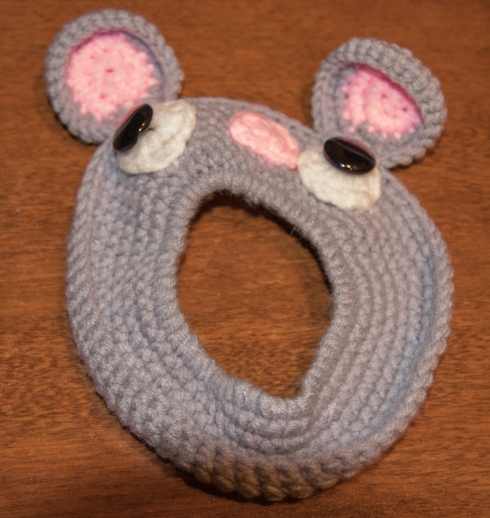
You slip on the lens and it can help to attract the child’s attention.  It also works with some dogs and other pets (and probably even adults!).  Isn’t it cute?  While I don’t sponsor items or advertise items,  I do like and recommend this item.  I will leave the link for this and other knitted “camera buddies” here in case you may want to look into purchasing one.

IMG_7820

I hope all of this info helps


Lake Atlantic Invitational Surfing Competition (Good Harbor Beach, Gloucester, MA)

Date Of Event: April 6, 2019

Location: Good Harbor Beach, Thatcher Rd, Gloucester, MA (about 45 mins northeast of Boston, MA or 1 hour and 30 minutes southeast of Concord, NH)

Summary: 26 surfers entered the first Annual Lake Atlantic Invitational Surfing Competition.

Websites: Lake Atlantic Invitational

Gloucester Beach Info

IMG_6184

Hang ten!  Good Harbor Beach in Gloucester, MA, was the home to the first Annual Lake Atlantic Invitational Surfing Competition earlier this month.

Twenty six surfers from the Gloucester area came together to show off their skills. The surfers went out in groups of 3 or 4.  And each group was represented by a different color which represented a different heat.  The order of the flags were changed so that each group (heat) would get a chance to begin surfing in a different order.  But, the groups were judged individually.

IMG_6036

The top three surfers won one of these cool trophies.

IMG_6023

Since I arrived about an hour before the competition began, I decided to take some photos of this beautiful place.

The beach is only a short drive from Boston, MA.  However, if you plan on visiting this gem during the summer, it may not be as easy as you think.  Click on the link above to view the parking policy during the summer.  In short, you need a sticker to park in the limited parking lot.  You can apply for a sticker if you live out of town.  But Gloucester residents get priority.  Unless you are a resident of Gloucester (and have a parking sticker to prove it), the best times to visit may be before Memorial Day or after Labor Day.  Or, during early spring when it’s absolutely freezing.  That’s what I did!

Most of the surfers came from Gloucester or the Gloucester area.  However, one of the competitors, Jake Danzer, 20, came all the way from New London, CT, where he attends the U.S. Coast Guard Academy.

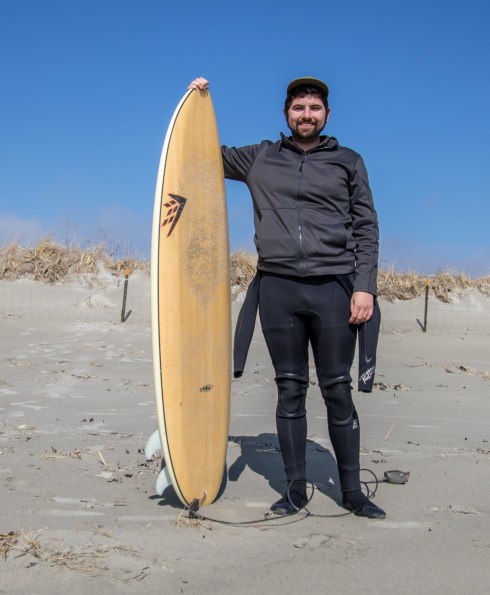
Alex Debreceni, from Dunstable, MA, was one of the surfers competing that day.
IMG_6032

There were other photographers at the surfing competition including the people who brought this drone to photograph the surfers in the water.  But, this dog would rather play with it.

IMG_6041

While it was pretty cold (in the 30s and 40s for most of the morning) and there was an evident wind that made it feel even colder, the waves weren’t all that, well, wavy.  The surfers did their best to show off their skills.

But, they all weren’t successful.

IMG_6328

Of course, I could no better.  And, just like in life, it doesn’t matter if or even how many times you fall.  What matters is how often you get back up on your board!

The winner of the competition was Colby, 18 of Gloucester. Rhodes Cole, of Rockport, came in second and John Lane, of Yarmouth, Maine, came in third.

Good Harbor is a great place to take your dog.  However, make sure to visit only during the designated times (unleashed dogs are allowed October 1st to March 31st ).  One of the reasons for this is to comply with state and federal laws that protect nesting areas for piping plovers.  Animal control arrived while I was leaving.  So they do enforce this regulation.

Despite the regulations, I did see quite a few dogs at the beach during the competition.

IMG_6029-2

Gracie is a 1 year old Lab mix.

IMG_5991-3

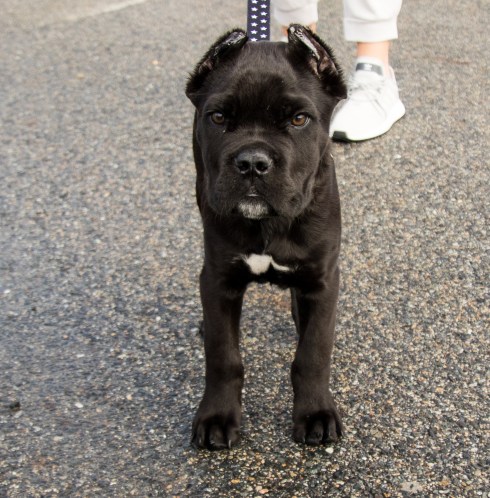
Boss is a 3 month old Cane Corso

A recent feature to my posts which I am trying to make a regular part of them is to explain the settings and methods I used to photograph my shots.  This was a tricky one for me.  I wish explaining photography was easy.  Unfortunately, it can be a little complicated, especially when you try to boil it down.  So, I have highlighted the places where I show the settings I used and any other important tips.  But, to gain a better context of why I used them and how it may help your photography, I would suggest reading the entire passages.   And this one is fairly long.

When writing these tips I always think what would I have wanted someone to tell me when I first started photography.  I learned a lot from trial and error and I would like to help others avoid having to learn this way whenever possible.

As I’ve mentioned in the past, I’m not by any means an expert photographer and I have really only been using manual mode and other modes outside of automatic for about 7 months now.  So please leave a comment if you notice I misrepresented or omitted some info.

Motion and sunlight.  They can be the most difficult elements to photograph in any photo shoot, especially for beginners.  But, just like anything else, once you get you get it.  The only way to understand and overcome these challenges is to shoot when these things are available  It’s not hard to find these things.  Shoot a 5K or a marathon.  Or, if the parties are ok with it, and they usually are, shoot some kids or adults playing basketball, baseball, tennis or some other sport.  Or, shoot birds, dogs or other animals.  They always seem to be moving.

To be honest (and I always am about photography), I could have and probably should have used a tripod.  It helps steady your camera and avoid blur when you’re photographing motion.  But, I was being  a little lazy, if I’m going to remain honest.  I, like many photographers, I like to move around, especially when photographing motion, and tripods can sort of slow you down.  But, I do recommend using a tripod when photographing motion.

Photographing motion requires a faster shutter speed.  I generally used the AV (Aperture Priority in Canon or AP in some other cameras) mode.  This allows the photographer to control the aperture and ISO while the camera controls the shutter speed.Given what I’ve mentioned above, fast shutter speed is very important when photographing motion and the AV mode is not the best mode to use for these types of shoots.  Frankly, it doesn’t do a good job handling motion always.  You’re much better manually adjusting the shutter speed.  This brings up one of the scariest two words for many beginning photographers: manual mode.

Being someone who used to get dizzy just thinking of using manual mode, I understand the trepidation some may feel.  It really isn’t as daunting as it may seem, though. Basically, you want to use similar settings you would want to when you’re in AV mode (or even automatic mode) and adjust the shutter speed accordingly.  As a general rule, I usually use a 500 or 1000 shutter speed (that is one five hundredth of a second or one on thousandth of a second) when photographing someone running or moving briskly.  It’s important to note that some cameras may have different shutter speeds depending on the model being used.  I used a 800 and 1000 shutter speed (again one eight hundredth of a second or one one hundredth of a second) to photograph the surfers.  Since there was so much light I went up to a 6.3 and 7.1 aperture for most of the photos when I zoomed in (3.5 to 5.6 when I wasn’t zooming in).  This was, in part, due to the lens I used.  The aperture for my lens will only go to a certain aperture when I zoom in.  If you use abetter (more expensive) lens you can sometimes use a smaller aperture when you zoom in.  I had to work on the settings in Lightroom in post since they did come out a little dark.

It’s also important to keep in mind that showing blur can be OK in some situations.  If you’re trying to show a bird hovering, for instance, you may want to show their tail blurry while the rest of their body is still.  I actually did this by mistake.  I used the wrong shutter speed and I received the results I just mentioned and people actually liked it.  You can see what I mean by the photo below.  Granted, I would have preferred to use a higher shutter speed and I wasn’t going to post it in my previous Facebook post.  But, some of my friends and family told me that by showing the motion the blur was OK, particularly since the rest of the body of the bird is in focus.  I used a shutter speed of 250 (or one two hundred and fiftieth of a second) shutter speed for this photo.  I should have used a 500 or higher shutter speed.

IMG_4615

Some other photographers will also show blur on purpose for effect when photographing vehicles passing by (you may see those photos of streaks of light which become evident when you use a slow shutter speed while vehicles pass by).

This website gives some very helpful tips and a useful chart to determine which shutter speeds to use: phototraces shutter speeds.

Sunlight is the other challenging part of photography, somewhat ironically.  When I first began photography, I used to think sunlight was not only ideal but essential to good photography.  Now, I hope for overcast skies.  The reason for this is sunlight can cause everything from sun glare to difficult shadows.  I always found it interesting and annoying when my automatic flash would turn on during a perfectly sunny day.  This of course had to do with the shadows which the sun can create.  To avoid this I always use AV or manual mode.  Remember to use a higher aperture if it is a particularly sunny day (5.6 or higher generally).  I also use a lens hood to help prevent sun glare. Another hack is to go to automatic mode, seeing what the camera suggests to use for settings and using that as a guide.  However, this is only a guide to get you in the right ballpark.  You can adjust it from there.  Also, if you camera hs a live view option you can preview what the photo should look like as you adjust your settings. Also, last but certainly not least, make sure to adjust your settings in the camera’s light meter. Make sure the line matches up to the middle of the spectrum.  Keep adjusting your settings until it is there.  

Just to touch briefly on lens hoods.  While using one recently I found that it was being picked up in my photos and causing the corners of my photos to look black and I had to crop the photos more than I would have liked.  To avoid this, you may need to make sure your lens hood is in a “12 o’clock” and “6 o’clock” position.  Once I made this fix it prevented the hood from being picked up by the lens.

One last tidbit I would like to mention about sunlight is the golden and blue hour.  Named for the colors of the sky (when clouds are not present) during the hours just before and after sunrise and sunset, the blue and golden hours are ideal for photography.  In fact, some photographers will only photograph during these times. However, realistically, yo cannot always avoid photographing during the non goden hours.  In fact, most of the events I photograph take place during the worst possible times for photography.  The best ways to handle sun glare and washed out photos is to use a lens hood, avoid shooting at or close to the sun and using Lightroom or Photoshop to compensate for shots that may have a lot of sunlight in the photos.

All is not lost though when it comes to shooting in sunlight.  In fact, you can use it to your advantage. For instance, the sun shimmering off objects like water can be very pretty.  Or, a ray of light poking through the clouds can make for a good contrast.

I hope these tips have helped and please leave me a comment to let me know if you like (or do not) this feature of my posts or if you have additional tips to add.


Prismatica (Boston, MA)

Date Of Visit: February 25, 2019

Location: 60 Seaport Blvd, Boston, MA

Hours: Open daily, 24 hours until April 1.  It’s been viewed during the evening or overcast days

Cost: Free

Parking:

  • Parking can be found at the heated One Seaport Garage, located at 75 Sleep Street, Boston, MA 02210

Handicapped Accessible: Yes

Dog Friendly: Yes

Website: Prismatica

Summary: 25 illuminated panels light up the Boston Seaport area.

IMG_4721

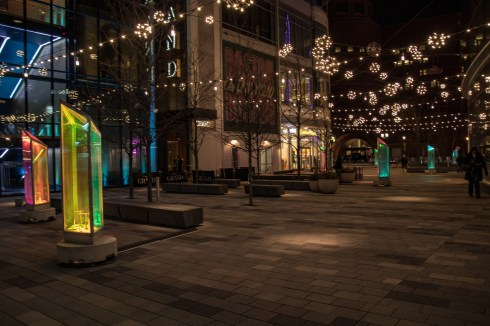
Don’t be surprised if you see lights and hear unusual sounds in the Seaport area.  It’s not the mothership coming for us.  It’s just another light display on Seaport Blvd.

The light display, appropriately named “Prismatica”, will be on display until April 1.  Although the lighted panels will be on display all day, it is best to view them during the evening hours, particularly after dusk for obvious reasons.

The 25 panels, which were made by RAW Design in collaboration with ATOMIC3, are laminated with a dichronic film that transmits and reflects every color in the visible spectrum.  The lights in the panels change depending on the position of the light source and the observer.

The colors of the pillars can be changed by the visitors. However, the lighted pillars in these photos were turned because of the high winds the evening I took these photographs.  In fact, it was the precursor to one of our many New England snow storms.  And, as they turned, their colors also changed.


But, that’s not all that changes.

The pillars also play sounds.  When you turn the pillars they emit soft sounds in addition to changing their colors.

The colors of the panels do not have to be turned or manipulated to change.  As you can see from the photos below, the panels change colors on their own.


As I mentioned in my previous post, I am going to add more of the settings I used and my advice about shooting displays and places like this.  Although I do recommend using a tripod for shoots like this (evening shoots with low light) and I did bring mine with me, I did not have to use my tripod because the external light sources at this venue provided enough light for me to shoot without having to use the tripod.  Like many other photographers, I prefer to avoid using a tripod whenever possible because it is bulky and slows me down.  I was also able to bring out some of the light by bumping up my ISO a bit and using my settings in Adobe Lightroom.  This brings me to my next point about shooting late at night or in any lighting situation actually which I will outline below.

One thing I have noticed, for whatever it is worth, that it can be tempting and very easy to overcompensate for low light environments by overcompensating with the exposure, contrast, saturation and other settings.  I see it often.  I am sure you do as well.  While it may vary on the situation, I try to emulate the images as I saw them to the best of my ability.  I could have very easily upped the saturation and clarity (and the urge is very tempting to do so).  But I wanted to represent the display as closely as to what I saw and what it really looked like at least on that night.  That is a key point, too.  The same place, display or person can and often will look different on different days or even at different times of the same day.  Before I go on and on, which I could easily do, I’ll spare you all of my thoughts about this point.  There will be many other shoots to delve into the settings in Adobe or Photoshop.

To wrap up my details of this shoot, I used a 3.5 or 4.0 aperture setting for most of these shots with a variety of shutter speeds from 1/10 to 1/100 shutter speed (I usually shoot with an aperture priority setting so the camera chose that speed) and an ISO of 320 and I probably could have even gone lower.

Feel free to send comments about how you may have shot this light display or any other thoughts you may have about anything I have posted.  I am still learning.  So I would appreciate any thoughts you may have.

Similar Displays I Have Visited:

Loop (Boston, MA)

Rose Fitzgerald Kennedy Greenway Part II


President’s Day Celebration (Quincy, MA)

Date Of Event: February 17, 2019

Location: Hancock-Adams Greenway, Quincy, MA (about 10 minutes south of Boston and 45 minutes northeast of Providence, RI)

Cost: Free

Parking: There was free parking available at the Ross Garage

Handicapped Accessible: Yes

Dog Friendly: Yes

Summary: Quincy, MA, held their first (of hopefully many) President’s Day celebrations which included games for children, a band, costumed entertainers, an orchestra, a play for children and the Fire Gypsy.

IMG_0548

What better place to spend Presidents Day than Quincy, MA, the home to two U.S. Presidents as well as former Governor of MA John Hancock (Hancock has been considered to be from Quincy after the part of Braintree he was from was annexed into Quincy)?

The first Presidents Day celebration included a tour of the crypt where the former Presidents John Adams and John Quincy Adams have been laid to rest.  Both presidents were originally buried in a tomb at the Hancock Cemetery across the street.  But, since John Adams wanted to buried in a church, the bodies were moved to the basement of what is now called the United First Parish Church.  The tomb where the bodies were originally laid to rest is still at the cemetery.  The presidents and their wives bodies, or remain, are in the crypt at the church.

Image may contain: plant and outdoor


Some very tall costumed entertainers greeted visitors.


Souljacker ably covered some Rolling Stones and other classic rock bands.

IMG_0088

Behind The Mask performed for the children at the event.


There were also games such s air hockey and other table games for people to play.


One of the biggest attractions was the Fire Gypsy.  Despite the very cold temperatures, everyone stayed for the entire show.


The Presidents Day celebration was dog friendly.  I saw these two dogs during my visit.

Callie is a 5 year old Saint Bernard.

IMG_0068

Ren is a 9 month old Whippet mix.

IMG_0107


Air, Sea And Land (Boston, MA)

Date Of Visit: January 28, 2019

Location: Seaport Blvd, Boston, MA

Hours: The sculptures are accessible 24 hours a day

Cost: Free

Parking: limited street parking is available.  There are also parking garages and lots in the area (specifically at 101 Seaport Blvd and 85 Northern Ave)

Handicapped Accessible: Yes

Dog Friendly: Yes

Summary: 7 multi colored sculptures by Okuda San Miguel line Seaport Blvd

IMG_3415

Land, sea and air are not just ways to travel.  They’re also a new art installation in Boston’s Seaport District.   The art project by Okuda San Miguel, a Spanish painter from Santander, Spain, was installed on Seaport Blvd in October, 2018. As a guide to know where the sculptures are located on Seaport Blvd, the art installations begin near the side street of Sleeper St and extend to East Service Rd.

The sculptures are lit up at night, and since I think the lighting makes art seem to come alive, I thought this would be the ideal time to photograph the art work.  I actually happened upon these statues while I was on my way to photograph a different illuminated outdoor exhibit.  But, it just goes to show there’s always so many different exhibits in the city all year round.

The exhibit is meant to bring the viewer into his imagination so they can expand their thoughts on evolution, coexistence, and harmony.  Mythology and beasts play an important role San Miguel’s exhibit. The 7 sculptures which are located  range in height from 8 to 12 feet.  In his exhibit, Okuda separates animals into 2 separate categories: domestic and wild.  He uses these categories to emphasize the natural balance of our environment.

I am posting the sculptures in the numerical order listed on the placards placed next to the sculptures.  The sculptures are numbered 1 to 7 beginning at the top of Seaport Blvd.  (near 60 Seaport Blvd). The sculptures are located in about a distance of a mile.

One thing I noticed is the sculptures almost look like they’re in 3D, especially when they’re lit up at night.  This is particularly evident with the multi colored vibrant sculptures.

I couldn’t find much information about the meaning or message about the art, except what I mentioned above.  The placards only listed the name of the sculpture and the category of the type of art the sculpture is categorized which I have included in parentheses.

The first sculpture in the display is called Creation (Light).

IMG_3415

Sculpture number 2 is called Creation (Water).

IMG_3412

The third sculpture is called Mythology (Mythological Being 1).

IMG_3385

Sculpture number 4 is called Mythology (Mythological Being 2).

IMG_3380

Natural Balance (Coexistence) is the fifth sculpture on Seaport Blvd.

IMG_3390

The sixth sculpture is Diversity (Domestic).

IMG_3395

The seventh sculpture is called Diversity (Wild).

IMG_3403

I am not sure how long the exhibit will be up although it seems unlikely the city would want to take down the sculptures during the winter since the inclement and cold conditions could make dissembling them difficult.  Also, it is somewhat dangerous to view and photograph these sculptures, particularly at night.  So, please do use caution if you do view these sculptures and use the many traffic lights on Seaport Blvd to ensure this safety.


Westfield 350th (Westfield, MA)

Date Of Event: December 31, 2018

Location: Amelia Park, 21 Broad St, Westfield, MA

Cost: Free

Handicapped Accessible: Yes

Dog Friendly: Yes, although it’s not stated specifically on the website for the event, I saw a few dogs there

Highlights: ice sculptures, ice skating, family friendly, parade, campfires with smores and marshmallow roasting

Summary: the city of Westfield, MA celebrated its 350th birthday with their first “First Night.” The first night celebration included a variety of family friendly events and activities on New Year’s Eve.

Website: Westfield 350

img_2227

“Party like it’s 1669.”  That was the theme of the first night in Westfield, MA.

Yes, in 2019, well now, Westfield MA is celebrating its 350th anniversary.  There will be sure to be other commemorative events.  But, the kick off celebration was actually in 2018 albeit on New Year’s Eve.

It was the first first night in the city of Westfield and they pulled out all the stops.

The free event featured a juggler, ice sculptures and ice skating.

img_2261-2

I particularly liked how the the lighting around the ice sculptures changed colors.  the 350 on some of the sculptures signified the 350 years of the city of Westfield.

Guests were able to skate for free (some better than others).  I’m always impressed whenever I see someone do something that requires a special skill, particularly skating.  I never learned. But, maybe some day.  It’s also inspiring and fun watching people try.

This activity was a little different.  I’m not sure what it’s called.  But it looks fun and the kids enjoyed rolling around in the balls.

The Witches Of Whip City were also at the event.  “Whip City” is a reference to Westfield’s nickname which is a reference to their past.  During the 19th century, Westfild was a leader in the buggy whip industry.  Things have changed and there is currently only one whip business in the area (Westfield Whip https://www.westfieldwhip.com/).  But, the city has retained this title.  It is why you may see some businesses with the name “Whip City” attached to it (Whip City Music, Whip City Brewing, etc).  I will delve into this and other historic New England historical factoids later in a new feature to my Facebook page that I will discuss on that page later.

img_2341

Unfortunately (and of course), it began to rain during the event, proving the old New England weather cliche to be true (“don’t like the weather? just wait a minute”).  So I was unable to photograph some of the other attractions there such as a multi layered cake that was, unfortunately, made out of wood.  There was also campfires for toasting marshmallows and Smores which, obviously, weren’t very useful during the rain.

It’s unclear whether the city will continue this festivity in the future.  But, based on the turnout and the fun had by all I would say it is likely.  And I’ll be there.  Maybe I’ll bring my skates this year!

Similar places I’ve visited:

Westfield Fair

Northeast Reenactors Fair

Things To Do In The Area:

Naismith Memorial Basketball Hal Of Fame


Christmas In Salem (Salem, MA)

Date Of Visit: December 1, 2018 (event held Friday until Sunday, 11-30 to 12-2, event is usually held the first weekend of December)

Location: Salem, MA

Hours: Most homes were open 10 until 5

Cost: $35 per person (discounts may apply to seniors, military personnel and children)

Parking: There are several parking lots in the area (specifically on Congress St and New Liberty St)

Handicapped Accessible: Some homes are not handicapped accessible because of their old designs

Dog Friendly: No

Website: Christmas In Salem

Highlights: tours of historic homes, decorations

Summary: An annual event that allow s visitors to tour the inside of historic homes throughout the historic Salem, MA, area

IMG_0130

How many times have walked by the many historic homes of Salem, MA, and wondered what they look like on the inside?

The Christmas In Salem event in Salem, MA (held annually the first weekend of Dec) lets you see for yourself.

The 39th annual self-guided tour, which began at the House Of The Seven Gables, included tours of 15 homes.  Some of the homes featured on the tour are historic buildings run by the park service, some are actual home residences.  Tickets can be purchased on the day you visit, or (and I highly recommend it) you can purchase your tickets in advance online.  There is also a trolley that can take you to some of the homes.

One of the perks of the tour was the photography policy was relaxed and photography was allowed at most of the homes and buildings, even in buildings where photography is not usually allowed (namely, the House of the Seven Gables).  In fact, it is one of the reasons I finally made it to the House of the Seven Gables.  They usually don’t allow photography in that building.

As there are so many buildings included in the tour (15 in total, but only 11 that allowed photography), I will give a brief description and background of each building with links for additional information when available. I took a variety of photos from each building, depending on the size and beauty of the building.

As mentioned above, there are 15 homes or buildings (with a “bonus” second tour of your favorite home or building). You may also split up your visits so that you can go on 2 separate days rather than trying to visit all of the homes or buildings in one day.  I will list all of the homes and buildings in the order they are listed on the tour map you are given when you check in at the House of the Seven Gables.

House Of The Seven Gables (houses 1 and 2 on the tour)

House Of The Seven Gables 

The House Of Seven Gables has always been one of my favorite historic homes in all of  new England.  I have always loved the narrow, almost secret passageways and its history.

The House of the Seven Gables has The verse written on the wall in the first photo is from Hawthorne’s work The Marble Faun.  Some of the tour guides, such as the woman shown in the final photograph, read holiday stories or or other related works.  The woman shown in the portrait is Susanna Ingersoll, Hawthorne’s cousin.

There was also a Christmas tree in one of the rooms at the home.  Fun fact (except for those alive at the time): Christmas was banned by the Puritans in the MA colony from 1647 until 1681.  Rather than being a time for celebration and festivity that included some of the pagan origins associated with the holiday, the Puritans thought the holiday should be a time for fasting and humiliation.  Another fun fact: the first Christmas tree, similar to the tree shown below, in America is said to have been in the home of Cambridge resident and Harvard College professor Charles Follen in 1835.

IMG_0169

There was a wine tasting area, as well as a place to view the food and toys of this era.  The food shown below on the far right of the table is a common delicacy of that time, cod.

The outside of the House of the Seven Gables is as pretty as the interior.

Another fun fact: Although he visited his relatives at the Turner-Ingersoll Mansion (aka House of the Seven Gables), Nathaniel Hawthorne never lived in the house.  He was born on Union Street.  But, it may not seem that way when you visit.  The Union Street house where Hawthorne was born was purchased by The House of the Seven Gables Settlement Association and moved to the museum campus in 1958.

This building, located a short walk from the Salem Witch Museum at 14 Mall St, is one of the homes where Hawthorne lived in Salem.  This building is not included on the tour.

The third home on the tour, the Captain William Lane House, and the fourth home, the Josiah Getchell House, did not allow photography.

The fifth home of the tour was the Thomas Mogoun House, 58 Derby St.  As you will notice from the photos from the homes and buildings in the photos is that while they do have the original, or close to the original frame and structure, they were indeed more contemporary inside, unfortunately.  I was hoping to see rustic beds with hay instead of mattresses.  No such luck.

One of the more serene and peaceful places on the tour was the Saint Nicholas Orthodox Church at 64 Forrester St.  A choir of men and women were singing traditional Christmas songs (not contemporary or radio songs of course).  I really could have stayed and just listened to them because of their beautiful voices.  I didn’t take any photos inside of the church and this is actually a photo I took of the church from 2015 when I first began my blog.

dsc_0600

The seventh home on the tour was the Ives-Webb-Whipple House at 1 Forrester St.  This house, which was built originally in 1760, was being shown and is still on the market.

The house was staged very tastefully.

The Captain John Hodges House at 81 Essex St was the 8th home on the tour.

The 9th home on the tour was the Richard Manning House located at 10 1/2 Herbert St.

The 10th building on the tour was the Immaculate Conception Church at 15 Hawthorne Blvd.  Although there was some pretty and interesting architecture and decor in the church, I didn’t take any photos there.

The 11th building on the tour, the Captain Simon Forrester House at, 188 Derby St, and the 12th home, the Benjamin W. Crowninshield House at 180 Derby St, did not allow photography.

Another building I had walked past countless times without visiting until this year (I stopped in during the summer and hope to post that shoot…someday) is the 13th building on the tour, the Salem Custom House at 176 Derby St.  Interestingly, Nathaniel Hawthorne worked here for some time.  He worked on a little book you may have heard of during his tenure there.

The 14th home on the tour, The Derby House at 168 Derby St was not available for tours during my visit.

The 15th and last home on the tour was the Captain Edward Allen Mansion House at 125 Derby St.

Not all of the historic homes are available for tours and the particular homes that are available for tours may change from year to year.  Since many of the homes are fairly small to average size and only so many people can enter a home at one time, the wait can be long to get into some houses. But the homes are all located near each other and the map lists them in a way that is makes them easy to find. I was able to hit each home in about 4 to 5 hours.  If you’re not in the Christmas Spirit, the mix of historical background and Christmas decor is sure to get you into it!

Similar places I have visited:

Witch House (Salem, MA)

Strawbery Banke Museum


Wreaths Across America (Veterans Memorial Cemetery, Agawam, MA)

Dates Of Visits: December 23 & 29, 2018

Location: Veterans Memorial Cemetery, 1309 Main St, Agawam, MA (4 miles southwest of Springfield, MA and 26 miles north of Hartford, CT)

Hours: The cemetery is open everyday from dawn until dusk.  The annual wreath ceremony takes place the third Saturday in December.  The wreaths will be at the cemeteries until Jan. 15

Parking:  Visitors can park on the side of the road in the cemetery and there is a parking area on the upper level of the cemetery.  There may also be limited street parking near the cemetery.

Handicapped Accessible: Yes

Highlights: 7,500 wreaths adorn the headstones of the graves at the military cemetery

Websites: Wreaths Across America

Agawam National Veterans Memorial Cemetery

Agawam Wreaths Across America

IMG_9985-2

It all started with one man and his wreaths.

In 1992, Morril Worcester, owner of Worcester Wreath Company and resident of Harrington, Maine, noticed he had a surplus of wreaths after the holiday season.  Thinking back to his visit to Arlington National Cemetery when he was a young boy, Morril decided to donate his surplus of wreaths to the cemetery.  With the help of then Maine Senator Olympia Snowe, Worcester sent his wreath surplus to Arlington Cemetery.  Special attention was given to lay wreaths at graves that seemed to get the least amount of visitors.

Over time, this cause grew.  Volunteers offered to transport the wreaths to other cemeteries from Maine to Virginia.  Then, in 2005, things changed.

After a photo of the graves at Arlington adorned with wreaths and covered in snow went viral in 2005, requests to help and expand this ceremony to all of the states poured in.  People offered to distribute and lay the wreaths at the cemetery, decorate the wreaths and help in many other ways.

Through the years, the cause has grown to include every veteran from every branch of the service including veterans who were prisoners of war and missing in action.

Now, Wreaths Across America conducts wreath laying ceremonies at more than 1,400 cemeteries, including Arlington National Cemetery, in all 50 U.S. states, at sea and abroad.  Veterans from all wars and conflicts the U.S. has been involved in are honored with a wreath.  While many, if not all, of the veterans cemeteries have wreath laying ceremonies conducted in them, they are not the only cemeteries where wreaths are laid.  Public cemeteries also have wreaths laid at the graves of veterans.  Wherever a veteran has been laid to rest you will find a wreath.

The goal of the Wreaths Across America group is to “remember, honor and teach” others throughout the year about the sacrifices of our veterans.   One way to do this is to sponsor a wreath.  The money from sponsoring a wreath is used for the wreath laying ceremony and the cost of transporting the wreaths.

One of the cemeteries where a wreath laying was conducted is the Agawam Veterans Memorial Cemetery.  Over 7,500 wreaths were laid at the cemetery.

I stopped by Agawam Veterans Memorial Cemetery to view and photograph some of the wreaths that have been laid by each veterans’ grave.  Agawam  is one of three Veterans Memorial Cemeteries in Massachusetts.  The other two are in Bourne, which is a naational memorial cemetery, and Winchendon which, like Agawam, is a state memorial cemetery.

It was bittersweet to see the care and honor given to all of the veterans’ graves at the cemetery.  The wreaths will be at each of the headstones until Wreath Clean Up Day on January 15.


Thank you for reading, commenting and liking my posts!

I also have also posted on my secondary, companion blog, Hidden New England, which you can find here: https://hiddennewengland.com/

You can find my Facebookpage for the blog here: https://www.facebook.com/hiddennewengland/