Tag Archives: Boston

Rose Kennedy Greenway Part III (Boston, MA)

Dates Of Visits: August 12, 13, 18, 19, 2018

Location: Various locations in Boston, MA

Hours: Open daily, 7 a.m. until 11 p.m.

Cost: Free

Parking: there is some street parking available at some parts of the Greenway (particularly on Atlantic Ave) and several parking garages in the area. There are also several MBTA train stations within walking distance to the Greenway such as South Station

Trail Size/Difficulty: 15 acres, 1.5 miles/easy

Handicapped Accessible: Yes

Dog Friendly: Yes

Highlights: flowers,scenic,dog friendly, historic

Websites: Rose Fitzgerald Kennedy Greenway

Rose Fitzgerald Kennedy Greenway Overview

Good Historical Overview Of The Greenway Project

Related Posts:

Rose Fitzgerald Kennedy Greenway Part I

Rose Fitzgerald Kennedy Greenway Part II

IMG_1628

The Rose Fitzgerald Kennedy Greenway is not just known for its beautiful art and flowers. The Greenway also has a lot to entertain all of the people who visit.

With its water play areas, swings and carousel, in addition to all of the other attractions along the way, it is possible to spend an entire day on the Greenway.

One of the biggest perks of the Greenwayis the free Wi-Fi. I tried it and it does work!

The biggest attraction of the Greenway is the Greenway Carousel. It is open during the spring summer and fall and part of the winter, specifically during the holiday season.

The Greenway Carousel is a handicapped accessible ride that children and parents, aunts, uncles and friends can ride together. All of the characters on the carousel are based on animals that are idengenous to the area.

I especially like the attention to detail in the art work on the carousel

Anther fun attraction for kids and adults are the water play areas. There are two water splash parks on the Greenway. One of the fountains is on Milk St . The other one is located at the Hanover and Cross St in the North End.

There are also small patches of grass for people and dogs to play on. They also show film at on of the larger grassy fields. Or, if movies aren’t your thing, you can just play some corn hole with friends.

IMG_9286-2

If you need a little rest or if you want to spend some time chatting with one of your loved ones, the swings in the North End section of the Greenway are a great place to sit and enjoy some good conversation and fun.

IMG_1254

The Greenway has lots of animal activity, particularly at night. I spotted this rabbit during one of my nightly visits to the Greenway.

IMG_88371

And I saw these cuties during one of my daytime visits to the

IMG_1341

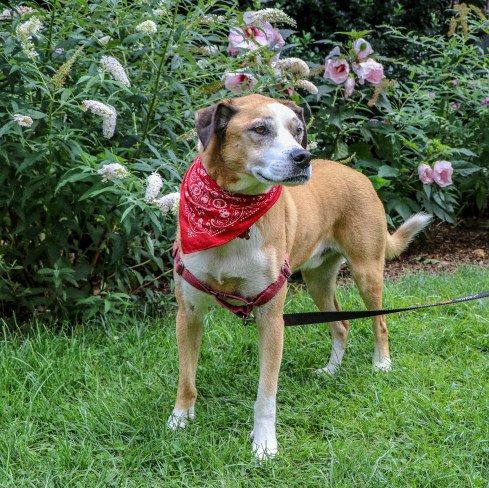
Harley is an 8 year old part Shepherd and Spaniel mixed breed.

IMG_1500-2

Max, a 2 year old Pit/Lab mix, loved the water play areas also.

Thank you for joining me on my visits to the truly special place!


Rose Fitzgerald Kennedy Greenway Part II (Boston, MA)

Dates Of Visits: August 12, 13, 18, 19, 2018

Location: Various locations in Boston, MA

Hours: Open daily, 7 a.m. until 11 p.m.

Cost: Free

Parking: there is some street parking available at some parts of the Greenway (particularly on Atlantic Ave) and several parking garages in the area.  There are also several MBTA train stations within walking distance to the Greenway such as South Station

Trail Size/Difficulty: 15 acres, 1.5 miles/easy

Handicapped Accessible: Yes

Dog Friendly: Yes

Highlights: flowers,scenic,dog friendly, historic

Websites: Rose Fitzgerald Kennedy Greenway

Rose Fitzgerald Kennedy Greenway Overview

Good Historical Overview Of The Greenway Project

IMG_2082

In my first blog post of the Rose Kennedy Greenway, I posted photos of some of the beautiful flowers and plants on the Greenway.  In this installment, I will include photos of the beautiful artwork on the Greenway.

There are several art exhibits on the Greenway.  I figured I would post them in the order they appear on the Greenway.

The first part of the Greenway in this post is at Chinatown near the Lincoln Street Triangle.

Year Of The Dog by Rosa Puno is a nod to the current year of the dog in the Chinese zodiac calendar.  The exhibit has spinning cube-like blocks made of wood on a steel structure that has Chinese words with their translations and excerpts from people in the neighborhood that Rosa collected from people in the neighborhood.

This part of the Greenway has other attractions such as the human-made waterfall and stream and a sitting area where people can spend time together, play games or just play in the water.  Ahh, to  be young again.

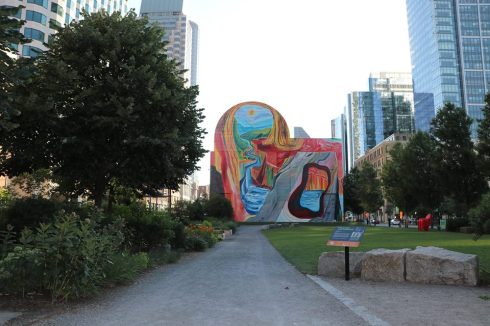
The next work of art is a mural that is painted on a building that sits on Atlantic Ave.  The building this mural is changed annually.  Each year, usually in the spring, a new mural is painted by a different artist.

The 70’x76′ mural on the building at Dewey Square is called Carving Out Fresh Options.  It was painted by Shara Hughes.

I was fortunate enough to see the artist working on her mural while I was walking to work in May.

And, of course, the finished product.  During the summer, people lay out on towels or on chairs on the lawn in front of the Greenway which can make photographing it without obstructions challenging.

mural4

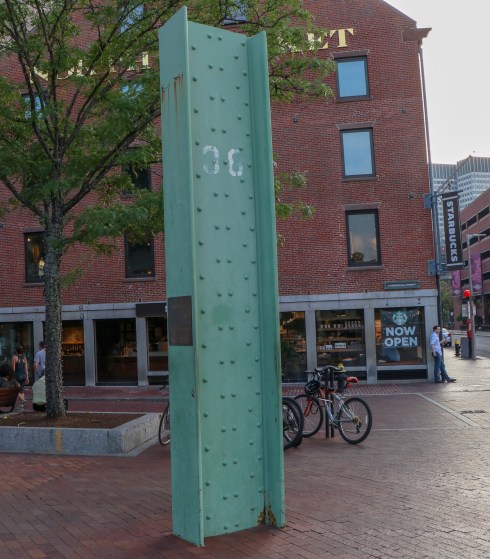
There also are historical markers on the Greenway.  Two remnants of the old raised Central Artery highway that once carried traffic over this area.

One of the beams from the original Central Artery is located the building with the mural above.  It is located on Congress and Purchase Streets which is easy to remember by the axiom “people purchase congress.”  Sad but true.  It is easy to miss as I have probably walked past it hundreds of times but never gave it a second thought until I wrote this post.

IMG_9291-2

A plaque on the beam gives a brief history of the construction of the Central Artery project (built between 1951 and 1959) and fun facts (well they’re facts) such as the number of vehicles which used the highway when it was first built (75,000 vehicles) to the number of vehicles that used it in 1990 when the “Big Dig” began to be planned (200,000 vehicles).

There is another beam from the Central Artery located on Surface Road located on the edge of Faneuil Hall.

IMG_9260

Rumor has it there may be another one on Clinton Street.  But, I couldn’t find it.

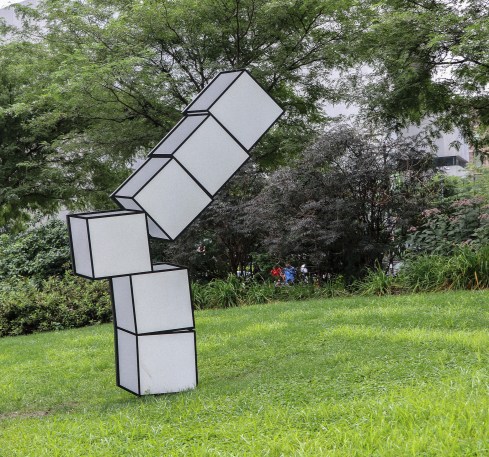
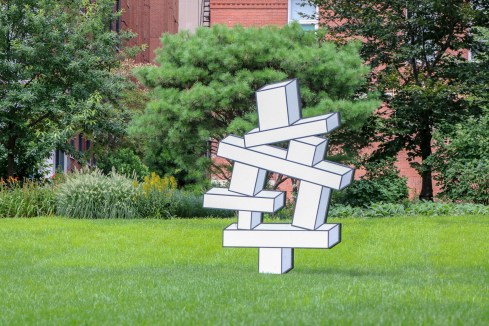
Located across from the first steel beam from the Central Artery is Balancing Act by Aakash Nihalani.

The display is broken into two works, Balancing Act I and Balancing Act II.

Balancing Act I represents a tower of six cubes which appear to fall over as the middle one is pulled out of alignment.

IMG_0174

Balancing Act II  shows blocks which are precariously piled up and appear to be ready to collapse.  I think we all can related to this apt description of our everyday lives.

IMG_0155

The works almost seem unreal.  It’s as though they were a mirage or photo shopped into the photo (I swear I didn’t).  Akash just knows how to use colors and  materials.

Way Of The Woods by Daniel Ibanez and Margen-Lab is a tribute to the North American landscapes.  The nine logs are said to transform into contemporary interpretations of these raw natural materials.

The next work of art is an illuminated tunnel-like structure made by Luftwerk called Transition.

It looks a lot more impressive during the evening hours.

Harbor Fog by Ross MIller is an interactive sculpture.  As a person or body comes closer to it it makes noises and generates fog.

The next work of art located on the Greenway is called GLOW.  GLOW is a collection of old neon signs that once illuminated the Massachusetts skies.  The signs are the collection of Lynn and Dave Waller.  Each sign is erected on a concrete block with the name of the city or town it once stood.  The signs are illuminated all day and night, during park hours.  But, as you can see by the photos, they look much prettier during the evening.

IMG_1915

The Siesta Motel on Route 1 North, Saugus, MA, circa 1950 sign looks cool enough during the day, particularly during an overcast day.

But, it looks much nicer during the evening.

IMG_8725

Unfortunately, the lights for the Fontaine’s Restaurant, VFE Parkway, West Roxbury, MA, circa 1952  (I actually ate breakfast there once…after the neon sign was installed wise acres) were not working when I went to visit it during the day and evening.

IMG_1970


IMG_1924

European Restaurant, 218 Hanover Street, Boston, 1970.

The remaining signs were all taken during the evening hours to highlight their colorful artwork.

IMG_8735

Bay State Auto Spring, 83 Hampden St, Roxbury, MA, circa 1965

IMG_8750

The neon sign for Cycle Center, Natick, MA, 1956 is one of my favorites.  It lights up and changes colors as the rider pedals.

IMG_8742

General Electric Radio, 240 Blue Hill Ave, Roxbury, MA, circa 1925

IMG_8752

Flying Yankee Restaurant, Route 20 and Route 12, Auburn, MA, circa 1953.

IMG_8771

State Line Potato Chips, Route 20, Wilbraham, MA, c. 1950s

There is also a memorial to the victims of the Armenian genocide as well as the Armenian immigrants and immigrants of all backgrounds that came to the United States and settled in the Boston area.

The Armenian Heritage Park has a maze for people to walk that leads a fountain at the center of the circular path.  Words like science and commerce have been etched in the paths. A plaque near a bench at the park states the park is dedicated to those suffered to preserve the Armenian heritage.

The Abstract Sculpture honors the victims of the Armenian genocide and victims of all genocides as well as our open shores.

The inscription on the sculpture reads:

“Boston and the Commonwealth of Massachusetts have offered hope and refuge for immigrants seeking to begin new lives. The park is a gift to the people of the Commonwealth and the City of Boston from the Armenian-American community of Massachusetts. This sculpture is offered in honor of the one and one half million victims of the Armenian Genocide of 1915-1923. May it stand in remembrance of all genocides that have followed, and celebrate the diversity of the communities that have re-formed in the safety of these shores.”

There is also a statue dedicated to Tony DeMarco.  Who is Tony DeMarco?  Don’t say that too close to the North End of Boston.

Tony DeMarco is a former World Welterweight Champion who grew up in the North End section of Boston, MA.  Despite winning the Welterweight title, the Sicilian born boxer was best known for his slug fests with Carmen Basilio.  He would lose both fights but fought valiantly in both matches.

Gelato, a 4 month old mixed breed dog, also enjoyed the art work on the Greenway.

IMG_2014

Thank you all for stopping by and reading.  In my upcoming third and final installment of the Rose Fitzgerald Kennedy Greenway, I will be focusing on some of the entertainment on the Greenway!

Sometimes it seems like your phone’s camera takes better photos then your camera, especially during the evening when you don’t have your tripod.  Click on the link below to access my Facebook page and view more night time photos and videos from the Greenway.  And give the page a “like” while you’re at it!

New England Nomad on Facebook


Rose Fitzgerald Kennedy Greenway Part I (Boston, MA)

Dates Of Visits: August 12, 13, 18, 19, 2018

Location: Various locations in Boston, MA

Hours: Open daily, 7 a.m. until 11 p.m.

Cost: Free

Parking: there is some street parking available at some parts of the Greenway (particularly on Atlantic Ave) and several parking garages in the area.  There are also several MBTA train stations within walking distance to the Greenway such as South Station

Trail Size/Difficulty: 15 acres, 1.5 miles/easy

Handicapped Accessible: Yes

Dog Friendly: Yes

Highlights: flowers,scenic,dog friendly, historic

Websites: Rose Fitzgerald Kennedy Greenway

Rose Fitzgerald Kennedy Greenway Overview

Good Historical Overview Of The Greenway Project

IMG_1384

Like it or not, the morning and evening temperatures are beginning to plummet and the days are growing shorter.  Since I only have a short window to visit some of the more interesting outdoor venues for this season, I finally made it out to Rose Fitzgerald Kennedy Greenway.

Named after the matriarch of the Kennedy family, the Greenway has a wide variety of attractions.  From a carousel to works of to the beautiful gardens and flowers along the trail, the Greenway has something for everyone.

Since there is so much to see and photograph along the Greenway, I decided to break up this blog series into three parts.  The first part, which I will post today, is going to include the gardens and flowers at the Rose Kennedy Greenway.  Part 2 will include the art on the Greenway and Part 3 will include the entertainment along the Greenway.  And, of course, there will be dogs included in each post as well!

Once upon a time, specially from 1959 when the elevated John F Fitzgerald Kennedy-Central Artery construction ended and 1981 when the “Big Dig” (an underground tunnel project) began, an elevated highway spanned what is now the Greenway.  Fun fact: some of the dirt from the “Big Dig” tunnel project was used to resurface Spectacle Island in Boston Harbor.

The first thing you’ll notice on the Greenway, particularly during the spring and summer, are the bright, beautiful plants and flowers.

The gardens and flowers along the Greenway are all treated organically so people do not have to worry about their children and pets being affected by any pesticides and make the flowers look beautiful.

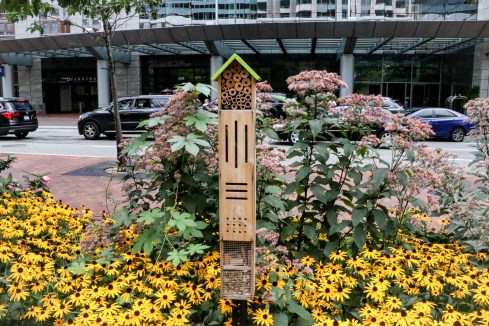
There are pollinators along the Greenway.  The pollinators, which were installed in 2016, are designed to attract and support pollinator species.  Since pollinating insects are important to all seed propagated plants, the pollinators provide an important role in the growth of the plants.

IMG_0124

The Greenway also has a garden where they grow edible fruits and vegetables such as bluberries.  The blueberries and other fruits and vegetables are a big hit with the birds.

I especially like how the buildings provide such a stark contrast to the beauty of the plants and flowers.

In fact, the buildings are so impressive I couldn’t help but take a few photos of the buildings as well.

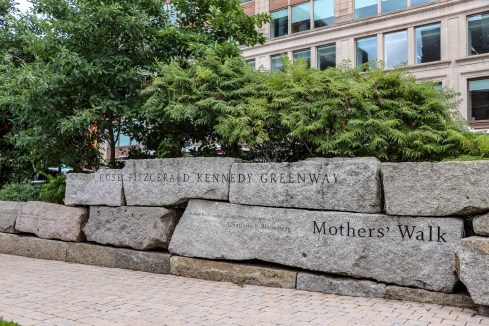
Although it is only 1.5 miles long, the Rose Fitzgerald Kennedy Greenway is full of surprises and special areas such as “Mothers’ Walk.”

Along the The Mothers’ Walk are engraved bricks with the names of loved ones.  For a measley $500 donation people could have names inscribed on bricks along the walk.

IMG_1958

Along the wall there is an inscription that reads, “To all who have cared, encouraged, inspired, laughed and loved, this Mothers’ Walk is dedicated to you and to those who have supported this beautiful Greenway.

There is also a park along the Greenway called The Carolyn Lynch Garden.  The garden was dedicated in Summer 2018 to Carolyn Hoff Lynch, an avid gardener and a leading philanthropist, who passed away in 2015.  The garden is bursting with colors in the spring and summer and has some scenic views.

Along Carolyn Lynch Park and other parts of the Greenway you will find historic events summarized on a timeline about the area.  The dates and events vary depending on where the timeline along the fences appear.  For instance in the part of the Greenway located in the North End, there are dates of events that took place in that area and quotes from people in the area.

The Greenway is a wonderful place to take your leashed pet.  Below are a few of the dogs I saw on the Greenway.

Tommy is a 6 year old Boxer, Labrador, Retriever, Beagle mix rescue dog.  Tommy is a social media star.  You can find him at bostondogtommy on Instagram.

IMG_2068

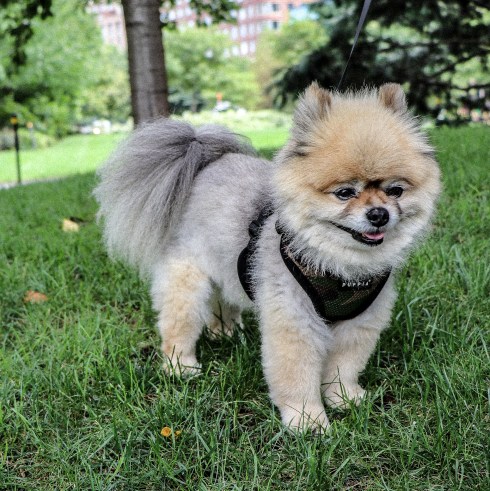
Jack is a 12 year old Pomeranian.

IMG_0110-2

Stayed Tuned for Part II coming soon!


Underground At Ink Block (Boston, MA)

Date Of Visit: July 12, 2018

Location: 90 Traveler St, Boston, MA

Hours: Accessible all day except between the hours of 1 a.m. and 5 a.m.

Cost: Free

Parking: There are 175 parking spots (parking at Underground Ink is not free) and additional street parking and parking garages nearby

Handicapped Accessible: Yes

Dog Friendly: Yes

Website: Underground At Ink Block

Highlights: art, bar, dog park, scenic

Fun Facts:

  • there is over 100,000 square feet of wall art at Underground Ink
  • the park is located under I-93 (Interstate 93)

IMG_3438

Boston’s newest hot spot doesn’t have a cover charge nor does it have a dress code.  It doesn’t even have a roof.  Well, it sort of does.

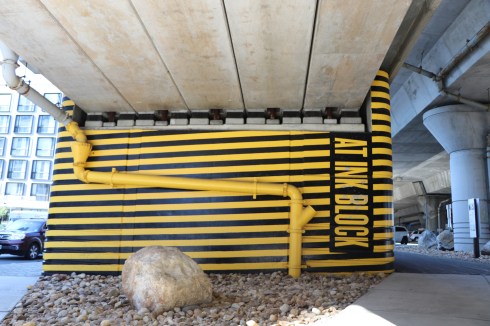
Located under the I-93 overpass, Underground Ink Block blends art, entertainment and beauty in a most unlikely place.

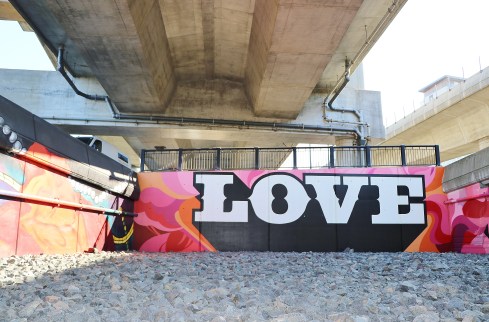
One of the more beautiful aspects of the park are the murals.

There are  several murals at the park.  This mural, which appears on the wall at the entrance to the park, was painted by Vyal Reyes.


There is a large group of murals by the parking area.

This particular mural was painted by Watts, California native Upendo Taylor.


Three artists worked on this mural which is part of a group of three murals that share one wall.  Problak Don Rimx and Marka27 all collaborated to paint this beautiful mural


New York native Cey Adams painted this lovely mural.

IMG_3607

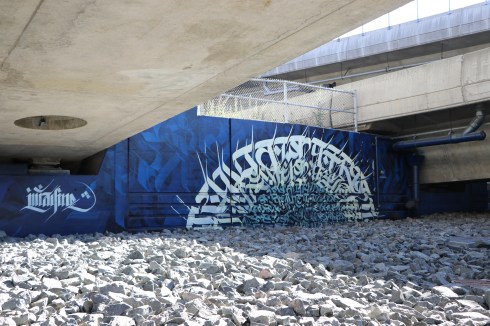
Nepali artist IMAGINE (Sneha Shrestha) painted this imaginative mural.  Imagine likes to incorporate her native Sanskrit language with modern designs.

IMG_3616

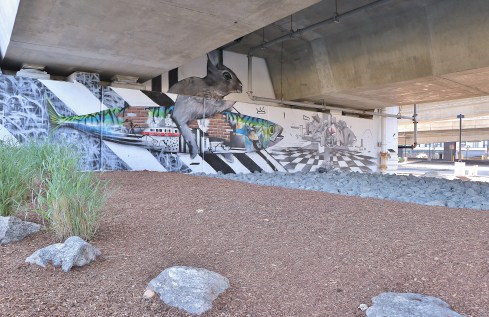
This mural, located under one of the overpasses above, was painted by Percy Fortini-Wright.

You may notice some of the landmarks and symbols associated with the Boston (such as the famous Citgo sign that hovers over the left field wall at Fenway Park) on the right hand corner of the mural.

IMG_3507

This mural, which covers the outermost wall of the area, was painted by Hoxxoh.

IMG_3531

If you get lost at the Underground Ink Block,  just follow the bright lines on the ground.  The colored streaks on the ground lead to the different murals around the park

Underground Ink also an area for hosting events, such as yoga, or to stop by and have a game of ring toss and toss back a few beverages with friends.

There are also some pretty views at the park (at least if you look in the opposite direction of the busy intersection at the entrance)


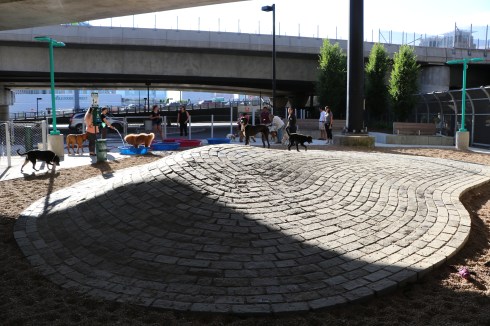
But, the highlight for many of us has to be the dog park.  Tucked away in the back of the parking area, the dog park has lots of room for dogs and humans to play.

IMG_3634

During my visit. there was a “Hound Around” event for dogs.  The event, which was sponsored by Capital One at Ink Block, was hosted by The Urban Hound.

The park is big enough for the dogs to roam around in and play without being too crowded.

There were pools for the dogs to cool down or get a quick drink.  I know.  Gross. But, hey, they’re dogs.  They don’t care!  Some dogs preferred to just drink from the hose.


There was a pretty big turnout and everyone played nice.

Oprah, a 3 and a half year old Boston Terrier, can really jump!  She was jumping up for her toy in this photo.

IMG_3804

Simba, a 2 year old Chow Chow, looks like a fluffy teddy bear.

IMG_3650

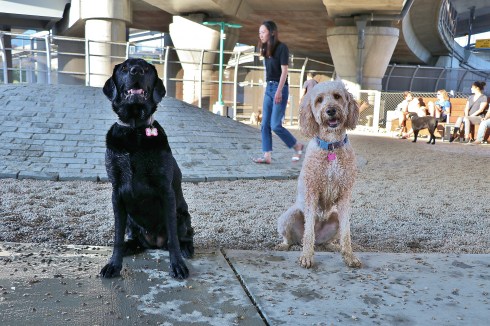
Besties Zoey, a 4 year old Black Lab, and Jovie, a 2 year old Golden Doodle, looked adorable after a dip in the pool.

IMG_3854

Junior, a 6 year old Collie mix, has beautiful markings.

IMG_3834

Yoshi, a 2 year old mix rescue dog, had fun playing with his ball.

IMG_3881

Badger, a 3 and a half year old Aussie Terrier mix, waiting patiently for his dad to throw his toy.

IMG_3731

Bella, a 7 year old Boxer, took a break to watch the other dogs play.

IMG_3714

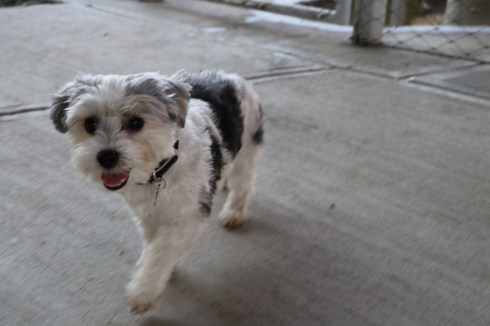
Kylie, a 6 year old Morkie (Maltese and Yorkie mix) was all smiles at the park.

IMG_3893

As I left the dog park, I met Nikki.  Nikki is a super talented designer and creator of dog bandannas and accessories.  Check out her website: Just Add Dogs.

If you and Fido missed out on this Hound Around event, don’t worry.  There will be another one Thursday, Aug. 9 from 6:30 to 7:30 at the Underground Ink Art Block.

Cute dogs were not the only animals I saw at the Underground Ink Block.  I also saw this rabbit having dinner.  As an aside, I have been noticing many more rabbits and other animals who do not typically belong in the city making their way into the city.  I do hope it’s only a trend and not a permanent thing.  After all, the city can be far more dangerous than the wild!

IMG_3520

Thank you for sharing another adventure with me!


John F Kennedy Presidential Museum & Library (Boston, MA)

Date Of Visit: November 4, 2017

Location: 1109 Massachusetts Ave, Boston, MA

Hours:

The Museum is open seven (7) days per week, from 9:00 a.m.- 5:00 p.m. The start time for the last introductory film of the day is at 3:55 p.m.

We are closed on the following holidays:

  • New Year’s Day (January 1)
  • Thanksgiving Day (4th Thursday in November)
  • Christmas Day (December 25)

We close at 2:00 p.m. on the following days:

  • Day before Thanksgiving (Wednesday, November 22)
  • Christmas Eve (Sunday, December 24)
  • New Year’s Eve (Sunday, December 31)

Parking: There is free parking for about 50 cars in a lot in front of the museum

Cost:

Adults $14
Seniors 62+ $12
College Students with ID $12
Youth/Teens 13-17 $10
US Armed Forces Veterans $10

Free:

Handicapped Accessible:The museum is wheelchair accessible and guests may request a wheelchair at the front desk (a photo ID must be left). Wheelchairs are available on a first-come, first-served basis.

Website: John F Kennedy Presidential Library And Museum

Highlights: historical items, photos and videos from John F Kennedy’s life.  There is also a special Kennedy 100 Milestones And Mementos exhibit which is scheduled to be on display until May, 2018.

IMG_9747

“What could have been?” is probably the most common phrase people come away with after their visit to the John F Kennedy Presidential Library And Museum

You can’t help but feel inspired while walking through the museum.  Even if you’re not an admirer of the man or his family, just looking at the historical items of the era and seeing how much he accomplished at such a young age is bound to make you feel motivated.  By the time he died at the age of 46, he had been a senator, war hero and President.  I’m  approaching that age and I’m not quite there in my career accomplishments.  Yet.

The first room you enter after paying your admission is a room with many of the items from JFK’s younger school days.  I actually used to use JFK’s less than stellar grades in his early education as an excuse when I didn’t always do well on my report card…it didn’t work out well for me, though.


There is also a photo of JFK with hsi favorite boat, the Victura, and his U.S. Navy dog tag.  During the summer, the Victura can be found on the lawn of the Kennedy Library.  However, during the winter months, and when I was visiting, it is kept at the Crosby Yacht yard in Osterville, Massachusetts where she was built.


Next to the first room of the museum is an auditorium where you can watch a quick film (about 20 minutes) about the life of President Kennedy.

After the film ends, visitors follow a stairwell into the heart of the museum where many of the historical items from Kennedy’s Presidency can be found.

The museum displays historical memorabilia and videos and photos in chronological order.  In the beginning of the museum you can view videos of the senator and presidential candidate Kennedy.


I especially liked the examples of shops and other memorabilia from that era.


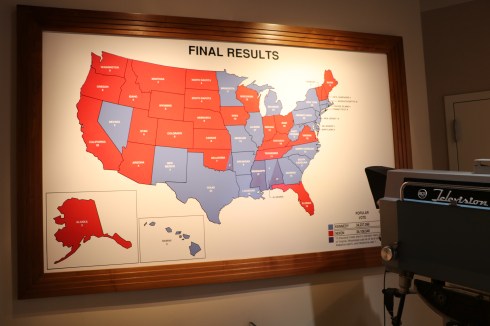
Looking at the electoral map from the night of the election shows a sharp contrast to what it would look like these days.

IMG_9788

The states in red show states the Republican candidate (Richard Nixon) won.  The blue states are states Kennedy won.  The chief reason behind this, besides the changing political landscape, is that Nixon was the senator from California which would explain in part why he did so well on the west coast.  Kennedy’s running mate, Lyndon Baines Johnson (who was from Texas), helped Kennedy carry many of the southern states.  In fact, the whole Kennedy/Johnson relationship is full of dichotomy and complexities.  It has been believed, and essentially proven, the two men did not like each other very much before the election (and not the first time a president and vice president didn’t like each other).  But, Kennedy and his people thought they needed Baines on the ticket to help deliver the south.

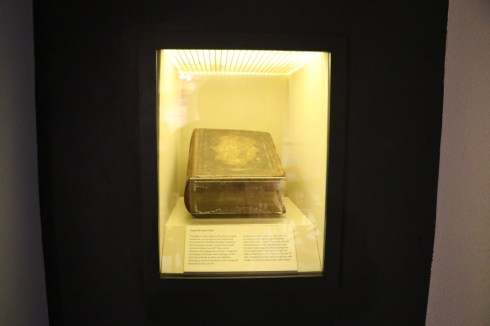
The book shown below, an 1850 edition of the Douay English translation, is the Kennedy family bible that was brought over from Ireland by his forebears.  It is the bible JFK was sworn in on during his inauguration.

IMG_9795

After viewing the historical items from his campaign and early days of his presidency, there is a larger area with memorabilia from his presidency can be found.  There are also letters, memorabilia and other items from the Kennedy’s and not just John Kennedy.  There are also historical items from Robert Kennedy and Sargent Shriver, John’s brother-in-law.  The historical displays include an exact replica of the Oval Office while Kennedy was president.


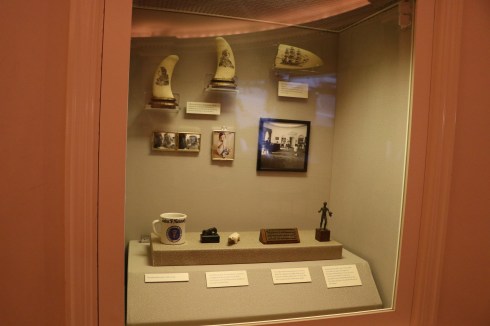
In the photo below are two whale teeth etched with portraits of King Christian VI of Norway and Frederick William, the Great Elector of Brandenburg.  These whale teeth were used as book ends in the Oval Office.

Next to the whale teeth, to the right, is a whale tooth scrimshaw inscribed with a full rigged ship.  This was a gift from his close friend and class mate at Choate School, Lem Billings.  Kennedy kept this on his desk.  So much for saving the whales.


IMG_9818

The section with Jacqueline’s personal items is wonderful also.


One of the more interesting things I found at the museum were gifts other world leaders had given Kennedy and Jacqueline Kennedy, the first lady.

This stucco head of Buddha (circa 2nd century A.D.) was given to the president and his wife by the king of Afghanistan, Mohammed Zaher Shah.

IMG_9808

This gilded metal kris and sheath, decorated with ivory and precious stones, was given to the president by President Achmed Sukarno of Indonesia on April 24, 1961.

IMG_9810

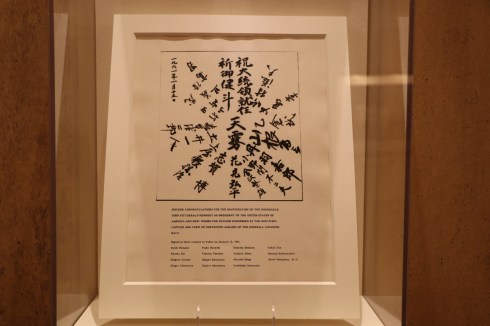
This congratulatory message was sent to President Kennedy on his inauguration in 1961 from the surviving crew and captain of the Amagiri.  What makes that so interesting?  The Amagiri was the Japanese destroyer that on August 2, 1943, rammed PT 109, the boat Kennedy and his men were on during World War II.

IMG_9815

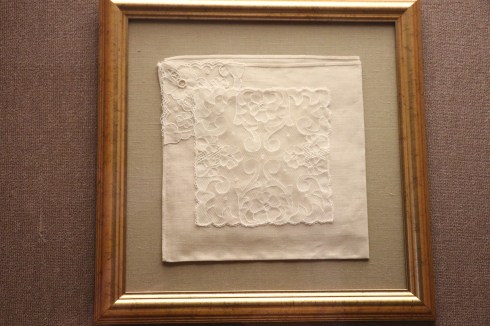
This Carrickmacross lace napkin was presented to President Kennedy by Prime Minister Sean Lemass of the Irish Fianna Fail party.

IMG_9857

While President Kennedy’s assassination is acknowledged, there is not much on exhibit about the assassination.  Rather, they focus on how the world responded to the tragedy. Fittingly, a darkened hallway leads to an area with photos of memorials dedicated to the slain president from all over the world.


There is also an area dedicated to the Kennedy family after President Kennedy’s death.  There are books written about John Kennedy, mementos that were made in his honor (such as the half dollar piece that was issued after his death) and the rest of the Kennedy family.   There are also historical artifacts such as a piece of the Berlin Wall which signify way the world has changed and how John Kennedy and other members of his family, specifically Ted, had possibly helped shape these changes.


There are also short films that play in small cinemas throughout the day at various locations in the museum.

The biggest attraction at the museum, however, is a special exhibit called JFK 100 Milestones and Mementos.

IMG_9877

This exhibit is on display to celebrate what would have been the 100th birthday (his birthday was May 29, 1917).  Everything from the hat and gloves he wore on his inauguration day, his first baby photo to hiss iconic Rayban sunglasses that he popularized are on display in chronological order of his life.  The exhibit is planned to be on display until May, 2018.


There are far too many items to post photos of.  Below are a few of the items that stood out to me.


Pictured below is the Profile In Courage Award that has been awarded annually since 1990.  Past recipients include John McCain and Russell Feingold (co-winners in 1999), Gerald Ford and John Lewis (co-winners in 2001), Gabrielle “Gabby” Giffords (2013) and former President Barack Obama (2017)


Behind the museum there is a path used by joggers and people just going for a walk.  There are some pretty views of the Boston skyline and the water.  There is also a pier you can walk out onto and look out at the bay.  It is a quiet place to ponder all that you have seen at the museum.


Sadly, we will be observing the death of this notable president later this month.  But, rather than focusing on his tragic death, it is much better to focus on his life and not his death.  This museum is a powerful reminder of his life and legacy.


Fall Pumpkin Float (Boston, MA)


Date Of Visit: October 20, 2017

Location: Frog Pond, Boston Common, Boston, MA

Website: 2017 Fall Pumpkin Float

Highlights: family friendly pumpkin festival, carousel, bouncy house and other activities for children (and adults)

Nothing says Halloween like costumes, candy and floating pumpkins.  Yes, floating pumpkins.

That is what was on display at Frog Pond last weekend as we ushered in the Halloween season.

But, these “floating pumpkins” weren’t floating in the air.  No, these pumpkins were floating on Frog Pond at the Boston Common.

Visitors who wanted to participate in the pumpkin float were asked to bring a hollowed out 8 inch or smaller carved pumpkin.

The carvings and designs on the pumpkins ranged from spooky to funny.

The organizers of the event encouraged visitors to come to the event in costume.  And they were not disappointed.

If you haven’t attended a pumpkin float before (it was my first time as well) and you want participate in the float event, each person drops off their pumpkin at one of the booths located by the pond.  At the booth, one of the volunteers inserts an l.e.d. light bulb.  I think it would have looked cooler with a candle.  But, since it is going into water, well that wouldn’t work out too good.  Then, the pumpkin is put on a piece of wood and pushed into the water so they all coalesce.  Periodically, a worker walked in the water to make sure they all group together.

As the sun set, the lights from the  jack o’ lanterns began to light up Frog Pond.

There was also a carousel, the Frog of Frog Pond, a d.j. from a local radio station, a bouncy house, bubbles, policemen on horses who took photos with visitors and other types of entertainment.


The Pumpkin Float, which was held at Pope John Paul Park in the past, was a dog friendly event.  And, some of the dogs came in costume!

IMG_9021

Porter is a 9 year old lion, I mean pit terrier.

IMG_8962

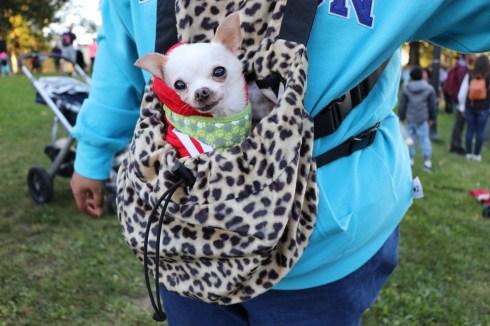
Tiny is a 3 year old Chihuahua.

IMG_8932Winnie is 18 months old.

IMG_9007

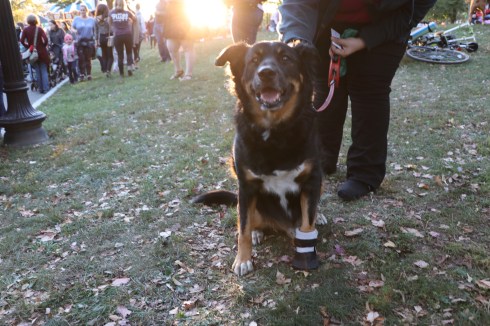
Bijo is an 11 year old mixed breed.  Bijo is wearing a boot because one of his nails was injured.

Below is a video of the “bubble man” at Frog Pond.  The kids loved popping the bubbles.

Click here to like my Facebook page so you can see photos and videos I do not post on my blog and be alerted in your Facebook feed when I post new blog posts about New England!  Thank you.


ICA-Part II (Boston, MA)

*This is Part II of my 2 part series about the ICA Museum in Boston, MA.  To view the first part please click here*

In addition to the works of Nari Ward, the ICA displayed art exhibits from a variety of other artists.  One of these artists is Dana Shutz’s.

Dana, an American artist based out of Brooklyn, is widely known for injecting humor into her gestural paintings.  She  has studied art extensively , even studying abroad at the Norwich School of Art and Design in Norwich, England.  While not all of her work had a description of their meaning or intent, I think many of them are fairly self-explanatory or, at the least, left to our own interpretation.

IMG_0071

Elevator On Canvas, 2017, oil on canvas.  This work is part of a series of paintings of an imagined struggle between larger than life figures and giant insects glimpsed between the gleaming doors of an elevator.  Besides addressing people’s claustrophobia, the art may speak to the current heated debate, inner struggles or struggle for attention within the public arena.

IMG_0074

Conflict, 2017, oil on canvas.  This work portrays a quarrel, possibly between lovers, The couple in the painting are both embracing and fighting at the same time.

IMG_0076

To Have A Head, 2017, oil on canvas.

IMG_0081

Shame, 2017, oil on canvas.

IMG_0078

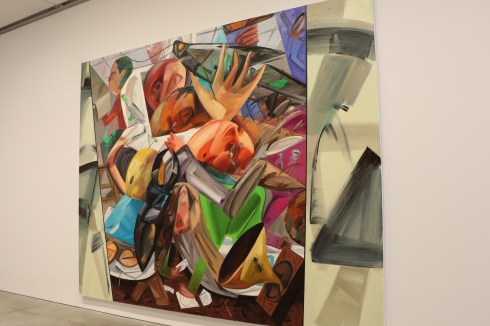
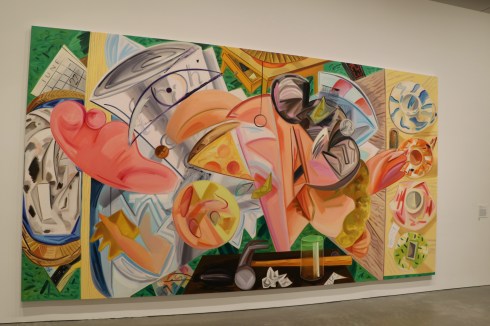
Shaking Out The Bed, 2015, oil on canvas.  This 18 foot wide canvas recalls the Western tradition of history painting.  This painting differs from most history paintings in that it does not highlight noteworthy men and women in our history.  Rather, her painting consists of everyday items that revolve around people in bed.  All of the things we use and, dare I say, rely upon on a daily basis.  A calendar, an alarm clock, day old pizza (a must) and a glass of water are some of the items Dana included in her painting.  Dana said she “wanted the whole painting to feel like a book that was being opened, like you were shaking out of bed and all of the objects contained within are falling and suspended in front of the scene.”  She went on to say she wanted to convey the feeling that “you just missed the alarm and the world is coming back to you in pieces.”

IMG_0083

IMG_0110

Flasher, 2012, oil on canvas.

In addition to Shutz’s work, there were a number of other artist’s work being displayed at the ICA.

IMG_0080

IMG_0102

Trace, 1980, by Nancy Graves made of bronze, steel, polychromed patina and paint.  Trace depicts a dynamic, wind-blown tree with its bright-green forked trunk rising from a red and brown ground and curving toward the top.  The amorphous crown of leaves is composed of layered, multicolored sheets of steel grating punctuated with geometric lines and grids.  Graves likes to inject nature and the natural world into her works.

Hidden Relief, 2001, by Sarah Sze made of a halogen work lamp on tripod stand, rulers, spring clamps, levels, plastic, styrofoam, bamboo, toothpicks, branches, bottle caps, string, artificial plants, artificial moss, T-square, Alligator clamps, T-pins, cotton swabs, pushpins, dried plants, paint and glass (or pretty much everything but the kitchen sink).

Sarah uses everyday items, like the items included in this display, to create site-specific sculptures and installations that take on the character of landscapes, architecture and improvisational systems.  She used a sample palette of white, orange, yellow, blue and black throughout the work which is brightened by work lights.  Sarah also drew diagram-like lines using pins and string in this work of art.


IMG_0104

Depose II by Keith Sonnier made of nylon sailcloth, metal.  This inflatable design balanced a ready made aesthetic with painted geometric elements.  The inflatable part of the sculpture assumes an anthropomorphic form that, when mixed with air from the blower, suggests a living being.  Initially a limp sack, the sculpture must breathe and expand to assume its final form. The title references the act of being deposed, wherein a person is required to give oral out-of-court testimony. The person being deposed is often asked exceedingly personal questions. Perhaps the pinched or pressed inflatable alludes to the feeling of duress that might arise from having to tell the truth in a compromising situation.

IMG_0100

Untitled (Topanga, CA, Umbrella 17) by Sam Falls made of nylon.  Untitled displays the fabric of an umbrella without the support and pinned to the wall.  Sam exposed some of the umbrella’s nylon panels in the California sun for a prolonged period of time.  Then, he interspersed the faded panels with panels that had been kept out of the sun causing a contrast in the colors of the sculpture.  Sam’s work of art invites speculation about the elements of time and change in art and nature.

The intermediate-Inceptive Sphere, 2016, by Haegue Yank made of artificial straw, steel stand, powder coating, artificial plants, artificial fruits, plastic twine, Indian bells and casters.

The Intermediate-Inceptive Sphere is an anthropomorphic sculpture that belongs to a series of woven straw works titled The Intermediates.  The sculpture is adorned with items such as bells that are meant to hang from the necks of cows in India and Korean bridal headpieces.  The work of art also invokes Asian folk cultures, shamanic figures and their rituals.  Haegue used plastic straw to foreground the tension between the organic and synthetic in contemporary life.

Ashes, 2017, is a video by acclaimed director Steve McQueen.

Ashes presents footage on two sides of a freestanding screen. One of the sides, originally shot on soft, grainy Super 8 film, shows a young, carefree fisherman named Ashes balancing playfully on a boat. The other side shows a second projection, shot in 16 mm film, that shows Ashes’s unexpected fate. The videos conjure an easy vitality and a vivid description of place against the darker forces of society and fate.

The last, but not least, attraction at the museum is the view.  Full length glass windows give stunning views of Boston Harbor.  I bet it must be spectacular during sunsets.

On the way to the train station, we met these dogs taking a stroll along the boardwalk at Fort Port Channel.

Emmerson, a 13 year old Shetland, was very comfortable in his stroller

Archie, a 10 year old Yorkie peeking out from behind Emmerson, decided to get out and walk around.

There were also some pretty views of Boston at night along the way.

Today’s featured blogger is The Culture Club.  The Culture Club visited the ICA recently.  I thought his post would be a good companion to my post since he may have photographed pieces I may have missed or weren’t on display when I visited the museum.  You can find his post here.  The Culture does reviews, writes about music and entertainment and he’s got a cute dog!


ICA-Part I (Boston, MA)

Date Of Visit: August 25, 2017

Location: 25 Harbor Shore Drive, Boston, MA

Hours:

Tuesday + Wednesday: 10 AM – 5 PM
Thursday + Friday*: 10 AM – 9 PM
*First Friday of every month: 10 AM – 5 PM
Saturday + Sunday: 10 AM – 5 PM

Closed Mondays, except on the following national holidays, when admission is FREE for all: Martin Luther King Jr. Day, Presidents’ Day, Memorial Day, Labor Day, and Columbus Day.

Closed on Patriot’s Day, Independence Day, Thanksgiving, Christmas, and New Year’s Day.

Cost:

General Admission: $15
Seniors: $13
Students: $10
Youth 17 and under: FREE

Admission is FREE for all eve

Parking:There are several parking options that are listed at their ICA parking info

Highlights: creative art displays, info sessions about the art

Tips:

  • parking is very limited in this area.  The museum recommends using public transportation.
  • The museum only has art on the 1st and 4th floors of the building (mostly the 4th floor)

Website: ICA

*I had to split this post into two parts, as it was too big for WordPress to save.  Part I of this post will center upon the works of the featured artist Nari Ward.  The second part of this post will focus on some of the other art at the museum.  I have also included half of the number of the cute dogs I photographed during this visit*
 

IMG_9998

Always at the intersection of art and social issues, he ICA (The Institute of Contemporary Art/Boston) recently highlighted the works of an artist who uses his art to make various statements about our social, economic and political climate.  Even if you may not agree with or see his points of view, I am sure you will enjoy his artistic aptitude.

During my visit, Jamaican and American Nari Ward’s work was being featured in his “Sun Splashed” exhibit at the museum.

IMG_0041

Sunsplashed, 2015, is the centerpiece of the art exhibit.  The second work of art is called, Scandal Bag: History Feeds Mistrust.

Nardi, born in 1963 in Jamaica and currently based in New York City, uses everyday items to create works of art that play on the history, economy and social issues surrounding his environment.  He also embraces cultural diversity.

Nari uses wood, metal, iron and other materials with everyday items such as soda bottles.  Nari hits on some hot button issues such as migration, citizenship and economic disparity in his works.

One of the things that struck me about these works of art is the thought and creativity that went behind all of them.

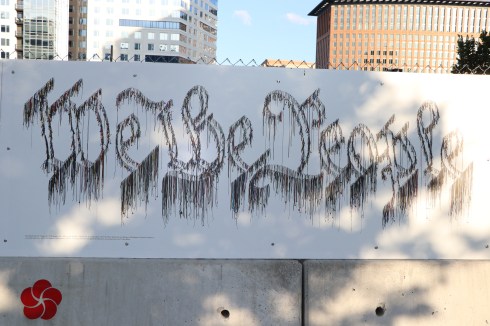
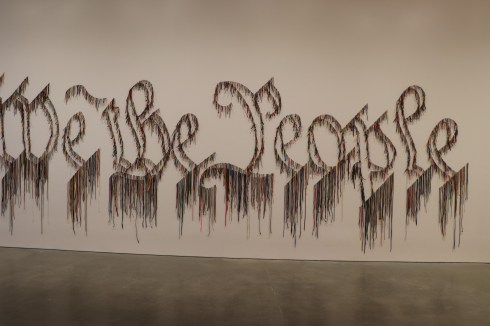
The We The People exhibit by Nari Ward was one of the main works of art at the ICA.  In fact, many of his works of art are being featured
IMG_0008

If you look very closely, you may notice it is not written in ink.  Rather, it is spelled out in artistic dangling shoelaces.  This exhibit was being displayed a block away from the museum.  It surely created a lot of interest and lured in quite a few visitors eager to learn more about Nari’s works of art.


Below are Nari’s works of art that were being displayed with a brief description and explanation of their meaning.  Sadly, his art is no longer there as the exhibit’s last day was September 3.  The first work of art is rather unconventional.  But, it was very interesting.


Jacuzzi Bed by Nari Ward is made of headboards arranged around heating lamps and fans.  The work of art is meant to produce an approximation of the Caribbean breeze.  The name is meant to conjure association with pleasure and comfort.  Nari says the work conveys his sense of nostalgic displacement.


Sky Juice, 1993, is made of an umbrella, iron fence, plastic soda bottles, photographs, Tropical Fantasy soda and sugar.  The soda bottles, hanging from the umbrella, have photos inside of them.  His goal was to create a work of art with disparate things from everyday life to create a work of art everyone can relate to.  “Sky Juice” is the name of a Bahamian drink made from coconut milk and gin (yum).

During my visit, one of the museum guides led an open discussion about the work of art where visitors and she discussed the deeper meaning of the work of art and what the work of art means to them.  She did this several different works of art during my visit.


Mango Tourist, 2011, by Nari, are “snowman-like” sculptures are made of burnt foam spheres that he decorated with mango seeds and small electrical parts.  The small capacitors bear traces of the economic and industrial history of New England and of course the snowmen are a staple of our winters.  The organic mango seeds resonate with his memories of Jamaica.


Happy Smilers: Duty Free Shopping, 1996, by Nari is made of awning, plastic soda bottles, fire hose, a fire escape, salt, sand, household elements, an audio recording, speakers and an aloe vera plant.  Party music and background conversation from the speakers gave the display a feeling of sitting on a fire escape on a hot summer night.

This exhibit was inspired by a candy store not far from where he lives in Harlem, New York.  While the store appeared to be a convenience store, it was really the site of a small scale gambling site.  This gave Nadir the idea of making an exhibit that shows you can’t judge a place, person or thing by outside appearances.

The name Happy Smilers was derived from a band that was led by Nadir’s uncle that entertained tourists in Jamaica in the 1970’s.  The fire escape and discarded furniture wrapped in fire hoses suggest an urban tableau.  The salt and sand, aloe vera plant, speakers and bright yellow walls are drawn from the cultural context of Jamaica.  The salt evokes a common Jamaican expression about the devil not being able to step over salt.  The succulent symbolizes healing.  Lastly, the soundtrack symbolizes one of the artist’s earliest childhood memories of lying in bed at night while he listened to rain fall on his tin roof in Jamaica.


The Naturalization Table is an exhibit based on Nari’s personal experience of becoming a naturalized U.S. citizen, this interactive artwork gives museum visitors a better understanding of that process. During certain days, visitors could add their photo to the display.


Radha Liquorsoul, 2010, is a metal and neon sign made of PVC tube, artificial flowers, shoelaces and shoe tips.  This was part of a work made from out of use liquor store signs that Nari removed from building facades in New York.  Ward was interested in the many uses and impact liquor has in our lives.  Nari also used shoe tips (which Nari considers a a signature material that symbolizes human presence), shoelaces and artificial flowers.  Nari was partly inspired by impromptu street or roadside memorials.


Homeland, Sweet Homeland, 2012, is made of cloth, plastic, megaphones, razor wires, feathers, chains and silver spoons.  The “Miranda Rights” which are listed on this work have appeared as a running theme on many of Nari’s works.  The combination of razor wire, megaphones, leather and gold thread with feathers were meant to evoke a kitschy domestic memento and a heraldic government edict.


Rock, Booked, Scissor, Vice, 2010, is made of book, rock, scissors and vice.  This exhibit was spawned from a mistake.  When Nari first saw the “Black’s Law Dictionary” as a child he thought there were different law dictionaries for white and black people.  Although his brother corrected, his initial thought stuck with him and inspired his work.    To create this work, Nari cinched the dictionary with a vice, pierced it with scissors and weighted it with a stone.  It is meant to symbolize a violent reenactment of the game “rock, paper, scissors.”  It is meant to represent the seemingly arbitrary application of the law experienced by people in many of the communities in America.


Savior, 1996, is made of a shopping cart, plastic garbage bags, cloth, bottles, metal fence, earth, wheel, mirror, chair and clocks.  Nari constructed the sculpture by utilizing the shopping cart, a common item, and using items to bling it up.  In the blue bag you can see clocks.  The sculpture had an accompany video titled, “Pushing Savior.”
IMG_0046

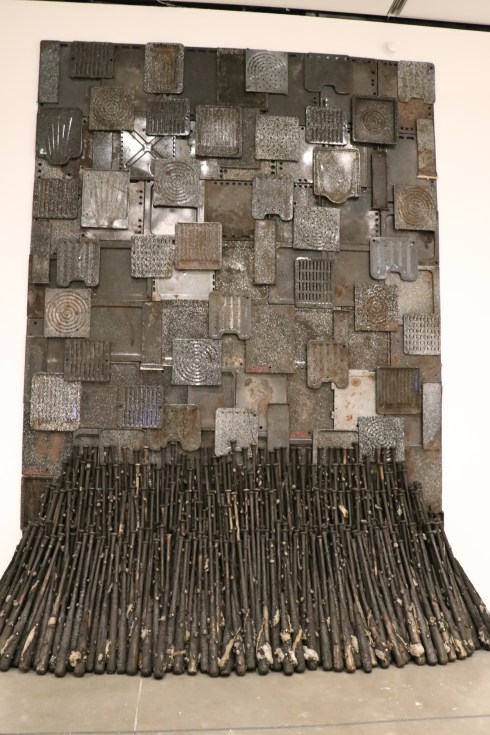
Iron Heavens, 1995, made of metal pans, cotton and wooden bats came from Nari’s observation that the holes dotting the the metal surfaces of certain baking pans look like stars.  Nari collaged pans together on a wall to evoke the night sky.

Nari used baseball bats to form a ground to the heaven above.  The bats were burned, sterilized and had cotton applied to their surfaces.  This was meant to convey violence and healing.  The materials were also used to signify the American South, especially the older south.  The cotton was used to signify slavery as that was the main crop slaves used to pick.  The baseball bats were used to signify the violence many blacks suffered.  The overall arrangement recalls the yard assemblages and sculptural folk traditions of the region.


Glory, 2004, consists of an oil barrel, fluorescent and ultraviolet tubes, computer parts, DVD audio recording, Plexiglas, fan, camera casing elements, paint cans, cement, towels and  rubber roofing membrane.

The tanning bed is made out of old oil barrels.  As this work of art was built one year after the Iraq attack, he used the oil barrels represent the political debates over the connection between oil and patriotism.

The oil barrel also signifies the issues related to identity and race.  While in some cultures, a tan is viewed as a mark of leisure and privilege.  However, “pigmentocracy” can ascribe a higher value to lighter skin tones in some societies.

As you stand by the Glory sculpture, you can hear recordings of voices and people talking in hushed tones.


Afroochase, 2010, made of ink, a found vinyl banner, cowrie shells, Afro picks and felt weatherstripping is built from a Chase Bank banner that he found mixed with various materials each of which have a symbolic meaning.

The cowrie shell has several possible meanings.  The shell has been used as a form of currency,  It is also used in divination ceremonies in African and North African and South African religious contexts.

Afro picks have been used as a symbol of black cultural identity and the shapes of the particular picks (the raised fist of the Black Power movement) refers to black nationalism and resistance.
IMG_0061

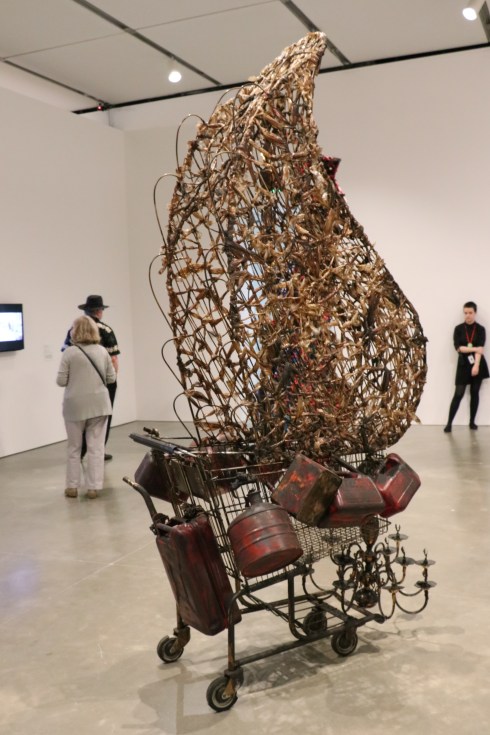
Crusader, 2006, is made of a shopping cart, chandelier, trophy elements, metals, plastic bags and plastic containers.

Crusader has been described as  a radiant poetic work that mixes the personal and political.  Nari used comedy to make a political statement about his feelings concerning the second Gulf War.  Oil plays a central theme in many of his works, evident by the oil canisters in this work.

IMG_0067

Beat Box, made of an old New York City payphone, a drum and a fire extinguisher was made as a way of showing the different ways people have communicated.  The old (the drums which have been used as nonverbal communication in some traditions ) with the modern (the payphone).  After Ward had modified the pay phone he put it back outside where it had originally came from.  Imagine the looks on the people’s faces when they tried to make phone calls!


I noticed how Nari likes to incorporate audio and videos into his exhibit.  This is only one example of this.  Those chairs look very comfortable!

IMG_0062

Den, 1999, made of wood, chain-link fence, metal pole, tacks, rug and wooden furniture legs

IMG_0063

Chrysalis, 2010, made of mirror, rope, foam, and a found paper bag

IMG_0065

Vertical Hold, 1996, made of yarn and bottles. This sculpture was made from old, used glass bottles Nari found at a dump site and some bottles he found while he was in residence at a Shaker community in Sabbathday Lake, Maine.  He wove the bottles together with string thus creating a web that he described as a quilt.  This work was inspired by bottle trees, a traditional African, Caribbean and Southern black sculptural form that was believed to protect against evil spirits.

IMG_0116

Canned Smiles, 2013, explores the intersection of art history and identity.  Nari was influenced by another artist, Piero Manzini.  Piero created Merda d’artista (Artist’s Shit) that consisted of 90 small cans labeled with the title that he sold.  The art exhibit by Piero was a sarcastic way of saying that anything that belongs to an artist is worth value.  It also was a commentary about how not all art may have merit.

Ward’s art display aims to question people’s perceived stereotypes and the reality of constructed values.  Nari used the Black Smiles idea to play on the minstrel shows which used to be popular in America during the 19th century.  The work inspires us to ask whether the notion of a smile trapped in a can is any more or less strange than the ideas we construct around identity.

During my visit, the ere was a social gathering on the desk of the museum.  Music, food and refreshments were being served and there were a number of therapy dogs at the event.

A “cuddle zone” was created by visual artist J.R. Uretsky.  The “Cuddle Zone” featured nine therapy dogs from Dog B.O.N.E.S. There was also quilted works for people to use as comfort aids.  You will also some of the dogs wore or sat on these quilted comfort aids.

IMG_0138

Hey, we all can use this kind of therapy!

In fact, the dogs were so popular and in such high demand, I was only able to photograph two of these special dogs.

IMG_0136

Spider is a 5 year old chihuahua.

IMG_0132

Ruby Pearl is a 4 year old pitbull.

Please connect with me on Facebook to view videos, links, articles, photos and other content not included on my blog.  Thank you!


Senator Joseph Finnegan Park (Dorchester, MA)

Date Of Visit: June 17, 2017

Location: corner of Taylor St. and Water St., Neponset area of Dorchester, Boston, MA

Hours: Open sunrise to sunset

Cost: Free

Parking: Parking is available by the main entrances on Water or Taylor St.  You can also park at Pope John Paul II Park on Hallet St or Gallivan Blvd as the trails for each park are connected

Park size/trail difficulty: 15 acres/easy

Handicapped Accessible: Yes

Dog Friendly: Yes

Highlights: scenic views, cycling/walking paths, wildlife

Website: Finnegan Park

IMG_4626

Bigger isn’t necessarily better.

Part of the Neponset River Greenway, at a scant 15 acres Finnegan Park is one of the smaller yet more charming parks to open in the Boston area.

Dedicated in May of this year, Finnegan Park is a small yet popular destination for anyone looking to get away from the hustle and bustle of the city it borders.

Some of the park’s more appealing features are the scenic views and birds that inhabit the area, if you find that sort of things appealing that is.  In the background you can see some of the residential buildings in the lovely Quincy, Massachusetts neighborhood. Egrets and Canadian geese are common visitors at the park.

There are also blocks of what looks like granite with words like “Charity” as well as the history of the area and descriptions of the wildlife in the area engraved on them.

One of the really cool things about the park is the train that passes by.  The very same train I take to work.

Named after former state senator and representative Joseph Finnegan who worked hard to revitalize the area, Finnegan Park is a great place to ride your bike, play hopscotch or take your dog for a walk.


Gladys had a fun time walking along the trails at Finnegan Park.

Finnegan Park is only one segment of the Neponset River Greenway.  In a future post I will be showing off another beautiful part of this project.


Sail Boston Tall Ships (Boston, MA)

Dates Of Event June 17-22, 2017

Location: Boston, MA

Cost: Free (if you take a cruise out to see to the boats as I did fees would apply.  It costs $35 for adults and $30 for seniors.  Children and students also get reduced rates)

Parking: Due to the increase in visitors (they are expecting 2 million or more people) parking is limited.  The closest public transportation station is South Station on the Red line of the MBTA (fares are reduced for this period of time while people visit the event)

Handicapped Accessible: Yes

Dog Friendly: Yes

Highlights: tall ships from all over the world in Boston Harbor

Website: Sail Boston

IMG_5069

Normally, when we see foreign boats in our harbor, it would be cause for alarm, especially given our past.  But, this group of ships from all over the world came in peace.

Millions have been predicted to descend upon Boston as we celebrate Sail Boston 2017.

To avoid the crowds and get a better view of the ships, I decided to book a boat on Mass Bay Lines to cruise by these majestic ships.  The boat was comfortable, wecould roam around the boat to get better views and we got so close to some of the freighters that we could wave and even shout to the crews on the boats.  In fact, some people on our boat shouted greetings in the language of the crew based on their point of origin.  I highly recommend taking a boat cruise if you plan on going to Sail Boston before the ships leave Thursday.

Our boat, The Freedom was docked at Rowes Wharf in the heart of the seaport district.

IMG_4777

The views leaving the pier were beautiful.

The first ship we noticed was the Europa.

From Netherlands, the Europa has a steel hull and has a rig height of 33 meters.  It was built in 1911.

When the ships did not have their sails up, it was difficult to identify them.  Someone did announce the names of the ships as we passed by them.  But, it was hard to hear him at times and it was also hard to keep track of them all.  I think this is Thomas E. Lannon, a 93 foot schooner from Gloucester, MA.  It was built in 1997.

This is the Esmeralda, the pride of the Chilean Navy.  Check out the condor on the figurehead.  To show just how different the ships look with and without their sails up, look at the photo below from the Sail Boston website.  Big difference.  Oh yeah, and their photography might be a little bit more professional.  Just a little though.


The Oliver Hazard Perry from Newport, RI, is a baby compared to most of the other ships from the Tall Ships festival.  It was built in 2016.

Again, it looks much more impressive with its sails raised.

Oliver Hazard Perry

Alert is a 70 foot schooner from Bailey Island, Maine.  It has a wood hull and it was built in 1992.  I was able to get the ship in various stages of dress.

The Adirondack III is an 80 foot schooner from Boston, MA.  It was built in 1997 and it has a wood hull.

IMG_5020

The Schooner Adventure is from Gloucester, MA.  It was built in 1926 and it is 122 feet long.

When and If is another 80 foot schooner.  It is from Key West, Florida and it was built in 1939.

The Formidable is a brigantine from Boston, MA.  It is 72 feet long and was built in 2000.

I was hoping to see more ships, especially with their full sails on.  But, I still think we saw a variety of pretty ships and boats.  What really caught my eyes was the buildings and structures against the ships and boats in the harbor.

These kayakers may have had the best views.  But, I think being dry on the boat was better for taking photographs.

Dogs like the tall ships also!  Cole, an 8 year old poodle, and his mom came by to view the tall ships.

To see videos, photos and other posts that I do not include on my blog, please connect with me on Facebook!