Hi I'm Wayne. Welcome to my blog.
I am a true New Englander through and through. I love everything about New England. I especially love discovering new places in New England and sharing my experiences with everyone. I tend to focus on the more unique and lesser known places and things in New England on my blog.
Oh yeah, and I love dogs. I always try to include at least one dog in each of my blog posts.
I discovered my love of photography a couple of years ago. I know, I got a late start. Now, I photograph anything that seems out of the ordinary, interesting, beautiful and/or unique. And I have noticed how every person, place or thing I photograph has a story behind it or him or her. I don't just photograph things or people or animals. I try to get their background, history or as much information as possible to give the subject more context and meaning. It's interesting how one simple photograph can evoke so much.
I am currently using a Nikon D3200 "beginner's camera." Even though there are better cameras on the market, and I will upgrade some time, I love how it functions (usually) and it has served me well.
The great thing about my blog is you don't have to be from New England, or even like New England to like my blog (although I've never met anyone who doesn't). All you have to like is to see and read about new or interesting places and things.
Hopefully, you'll join me on my many adventures in New England!
Summary: Pixels from some of our favorite video games (think Mario) and flowers were the main attraction at this event.
An assortment of colorful flowers were mixed with colorful blocks or pixels. Being a former gamer myself, this was the perfect mix of aromatic flowers and nostalgia.
All of the orchids, over 2,000 to be precise, provided some color to the dreary winter. The flowers were meant to evoke the aesthetic of retro video games.
The orchids were displayed in two subtropical conservatories. Each conservatory had a variety of colorful pixels. in the room and hanging from the ceiling.
I did learn something, besides the innumerable types of orchids that exist. I also learned to get the best photos of these flowers, you really need a macro lens. I didn’t have one at the time of this photo shoot. So, I took these photos with a 35 mm prime lens. Then, I quickly went out and bought a macro lens for future flower shoots.
There was also pixel and petal based art and info in the hallways and learning center.
An added bonus was the “find Yeti” challenge on the grounds of the botanic garden.
Can you see them?
They’re pretty good at hiding. But, I was able to find them during my walk through the grounds.
Summary: 17 spots (24 works of art) in downtown Boston (Downtown Crossing, Government Center and Rose Kennedy Greenway to be exact) with some fun and artistic exhibits
In it’s second year, the Winteractive exhibit in Boston, MA, featured a variety of creative and, in some cases, illuminated art displays.
The displays, which were scattered throughout the Downtown Crossing, Government Center and Rose Kennedy Greenway areas were created by a combination of American artists and our friends from the north in Canada.
The first exhibit at Winteractive was actually one of the six Mr. Pink inflatables.
Winthrop Center
Mr. Pink #1 (pvc, steel and cable)
Federal St
Located at Winthrop Center, Mr. Pink 1 was sneaking a peak into the Vermilion Club on Federal St. “Monsieur Rose” (Mr. Pink) is a considered a type of art called Mignonisme or Cuteism. Mignonisme is a form of art that embraces the aesthetics of cuteness in our physical and psychological environments. You will see a few more of Mr. Pink (6 in total) in this exhibition.
The Living Lantern
NEON Studio & Frankie Boyle
Shopper’s Plaza, Washington St
As you can see by the photos above, the Living Lantern offers a sense of light and hope. Visitors were encouraged to spend time and observe the lanterns change color, The changing colors were meant to express a deeper and longer lasting emotional relationship between people and their surroundings. The animated light colors infused the space with flowing colors. Video of the lantern can be viewed at the bottom of the post.
No, that’s not my car. For one, it has less miles on it. But, it does remind me of the debris one might encounter on our highways in New England.
This art installation called Alouette is meant to be a representation of the failed promise of a brighter future. It also could equally represent the ever-growing obsession with connectivity and the resulting accumulation of space waste. This exhibit was made in 2017 by Brandon Vickerd who hails from Hamilton, Ontario, Canada. Brandon likes to introduce anomalies into everyday life to show the failures of scientific positivism and the utopia of its boundless progress.
Sonic Runway
Rob Jensen and Warren Trezevant,
Government Center
The Sonic Runway was a light-art installation that converts audio signals into patterns of light that shoot down a 342 to 432 ft (105 to 132 meters) corridor of 20 to 25 LED lined arches at the speed of sound.
At the front of the Runway, the observers see musical sound waves rippling away from them. Walking down the corridor, sound and light are always in sync. Looking back from the far end, walkers can see the sound waves coming at them, and hear the music as the pattern reaches them.
Mr. Pink 2
Philippe Katerine
Historic Boston Inc, School St
Mr Pink was located on the roof top of Historic Boston, Inc. on School St.
Celestial Garden
Lucion
Dewey Square, Rose Kennedy Greenway
One of my favorite displays in the Winteractive exhibit, Celestial Garden features a group of circular shaped spheres that change colors with the largest sphere housing some interesting works of art.
Celestial Garden was described a sa unique artistic installation that illuminates the heart of Boston. Inside the 30 foot in diameter sphere, a fantastical garden comes to life, blending sky, land and sea. This immersive space is home to fantastic plants and creatures, created from cut-outs painted with fluorescent colors that light up under the black light as soon as night falls.
Nature’s Glow
Mike Geiger
Summer St Pedestrian Walkway
Nature’s Glow was described as a light installation that stood as a testament to the harmonious coexistence of the spiritual and natural worlds. The design symbolized the nurturing embrace of a forest spirit, manifested in the structural framing, which tenderly shelters a bed of foliage. The spirit’s serene, watchful presence connects us to the nurturing forces of nature, reminding us of our intrinsic bond with the environment. This installation encourages visitors to reflect on their own relationship with nature and the unseen forces that protect and surround it.
Slap Shot
LeMonde Studio
High St
Slap Shot was a human powered hockey stick and puck. There was a little crank you could turn that turned on the lights on the stick and puck. You might see the lights on the white tape of the stick. There were also lights on the puck!
The exhibit celebrated the NHL’s first-ever 4 Nations Face-Off coming that took place in February, when Montreal & Boston served as host cities to some the best hockey players in the world representing their home countries: the US, Canada, Sweden, and Finland.
Mr Pink 3
Philippe Katerina
Post Office Square
Mr Pink was also found in the trees at Post Office Square.
Mr Pink 4
Philippe Katerina
the alley next to Barry’s on Chauncy St
Cycle
Serge Maheu
Government Center
The next exhibit, Cycle, was located at Government Center. It was lit up and it did change colors.
Cycle is an interactive installation inspired by the revolutions of the sun and the moon, that illuminates open spaces.
Composed of a series of modules allowing various configurations, and equipped with several light animation sequences, Cycle delights with its variations in intensity and color. Diffusing brightness from its core, it evokes the halo effect of an eclipse.
In a maestria of light and sound, Cycle comes to life at the rhythm of bystanders’ interactions. By moving to the beat of the ambient music, the young and the young at heart transmit their energy to Cycle, transforming it into a larger-than-life musical sequencer.
Hockey Hijinks
Brandy Saturley
Boston Downtown Window Display
This display combined Canada hockey and art history. Some of the art, such as the woman with the man in the Montreal Canadiens jersey are callbacks to real art (in this case American Gothic).
A Winter Messenger
Breehan James
Boston Downtown Mural
In folklore, white deer are said to bring luck and good fortune. In some cultures, they are associated with enlightenment, healing and personal growth. They are said to inspire us to seek wisdom, seek wisdom and embrace change while finding meaning and beauty in our connection to the natural world.
Nature’s Solace
Mike Geiger
New England Sea Aquarium
Nature’s Solace is a light installation that symbolizes the balance between the spirit and nature. This design captures the essence of multiple forest guardians, whose presence is echoed in the structure that gently houses a lush canopy of greenery. The guardians’ calm and protective aura serves as a reminder of our deep connection to the earth and its caretakers.
Mr. Pink 5
Philippe Katerina
Hyatt Regency Boston
This Mr. Pink could be found pointing at passerbys.
Polar Bear Passages
Brandy Saturley
Polar Bears (Ursus maritimus) are magical creatures, loved by many. These white beauties often stir deep emotions in humans, especially now as their habitats are disappearing due to global warming. The Polar Bear is seen as a guiding spirit when facing dramatic life transitions, especially at the onset of a new path or major change in life. Capturing the playful and inquisitive creature as he searches for a new home.
Mr Pink 6
Philippe Katerine
29 Winter St
This high flying Mr Pink attracted large crowds!
It has only been a little over a month since Winteractive 2025 ended and they’re already planning for Winteractive 2026 on their website! And I plan on being there!
Please see below for some videos from the event!
I have been continuing my review of books by authors from New England or about New England. The latest book I re-read was Following Atticus by Tom Ryan (304 pages).
Without revealing too many spoilers, the book is an inspiring story of a man and his love of hiking and, more specifically, his love of hiking with his dog, Atticus. What a pleasure it was to re-read this gem! In fact, I feel like re-reading it again! The story isn’t just about a man and his dog, though (although it is the main plot). There are also stories of the challenges he faced with his family and other people in his community. You don’t have to love or even like hiking or dogs (however weird that seems) to enjoy this book. Although, it may help if you do.
You can read my full review (with spoilers) at my good read profile below.
Location: Botanic Garden at Smith College, 16 College Lane Northampton, MA (2 hours northwest of Boston, MA)
Summary: Chrysanthemums in a variety of shapes and hues took center stage at the botanic garden. There were also a few additional surprises at last year’s event.
It’s amazing the things you find when you finally clean up. I came across a memory card I thought I had lost. Among the photos in the memory card was the colorful “Mums Show” at the Botanic Garden at Smith College. I am especially glad I was able to post these photos for a reason I will reveal later. I hope you enjoy viewing them as much I enjoyed taking these photos!
This was the last Mums show at Smith College. There are a variety of reasons why Smith College is ending this tradition. It was a tradition that lasted over 120 years. The main reasons for their decision are minimizing pesticide usage, prioritizing educational opportunities as well as the lack of space, resources and staff required to put on the show.
The show spanned two greenhouses jam packed with colorful mums. The second greenhouse of the exhibit features hybridized mums created by students in Gaby Immerman’s class: Plants in the Landscape. Gabby holds a joint appointment as biology faculty and as the experiential learning specialist. Besides being a teacher at Smith College, Gaby has also served on the Board of Grow Food Northampton.
You may notice some numbers in or near some of the mums. Visitors could vote for their favorite mums. Finally, an election I can get excited about.
The mums were in full display throughout the show. I love how they always seem to mix the colors of the different flowers and plants.
As I found out during this show, there are a wide variety of types of Chrysanthemums. This “mum” is called a Early-Flowering Incurved Chrysanthemum, or Incurved Mum.
The Mums Show features not only Chrysanthemums but a variety of trees, plants and flowers. This Theobroma cacao Malvaceae, or more commonly known as the cacao tree or cocoa tree, smells just like cocoa or chocolate. This makes sense since its seeds are used to make cocoa butter, chocolate liquor, cocoa solids and, of course, chocolate. Since the tree is native to the tropics of the Americas, the area where this tree was planted and cared for had to be kept at a relatively warm temperature and humid climate.
These star like flowers are called Hoya Carnosa (aka the wax plant or porcelain flower). It is native to East Asia.
So, if “mums: aren’t your thing, there are lots of other trees, plants and flowers to attract your attention.
You may notice what looks like steam or more accurately condensation in some of the photos. This is due to the warm climate in the room with the cocoa tree and other plants, trees and flowers that required a warmer temperature to thrive.
I was able to enter the botanic garden and hour early. So, I was able to get most of my photos without people in the background of the photos (one of my pet peeves). I did get this guy hard at work in my photo though.
One of my favorite parts of the botanic garden is this wall of cacti.
This cactus looked kind of creepy! It reminded me of a creepy crawler you might see in a horror or sci-fi show!
There also was a preview of one of the temporary exhibits at the garden called “Botanical Bodies: When Identity Blossoms On Skin.” The exhibit showcased photos of tattoos that people, some students and faculty at the college, have on their bodies.
The student-curated photography exhibit explores the intimate relationship between nature and personal identity through photographs and stories of individuals adorned with botanical tattoos that celebrate the beauty and diversity of plant life as a form of self-expression. Each photo is said to tell a story that connects us to nature, heritage and personal meaning. The exhibit, which was installed at the end of January, will run through May 30, 2025. So, there is still time to see it!
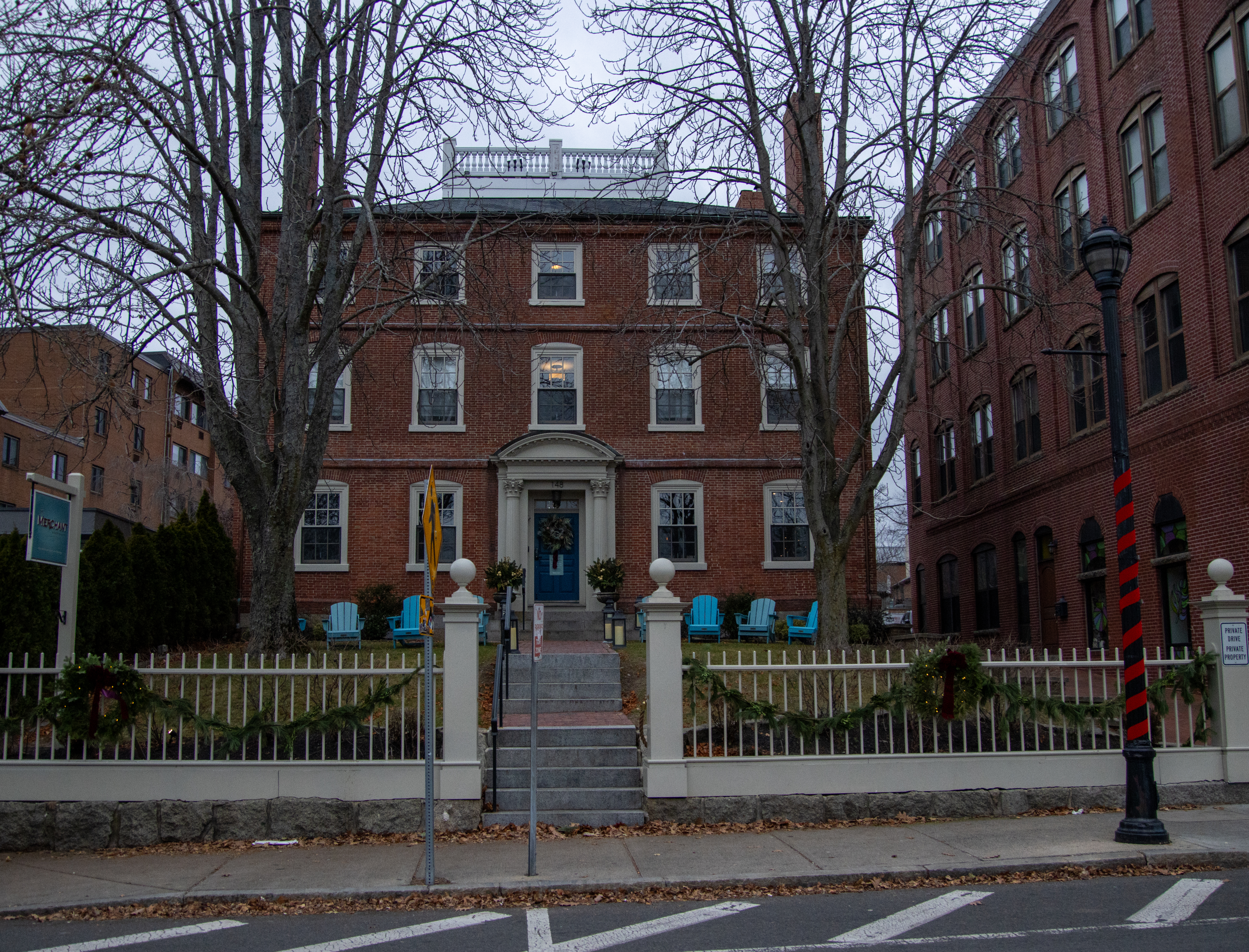
John Bertram, a wealthy merchant and philanthropist in Salem, built this house as an investment for his three daughters: Jennie, Annie and Clara. Upon his death in 1863, his own mansion was donated to the city of Salem. The building was donated as the future Salem Public Library. However, after the sisters showed interest in the home they inherited the house.
It is unlikely that Annie Webb ever lives on Carpenter St. Instead, Annie lived on Chestnut St with her husband, William G. Webb, and used the property on Carpenter St as a rental. Annie sold the house in 1920 to a long time tenant. A succession of owners occupied the house through the years before the current owners acquired it in 2011,
The Bertrams built the house in the Colonial Revival style, an architectural style popular in the 19th century which incorporated an eclectic mixture of stylistic details considered as representing aspects from several earlier historical styles. Ornamental elements typical of the Colonial Revival style used on the exterior of the house include dentilated and bolection moldings at the cornice and elaborate pediments over some of the first floor windows. The roof is an adaptation of the Mansard type popular in France about that time. The house is built in an L-shaped plan with the main entrance at the corner of the L where there is a single story porch.
Speaking of the porch, there was this cute pillow on a chair on the porch to the entrance of the house.
Inside the home there were more Christmas decorations.
This game looked like it would be fun to play!
Meet Belsnickel. A crotchety, fur clad, gift bringer, Belsnickel is a figure in the folklore of Palatanite region of southwestern Germany along the Rhine (think Dwight from the office in the Christmas special). In some traditions, he is said to reward the good children while punishing the bad children. So, you really better be good!
This statue seemed like a kinder Belsnickel.
The sunny living room area gave some light and warmth to the home despite the wintry weather outside.
Of course, I spent a little extra time in my two favorite rooms: the kitchen and dining room.
And, of course, what would a Christmas home tour be without not one, but two Christmas trees!
This concludes the 2024 Christmas In Salem Home Tours posts! I hope you all have enjoyed the Christmas In Salem home tours as much as I enjoyed posting about them!
The Nancy Courtis house (the house on the right side of the duplex in this photo) was built for Nancy around 1846. The double house was built in the Greek Revival style. Nancy purchased the property on May 26, 1843 and later had the house built there.
In 1850, the property was worth $5,000 in todays dollars. Nancy had a brother, William Courtis, and a sister Hannah Courtis. She never married and no occupation was ever listed for her. Nancy died in 1875. Since she did not have children to leave her property to, he property was left to her nephew, Ambrose Saunders.
As I entered the Nancy Courtis House, I noticed this mistletoe. The tour guide told us 16 couples had already smooched under it! And that was only a few hours into the tour!
For some reason, this Christmas tree seemed more “full” than the other trees on the tour. The decorations. lights and ribbons gave some heft to the tree!
But, one tree was not enough for these folks. This “bird tree” has a variety of different birds in it. You may have to enlarge the photo to see them.
There were also wreaths and other Christmas decor in the home.
On the way out of the home, the tour guide explained how the paint used for the doorway was not a random choice or a fancy passing. The owners of the home, transplants from Louisiana, brought over their superstitions and beliefs with themselves. One of those beliefs is to paint your doorways, particularly the doorway to your porch, in Haint blue. The superstition holds that evil spirits won’t cross water and the blue color represents the barrier to these spirits. It seemed very appropriate for this superstition to be brought to a city known for its superstitions and beliefs in the paranormal.
I know. Christmas posts in April? But, I feel a certain feeling of nostalgia and cheer posting these photos and retelling these stories. I’m just glad I took copious notes during the tours! For those who may be sick of these posts, only one more home left on the tour!
As you may have noticed by the title, this home has a long history of not only being a business but also a lucrative business.
Two brothers, Jacob and Elijah Sanderson, both cabinetmakers, constructed a building on this site in 1793 to be used as a shop. Considered two of the most prominent cabinet makers, the brothers established a firm by the name of E & J Sanderson Co in 1799. The business was a cooperative business venture in which cabinet makers, carvers, gliders, turners, upholsterers and other craftsmen collaborated to produce furniture for local, regional and foreign export or wherever the cargo could be sold for profit. Renowned Salem carver Samuel McIntire supplied piecework to the firm. Following the deaths of two brothers, the property was acquired in 1814 by Joseph Edwards, housewright, who built the house that stands there today.
Joseph Edwards built the house in the Federal style with five bays and an enclosed entrance porch centered on the facade. Fluted pilasters mark the corners of the flat-roofed porch and partial sidelights flank the six panel door. Two pedimented dormers punctuate the roof slope. The house. oriented with the gable and toward the street, sits directly on the sidewalk. A three story angled wing extends behind the main block.
In the 1820s, the owner of the home, Thomas Cole, became proprietor of a school for girls in Salem, the Female School on Marlborough St (now Federal St). This school was said to elevate the learning standards for females to the same level of those that already applied to males.
Glyphs, cornicing, moldings and wainscoting are terms I were not aware of before I went on this tour. Yet, they were in abundance at the Edwards home.
In short, these terms are used to describe decorative designs, dots and other ornamental grooves and patterns. This is one of the great things about these tours. I always learn something new during each house tour.
I especially enjoyed the flowers (real or otherwise) and other colorful decor of the home.
Because of the size and dimensions of some of the rooms, many of the homes had their trees in a corner. I always liked having the tree in the middle of the room when I was a kid. That way, everyone could bump into it and knock it over. And, more importantly, there was more room to put presents under it.
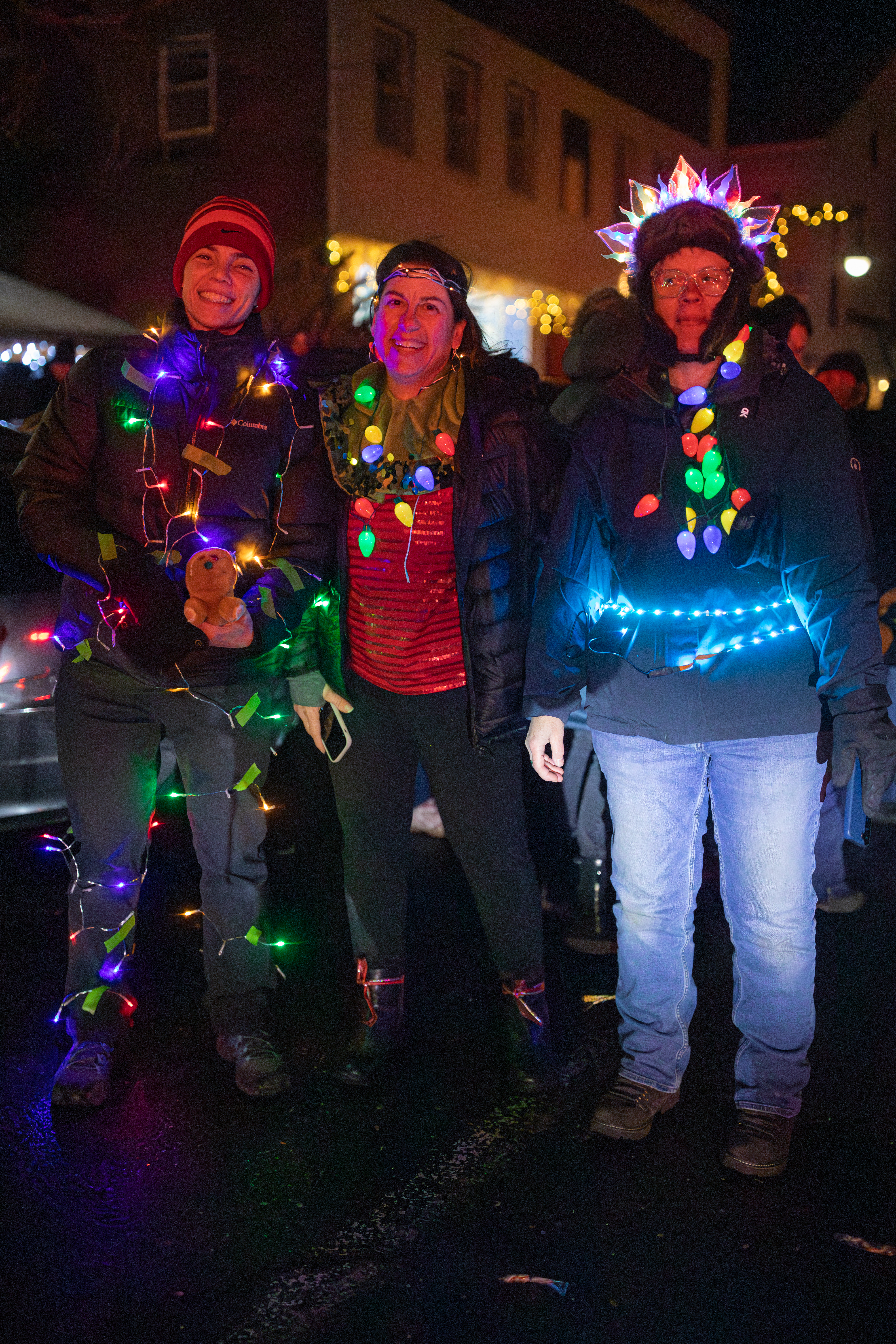
People came to the tours dressed in their festive decor. These young ladies wore their favorite holiday headwear. Funny enough, I had photographed some of these very same people at last year’s tour! I hope to photograph you all again next year!
While the house tours may not officially be dog friendly, you may be able to carry your dog into the homes. Brooklynn, a 6 year old Morkie (Maltese Yorkie mix), had a fun time at the tour!
This clapboard house , built as an early Federal style building, has three bays and a center chimney. The gable end faces the street. The doorway entrance on the south side has Doric-style pilasters on either side supporting a flat entablature ( superstructure of moldings and bands which lies horizontally above columns, resting on their capitals). A rear addition that was added circa 1860 features a one story porch with a railing, along the southside, facing a patio.
Born in 1767, Nathaniel Land was a master silversmith as well as the son and nephew of master silversmiths in Salem, MA. The house was built for Lang in 1783. However, Lang’s and his wife Priscilla’s homestead is believed to be in North Salem. Additionally, it is believed Lang may have bought the home as an investment and never actually lived in the house.
Like the Micah Wild House which I posted about earlier, the Nathaniel Lang house had a side facing front. THis, as I mentioned in the previous post, was often done for tax purposes as the more narrow side of the home would be taxed. Since I only photographed the side of the home I am adding this photo from Zillow to give a better perspective of the home.
Even before you entered the Nathaniel Lang home, you could feel the Christmas spirit.
Inside, the home had a very cheery feel to it with this Christmas tree taking up the corner of the living room area.
There were also Christmas decorations placed throughout home.
This spoon which was used in the home was framed and hung on the wall as a reminder of the history of the home.
There were other reminders of the historic nature of the home.
This flooring is the original wood flooring.
And this wood, which they found during renovations, is also original to the house.
It’s incredible to think this home still has these original features. They just don’t make things like they used to!
This glass of this door was very colorful. I also liked how the portrait of their dog seemed as though it was looking out at everyone. Nice touch!
As I was leaving the home, I noticed one of the more charming aspects of the home. The back porch gave the home a very relaxing and almost country feel despite being located near the busy downtown area. One can imagine sitting on the bench or chairs with some friends and a beverage,
As you can see, this home had so much to offer! It was one of the more interesting homes on the tour thus far!
A two story clapboard Federal style house with five bays, the John Dodge House features a pedimented front entrance with fluted pilasters on either side of the door and horizontal row of lights above the door. The house was said to have been built around 1794 by a John Dodge. However, there were several men living in Salem at that time with the name of John Dodge (I’m sure the name Dodge was like Smith is these days). It is believed by historians the original owner was the John Dodge who died in 1812, leaving behind a wife and 6 children.
The house was sold to Lucius Bolles in 1808. Bolles was the first minister of the First Baptist Church of Salem and Corresponding Secretary of the Baptist Board of Foreign Missions fourteen years. He was also one of the founders of Newton Technological Institution.
Bolles sold the property to Priscilla Dike, the wife of John Dike, a prominent lumber and coal dealer. Mrs. Dike was the aunt of the famed Salem author, Nathaniel Hawthorne, who most likely visited the home frequently.
The keen eye may notice the photo of the house posted above was not taken during the tour. I missed this one during the tour. So, I took this photo last weekend.
The home had so many wonderful decorations.
Each of these figures on the mantle represents or is doing one of the things in the 12 days of Christmas. For instance, there is a caroler drumming.
And of course Christmas trees! I think this tree needed a little taken off the top!
I especially enjoyed the old timey decor of the wooden decorations.
While doing work around the house and property, there were some unexpected discoveries.
These shoes were found by the chimney near the attic. Shoes had a special significance during the times of the 1700 and 1800s. They are the only item of clothing that takes the shape of the person who was wearing them. They were believed to hold something of the wearer’s essence or personality even when they were not being worn. It was believed that it was this association with the wearer that could fight off evil spirits should they try to enter a home.
The blue and white Chinese porcelain pieces were found while digging in the cellar of the house. The wrought iron nails, also found in the cellar, are believed to be original to the house.
Believe it or not, this piece of furniture traveled from England to Salem! At least that is the story behind it. What is known for sure is it was transported from Boston to Salem.in 1794 which must have been an arduous journey. Although it may have been cleaned up and polished over the years, it’s incredible to see it has stayed in such good condition over the years.
It feels weird posting about Christmas in March. Yet, I also feel a sense of warmth and joy looking back on these photos. Christmas decor and the Christmas spirit are always appropriate no matter the time of the year!
Located on 4 Federal, Court, the Mikah Wild House was built in 1804. The house is considered a classic example of the Federal style house with its gable end to the street. An interesting factoid as to why this house was built this way is that homes were built this way to avoid taxes. People were taxed by the street frontage of the house. And, since the side of the home was more narrow and smaller then the actual front of the home where the the front door is located, people paid less taxes. Duly noted. Although I’m sure that law has been updated by now.
Unfortunately, I did not take any photos of the side/front of the home. But, I was able to find this photo on redfin.com. as it will show the descriptions I will outline below.
The south facing facade of the home has five bays and a central entrance trimmed with flat pilasters and a semicircular fanlight above the door.
The builder of the house, Micah Wild, was a native of Braintree, MA, and a Revolutionary War veteran. He moved to Salem, MA, in 1790 and he acquired the land to build the house in 1802. In 1806, fellow Revolutionary veteran James Barr and he agreed to lay out a private way or court, 24 feet wide, extending from Federal Street to land belonging to James Ropes. Wild built the house on a parcel of land of that right-of-way. The Wild family did not live there very long. As they moved from Salem to Andover, MA, in 1810.
In 1815 Eben Dodge, a flour and grain merchant, and his wife Joanna acquired the house. Their son, Eben Dodge, Jr, was born in 1819. He would later go on to become a professor of religious studies and the fourth president of Madison College (now Colgate University).
The current owner acquired the house in 2022.
I was hesitant to go to this house because I didn’t want to go to Federal Court. But I took my chances.
While waiting to enter this home, I met this elf.
Brian is also know for dressing up as the witch “Borah” in Salem during Halloween.
A portrait of the home hung on the wall leading to the stairwell. Much like the rest of the house, the stairway was decorated for the holidays.
Stars, holly and even a Santa statue filled the home with holiday cheer!
Fun fact: the home was said to have been bought by Robert Parker of the “Parker Brothers” family.
There was also a Christmas tree and other assorted decorations.
I bet this closet could come in handy during the holidays!
My favorite part of the house was the free candy, of course. Mental note: Don’t put candy canes and chocolates in your pockets when you’re crouching down to take photographs.
The Witch House in Salem, MA, may be not only the most photographed housew in Salem, it may also be the most infamous.
Built in circa 1675, the building was built by Captain Nathaniel Davenport of Boston. The wood-frame and clapboard home was sold to Salem merchant Jonathan Corwin. After purchasing the home, Corwin hired mason Daniel Andrew to complete the structure.
In 1692, during the Salem witch trials, Corwin, who served as a magistrate and justice, would question and examine some of the accused witches in this very house. None of the accused ever lived in the house. And, of course, none of the accused witches were actual witches.
The house was built in a center chimney style. The clustered brick chimney served as an anchor for the house. A two-story projecting projecting porch is flanked by peaked gables on the facade, a rear lean-to extends the space on the back. The entire second story overhangs the first story in the front with decorative drop pendants at the ends of the overhangs of the porch.
Through the year, multiple changes and alterations were made to the structure. In the second-half of the 19th century, owner George P. Farrington, attached a drugstore to the east front of the structure.
In the 1940s, the city wanted to enlarge North St (the original location of the Witch House). But, the citizens of Salem raised $42,000 to save the home and to have it moved to its current location on Essex St. The Witch House was eventually opened as a museum in 1948.
I have mixed feelings about this house. Innumerable people line up to take photos in front of this infamous home. While it’s important to keep reminders of the past and it’s also good that places where tragic things have taken place have transformed into places of historic value (and business), it still doesn’t sit well with me.
The Witch House had a self-guided tour that had print outs with information about the house. While the house is generally known for the tragic events of the Salem witch trials, this tour dealt more with the Christmas traditions and some of the rituals and remedies of the day.
According to the handouts, the colonists brought over many of their Christmas traditions from England. Some of these traditions include eating and singing religious hymns. Did I mention eating?
I got hungry just posting these photos! And, of course, one would need implements to eat these foods.
These utensils were found through archeological digs and excavations.
The Christmas festivities from that time lasted from December 25 until the Twelfth Day, January 6. During this time period very little work was done. What a bunch of party animals.
The Witch House was festively decorated for the tours.
During the times of the witch trials, people used holly remedies as cures. Archeologists found ritual shell-cups in North America with residue dating back to 1,200 BC. The leaves can be used to make tea and alleviate digestive disorders, water retention, jaundice, rheumatism, periodic fevers, measles and respiratory illnesses such as cold, coughs, flu and pneumonia. Somedays I feel like I may have every single one of those. Holly leaves can also be used to treat symptoms of dizziness and high blood pressure. They also can be used topically for sores and itching.
There were some documents from the witch trials. These actual documents from the trials are kept in a sealed container.
The Witch House also displays an assortment of wares and other tools of the era.