Date of Visit: July 25, 2026
Location: Greenfield, MA (2 hours northwest of Boston, MA or 1 hour north of Hartford, CT)
Cost: Free
Parking: Metered parking is available throughout the city
Summary: 10 murals celebrating America’s independence have been painted on the sidewalks of Greenfield, MA
Website: MA250 Sidewalk Art Tour
There have been incredible celebrations and memorials throughout this year all of New England in celebration of the country’s 250th anniversary. And the sidewalk art in Greenfield, MA, is another example of how art can be used to be celebrate our country’s independence.
The ten murals, which are painted on the sidewalk rather than walls, celebrated a different aspect of our independence.
While all of the murals are located in or near Greenfield Center, you will have to drive to a few of them. I am listing them as they appear on the website. But, I didn’t photograph them in this order. Some of the addresses are approximations since some of the locations, like a cemetery, don’t have an actual address. Also, some of the locations are near certain areas, like the intersection of Meridien and Deerfield St. So, it’s important for you, or preferably a passenger, to look at the sidewalk while driving to some of these locations.
Since most of the descriptions use the artist’s own descriptions of the works of art, I copy and pasted the descriptions from the website as I wanted to represent the artists’ descriptions in their own words. Plus, it made it easier for me. So, it was a win-win!
“Liberty is Unfinished Work” – City Hall, 14 Court Square by Danielle Lucier
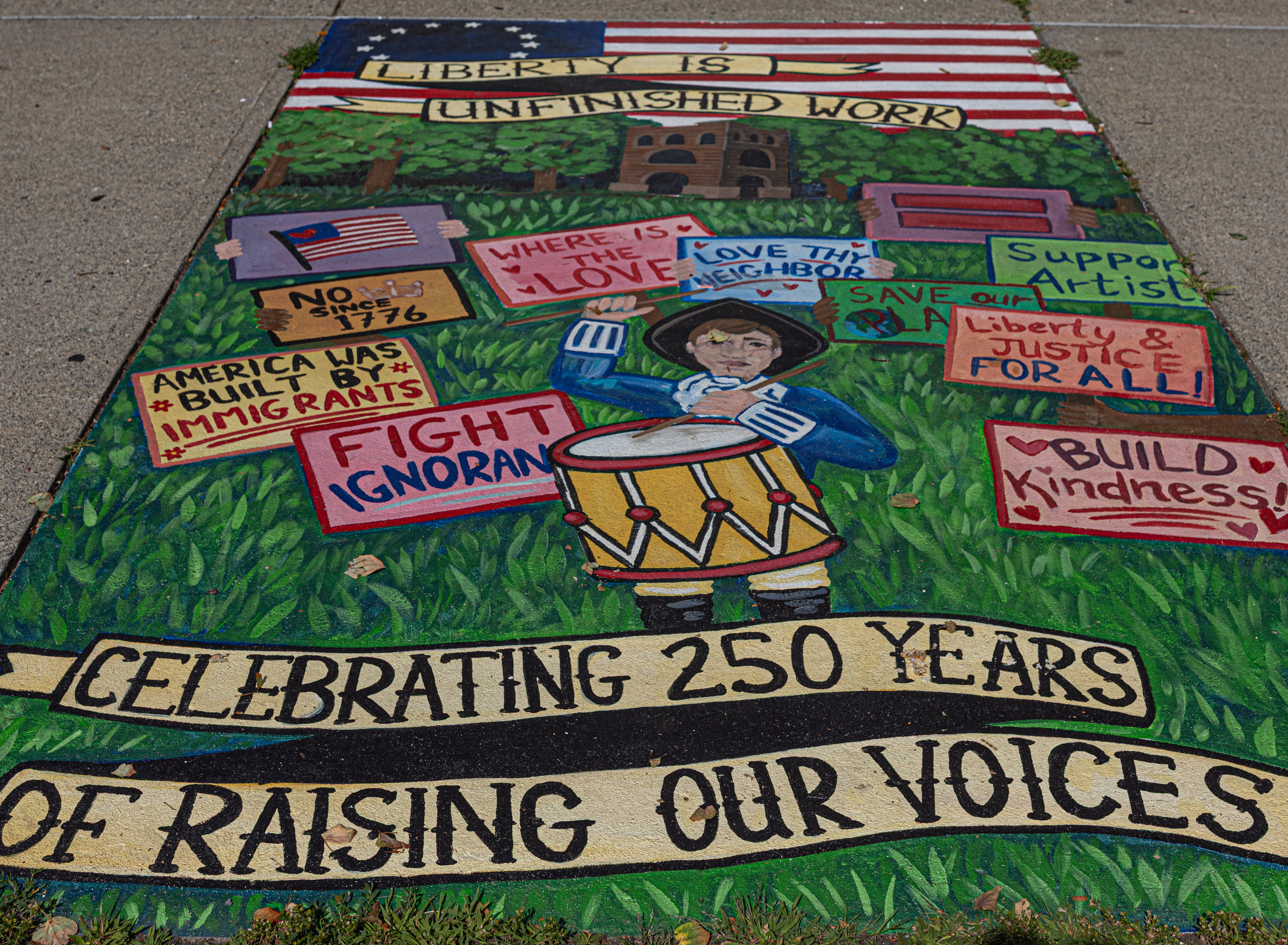
Sometimes photography can seem simple. Just point, adjust settings, sometimes repeatedly, and click. However, sometimes it’s not so easy or straightforward. Since this mural was painted vertically on a sidewalk and it was difficult to read all the lettering, I actually photographed this mural on a step stool. By photographing it from a higher angle and looking down, I was able to photograph it with all of the worlds visible and legible. I did have to duck a little so my shadow didn’t appear though.
Created for the 250th anniversary of the American Revolution, “Liberty is Unfinished Work” reflects on the ideals that inspired our nation’s founding, while also acknowledging that liberty is an ongoing project that we work towards every day. My piece depicts a Revolutionary War drummer boy leading a group of present-day marchers with modern signs, connecting the spirit of civic action that shaped the American Revolution with the ways people continue to advocate for their rights, communities, and futures. By putting the drummer with modern day marchers, I also wanted to give viewers a way to relate their work back to history- and to feel like a participant in an ongoing story rather than a distant observer of a historical event.
When designing this piece, I thought about the Revolution not only as a defining historical event, but also as the beginning of a conversation about liberty, representation, and self government. The American Revolution was driven by ordinary people who believed they had the right to make their voices heard. So instead of portraying a moment in the past, I wanted to explore things like who had a voice, who was included, and how those people worked together to create change- and create a piece that felt relatable as a person existing 250 years later.
As an artist reflecting on the 250th, I felt both contemplative and celebratory. It gave me this beautiful opportunity to honor courage, aspirations, and sacrifices that shaped our nation- while also recognizing that liberty isn’t a finished achievement. This anniversary serves as a reminder that each generation inherits the responsibility to expand, protect, and redefine freedom in its own time. This mural was made to celebrate the continuing work and the people who carry it forward.
Visual description: a tall rectangular sidewalk square with banners at the top and bottom. The banners say “Liberty is Unfinished work. Celebrating 250 years of raising our voices”. In between the banners is a green hilly landscape with Poet’s Seat Tower at the top. A revolutionary drummer boy leads a crowd of modern-day protesters with bright, colorful signs standing up for what they believe in.
“What Holds Us Together” – Transit Station, 11 Olive St by Cameron Schmitz
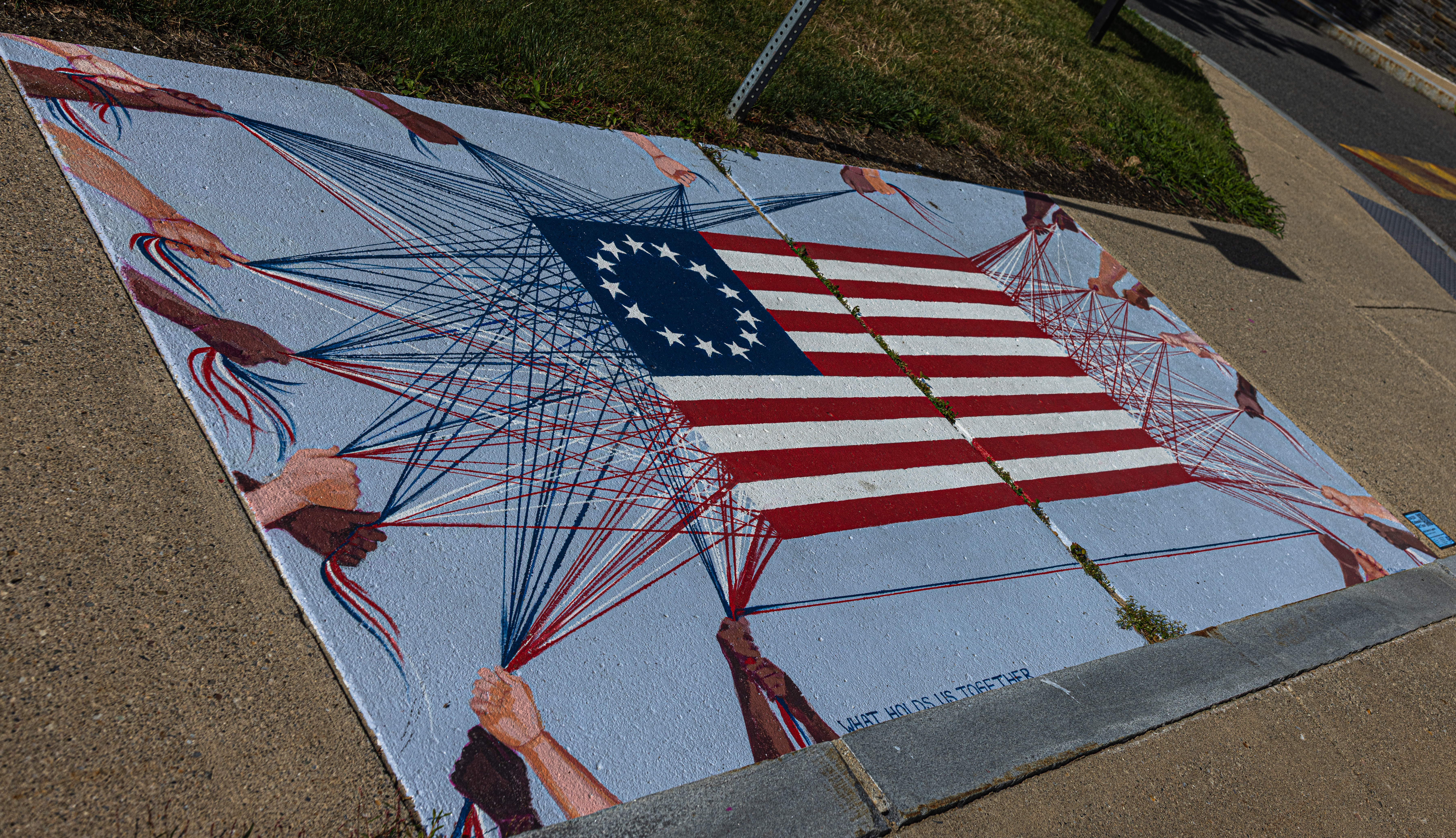
Painted in honor of the 250th anniversary of the American Revolution, my mural, “What Holds Us Together”, celebrates the diverse people whose contributions, sacrifices, and shared efforts have been essential in shaping our nation from its founding to present day.
Suspended in the center of the mural, the original thirteen-star American flag appears to emerge from a web of intersecting threads, its fibers extending outward, held together by the hands of many different individuals. Like a woven tapestry, overlapping strands of red, white, and blue extend outwards, interweaving and converging into an intricate network of connection. The diverse hands which collectively hold the flag’s fibers together, represent people of different backgrounds, cultures, ethnicities, and generations, each contributing to the ongoing work of strengthening the fabric of our nation.
My inspiration for this mural is rooted in an often-overlooked truth about the American Revolution itself. Traditional depictions of the Revolutionary era have frequently centered on white colonial figures, leaving many other contributing members largely absent. Yet the struggle for independence was shaped by people from a wide range of backgrounds. African American men, both free and enslaved, served as soldiers, sailors, laborers, messengers, spies, and support personnel throughout the war. African American women contributed as caregivers, laborers, messengers, camp followers, and community builders whose efforts helped sustain both military and civilian life during the Revolution.
Indigenous nations also played significant and complex roles throughout the Revolution. Native soldiers, scouts, diplomats, guides, and leaders influenced military campaigns, intelligence networks, and political alliances, while Indigenous women often held important roles in diplomacy, decision-making, and sustaining their communities through a time of profound upheaval. The choices made by Native nations shaped both the course of the war and the future of the continent.
The story of American independence is far more diverse, interconnected, and nuanced than it has often been portrayed. By depicting hands of different skin tones collaboratively supporting the flag, this mural recognizes the countless individuals whose labor, sacrifice, and participation have been vital in weaving our nation into being. It serves as a reminder that diversity is not a recent addition to the American story, but is in fact, an essential part of it. The strength of our nation has never rested in a single people, culture, or perspective, but rather, is the result of contributions of many individuals whose lives and efforts have become interwoven across generations.
The hands of this mural do not simply hold the flag together—but are also being held together in unison as its maker. Some hands overlap, some press intimately against one another, and others work side-by-side, symbolizing the trust, collaboration, and shared responsibility that is necessary in sustaining our democracy.
Two hundred and fifty years after the Revolution, the ideals of liberty, self-determination, and democracy remain unfinished work. Like the threads of the flag itself, these ideals must be continually strengthened and held with care by each generation.
“What Holds Us Together” invites viewers to recognize the many people who have been—and continue to be—an essential part of the fabric of our nation, and to reflect on the relationships, care, and collective effort that binds us together.
The strength of our nation lies in the spirit of cooperation that made the American Revolution possible, and in the many hands that continue to work together to hold, weave, and sustain our democracy and our shared future.
“The Pen and the Press” – Justice Center, 43 Hope St by Althea Keaton
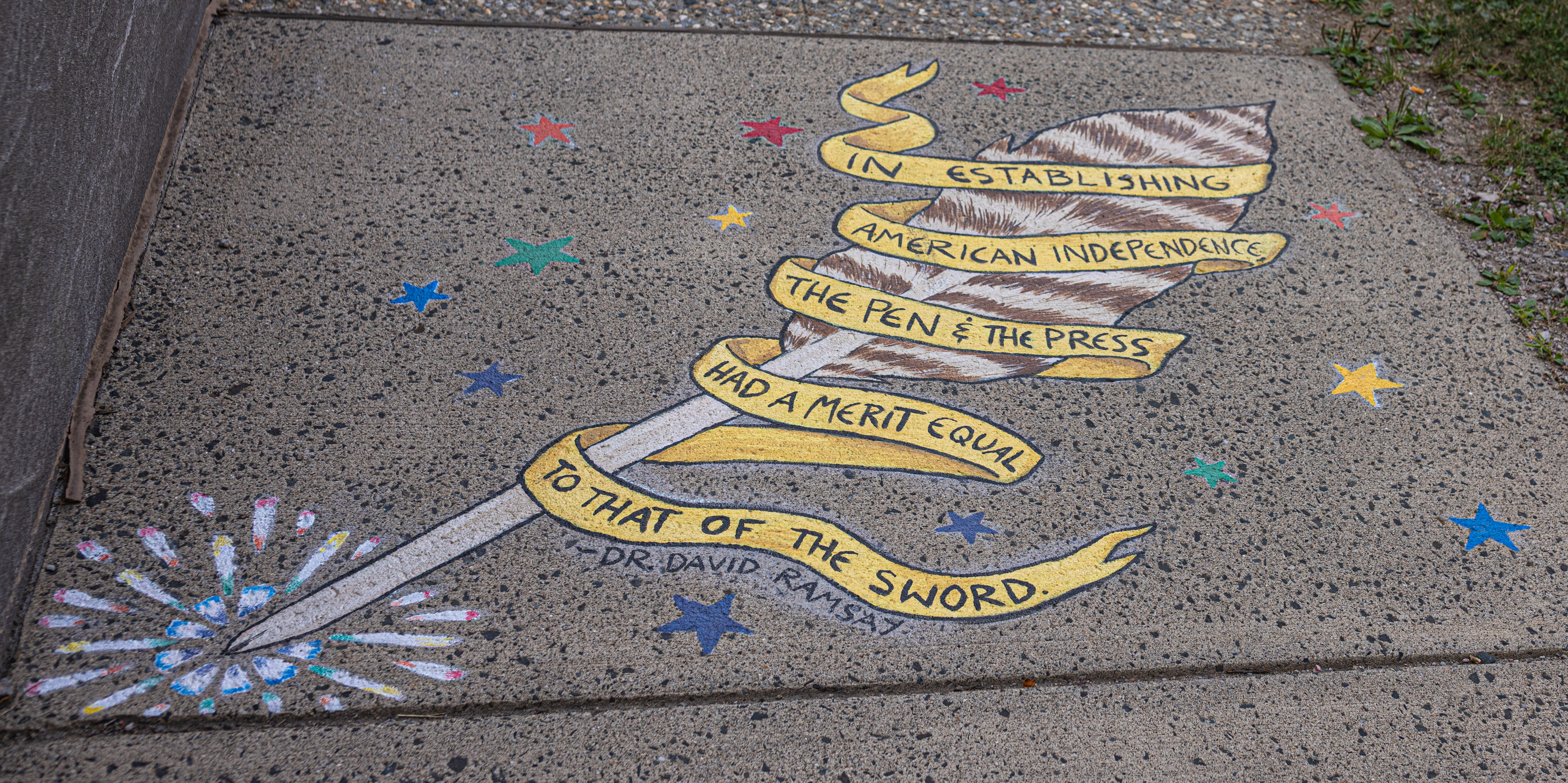
“In establishing American independence, the pen and the press had a merit equal to that of the sword.” – Dr. David Ramsay
Dr. David Ramsay was one of the earliest major historians of the American Revolution, as well as a politician and author. He served as a field surgeon during the American Revolutionary War until he was captured by the British army and imprisoned for a year. He wrote many well-respected volumes on American history, both more broadly and specifically about the Revolution. This quote of his reflects his direct experience of the Revolution, both as a writer and as someone who served on the battlefield.
During the U.S. Revolution, newspapers played an essential part in shaping public opinion. At that time, newspapers were the most effective means of mass
communication. They spread not only the news, but political ideas, propaganda, foreign dispatches, official documents, and more. Massachusetts in particular was a hotbed for newspapers, with Boston establishing the United States’ first regular newspaper, the Boston News-Letter. By the time of the Revolution, there were numerous Massachusetts papers vying to influence public opinion, the majority of them Patriot papers advocating for independence.
A revolution is not won only with weapons, but with words and ideas. Although the quote this mural is structured around specifically references the American Revolution, it is relevant beyond that corner of history. Freedom of speech and freedom of the press – two of our First Amendment rights – are essential to maintaining a functioning democracy. We may no longer typically exercise these rights via quill or letterpress, but they are still vital.
The barred turkey quill pictured in this mural is a literal depiction of the kind of writing implement commonly used in the 1700s, but it is also a symbol of ‘the pen’ as a concept. Today’s ‘pen’ may be a stylus, a smartphone, or any number of devices. The specific implements may have changed, but they are still potent tools, and they can reach farther than anyone could have possibly imagined in 1776.
Visual description: A barred turkey quill is set at a diagonal, as though writing. A yellow ribbon winds around it bearing the quote, “In establishing American
independence, the pen and the press had a merit equal to that of the sword.” – Dr. David Ramsay. At the tip of the quill, there is a firework-like burst. Thirteen stars sparkle around the quill in red, orange, yellow, green, blue, and purple.
“Let Virtue Reign” – Greenfield Library, 412 Main St by Youme Nguyen Ly
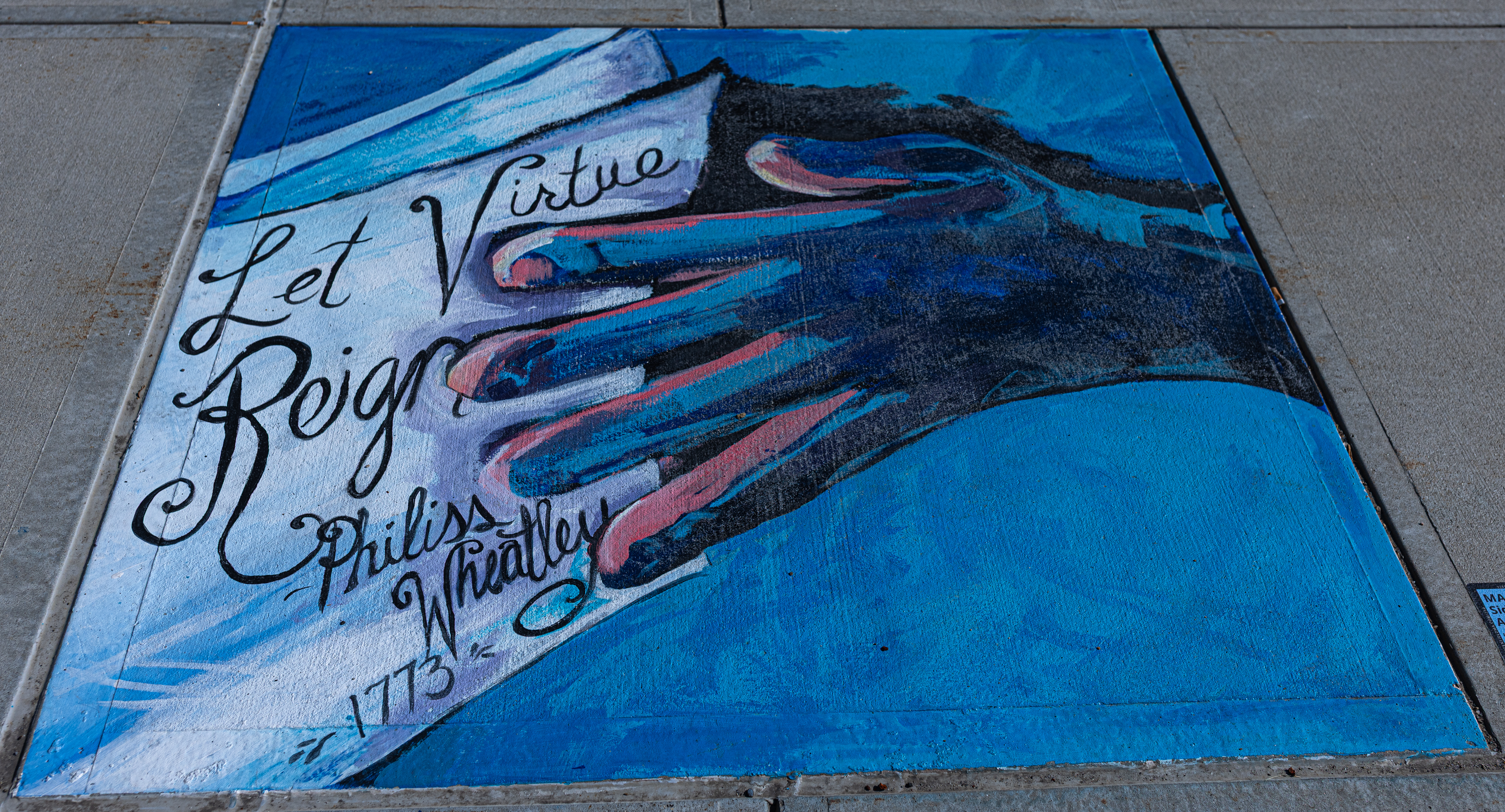
Let Virtue Reign is painted in front of the Greenfield Library. A dark blue hand holds a stack of papers, the topmost of which reads, “Let Virtue Reign 1773 Phillis Wheatley”.
The hand represents Elizabeth Freeman, the first African American woman to successfully file a lawsuit for freedom in the state of Massachusetts, less than a year after the adoption of the Massachusetts State Constitution. Her case would ultimately lead Massachusetts to outlaw slavery.
Phillis Wheatley was one of the best-known poets in pre-19th century America. Born in West Africa in 1753, enslaved as a child in Massachusetts. She learned to read and write and was emancipated in 1773, the year her collection “Poems on Various Subjects, Religious and Moral”, was published. She wrote in support of anti-slavery movements. “Ode to Dartmouth”, the quoted poem, was written to encourage Dartmouth’s abolitionist work.
This painting celebrates two Black women who were actively working in Massachusetts and beyond, 250 years ago to make the future better for everyone.
“Free Press” – Main St & Sears Ave by Althea Harris
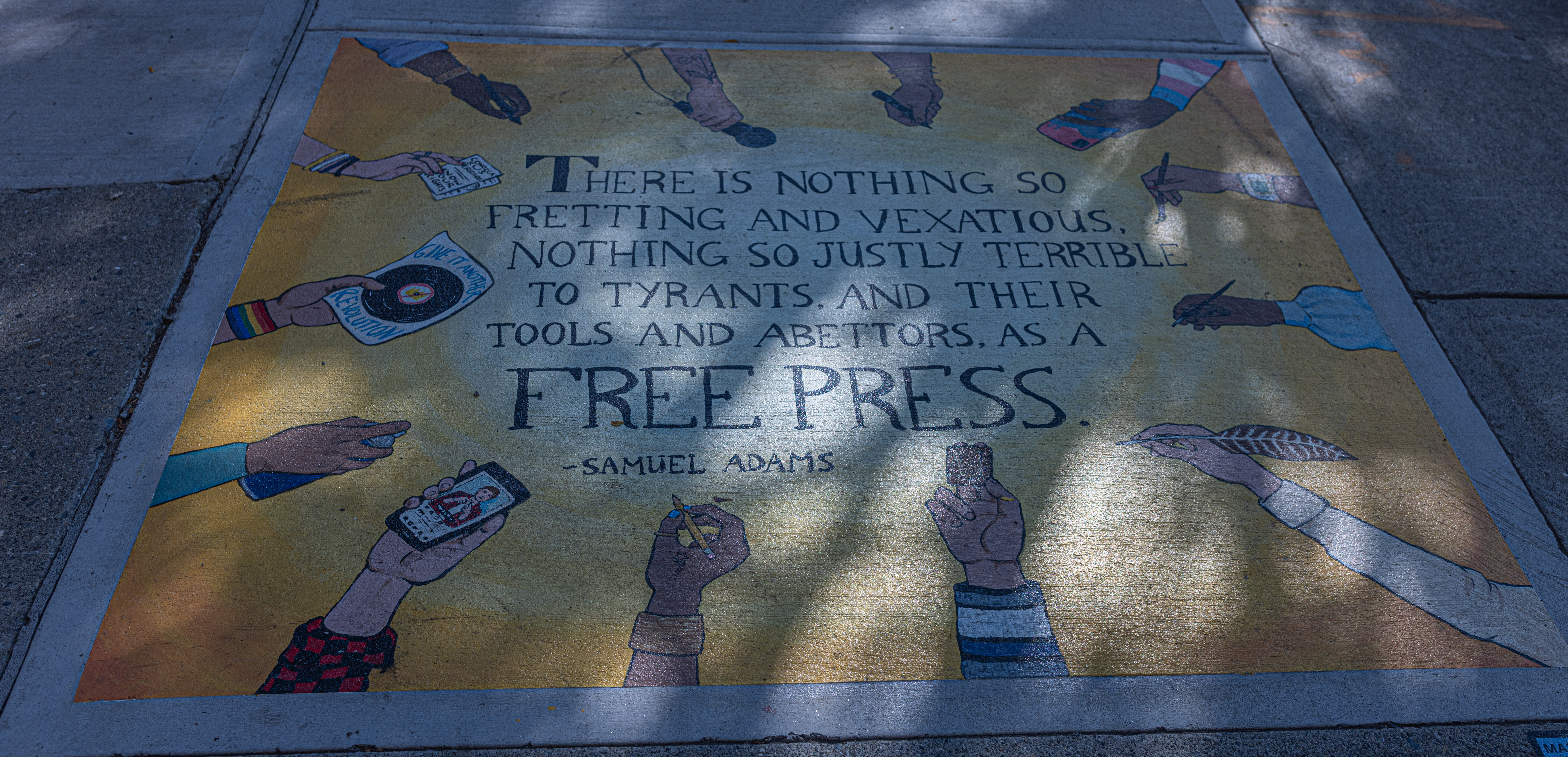
“There is nothing so fretting and vexatious, nothing so justly TERRIBLE to tyrants, and their tools and abettors, as a FREE PRESS.” – Samuel Adams (from his statement on freedom of the press in the Boston Gazette, March 14, 1768)
Founding Father, signatory of the Declaration of Independence, and colonial Massachusetts politician Samuel Adams was, as you may have guessed from this quote, a strong proponent of the role of a free press in ensuring freedom from tyranny. Adams actively used the press as a tool to advocate for colonial rights and independence, criticizing British rule and promoting his political ideals through essays and letters in colonial newspapers, especially the Boston Gazette. With its weekly publication and its circulation of approximately 2,000, this paper had a significant reach for the time period. By the 1770s, Massachusetts had numerous newspapers – most of them Patriot-led – and Adams was far from the only person to take advantage of this medium of mass-communication and its ability to push the tide of public opinion in favor of revolution.
The appearance of the press has changed significantly over the past 250 years, but the importance of a free press has not declined. A newspaper with a circulation of 2,000 has much less clout in the U.S. of 2026 than it did in the pre-revolution colonies, but the dissemination of news, political thoughts, and opinions is still an essential (and Constitutionally protected) right. This mural is a celebration of a free and active press as it has evolved over the years, and it is also a call for the viewer to support freedom of the press in its many forms.
For this mural, I felt it important to celebrate not only a revolutionary past but also the revolutionary present and future. Independence is not something that was won once in 1776 and need never be fought for again, but something we as a country continue to strive for and evolve towards. Rights have been hard-won, some only recently won, and some even more recently revoked. Freedom of the press is encoded in our Bill of Rights, and true freedom of the press cannot belong in only the hands of a few. It needs to come in many forms and from many people.
Free press is still a potent tool for shaping public opinion as well as for spreading journalistic news. Think pieces still come in newspapers and magazines, but they are also found in social media feeds, pinned on bulletin boards, spoken or sung aloud at open mic events. In times when rights are being infringed upon, find people who are impacted and listen to their voices, read their words. Seek out multiple journalistic sources. Fact check and dig deep rather than trusting AI summaries. Use your own voice to speak out against the silencing of journalists. And don’t be afraid to pick up a pen, paintbrush, or microphone and speak your own truth.
We need all hands on deck to keep this ship moving forward.
Visual description: Thirteen hands reach in from the edges of the sidewalk panel holding various implements of communication from the 1800s to today, including: a quill, a paintbrush, a letterpress block, a zine, a microphone, a smartphone, and more. They are set against a bright yellow background, which fades into an off-white glow in the middle to emphasize the quote the hands surround. “There is nothing so fretting and vexatious, nothing so justly terrible to tyrants,
and their tools and abettors, as a free press.” – Samuel Adams
“Old Friends” – Fiske Ave Pocket Park by Youme Nguyen Ly
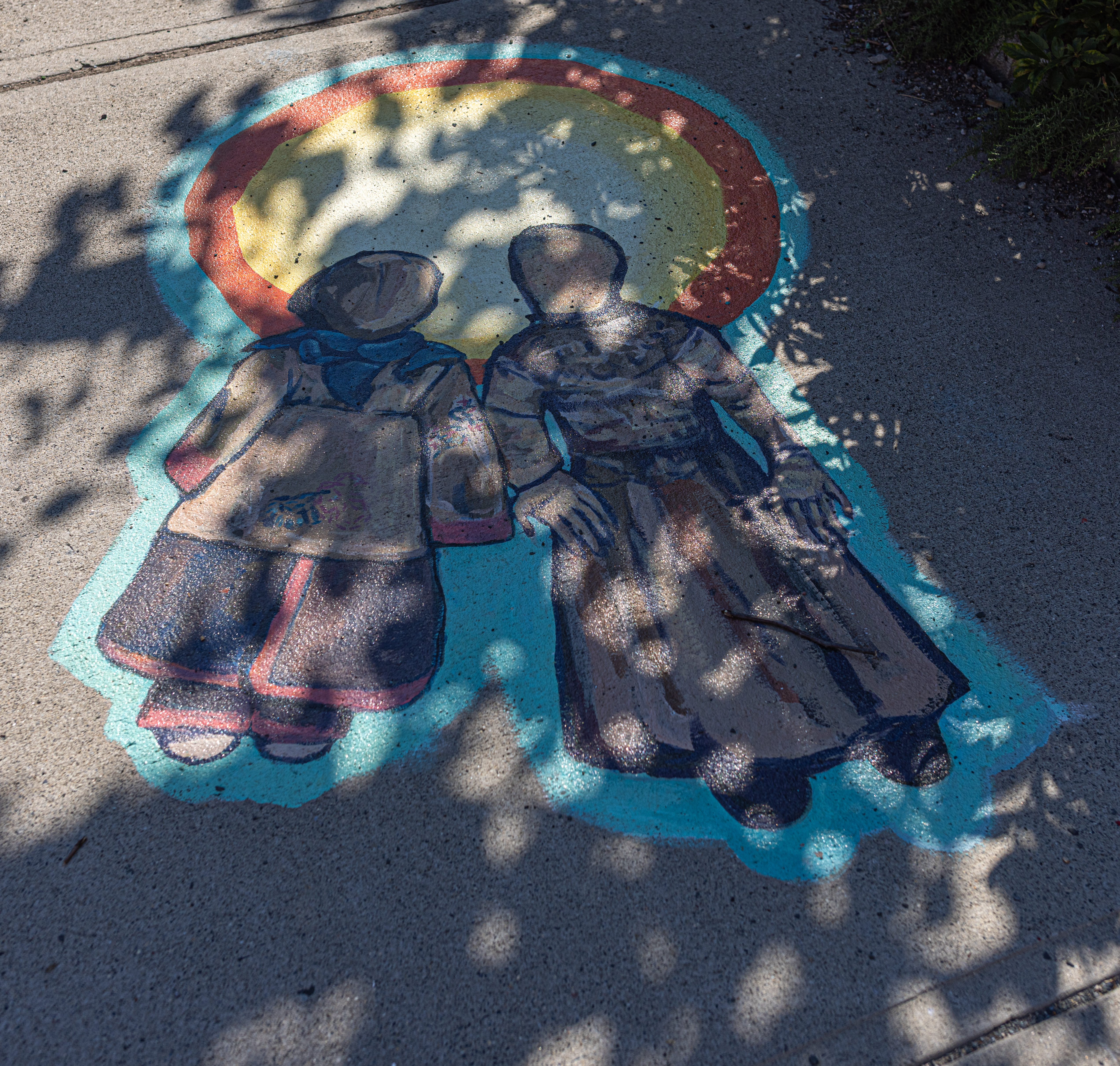
Old Friends depicts two dolls with a shared sun radiating behind them and a bright outline of sky. On the left a traditional corn husk amsute’kan made in New England.
A traditional story tells that Corn Spirit created the cornhusk amsute’kan for children to enjoy and to watch over them. Originally, she had a face, when she became distracted by her own beauty, her face was taken away to remind us not to focus on our own looks so much that we forget to care for others. On the right side, one of the oldest surviving ragdolls in this country, named Bangwell Putt. She belonged to Clarissa Field of Northfield, Massachusetts. Clarissa was born blind in 1765. The doll’s carefully constructed fingers suggest the importance of touch. In my depiction, the dolls have been friends for over 250 years and carry the respect and gratitude for Indigenous and Non-Indigenous friendships, past, present and future. This piece further serves as a tribute to the importance of children and the essential role of childcare.
“Essential Pieces on the Tapestry of a Revolution” – Historical Society, 43 Church St by Danielle Lucier
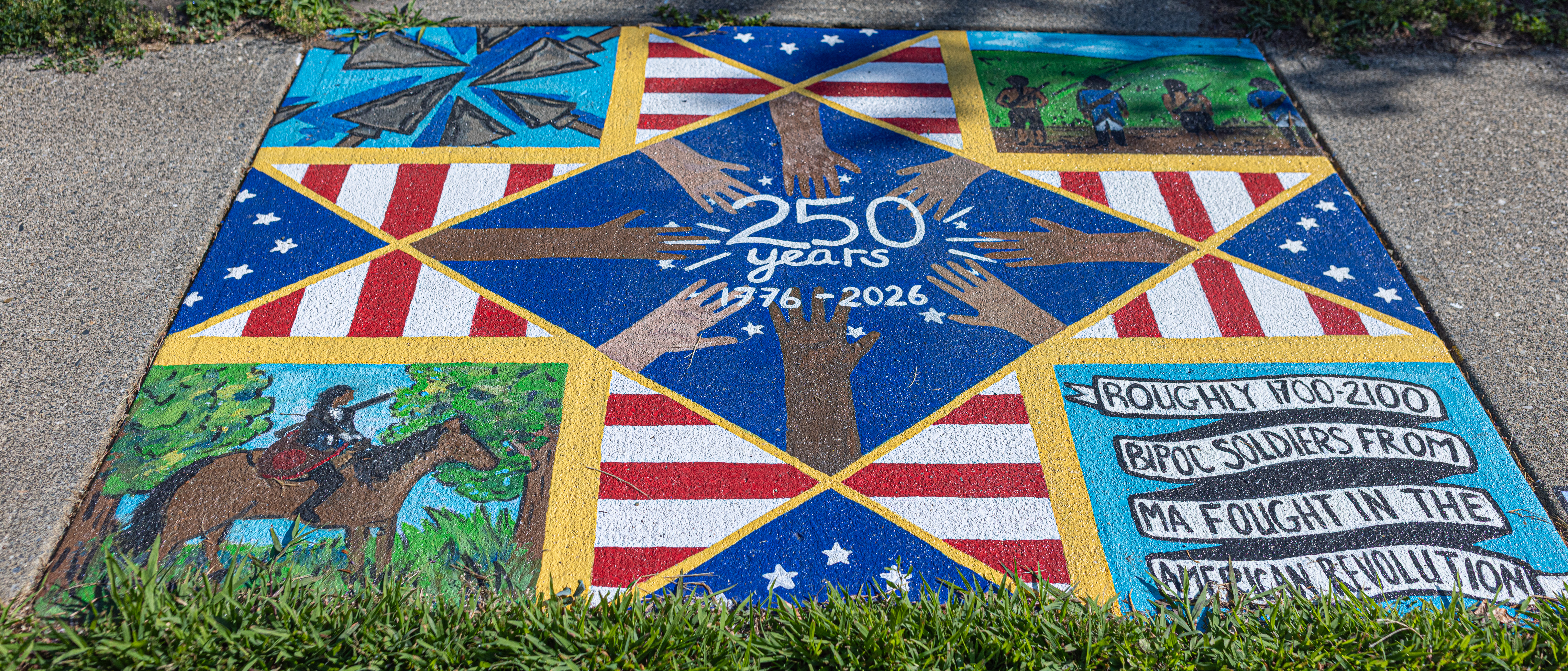
This piece, created within the shape of an American traditional quilt square, is a celebration of the diversity of the American Revolution that often gets overlooked throughout historical representations of the war. This quilt square is built of pieces of the original thirteen-star American Flag, pieced together with imagery representing BIPOC roles in the Revolution- all coming together to form one solid piece of our historical tapestry.
In doing research for this piece, everything I found online was vastly misrepresentative of the actual people who worked together in the American Revolution. Most information available showed Colonial white figures- and mostly men at that. Yet upon deeper research at the Historical Society of Greenfield, I found many books and references referring to BIPOC soldiers, spies, messengers, and laborers (free and enslaved) – all in the same positions as these colonial white men. This sparked something in me that felt like a piece of this historical quilt was missing – and inspired my quilt block design. I wanted to pay honor to these hardworking BIPOC people who fell through the cracks in the history books, who didn’t get the credit and honor they deserved.
I found out that roughly 1700-2100 BIPOC men from Massachusetts served as soldiers and sailors throughout the war- and BIPOCwomen worked to build communities, sew soldiers clothing, serve as caregivers, and when not traveling with the camp – they also helped to hold up life at home taking on their duties and the duties of the men who were off fighting.
“Essential Pieces of the Tapestry of the Revolution” is a piece dedicated to African American and Indigenous soldiers and war contributors. Our history is so much more diverse than representation has ever shown – and having this chance to create a piece that tells more of the real story was a true honor. Work and decisions made by BIPOC war contributors played such a large role in the history of our independence- a history that is so much more multicultural and diverse than history texts have led us to believe. It takes hands from all backgrounds coming together to work for a common cause – to create a successful revolution.
Visual description: this square sidewalk tile is broken up into 9 smaller squares to represent an american traditional quilt block. Pieces of the original 13-star flag, and red and white stripes come together to form a pointed star-like pattern, and imagery of Indigenous and African American soldiers are in opposing corners. The center says “250 years 1776-2026” and has hands of all skin colors reaching towards the center of the piece. A banner in the bottom corner says “roughly 1700-2100 BIPOC soldiers from MA fought in the American Revolution”.
“Roles of Children During the American Revolution” – Federal Street School, 125 Federal St by Jill Strait
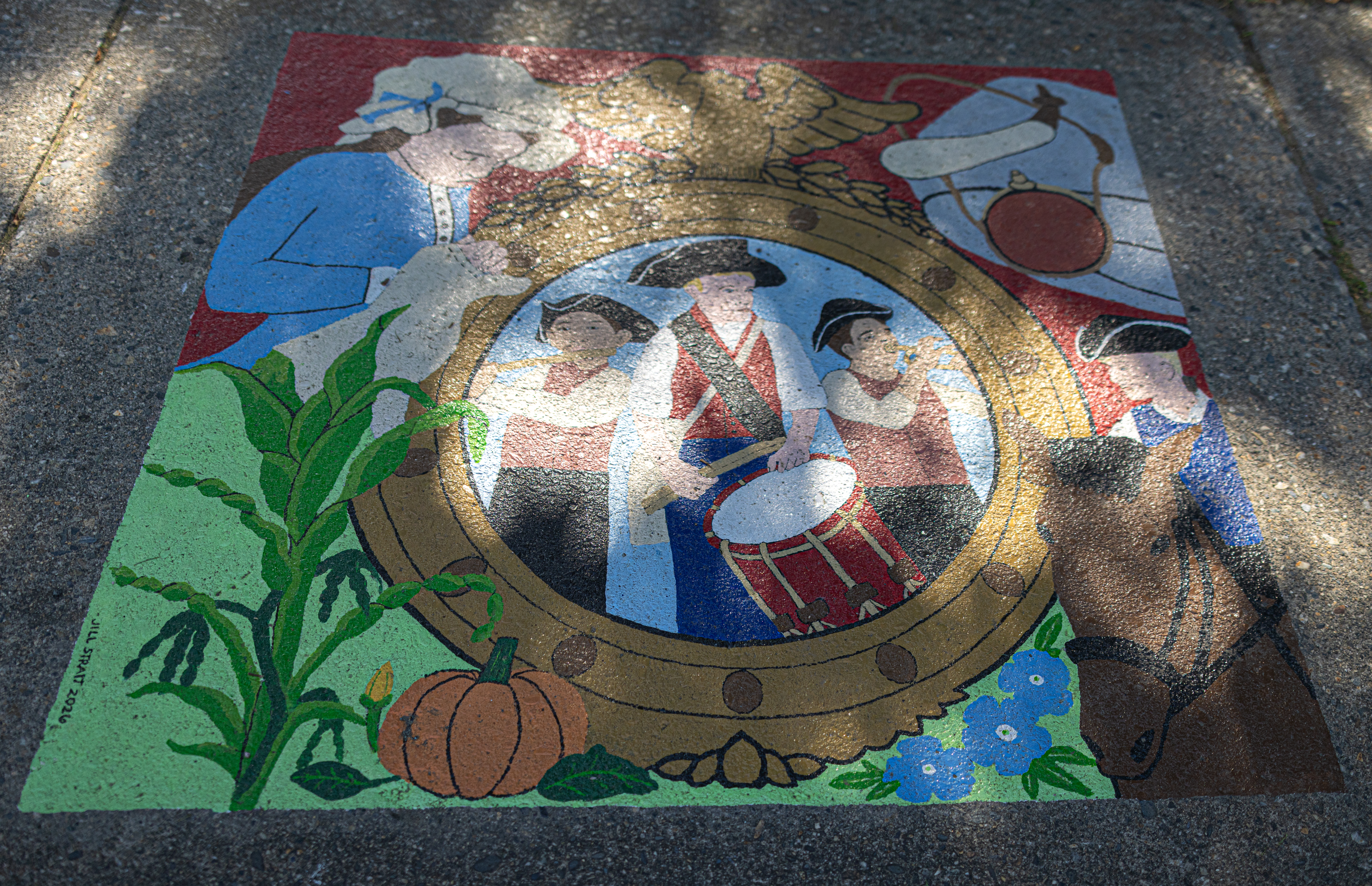
This mural depicts the various roles children played during the Revolutionary War, a time when the absence of child labor laws meant young people often set aside their education to assist with adult duties. I especially wanted to highlight musicians, who were often in their teens or younger, so they are featured in the center of the piece playing the bugle, drum and fife. Clockwise from left is a young girl hand-sewing a garment, as children worked on uniforms and helped with mending. They often brought essential supplies where needed, on the top right there is a folded blanket, powder horn and a canteen of water. Below that is a teen on a horse, serving the role as messenger. And lastly, farming was a role that kept children occupied, represented by the “three sisters”—squash, corn, and beans—in the lower left corner.
“Caregivers” – Federal Street Cemetery, 175 Federal St by Joe Pye and Ginseng by Youme Nguyen Ly
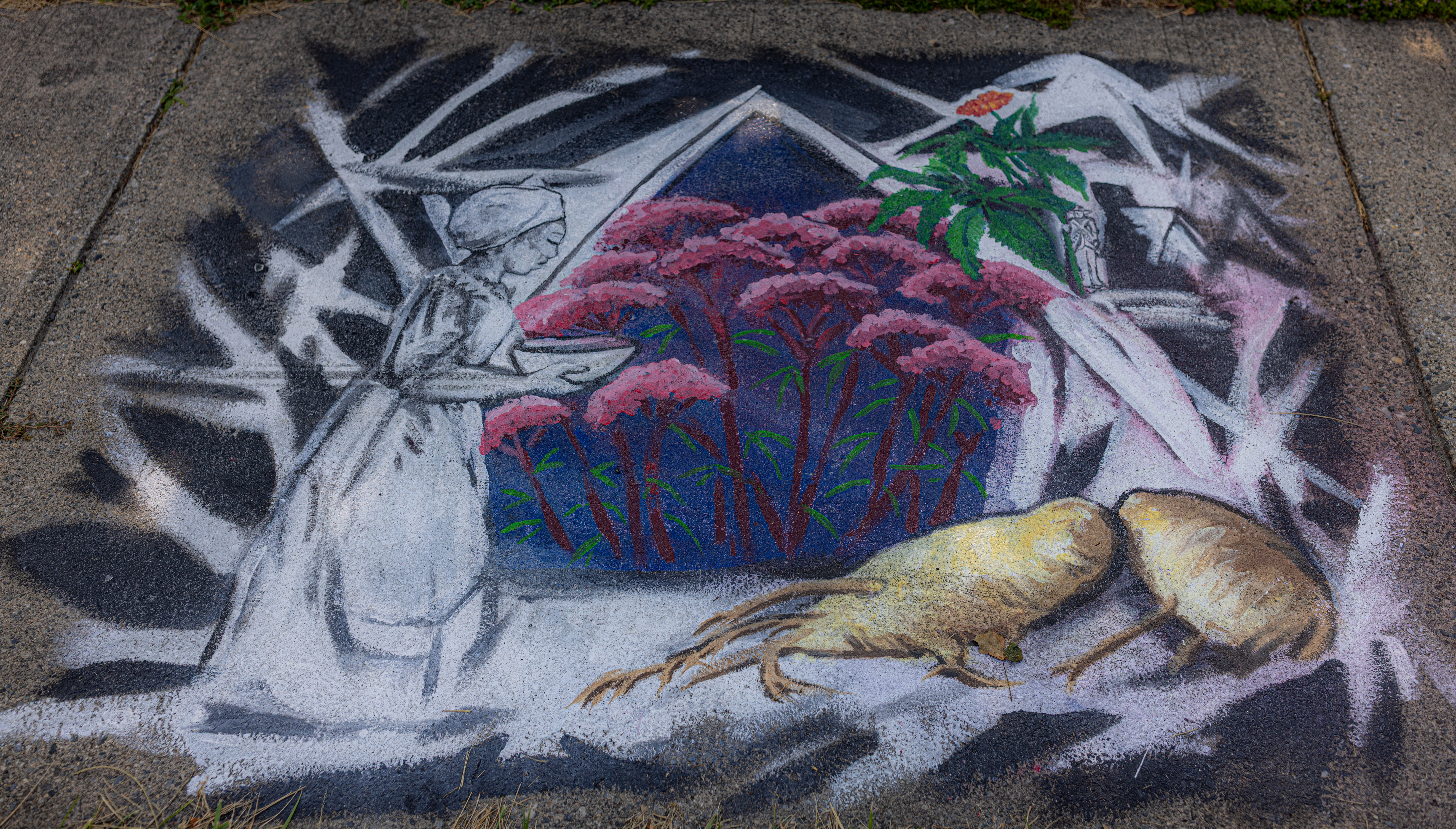
Caregivers, Joe Pye and Ginseng, shows a black and white tent with abstract pink flowers, red stems and green leaves of Joe Pye weed growing from within. A woman arrives to the tent with a healing bowl of soup. In the abstract black and white background, a tiny black and white revolutionary soldier holds the green living stem of a full color red and green ginseng plant instead of a weapon. Two large ginseng roots are depicted in full color golden yellow, at the base of the illustration.
American ginseng is a medicinal plant native to North America. Income generated from gathering and selling wild ginseng influenced the early history of this country. Local ginseng use and trade stretches back much further than the Declaration of Independence. Long before North America was colonized, various Indigenous peoples used ginseng in medicine.
The story of how this plant came to be called “Joe Pye Weed” has evolved over time. Stories tell of Zhopai, an Abenaki medicine man who treated typhus with this plant. Some researchers believe “Joe Pye” was what white settlers called Joseph Shauquethqueat, a Mohican. Shauquethqueat was a sachem and selectman. It’s believed that white colonists saw Shauquethqueat healing with the plant Pkuwiimakw and named the plant after him.
I painted this with healing in mind, healing that nature offers everyone if we can listen for it. I am also honored that it was chosen for the cemetery location, as those that came before us are part of who we are now and who we will become.
“Crossing the Dela-Western Mass” – Riverworks Park, 250 Deerfield St, just past Meridien & Deerfield St by Youme Nguyen Ly
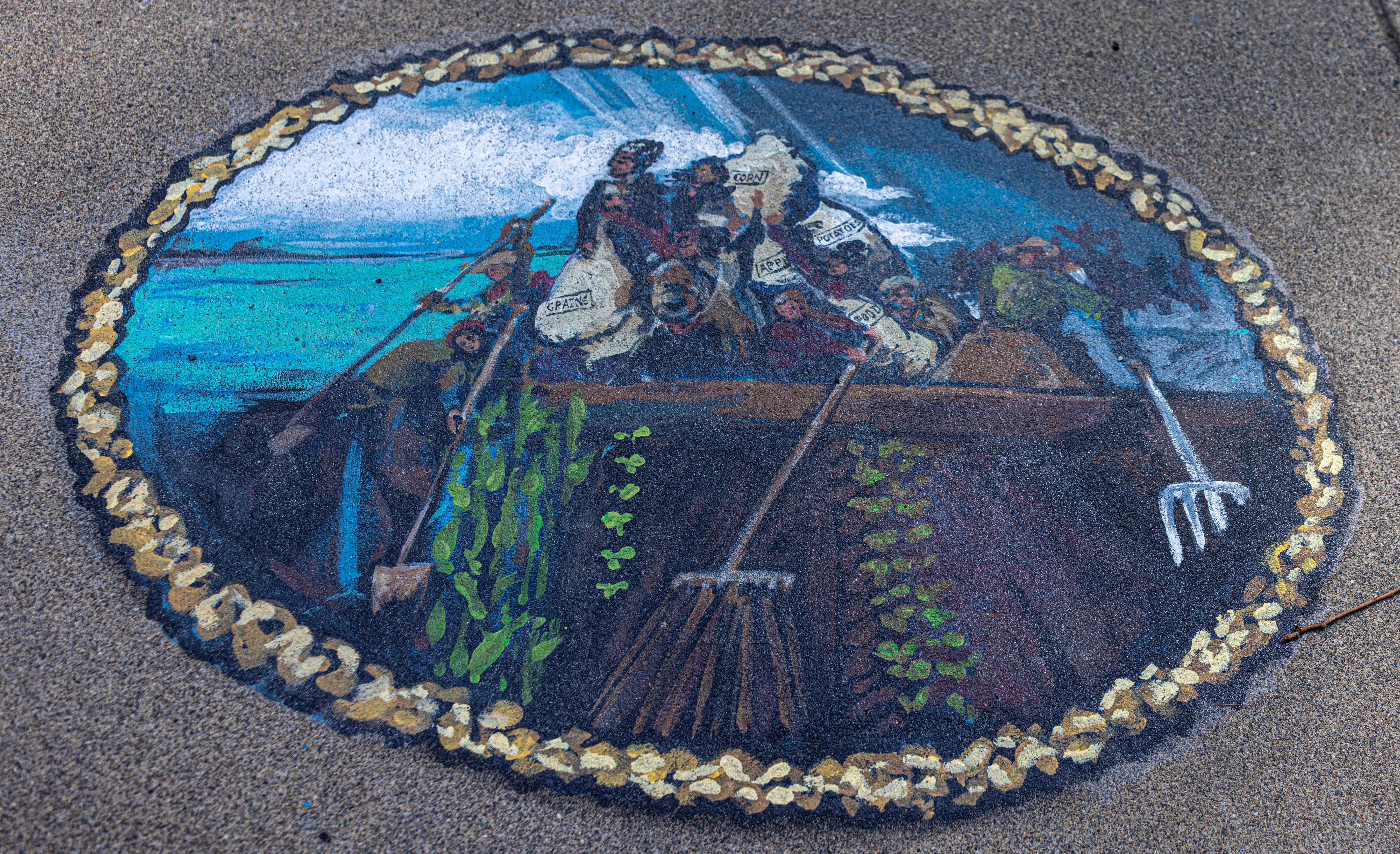
The Crossing of Dela-Western Massachusetts, references a famous painting of Washington Crossing the Delaware by Emanuel Leutze. In the original painting, George Washington stands at the front of a small boat crowded with thirteen individuals, mostly soldiers, but also a farmer, and a merchant. In my painting, the diverse figures are farming land instead of rowing, what was once an oar is now a shovel. The people are transporting giant sacks of potatoes, corn, one bag simply labeled food.
I wanted to honor the farmers, female, male and non-binary, of all who lived in Greenfield 250 years ago, and grew food which fed the revolution.
What I loved most of these uniquely artistic works of art is how they each showed a different creative display of our fight for freedom and liberty and how that fight continues.
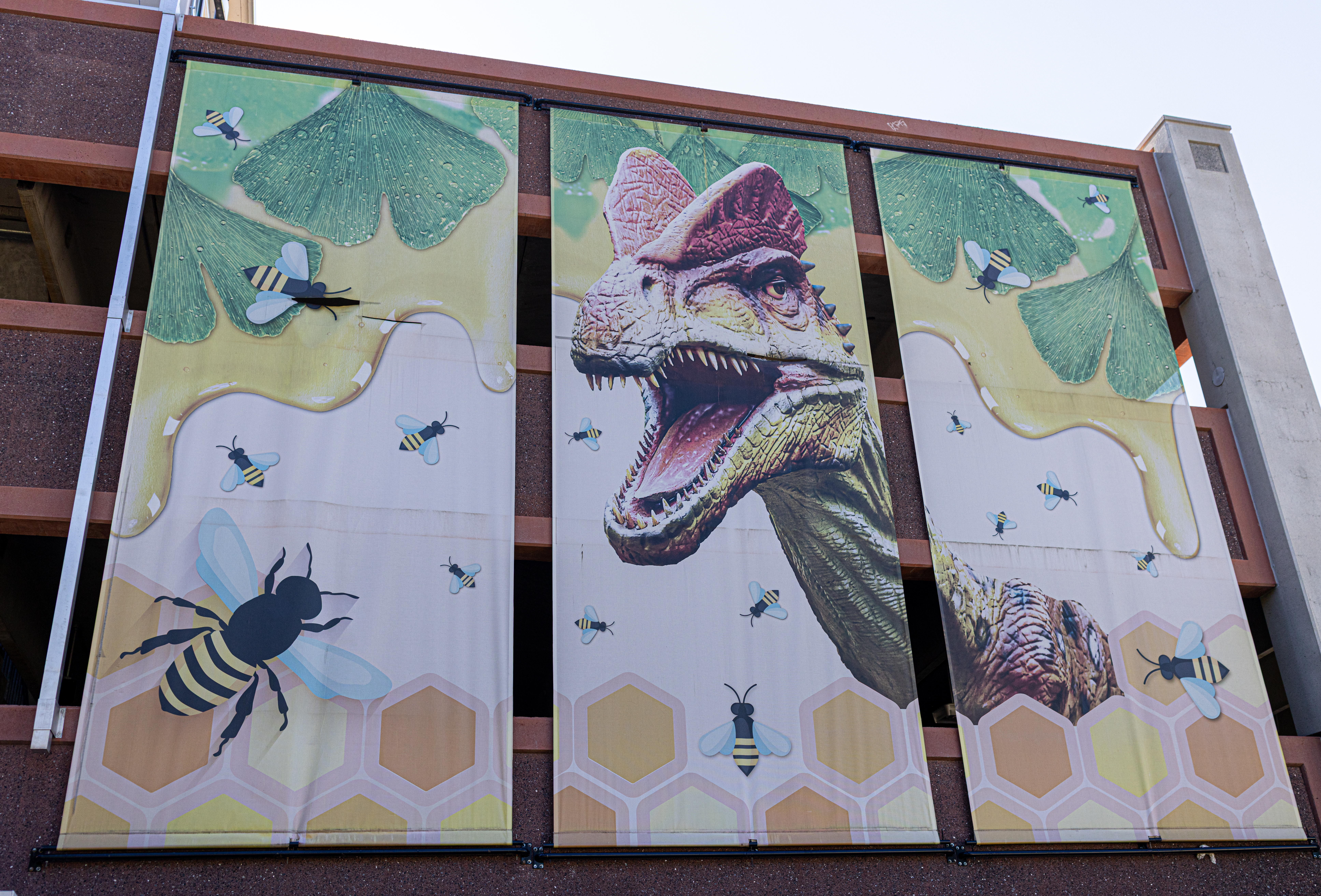
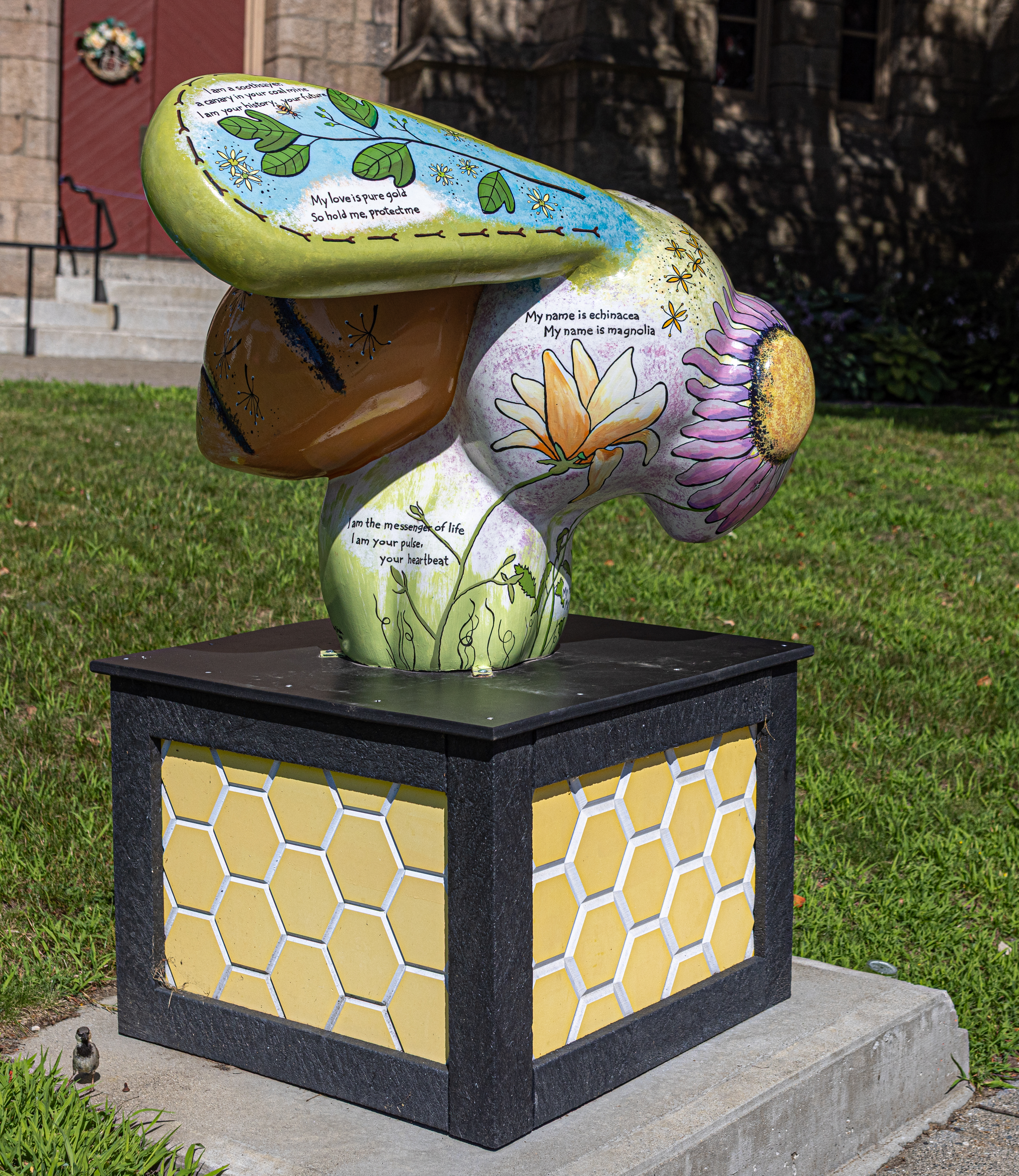
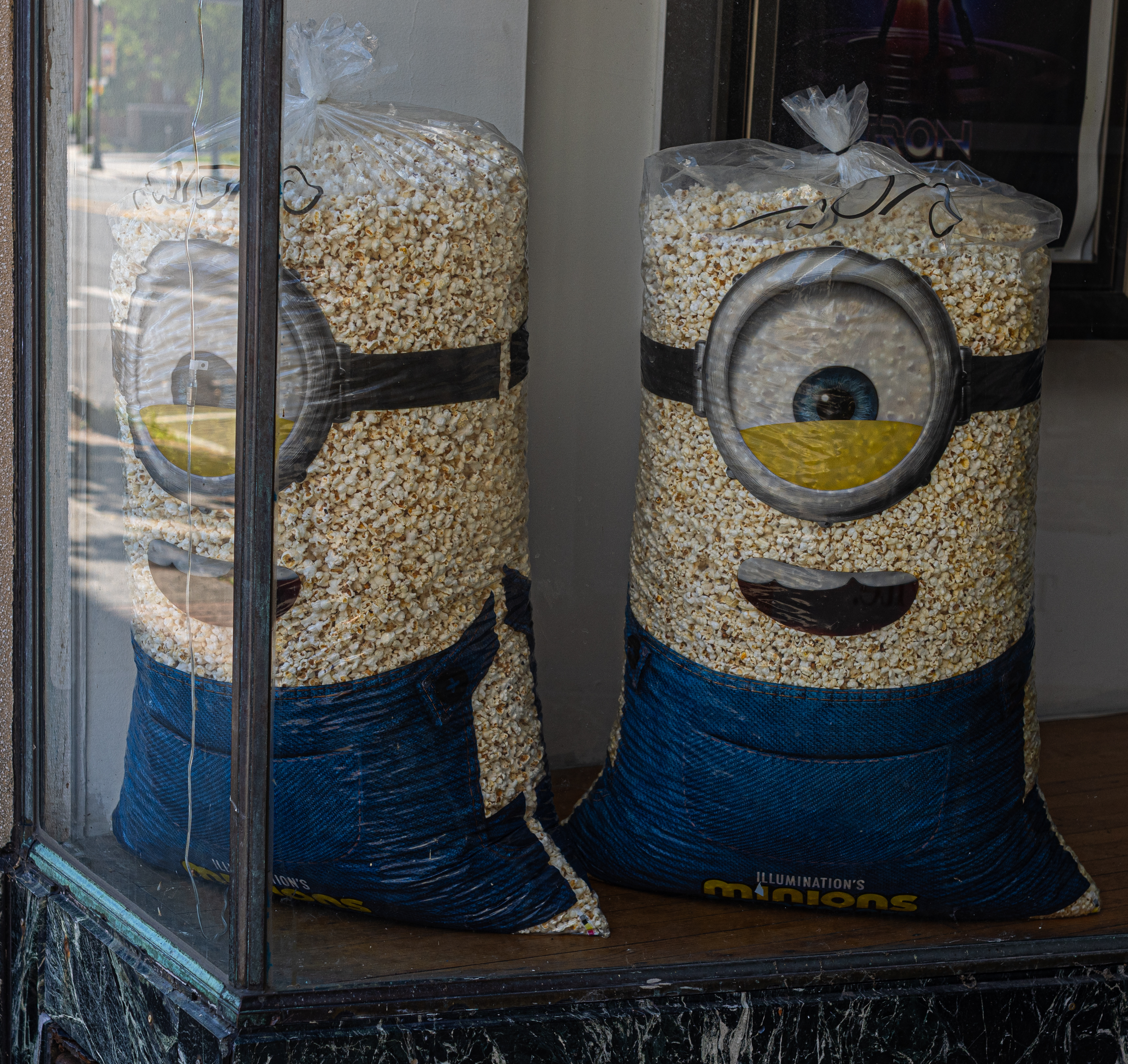
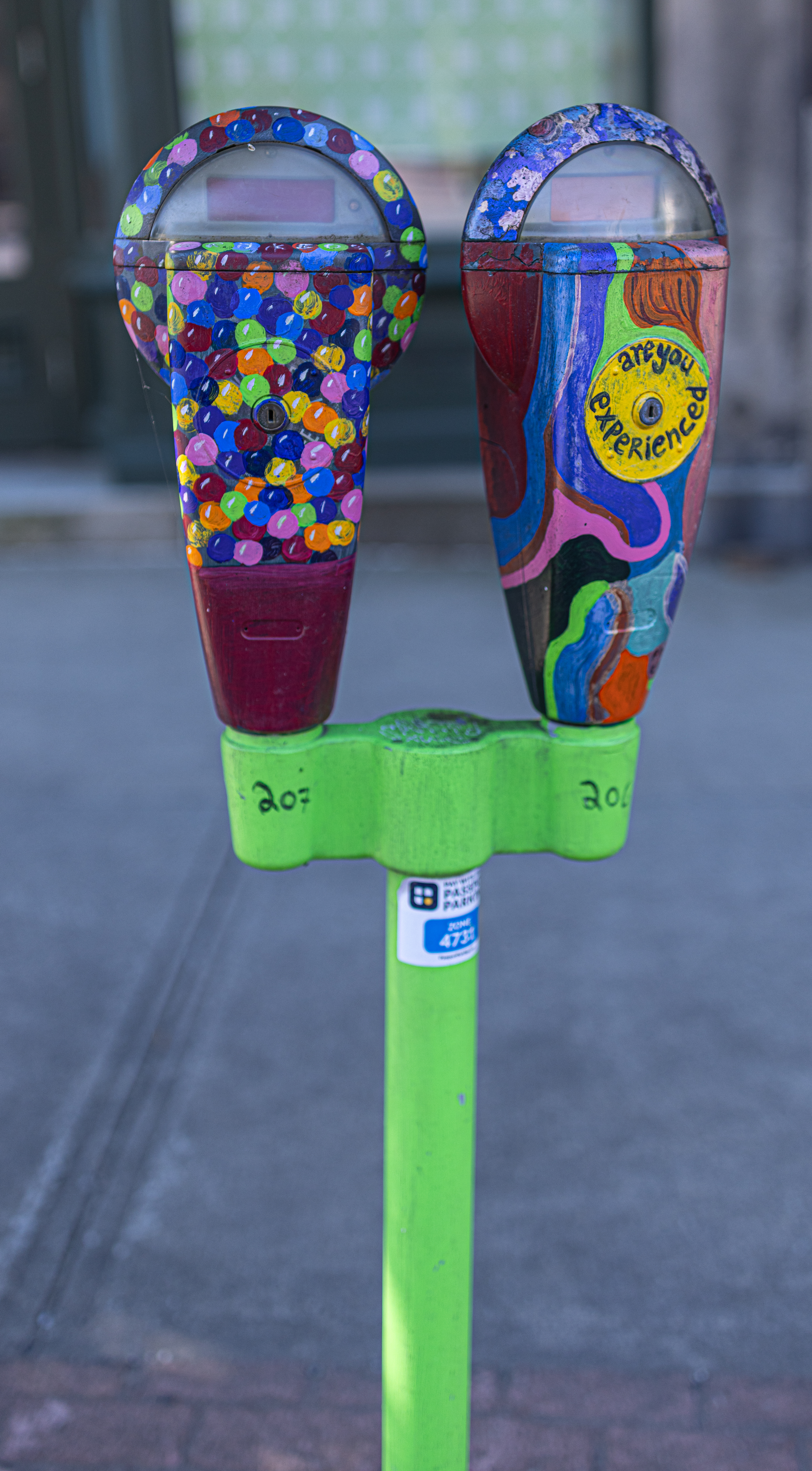
There were many other interesting and fun things to see and do in Greenfield. From industrial sized popcorn bags made to look like Minions to bees (which has a story that deserves their very own post), parking meters painted to look like cultural icons and other murals as well as a nod to dinosaurs, Greenfield has so many more interesting things to see! It’s definitely worth another visit.