Dates Of Event: June 1-3, 2018 (event usually takes place the first weekend in June)
Cost: Free
Parking: Street parking, which is limited during festivals, costs .75 an hour (4 hour limit) and there are several parking lots and garages. You can find more information about parking in Salem here.
Murals weren’t the only types of art on display at the Salem Arts Festival.
In addition to the amazing art on display and family friendly activities I highlighted in Part I of this series, there were several bands, dancers and other entertainers who set up on the stairs of the Old Town Hall on Front St.
All of the performers were very talented and entertaining (view the videos below to see for yourself)
All of the performers had some ties to New England, and in many cases the Salem area.
Liz Bills And The Change are from Haverhill, MA (about 40 minutes north of Salem), rocked the alley next tot he Coffee Brewhouse. Great presence and style.
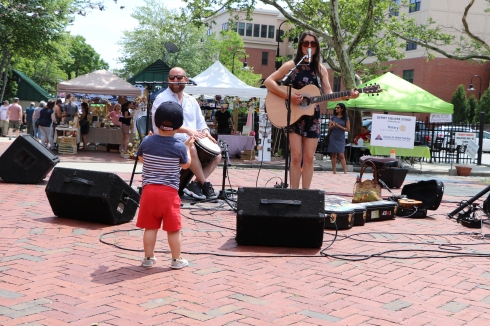
One of the things I really enjoyed about the performers was the variety of music and entertainment. In fact, I actually heard and enjoyed some music from bands that I never thought I would be into. One of those bands was the Boston-based Outrageous Fortune Trio Jug Band mixed jazz and blues in their repertoire. I particularly enjoyed their version of “Come Together.” He actually used the cane in the photo below as an instrument.
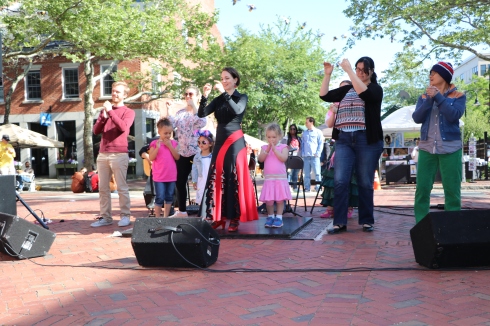
I also had a surprise encounter with a friend from my gym. Anthony (“Antonio”) plays the Flamenco guitar for Boston Flamenco. Anastasia and Anna Maria joined him in his performance.
At the end of their performance, Anastasia gave some of the visitors a lesson in Flamenco dancing.
The entertainment was not just limited to music, though. One of my favorite forms of entertainment was the dancing of the Salem YMCA Fly Kidz. These kids can dance!
And what would an arts festival in Salem be without a visit from Dark Follies?
Dark Follies incorporates stunts (a straitjacket escape artist), dancers and other magical entertainment into their acts.
If that was not enough, the Aerial Artistry of Baechtold & Abel (and their college understudy) took center stage on Front St. Their acrobatics were so graceful. But, what people may overlook is the strength these acrobats must have to be able to support their own and their partner’s body.
Speaking of Front St, there were “tiny dancers”, or more accurately a tiny stage with real life sized dancers performing.
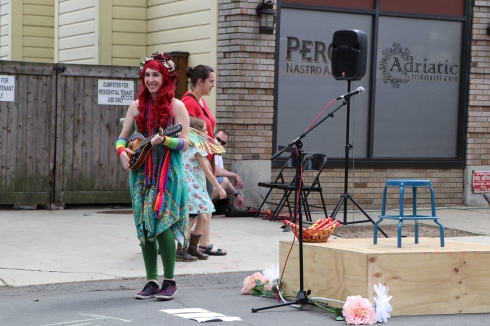
There were also fairies who blew bubbles, read stories and danced with the children (and a few adults).
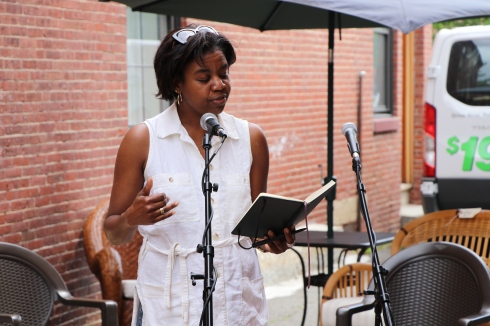
There was also a “Poets In The Round” poetry reading event.
The street performers who you might usually see only during the Halloween season also came out to partake in the festivities and take photos with their fans. Or, just take in the scenes with a, uh….friend. It was like Halloween in June!
Of course, what would an art festival be without dogs?
Rocko looked cool rocking his bee wings with his doting humans.
Igor (the Hairless dog) was one of the more unique dogs I have photographed. You may notice his two different colored eyes.
Below are some videos of the performers from the art festival. Sorry for the “shaky cam” in some of the videos, particularly those taken at the end of the day.
And, believe it or not, there is at least one more installment of photos from the art festival coming soon!
Dates Of Event: June 1-3, 2018 (event usually takes place the first weekend in June)
Cost: Free
Parking: Street parking, which is limited during festivals, costs .75 an hour (4 hour limit) and there are several parking lots and garages. You can find more information about parking in Salem here.
The 10th Annual Salem Arts festivals was the place to bee last weekend.
As part of their Bee To Brick awareness campaign, the festival posted colorful bees along Artist Row and Front St. The purpose of the campaign is to raise awareness of these pollinators as they are crucial to our ecosystem, and, in some areas, in danger of being depleted. So, the next time you see a black and yellow insect don’t swat it, just shoo it away!
The “bees” were made out of plastic bottles and other recyclable materials.
But, the bees were only one highlight of this event. The three day (I attended 2 of the days), was full of performers, arts and crafts and various family friendly events. The weather was picture perfect with sunny skies for all to enjoy (and I had the burn to prove it). In fact, there was so much to see and do, I am going to have to post about this festival in parts (probably 3 or 4 parts). In part I I will focus on some of the events on Artist’s Row.
I arrived early Saturday before all of the events started. In a matter of hours this path (Artist’s Row – a haven for the artistic and lovers of artistic expression) would be packed with performers, vendors and revelers.
Along Artist’s Row, there were lots of events for kids, adults and even dogs to enjoy. Kids could get wings (part of “bee to brick” theme), give a high five to, by far, the tallest attendee of the festival, Jasper, “King Of The Rag Dolls.” There were also tables were kids could make hats, draw in a Salem Coloring Book and even make a Happy Father’s day card.
There were also vendors set up along the row and on Front St. One of the vendors I met was the talented and friendly Joey, owner of Salem Pet Photography.
This won’t be the last time you see a photo of Joey in my series of blog posts for this festival.
There is so much to see and do in Salem. But, fear not, if you get lost on Artist’s Row there is a sign post to direct you in the correct direction.
The main attraction on Artist’s Row was the annual Mural Slam.
An artist or team of artists were given a photo to recreate as a mural. Just seeing the progression of the murals is amazing. It is incredible to see just how the recreations are just as good, if not better, than the original photographs. The deadline for the murals was 8 p.m.on Sunday and I could not stay that long. I took photos of the murals in their latest stages just before I left. I will have to go back at some point to view all of the finished murals. You can find more updated photos from the Mural Slam here.
Casey Stanberry, an architect from Cambridge (MA), was tasked with one of the hardest tasks; painting each street, intersection, building and other object from an overhead view of Salem. The painstaking project took him two full days to complete.
“Caw-Caw” was painted by Madison Economides.
“Day Dream” was painted by Amanda Beard Garcia and Mariah Leah
Bruce Orr, who has worked as an art therapist, art teacher, painter and illustrator, painted this work.
Mike Grimaldi worked on this mural
Boston based artist Sophy Tuttle painted this beetiful mural.
This mural was painted by the Salem Academy Slammers (students from the Salem Academy Charter School in Salem, MA)
Kate Holloway painted this mural
Dan Belisle, a self taught artist from the North Shore of MA, painted this mural.
This “community abstract painting” (visitors could add their own efforts to this work before the actual artist finished it up) called “Geometry” was painted by James Eric Rogers (with help from the community of course)
Liz Sullivan, who considers herself an “artist turned graffiti writer”, painted this mural.
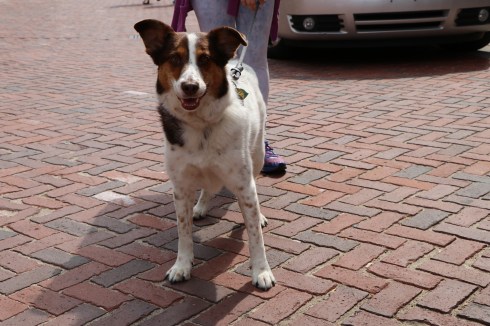
I also came across a four legged lover of the arts: Rosie, a 17 month old Terrier Hound mix.
Stay tuned for my Part II from the Salem Arts Festival which will include many of the performance artists on Front St. (and probably a few more dogs)!
Dates Of Event: June 1-3 (during Salem Arts Festival)
Location: Throughout Downtown Salem
Parking: Street parking, which is limited during festivals, costs .75 an hour (4 hour limit) and there are several parking lots and garages. You can find more information about parking in Salem here.
Handicapped Accessible: Yes
Dog Friendly: Yes
Highlights: A collection of figureheads displayed throughout downtown Salem
Tip(s): While most of the figureheads are located on Essex St, follow the red historical tour line throughout the city to find the remaining figureheads
In observation of the Salem Arts Festival, the Salem Historical Society decided to send out the ladies of Salem.
The Ladies Of Salem are a collection of figureheads constructed by a variety of artists.
While these figures have been displayed before (see related post above), when I did photograph these figureheads in the past there weren’t as many on display as theere were this past weekend. Some of them were missing (they had been destroyed or stolen off their mounted displays) and others looked a little roughed up. Besides I was in Salem to photograph the Arts Festivals (posts on this event soon). So, I thought I would photograph all of the figureheads in their current state. And, much to my delight, they all looked as though they may have been touched up a bit and the were all actually there. Since they were posted rather high on lamp posts, a ladder or cherry picker would have came in handy. But it was still fun photographing all of the figureheads. Plus, it gave me a chance to photograph some dogs along the way.
There appeared to be a few figureheads on display that either were not posted or I may have missed in my earlier visit in 2016. The tricky thing about looking for these figureheads is there wasn’t a map or website with the locations of the figureheads’ locations. This made it more difficult but also more fun.
The one tip I was given by the helpful workers at the tourism office is to follow the red line which represents the Salem Heritage Trail and includes many of the famous historical haunts in Salem. The trail is only about a mile or so and there are lots of fun and interesting things to see along the trail.
More than half of the 21 Ladies of Salem are displayed along the Essex Street Pedestrian Mall. The other figureheads may be found on Derby and Washington streets, as well as one that is posted at Old Town Hall.
The figureheads are put on display from time to time, especially for different events such as the arts festival or the maritime arts festival.
The artists were given a blank canvas on a 33-inch-tall-by-14-inch-wide and 14-inch-deep figurehead molded of a hard yet lightweight fibrous material. Before the mounting board is attached, the figureheads weigh only 7 pounds.
I wanted to take closeups of the figureheads’ faces to show off the details of them. I also like to think of them as being in deep thought, gazing off to the sea or some other distant place.
Most of the figureheads are dressed or painted to represent the sponsors of the figurehead. For instance, the figurehead that is sponsored by Essex’s N.Y. Pizza & Deli in the Salem Museum Place Mall (aka Witch City Mall), has a crown and “I Love Pizza” t-shirt on. You may also notice stickers of bees on the signs of the figureheads. The bees are part of the “bee proud” awareness promotion for pride month.
Figureheads on ships were said to have strong magical or religious significance. As you may notice from the photos below, women were largely used as the shapes of the figureheads. They were supposed to be used to appeal to the ocean gods and spirits and cause these spirits and gods to be stricken by their beauty, enabling the ships to proceed without any interference from these potential evil doers.
The Phoenicians are said to have been the first people to use figureheads, from around 2500 to 539 BC, when they adorned the prows of their oared galleys with wooden carvings that depicted animals, birds, dieties, and serpents.
The Egyptians and Chinese instituted the practice of painting eyes, known as Oculi, on the bows of their vessels, so that they may find their way across the oceans.
Catholic countries, such as Spain, used religious figureheads, such as Jesus Christ and the Virgin Mary, in the hopes that these figureheads would bring them safety and fortune in their voyages.
However, the “golden age” of figureheads is said to be between 1790 to about 1825. During this time frame many warships and merchant ships built in North America and England were decorated with these artful figureheads.
But, the figureheads I found were built much more recently.
The first figurehead I spotted is by the artist Shalimar.
This figurehead was made by the artist Demetrius Lacroix.
This figurehead, which I did not include in my earlier post about the Lady Of Salem figureheads, was sculpted by Alicia Irick Cohen. The figurehead does have some obvious wear and tear, unfortunately.
This figurehead was created by the YMCA/Girls Today Program.
The artist for this figurehead is Amberlynn Narvie.
Niko Papadimitriou is the artist for this figurehead.
This figurehead was created by Vonn Bittercup.
The artist for this figurehead is John Devine.
Kenneth Glover is the artist for this figurehead.
This blue faced beauty was created by Mr. Bleckley’s 5th grade student artists
Dori Phillips painted this figurehead.
This colorfully painted figurehead was made by Cynthia Mikula Smiszek.
Karen Lamesa and Tina Armstrong painted this figurehead.
Jeanne Pare-Kapnis painted this figurehead.
Sheila Billings made this figurehead.
The figurehead below was crafted by Jeanne Pare
The next figurehead was painted by Jill Pabich.
This figurehead was painted by Kerry May Killam.
Jeanne Pare-Kapnis painted this figurine that was located on Derby St.
Mary-Ellen Smiley painted this figurehead which was located in the Old Town Hall near the Essex Pedestrian Walkway.
I could not locate a sign with the name of the artist for this figurehead. Unlike most of the other figureheads, this one was located in a store on Essex St (Witch Tee;s)
Although not part of the Lady Of Salem display, there are additional figureheads in the Peabody Essex Museum, also on Essex St. You would have to pay an entrance fee to the museum to view them. But I have a photos of them below from my visit October 8 of last year.
Besides being the weekend of the arts festival, the weather was perfect for visitors and their dogs. There were lots of dogs enjoying the figureheads and the festival. Below are a few of the cute four legged visitors I met during my visit.
Brody is an adorable 10 year old mixed breed dog.
Don’t blink or you might miss Wink, a 13 year old Pomeranian and Brody’s sibling.
Aster, who is as handsome as the flower he is named after, is a Border Collie and Australian mix.
Luna is a 3 year old Chihuahua. He has very cute features.
I love Lance’s fur and and sweet nature. Lance is a 9 year old Standard Poodle.
Who doesn’t love Golden Retrievers? Not anyone I would want to know. Bowen, named after a wharf in Newport, Rhode Island, is a 3 month old Golden Retriever.
I am not sure how long the Ladies will be on display, although they may have all been taken down after the arts festival which ended Sunday (June 3). I am pretty sure you may see them again during the summer, specifically during the 30th Annual Salem Maritime Arts Festival August 4th and 5th of this year. It’s a pretty good bet you may see me there!
Also, keep an eye out for my photographs from the 10th Annual Salem Arts Festival from the first weekend of June which I will be posting in parts since there was so much to show you all!
But this scam does not involve some shady Nigerian Prince or a bug with your Windows operating system. No, this is an entirely different kind of scam.
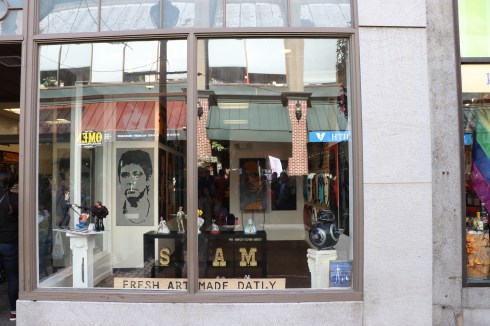
SCAM (The Salem Collective of Artists and Musicians) has a wide collection of unique art from artists in Salem and the neighboring areas. I wen there on a whim. It was a busy weekend in Salem just before Halloween. So, I thought I would duck out from the foot traffic and stop in, And, was I glad I did!
I originally visited SCAM in October, 2017. The decor did have a Halloween or spooky theme in some areas and an early Christmas themed work of art.
The entrance way to SCAM is a shared entrance with Witch Tees on the pedestrian walkway on Essex St. Go to the right at the entrance to enter the art museum.
The first floor has a variety of art, novelty items and some merchandise for purchase.
My favorite pieces are the vintage art of celebrities from the past such as the art work with Marlon Brando and Leonard Nimoy. Little known fact: Leonard Nimoy was born in nearby Boston, MA.
I also liked the height chart that corresponded with the height of other celebrities. I was Keanu Reeves! Who knew Lady Gaga was so tiny! I also like how they have Matt Damon’s “crouching height.”
Most of the art is on the second floor. There is a variety of unique art and innovative items on the second floor of SCAM.
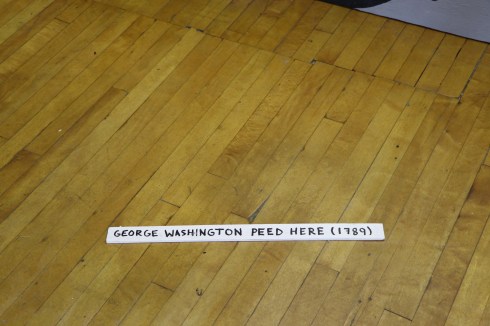
Watch out where you step when you go upstairs!
That is just one of them more offbeat pieces of art or entertainment at SCAM.
The works of art on the second floor of SCAM are very creative and impressive. Some of the art on display is for sale.
SCAM is not a very big art museum. You can easily go through the building and view all of the art in 20 minutes or so.
From the outside of the building was yet another innovative work of art!
SCAM changes up their decor and art from time to time. During a recent visit on February 10, I noticed there was a new set up in the front window. I love how they integrate action figures into different locations.
Below is a short video of the display at the front of SCAM.
Wed.-Mon.: Two museum highlights tours: B6: The Robert W. Wilson Building and Buildings 4, 5, and 7 at 2pm Summer Hours (begin June 2018)
10am—6pm Sundays—Wednesdays
10am—7pm Thursdays—Saturdays
Cost:
Admission
Adults $20
Seniors / Veterans $18
Students with ID $12
Kids (6–16) $8
EBT/WIC Cardholder $2
They also offer 2 day and 3 day admission tickets
Parking: There are four parking lots in the museum parking area
This pole with mirrors on it is just one of the unusual work of art on the grounds of the museum. This work of art is part of the Totally Totem exhibit by Marko Remec that was on the grounds of the museum in 2016. Marko attached ready-made objects such as mops, brooms, safety mirrors, and rear-view mirrors to utility poles, transforming them into contemporary totems.
It’s a bird. It’s a plane. Oh, never mind, it’s just a trailer on top of a bridge.
This work of art, part of a three part art piece titled, “All Utopias Fell”, was created by Michael Oatman. The trailer, called The Shining, is a 1970’s era Airstream mobile home that Oatman bought online from a dealer in Ohio.
The worst part of the exhibit for some may be the walk along some narrow steps inside a creepy boiler house, more on that later, and then a short jaunt along a bridge to the Airstream.
““The Library of the Sun”, the decorative interior of the Airstream is the second part of the exhibit. Decorations, prints as well as a variety of other vintage and novelty items line the walls and shelves of the trailer. Many of the items inside the Airstream are humorous relics of the past. A rotary phone, a sewing machine, a workbench, books held into place with leather safety belts and even a photo of Guy Lombardo and real jars of preserved food. are just a few of the vintage memorabilia inside the mobile home.
The third and final part of the exhibit is “Codex Solis” which is a a solar panel project that Oatman has worked to create with the museum for the past 3 years. The solar panels Every task light and video screen on the Airstream is powered by the solar panels according to Oatman. According to their website, roughly 25% of MASS MoCA’s energy is produced on-site through solar panels on these roofs
The views from the exhibit are stunning.
The work of art is inspired by vintage era pulp aeronauts such as Buck Rogers, Tom Swift, and Tom Corbett: Space Cadet, as well as the works of Giotto, Jules Verne, NASA, and Chris Marker’s 1962 film La Jetée. Slightly larger than my apartment, The Shining does seem like it could be a little cramped for most people.
These cans were strategically placed to form some artistic displays.
“All Those Vanished Engines” is an audio and visual exhibit by Stephen Vitiello. Inspired by a commissioned text by novelist Paul Park, the exhibit uses both sound and visual arts to entertain its viewers.
The Boiler House was commissioned by Sprague Electric Company in 1947. It was preserved by the museum as a relic of the great industrial age of carbon. There are three boiler hoppers, coal hoppers, steam fittings and ash disposal conveyors. Especially after viewing the solar panels on the roofs of some of the buildings, it is a reminder of how far we have come in our technology. I couldn’t help but think Freddy Krueger was lurking around one of the corners.
There are a lot of strange works of art on th emuseum grounds. I’m not sure what these are supposed to be.
Remind me to never bring my camera to MASS MoCA. There is so much more art to share from this museum. But, I may be taking a break from posting the art from this haven for art lovers.
I have some other interesting photos from places and events I have visited recently. So, I am taking a short break from my MASS MoCA posts. But, I will resume my MASS MoCA series after I post some photos of winter in New England!
Wed.-Mon.: Two museum highlights tours: B6: The Robert W. Wilson Building and Buildings 4, 5, and 7 at 2pm Summer Hours (begin June 2018)
10am—6pm Sundays—Wednesdays
10am—7pm Thursdays—Saturdays
Cost:
Admission
Adults $20
Seniors / Veterans $18
Students with ID $12
Kids (6–16) $8
EBT/WIC Cardholder $2
They also offer 2 day and 3 day admission tickets
Parking: There are four parking lots in the museum parking area
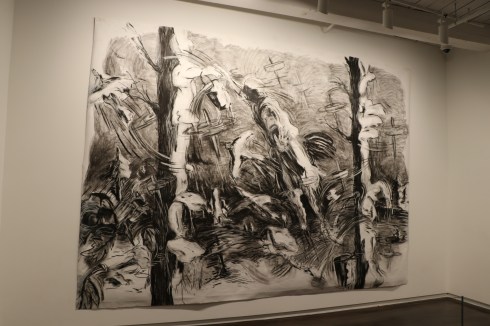
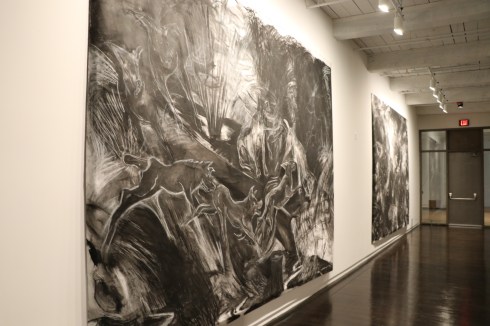
One of the featured artists at MASS MoCA is artist, musician, composer, film producer and entertainer Laurie Anderson. All of the art posted below was made by Laurie with charcoal. These drawings feature dog Lollabelle and visions of the Tibetan afterlife as her inspirations.
Many of the exhibits at MASS MoCA have a social, political or other type of message. This exhibit showcased some of the different aspects of the criminal justice system. The scanner like devices in the pink and blue lights had text that looked like police chatter on it. Along the walls are fingerprints taken from people who have been arrested and reports that have been blocked out.
The exhibit also included a collection of documents from prisoners in Guantanamo Bay and some of the other holding facilities overseas. Many of them, but not all were blacked out. Some were entirely blacked out. What struck me is how some things, like how an inmate injured himself or some other traumatic event, were explained so matter of fact.
This mural has the lyrics to the Graham Koxon song, “Fame And Fortune” in it.
Resist the temptation to sit on this bench created by Jenny Holzer.
Thank you for stopping by and checking out part IV of my blog post series on the art at MASS MoCA. Believe it or not, yes, there’s more. Part V of my series will include some of the outdoor art and some very interesting art from some unusual places at the museum. Stay tuned.
Wed.-Mon.: Two museum highlights tours: B6: The Robert W. Wilson Building and Buildings 4, 5, and 7 at 2pm Summer Hours (begin June 2018)
10am—6pm Sundays—Wednesdays
10am—7pm Thursdays—Saturdays
Cost:
Admission
Adults $20
Seniors / Veterans $18
Students with ID $12
Kids (6–16) $8
EBT/WIC Cardholder $2
They also offer 2 day and 3 day admission tickets
Parking: There are four parking lots in the museum parking area
As I mentioned in part I of my MASS MoCA post which can you find here, MASS MoCA has such a vast collection of art and creative works, you could spend an entire weekend there taking in all of the art in the various buildings. In fact, I had to make two trips myself to be able to see everything.
In the previous post, we saw some of the incredible works of Sol Levitt. But, there are many more creative exhibits at the museum. One of the more unique works in a display by Nick Cave.
Located in Building #5 at the museum, Nick Cave’s exhibit, “Until”, is, in part, a collection of 16,000 aluminum wind spinners hung from the ceiling. This exhibit is the creation of Chicago artist, Nick Cave (not to be confused with the singer by the same name). As you may see from the photos and videos below, the spinners seem to change colors and design as they spin. As you may notice in the photos and videos of the spinners, guns seem to play an integral role in the designs of the spinners. Spinning guns. Nothing good could come from that. I especially like looking at people’s expressions as they look at them.
For those who aren’t afraid of heights, in the midst of the various spinners are ladders that you can climb to look at another part of the exhibit. Statues, figurines and other types of decor are strewn on top of chandeliers.
The items on the chandeliers are meant to represent the days of the past.
Also part of Nick Cave’s exhibit, is a tent structure made of quilts. The quilts have some creative designs to them and they are sure to get the attention of curiosity seekers, both young and old.
Ad you walk through the hallways to all of the different exhibits , there are lots of art that can catch your eye.
This exhibit, also in Building Number 5, is called, “A Quake In Paradise (Labyrinth).” The maze-like exhibit includes a group of panels printed with the artist’s signature that layers mechanically reproduced imagery.
Believe it or not, there are many, many more exhibits and works of art I am going to showcase in future posts. Below, are two videos from Nick Cave’s “Until” exhibit. I took the first two videos. The last video posted is from the account of jay sarajevo.
Wed.-Mon.: Two museum highlights tours: B6: The Robert W. Wilson Building and Buildings 4, 5, and 7 at 2pm Summer Hours (begin June 2018)
10am—6pm Sundays—Wednesdays
10am—7pm Thursdays—Saturdays
Cost:
Admission
Adults $20
Seniors / Veterans $18
Students with ID $12
Kids (6–16) $8
EBT/WIC Cardholder $2
They also offer 2 day and 3 day admission tickets
Parking: There are four parking lots in the museum parking area
As I was looking through my photos from last year, I came across some photos I took at MASS MoCA last summer. Since there are so many photos of many different exhibits, I am planning on posting my photos in several parts. I hope you enjoy this trip through the many art works and creative exhibits at this very unique museum.
Once the site of a factory building complex, MASS MoCA (Massachusetts Museum of Contemporary Art) is now home to a variety of art from a variety of artists and styles.
Formerly the Arnold Print Building which operated there from 1860 to 1942 and the Sprague Electric Company, MASS MoCA consists of several buildings, some of which are connected by bridges and walk ways.
MASS MoCA has both permanent exhibits (or at least semi permanent exhibits) as well as many temporary exhibits.
Decorated walls are a constant theme at the museum. One of the permanent exhibits on display at the museum are these walls with stylized designs on them.
This work of art by Barbara Takenaga called Nebraska (2015)is composed of acrylic on digitally printed wallpaper. The wallpaper was translated from her handcrafted easel work. The 120 foot mural represents the open plain of Nebraska, Takenaga’s home state. The design is meant to represent the corn and stars that are evident on an evening in her home state. The work of art is meant to show the “blue hour” when the earth and sky begin to merge.
On the second floor of the museum, there are several walls with different designs painted on them.
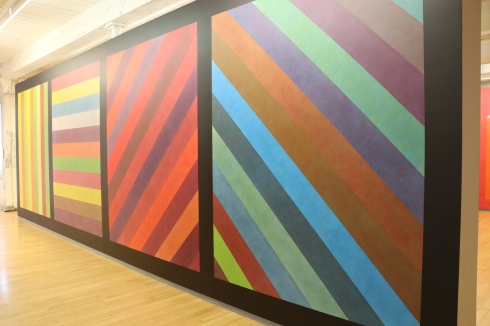
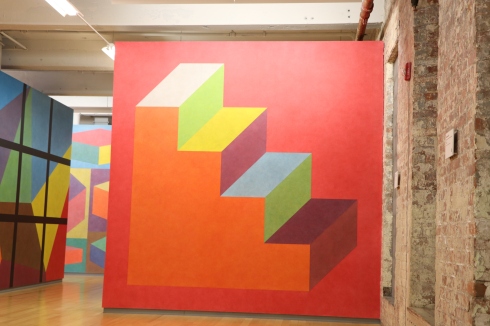
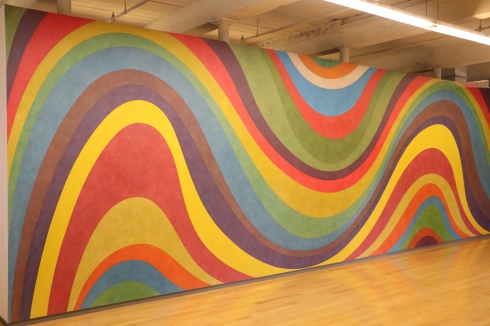
The following art is part of Sol Lewitt’s A Wall Drawing Retro-spective exhibit.
This exhibit comprises 105 of LeWitt’s large-scale wall drawings, spanning the artist’s career from 1969 to 2007. These works of art take up nearly an acre of specially built interior walls that have been installed, per LeWitt’s own specification. They span over three stories of a historic mill building situated at the heart of MASS MoCA’s campus. The 27,000-square-foot structure, known as Building #7, has been fully restored for the exhibition by Bruner/Cott & Associates architects.
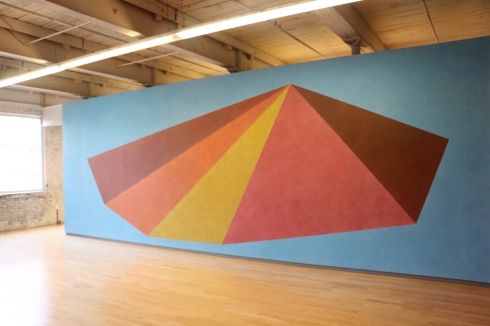
“Wall Drawing 439” – May, 1985, asymmetrical pyramid with color ink washes superimposed. Color ink wash.
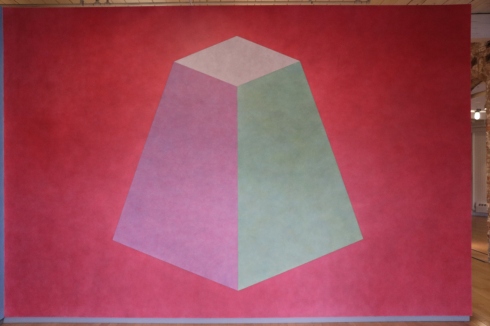
“Wall Drawing 527” – April, 1987, two flat-topped pyramids with color ink washes superimposed. Color ink wash.
From left to right: “Wall Drawing 583H” : rectangles with color ink washes superimposed. Each is bordered by a 10-inch band with color ink washes superimposed, a 1/2 inch white band and a 4 inch black band – color ink wash, December, 1988
Center: “Wall Drawing 584 H”: squares, divided horizontally and vertically into four equal parts. Within each part, color ink washes superimposed. The squares are bordered by a 1/2 inch white band and a 4 inch black band – color ink wash, January, 1989
Right: “Wall Drawing 583F”” rectangles, with color ink washes superimposed. Each is bordered by a 10 inch band with color ink washes superimposed, a 1/2 inch white band and a 4 inch black band – color ink wash, December, 1988
In the far right corner of this display by itself is “Wall Drawing 725” – On a blue wall, a black square within a white border. India ink, color ink wash, gouache. April, 1993.
“Wall Drawing 343 A-F”: On a black wall, nine geometric figures (including right triangle, cross, X) in squares. The backgrounds are filled in solid white.
December 1980
White crayon on black wall
“Wall Drawing 340”
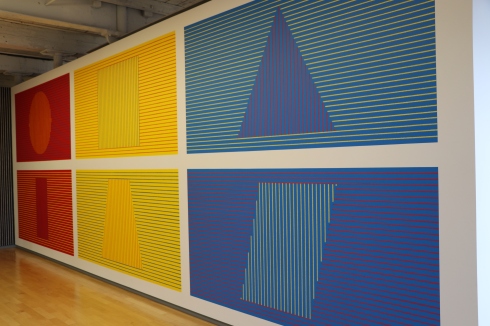
Six-part drawing. The wall is divided horizontally and vertically into six equal parts. 1st part: On red, blue horizontal parallel lines, and in the center, a circle within which are yellow vertical parallel lines; 2nd part: On yellow, red horizontal parallel lines, and in the center, a square within which are blue vertical parallel lines; 3rd part: On blue, yellow horizontal parallel lines, and in the center, a triangle within which are red vertical parallel lines; 4th part: On red, yellow horizontal parallel lines, and in the center, a rectangle within which are blue vertical parallel lines; 5th part: On yellow, blue horizontal parallel lines, and in the center, a trapezoid within which are red vertical parallel lines; 6th part: On blue, red horizontal parallel lines, and in the center, a parallelogram within which are yellow vertical parallel lines. The horizontal lines do not enter the figures.
July 1980
Red, yellow, blue crayon on red, yellow and blue wall
“Wall Drawing 335”:
On four black walls, white vertical parallel lines, and in the center of the walls, eight geometric figures (including cross, X) within which are white horizontal parallel lines. The vertical lines do not enter the figures.
May 1980
White crayon on black wall
I found myself mesmerized by these works of art. It seemed like the colors and shapes were busy, as if staring at some of them too long can give you a headache. Yet, I couldn’t stop looking at them. Some of them, especially the lines on the wall with the circles and rectangles on the grey wall seemed to change shapes and direction based on which direction you looked at it from.
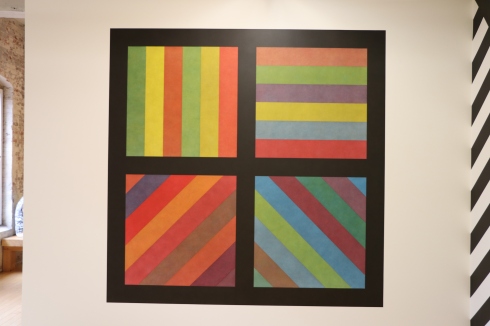
“Wall Drawing 681C”: a wall divided vertically into four equal squares separated and bordered by black bands. Within each square bands in one of four bands in one of four directions each with color ink superimposed. Color ink wash, August, 1993
“Wall Drawing 414”
Drawing Series IV (A) with India ink washes. (24 Drawings.)
March 1984
India ink wash
“Wall Drawing 391”
Two-part drawing. The two walls are each divided horizontally and vertically into four equal parts. First wall: 12-inch (30 cm) bands of lines in four directions, one direction in each part, drawn in black India ink. Second wall: Same, but with four colors drawn in India ink and color ink washes.
April 1983
India ink and color ink wash
I especially liked how the walls were displayed throughout the room. The aisles between the walls made for good photo opportunities.
Across from “Wall Drawing 414” was the color version of the same work of art
“Wall Drawing 413”
Drawing Series IV (A) with color ink washes. (24 drawings.)
March 1984
Color ink wash
“Wall Drawing 692”
Continuous forms with color ink washes superimposed.
October 1991
Color ink wash
“Wall Drawing 610”
Isometric figure with color ink washes superimposed.
June 1989
Color ink wash
“Wall Drawing 422”
The room (or wall) is divided vertically into fifteen parts. All one-, two-, three-, and four-part combinations of four colors, using color ink washes.
November 1984
Color ink wash
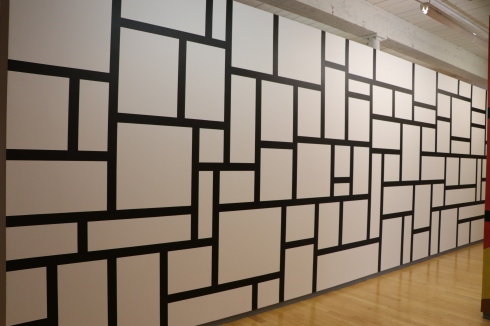
“Wall Drawing 614”
Rectangles formed by 3-inch (8 cm) wide India ink bands, meeting at right angles.
July 1989
India ink
“Wall Drawing 684A”
Squares bordered and divided horizontally and vertically into four equal squares, each with bands in one of four directions.
June 1999
Color ink wash
“Wall Drawing 630” & “Wall Drawing 631”
“Wall Drawing 630”
A wall is divided horizontally into two equal parts. Top: alternating horizontal black and white 8-inch (20 cm) bands. Bottom: alternating vertical black and white 8-inch (20 cm) bands.
January 1990
India ink
“Wall Drawing 631”
A wall is divided into two equal parts by a line drawn from corner to corner. Left: alternating diagonal black and white 8-inch (20 cm) bands from the lower left. Right: alternating diagonal black and white 8-inch (20 cm) bands from the upper right.
January 1990
India ink
“Wall Drawing 766”
Twenty-one isometric cubes of varying sizes, each with color ink washes superimposed.
September 1994
Color ink wash
“Wall Drawing 415D”
Double Drawing. Right: Isometric Figure (Cube) with progressively darker graduations of gray on each of three planes; Left: Isometric figure with red, yellow, and blue superimposed progressively on each of the three planes. The background is gray.
March 1993
Color ink wash
“Wall Drawing 522D” (to the right in the photo)
Tilted forms with color ink washes superimposed.
December 1987
Color ink wash
“Wall Drawing 793B”
Irregular wavy color bands.
January 1996
Color ink wash
“Wall Drawing 792”
Black rectangles and squares.
June 1995
Dispersion paint
“Wall Drawing 579”
Three concentric arches. The outside one is blue; the middle red; and the inside one is yellow.
November 1988
Color ink wash
“Wall Drawing 766”
Twenty-one isometric cubes of varying sizes, each with color ink washes superimposed.
September 1994
Color ink wash
“Wall Drawing 386”
Stars with three, four, five, six, seven, eight, and nine points, drawn with a light tone India ink wash inside, an India ink wash outside, separated by a 6-inch (15 cm) white band.
January 1983
India ink wash
Based on the museum’s website, there appears to be many more walls with Lewitt’s work on them in the building, many of which seem to have been added since my visit.
Cosmic Latte is an exhibit designed by famed artist Seymour Finch. The 350 lights are meant to represent a constellation. The name Cosmic Latte refers to the official name given to the color of our universe. A 2009 study of the light emitted by 200,000 galaxies proved the light of our universe is more of a beige color than the blue color it is usually described. The spacing of the fixtures is meant to model the atomic of powdered pigments that Finch used to emulate the specific Cosmic Latte color. He used the following colors to achieve this Cosmic Latte hue: titanium white, Mars Yellow, chrome yellow and cadium red.
The fixtures are arranged in a similar pattern to that of the Milky Way as it is observed in the Northern Hemisphere in March. The undulating swathe of the lights relates to the nearby Hoosic River which is visible through the windows.
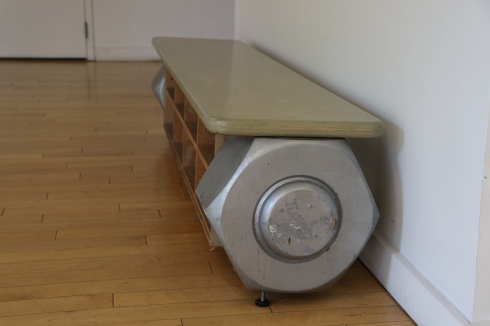
Art is everywhere at MASS MoCA. These benches with cubby hole storage were located just outside of Kidland, where the Cavernous display was located.
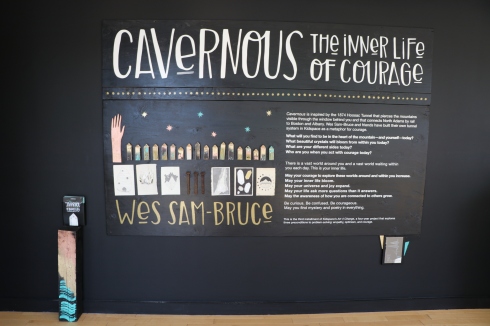
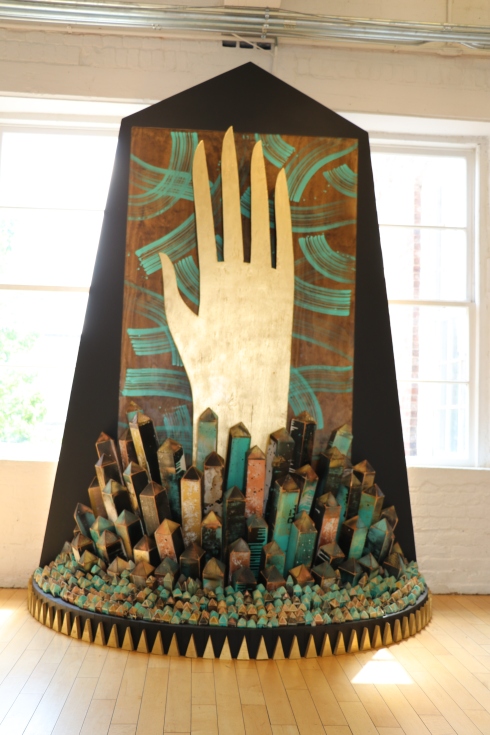
During my visit, there was a special, temporary exhibit on display for children. Inspired by the Hoosac Tunnel which, in 1974, was built to be part of a rail system that connects Albany NY to Boston, MA, Cavernous: The Inner Life of Courage is an interactive work of art in which visitors can walk inside and play inside. The exhibit is meant to teach visitors what it takes to be courageous and persevere in the face of mountain-sized obstacles. Visitors are invited to play in a tunnel-like structure built specifically for the museum. Designs and words are written on the floors and walls. There are also cushioned seating for children to sit on inside the work of art. Good luck getting the kiddies to leave!
Children and other visitors were encouraged to leave little notes in the cavern.
The tunnel system that was built was meant to be a metaphor for courage.
This exhibit was part of the Kidspace area of the museum.
This is part one of a multiple series post. I am not sure how many posts will be involved in the MASS MoCA serries. But, stayed tuned for more creative works of art!
Below are some videos of the work involved in creating some of the art at MASS MoCA
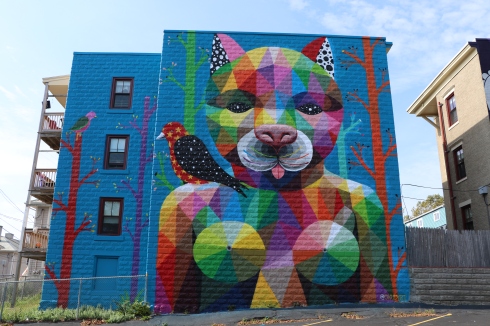
some of these murals are in residential areas or painted on apartment complexes
Sometimes poor judgment can lead to good outcomes. Such was the case when I decided, against my better judgment, to visit Salem, MA (the Halloween headquarter of America) on a Saturday afternoon in October. Parking was sparse (all of the main parking lots and parking spaces were taken or full). But, because I had to park farther away from the downtown area, we spotted another hidden treasure in the city.
These murals were found on Congress St
But, most of the murals are located on Harbor St and Ward St.
These murals were all located along a wall on Harbor St. Some of them were so well done they actually looked like photographs.
As these murals show, Salem is so much more than scary monsters and witchcraft lore.
So, the next time you’re in Salem, don’t just spend your time looking for ghosts and goblins, make sure to stop by and take a look at these works of art!
Highlights: Art displays, shops, restaurant, holiday displays
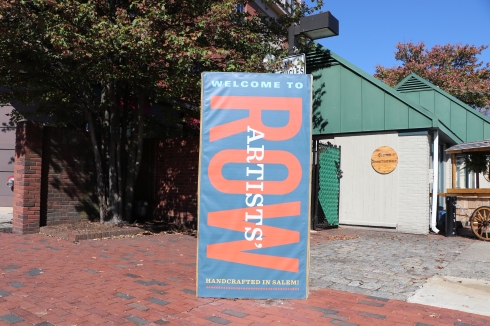
A haven for artists, art lovers or just people looking for unique works of art, Atists’ Row is another area which showcases the art and creativity of Salem.
I photographed Artists’ Row during my many excursions to Salem during the month of October.
As the name suggests, art is evident throughout the row.
From time to time, Artist Row has different art on display throughout the alley. This particular art display was on exhibit during my visits. The lettering and images bumped out so you can feel the images even if you couldn’t see them. I especially like the references to Salem that are portrayed throughout the work of art.
Art is abundant along the Row.
You can not only view art on Artists’ Row. You can create you own art as well.Artists of all ages and backgrounds have the chance to create their own or just sit and enjoy the art around them. The tables with the plants growing out off them are one of the favorites of the visitors at Arrtists’ Row.
These rocks with words and quotes painted on them are piled on the side of the row for anyone in need of some inspiration.
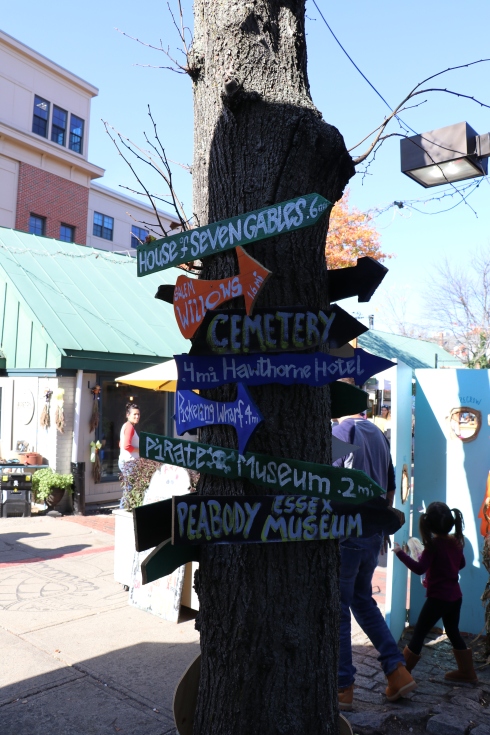
These helpful signs show you which direction to go if you are lost.
The shops along the row offer a variety of handmade crafts and other creative works of art.
The shops on Artists Row have to sign leases each year and, due to the weather conditions, some of the shops are not open year round. So it is possible that some of the shops listed below may not be there when you visit.
Grace & Diggs has a variety of handmade, items all made by the owner Linda. Many of the goods there have a very Halloween in Salem theme.
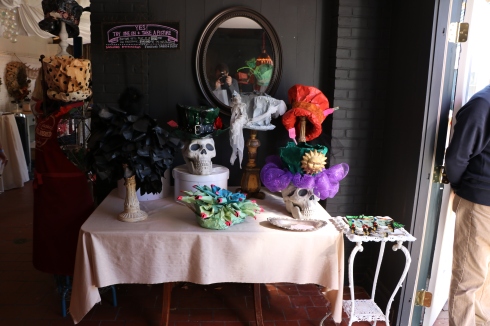
There is also a stand with hats on them that you can take a selfie with and post on Facebook (don’t forget to hashtag Grace&Diggs when you post the photo)!
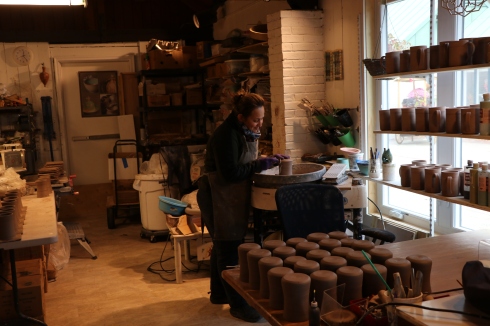
Ceramics By Sibel also has a variety of arts and crafts, all hand made by Sibel. Many of her works are made using clay. On her website, Sibel says she is “made of clay. It is in my DNA.” When she is not operating her business, Sibel sells her art at fairs and other markets (she is only by appointment only in Nov and Dec and her business is closed after Dec until May)
Sibel was busy working on a new piece of art during my visit.
Boston Woodturning is another shop on the row. Boston Woodturning creates crafts out of wood at their shop. They also held a fun event in October in which they helped create and design little ghosts and scarecrows out of recycled materials for the children who stopped by their store.
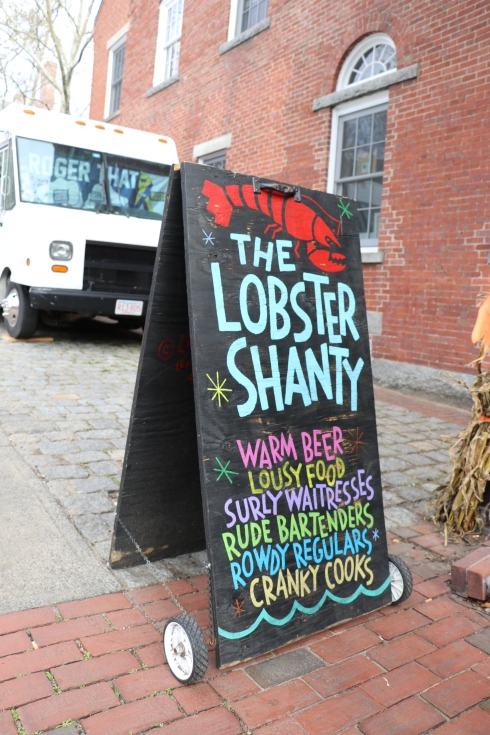
The one mainstay throughout the year is the Lobster Shanty.
Sounds like my kind of place!
Now that the huge crowds of the Halloween season have long since dispersed and the area is tastefully decorated for the holiday season, it may be a great time to visit Artists’ Row.
Dogs like to walk among the art on Artist’ Row. Must be because of all of the trees there.
Bernie is a 10 year old Rat Terrier. His mom said he thinks he is the “Mayor Of Salem”. Take that, Kim Driscoil!
Hugo is a 9 year old Great Pyrenees. You can follow him on Instagram at hugoofsalem











































 New England Nomad