Category Archives: statues

Grieving Gold Star Mother Statue (Manchester, NH)


dsc_0873

Date Visited: August 7, 2016

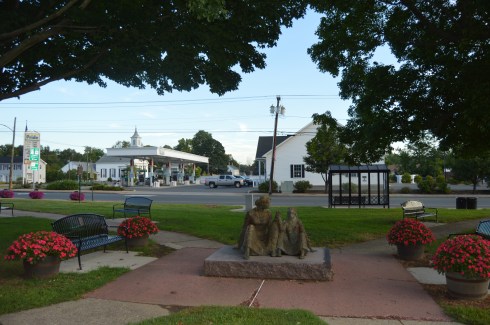
Location: Charles R. Stanton Plaza, in front of the JD’s Tavern and Radisson hotel, 700 Elm St # 1, Manchester, NH

Hours:  Open daily, 24 hours a day

Cost: Free

Parking: You can usually find metered off street parking

Dog Friendly: Yes

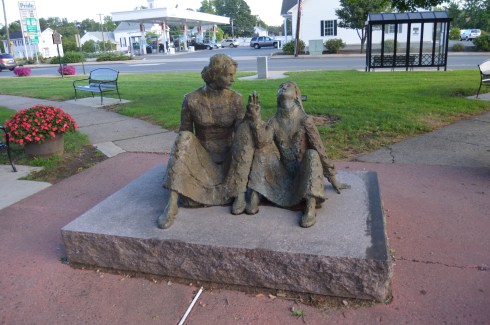
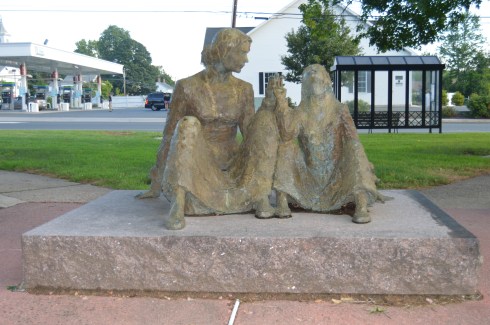
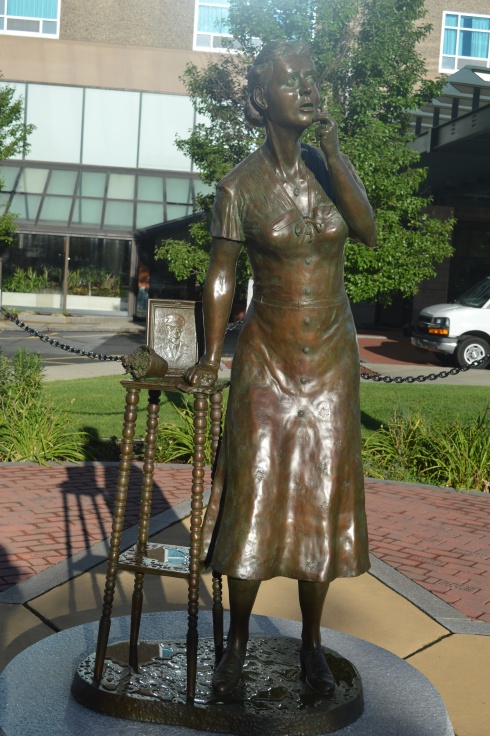
I found this statue to be timely considering some of the discourse these days. The Grieving Gold Star Mother statue located, appropriately, across the street from the Veterans Memorial Park at Charles R. Stanton Plaza in front of the Radisson and JD’s Tavern at 700 Elm St, Manchester, NH, is a tribute to all mothers and families who have lost a loved one at war.

The Grieving Gold Star Mother shows the teary eyed mom clutching a telegram, presumably with the notice of her son’s death. A potted planted lies knocked over in front of a photo of her son.

The 407 pound bronze statue, sculpted by Andrew Chernak, was said to depict a mother from World War II because that is the war that had the most fatalities. However, the Gold Star Mothers group was formed by Grace Darling Seibold during World War I when her son, George Vaughn Seibold, was lost (his body was never identified). In an effort to console herself and other mothers who had lost a child during the war, Grace created the group. The group not only consoled each grieving mother. They also dedicated themselves to doing community service and visiting wounded service members.

There are two Grieving Gold Star Mother statues in the U.S. The first Grieving Gold Star Mother statue is located in Carmel, New York. There is also a Gold Star Mother and a Gold Star Father memorial with statues of each Gold Star parent in Clinton, Ohio.

Bricks with the names of all of the wars the United States have been involved in (Colonial and post Colonial times) have been placed in front of the statue. The list of conflicts and wars and the loss of lives involved in those actions are staggering.

The memorial in New Hampshire was erected in April 15, 2011.


The Nature of Glass: Contemporary Sculpture at Chesterwood 2016 (Stockbridge, MA)

Date Visited: July 16, 2016

Location: Chesterwood, 4 Williamsville Rd, Stockbridge, MA (413)298-3579

Hours: Open Saturday of Memorial Day Weekend to the Monday of Columbus Day Weekend. May 28 – October 10 of this year from 10am to 5pm daily. Self-guided tours only. Residence closed daily from 12:30pm – 2:00pm

Cost: Adults, $18.00; Seniors, $17.00; Grounds ONLY fee, $10.00; NTHP Members, Military & Children, 13-17, $9.00; Friends of Chesterwood & Children Under 13, Free

Parking: There is ample parking in the various parking areas for at least a couple hundred cars

Time To Allot For Visit: 1 hour to 2 hours (less if you don’t appreciate art)

Dog Friendly: No

Highlights: lots of art, statues, scenic trails

Nature Of Glass: Contemporary Sculpture
DSC_0496

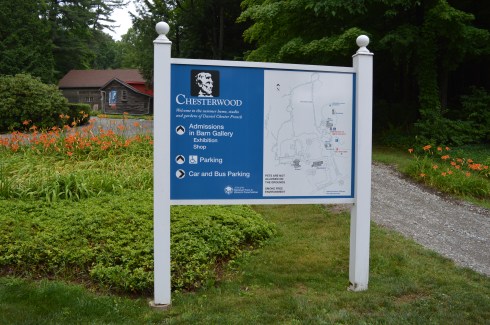
Named after one of America’s foremost sculptor, Chesterwood is home to  the works of Daniel Chester French.  French’s work can be found on multiple continents.  His most prominent works include designing the Abraham Lincoln and the Minute Man statue in Concord, MA among many other works of art.

In addition to statues and replicas of French’s work, Chesterwood also shows off exhibits on its spacious grounds.  The latest exhibit, on display until September 18, is a bit of a break from the traditional pieces of French.  The Nature Of Glass shows a variety of unusual works of art for the entire family.

This blown gas display called Optic Lens Installation (2016) is by Richard Royal.  Part of the Optic lens series, this art evolved from his fascination with water or being near water as well as lighthouses and the Fresnel lens.  On the description plaque for this design, Royal said safety and security are recurring themes.  he finds glass and light as instruments of safety to be inspiring and he finds the system of glass and light to be metaphor for simple concepts and a reminder that basic things in life are sometimes the most important and have the strongest impact.

Throughout the exhibition, I found the artists to have a such depth and insight into what may seem to be simple displays.  This is a recurring theme throughout the displays.  It does make sense that the artists would have a deeper meaning to their work.  One does not put so much time and effort into a work of art without having some deep significance to their work and inspiration.

This sculpture by John Kiley is called Clear Cut (2016).  Kiley made this 8 foot sculpture out of glass, steel and Douglas fir.  According to the information on the sign next to the display, Kiley described his work as using circular openings to show interior divisions of space to alter their sense of space and light.  Depending on your point of view, the overlapping circles can focus your attention in different ways.  The Douglas fir is meant to connect the ground through a natural material to the sky using material engineered by humans, evoking a sense of history, place and reflection.

Martin Blank created Crystal Reveil (2012) from hot sculpted glass. The segments of the sculpture are curled and hollow so you can look through the sculpture and see a different form of negative space. The individual forms are very delicate and skin-like, similar to the madrone tree which is prevalent in the pacific Northwest.

Depending on where you stand and the time of day that you view Time Of Day – Blue Moment (2016), by Richard Jolley, looks different.  As you can see by the photos above, you see different things from each angle.  The work of art is of a veiled form of a human figure that changes color at specific times of the day.  The passage of light through the small portal will shift the light transmission and wash the figure in a blue light referencing daily time sequencing and change.  The intent, according to Jolley is to not only mark a specific, finite time of day but also to address the significance of the passage of time and awareness.  He went on to say how it addresses in a deeper sense time and the effect it has on every aspect of our existence.

I did photograph Time of Day again later in the day after viewing the other sculptures about an hour later to see any changes in the work.  Unfortunately, it was an overcast and misty day.  So, since there was a lack of light, the changes in the art work were very minor.  The photos are shown below

One In One (2014) by Thomas Scoon is a cast glass and granite sculpture.  Just short of 5 feet (57 inches to be exact), the figures are meant to show people rising from the external landscape.  He tried to choose rocks that evoked the feeling and gesture of human forms, specifically torsos and heads.  The layering of kiln-cast glass and stone allows light to pass through the figures and embodies the spiritual and physical essence of human nature into the sculpture.  He felt the combination of the materials expresses both the fragility and the enduring qualities and humanity.

Scoon continued with his granite and glass theme with Companion Series I-IV (2016).  Similar to the One In One sculpture,this work shows human figures made of cast glass and granite.  I suppose he didn’t want his other sculpture to feel lonely.

Earth/Sky (2016) by Tom Patti is one of the more unusual works at the exhibit.  Patti wanted to show the ambiguous condition between the literal and the phenomenal.  Patti felt the unique quality of the reflection combines the transparency of glass in his design.  This combination results in an ambiguous sense of space that obscures any references to the physical solidity of the materials, revealing the natural essence of the environment.

This work of art, like many more in the exhibit, was not as provocative because of the lack of light on the day of my visit.  If the sun had been out the shadows would have played off the work of art more dramatically.

One of the more unique works of art, Remember What (2016) by Marko Remec is 128 thirty two inch dome acrylic mirrors.  Also made of aluminum, steel hardware and twine, Remec’s work is described as a “chess pattern gone awry.”  The mirrors reflect 180 degrees of Chesterwood.  The work is a reconfiguration of the installation Can’t Hear You that had been displayed at MASS MoCA in North Adams, MA.

Another piece of work that would have benefited from sunlight, Vitro Muralis (2016) by William Carlson is made of granite, metal and glass.  The sculpture shares a common area of overlap.  The edges have a visual noise as they collide into shared space.  The transparent components are meant to offer a language of design as a text of spiral repetition and marks that are more musical than linguistic, according to Carlson.

Another design by William Carlson, Sine Nomine (Without A Name) (2014) is another sculpture made of metal and glass. The “x” in the middle of the sculpture is meant to reference missing identity.  It has also been used as a mark for those who cannot sign their name or in equations in algebra as an unknown in the equation.  Other interpretations include a reference to something that has been eliminated from a list.  The historical use of the x also makes it a powerful graphic symbol universally understood.  The exact meaning is not made clear in the plaque next to the sculpture.

Icebergs and Paraphernalia 117 (2007) was inspired by traveling through the Polar Regions, specifically a small stranded iceberg off the shore of Greenland that looked like a bird.  Created by Peter Bremers, the work of art is made of kiln-formed glass cut and polished and outdoor glass.  The almost marble structure pays tribute to the marble sculptures of the French.

Also made of kiln-formed glass cut and polished and outdoor glass, Movement II (2007) depicts a window moving forward.  The concept of the work is that we perceive “reality” as a dynamic image that changes in time and as a result of the viewer’s change in perception as well as how we rewrite history as our understanding of the past transforms the present and vice versa.

Daniel Clayman’s North 41.47 West 71.70 Copper (2016) may just look like an ordinary rock but there’s much more to this boulder.  The name coincides with the GPS coordinates where the boulder was found.  Copper refers to the interior treatment of the piece.  While on a jobsite excavation, Clayman observed large boulders being carted away to make room for a new landscape design. Clayman was struck with the idea of reformatting an ordinary boulder into a magical object.   When the sun is out, the sun reflects off the copper boulder making it a highly detailed surface (I had to use a flash to gain the same effect).

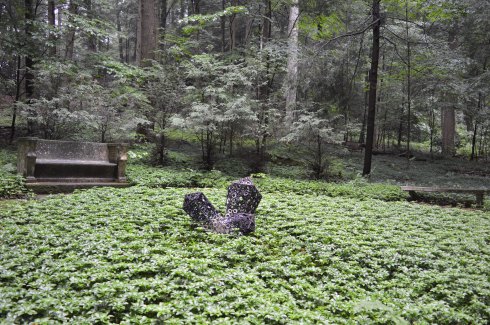
Julia’s Garden (the pieces range from 2010 to 2016) includes pieces from Nancy Callan’s Orbs And Winkle’s signature series.  The design consists of geometric forms (spheres and cones).  Callan strived to create a sense of infinity complexity with lines that wrap and fold around the shapes.  Each orb is like a world in itself.  The shapes of the orbs are said to represent planets.  The cones are meant to be like stocking caps – a reference to Rip Van Winkle – which gave the name Winkle to the pieces.  The cones also add a vertical element that echoes the growth of plants and trees – straight towards the sun as in White Spiral Cone or gently unfurling as in Ivory Winkle.
DSC_0474

Trigonal  (2016) by Kait Rhoads was inspired by a trip Rhoads took to  the Joshua Tree National Park in California after her the mother’s death.  Rhoads was struck by the beauty in the contrast of the quartz seams running through the fields of granite rock in the landscape.  Her search for healing and cleansing within a natural habitat largely untouched by man drew her to create the work of art.  She placed the color of the desert sky onto the form of the quartz crystal in a wash of opaque white ranging to intense transparent blue.

There is another work of art that I somehow missed.  Sidney Hutter’s Louie’s Electric Two (1976, revised in 2016) is sandblasted mirror glass design.

Dogs are not allowed at Chesterwood.  But, I did find this friendly cat.

Connect with me on Facebook to view photos, videos and other posts not included in this blog

New England Nomad


American Legion Park (Feeding Hills, MA)

Date Visited: July 3, 2016

Location: 478 Springfield St, Feeding Hills (Agawam), MA

Hours: Open everyday, 24 hours a day

Cost: Free

Time To Allot For Visit: 5-10 minutes

Parking: While there is no designated parking area for the park there is plenty of parking available at the American Legion Post located behind the park and parking is available at the strip mall across the street

Dog Friendly: Yes

Highlights: sculpture, tank, memorial, well manicured grounds

DSC_1000

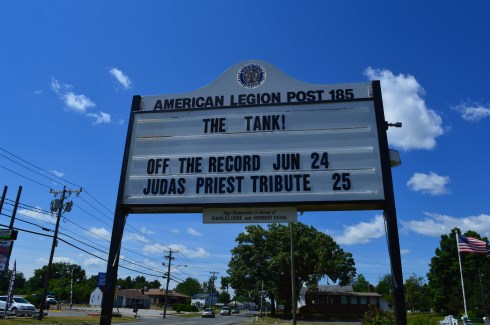
I don’t know about you but I’m really stoked to see that Judas Priest cover band.

But the real attraction on Springfield St in Feeding Hills (a territory in Agawam, MA), is the tank and Freedom Eagle sculpture located in front of “The Tank” American Legion Post 185.  The Tank is an eatery/event venue servicing veterans.

DSC_1023

DSC_1028The tank is a M-60 tank monument dedicated to all veterans (past, present and future)

DSC_1009

This slideshow requires JavaScript.

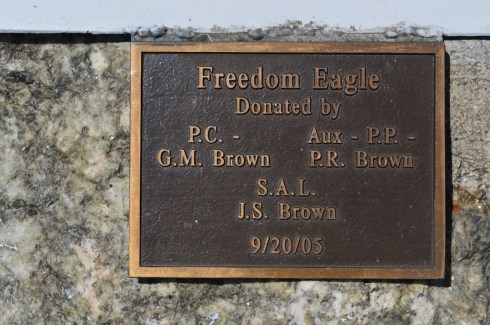
Donated in 2005, the Freedom Eagle shows an eagle soaring through the air, fish clutched tightly in his or her grip

DSC_0994

This slideshow requires JavaScript.

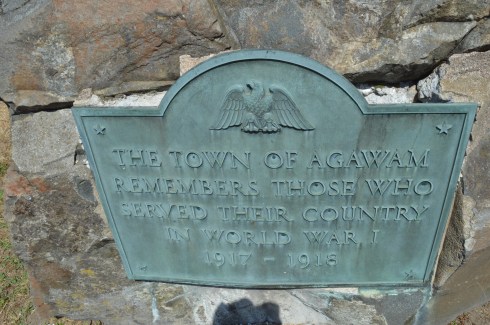
There is also a memorial from the town of Agawam in remembrance of the people who served during World War I.

DSC_1032DSC_1031

Although it is a small park there is a lot to take in and it certainly makes you proud and grateful.

The area is also a common spot for dog walkers.  Across the street, we saw a group of four big dogs being walked.  This is a group of Bernese Mountain Dogs.  The dogs go to the local senior center and  visit Alzheimer’s patients as therapy dogs.

DSC_0019

From left to right: Roma, Tony and Lena (one of the other dogs was a bit camera shy).

DSC_0032

Please connect with me on Facebook to view photos, videos and other posts not included in this blog: New England Nomad


Battery Park (Burlington, VT)

Date Visited: May 13, 2016

Location: 1 North Ave, Burlington, VT

Open: 365 days a year, 24 hours

Cost: Free

Parking:  Off street parking when it is available

DSC_0702

Located along a busy stretch of roadway in Burlington, Vermont, Battery Park may be best known for its place in the history of American warfare.

Battery Park was named for the artillery stationed there by American forces during the War Of 1812.  On August 13, 1813, American gunners at that location, aided by the naval ship the USS President, successfully defended their position against an attack by a British squadron led by Lt Colonel John Murray.

Since then, the park, which was established in 1870, has taken on a more artistic and more peaceful ambiance.

Statues, memorials and other works of art are scattered along the sidewalk and grass off North Avenue.

DSC_0739DSC_0747DSC_0752

This statue was made by the renown sculpture Peter Wolf Toth.  Toth specializes in sculptures of Native American people.  He has sculpted dozens of statues and has one statue in each of the 50 states in the U.S. as well as in other countries.  This statue above is a monument to Gray Lock’s War veteran chief Gray Lock.  The statue, carved of wood, was dedicated June 22, 1984.

At first glance, this tree may seem rather nondescript, just a tree in a sea of other trees.  But, this is no ordinary tree.  his tree was planted in memory of the September 11 terorist attacks.

Another monument at Battery Park is dedicated to Worker’s Memorial Day (April 28th) which has been designated by the AFL-CIO to remember those who have suffered and died on the job and to renew the fight for safe jobs.

There are also these unique structures which I still haven’t figured out.

Lake Champlain provides the perfect the backdrop to the park.

DSC_0732DSC_0731DSC_0725


The monuments and statues do not end there.  In the background of the park you can see what have been described “winged monkeys” (from the Wizard Of Oz film).  To really get good photographs of these figures you have to be closer to Champlain College.  The figures are actually on top of some of the buildings in the area of the school’s campus.  But, you can see the distinct figures of some of the characters.  Specifically, it looks like the witch’s guards to me.  I didn’t have the time or energy at that point to (I started traveling and photographing at 7 and it was close to 6 on this day when I photographed Battery Park).  But, it’s also fun trying to see the hidden statues.

DSC_0719DSC_0718DSC_0722

Rudyard Kipling is said to have noted that Battery Park has one of the two finest sunsets in the world.  As the photos demonstrate, I was unfortunately not able to photograph the sunset this particular evening due to the rain and clouds.

In addition to these statues and monuments, there is a statue dedicated to American Civil War General William W. Wells and other local luminaries.

There is also a playground area at the end of the park with swings and slides.

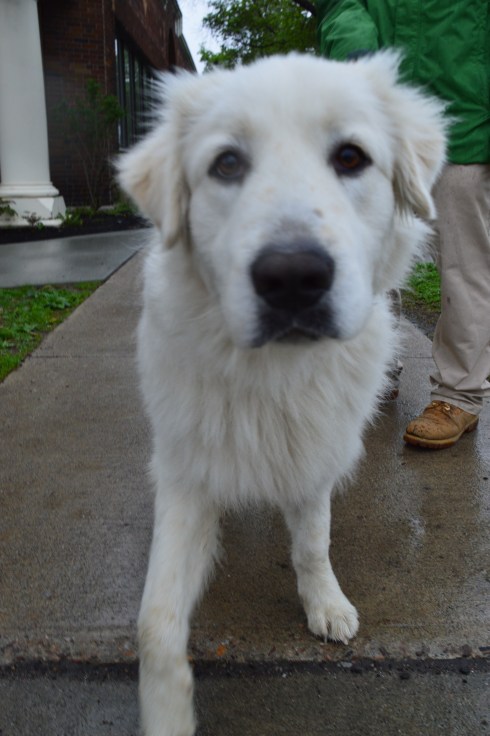
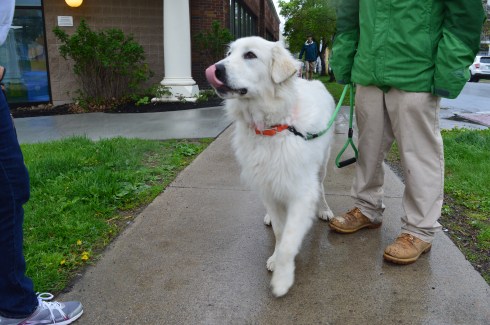
Dogs love Battery Park too.  Gus, a 2 and a half year old, Great Pyranese

DSC_0699DSC_0698

Please stop by and like my Facebook page! New England Nomad


Wilcox Park (Westerly, RI)

Date Visited: April 30, 2016

Location: 44 Broad St, Westerly, RI

Cost: Free

Hours: Open from dawn to 9 p.m., 365 days a year

Parking:  There is not a designated parking lot for Wilcox Park.  But, you should be able to find off street parking.

DSC_0226

Wilcox Park is not your average park.  In fact,  it is unique in many different ways.  One thing that makes Wilcox Park unique is that it is not part of the DCR or any other city or governmental body.  Wilcox Park is privately operated by the Westerly Public Library’s Board of Trustees.  The library, located on the grounds of the park, and a group of volunteers help keep the grounds clean and orderly.  They rely on donations and fundraisers.

Westerly Library is attached to the park at the entrance.  The library’s beautiful architecture of the building is both artful yet modest.  It complements the beauty of the park and seems right in place.  There are also benches for visitors to unwind and perhaps read a book from the library’s collection.

There are also a number of statues in the grounds of the library.


As you entered the park, one of the first statues you will see is the statue of Christopher Columbus sculpted by Ciriaco (or “Charles” as he was commonly known as) Pizzano in 1949.  Originally from Avellino, Italy, Pizzano was living in Medford, Massachusetts, when he decided to sculpt this statue, appropriately, out of Westerly granite.

DSC_0230DSC_0239DSC_0238


The inscription reads:


CRISTOFORO COLOMBO
INTREPID ITALIAN EXPLORER
WHO LINKED THE OLD WORLD OF
OUR FATHERS TO THE NEW WORLD
OF OUR SONS

On the back of the pedestal:

DEDICATED
BY
THE CITIZENS
OF
WESTERLY AND PAWCATUCK
A.D. 1949

Somewhere Leif Erikson is rolling around in his grave.

Down the staircase from the entrance to the park is a fountain (which was not running when I went to visit due to the still cold temperatures).  The Wilcox Memorial Fountain was designed by John Francis Paramino in 1898 and was dedicated in honor of Harriet and Stephen Wilcox who had donated the land for the park.

There are a variety of beautiful trees, plants, bridges and statues at Wilcox Park.

This slideshow requires JavaScript.

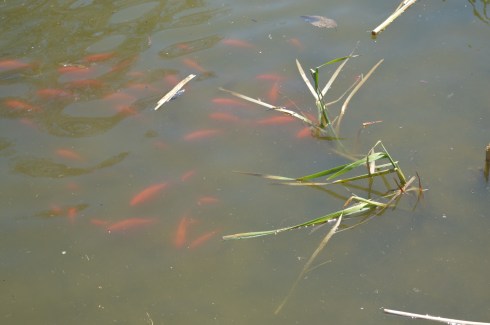
There is also a pond along the trails at Wilcox Park.  It is populated with Koi fish

DSC_0323

ducks

DSC_0303DSC_0296

There’s room for two on this thing, right?

DSC_0310

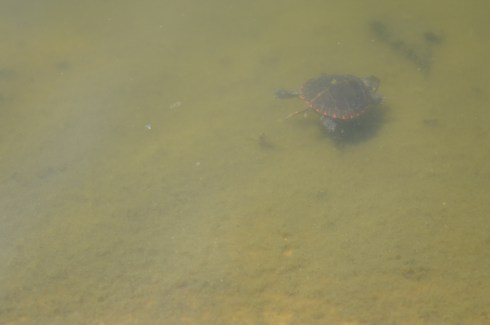
and baby turtles.  I couldn’t find his mommy but I am sure she was nearby.

DSC_0411DSC_0410

and rabbits

The bronze Runaway Bunny statue was dedicated in 1998 by Connecticut sculptor Joan Binney Ross.  it is based on the book of the same name by Margaret Wise Brown.  Unfortunately, the bunny has been the target of vandalism, predictably.  But, it has been restored after each attack.  Cameras are now installed liberally around the park to deter vandalism or catch the vandals.

This fella just wanted to play with the ducks

DSC_0404DSC_0405

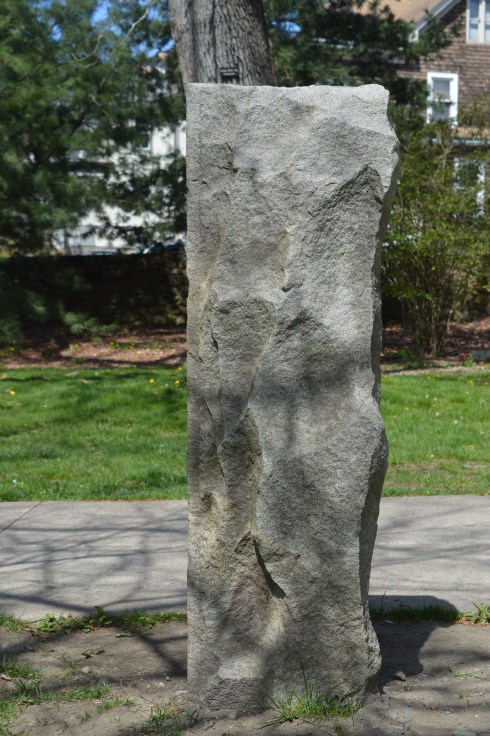
This sculpture sort of looked like a face to me.  A very ugly face.

DSC_0388

Dogs are allowed at Wilcox Park.  Bandit, a Siberian Husky, had fun playing in the park.  Apparently, Bandit earned his nickname because he “takes things”.  What a beautiful dog.  He caught my eye because of his handsome markings and his very cute smile. You can tell he’s a “bandit” based on his playful grin.

DSC_0352DSC_0353


Hartley Mason Reservation & York Harbor Beach (York, ME)

Date Visited: April 23, 2016

Location: 480 York Street, York, Maine

Hours: Always Open

Parking: 2 hour off street parking is available, but limited.  There are also a few parking areas near the beach.


DSC_0170

A common destination for weddings, dog walkers and beach goers, the Hartley Mason Reservation is a small park with benches, memorials and other works of art.  Perhaps the most popular attraction to this site is the rock with the tiny figures, titled, “Pleasure Ground”.  The sculpture was made by Sumner Winebaum, a York resident, in 2011.  He titled it “Pleasure Ground” because Mason had described the reserve as a “pleasure ground”.  The sculpture is built on a rock nearly 8 feet long, 4 feet wide, and weighs three tons,.  The bronze figures range in height from 10 to 12 inches tall. Winebaum said his goal was to show people enjoying the park such as the two boys wrestling, the person reading and the two women debating (which he has described as his favorite part of the sculpture).

Tiny people doing all the things regular people do.  I wonder what book that tiny figure on the edge of the rock is reading.  Perhaps, “Little Women”.

An easy, clearly marked path leads down to the beach.

DSC_0197

Along the trail, there are also benches dedicated to people who have passed.


There is also a memorial dedicated to those lost at sea.  The York Fisherman’s Memorial is

DSC_0215

DSC_0213

The inscription on the front reads: O HEAR US WHEN WE CRY TO THEE FOR THOSE IN PERIL ON THE SEA.  

On the back of the monument, there is an inscription that states: Dedicated to those who lost their lives at sea & for those who work and love the ocean… 

The memorial is dedicated to Captain Daniel A. Donnell who died at sea hauling traps.  He was 78 at the time of his death.

The trail is also a great place to take photos of the beach from afar.

From the moment I pulled up to the parking in front of the Hartley Mason Reservation, the view of the water struck me, especially with the weather conditions as they were.  A misty cloud covering filled the afternoon sky reaching all the way to the water making it hard to discern where the water ended and the sky began.  For most people, this is hardly ideal beach weather.  But, I, and my sensitive Irish screen, have always preferred this weather to the scorching unabated sunlight.

The trail eventually leads to the beach (there are also side trails, or if you’re feeling spry you can just walk down the rocky or grassy areas off the trail).  Due to time constraints, we just stopped at the beach head and took photos from there.  There were some modest waves and some pretty views. The beach does have a lot of rocky areas that wouldn’t be very comfortable to walk around in on sandals.  Wear comfortable footwear.

This slideshow requires JavaScript.

Although the beach area is much larger and may have more accommodations (I will visit again later to capture the beach in its entirety), the section I visited had very little room for lying out.  There really was just rock and a concrete slab to stand, sit or lie on.  The parking is also pretty sparse at this section of the beach.  There are only a few parking spots and some are designated for certain people.  There is also an outdoor pool near the beach.

DSC_0268

The beach was very busy with not only human visitors but cute furry ones as well (I suppose some of the human visitors were furry as well but that is neither here nor there).

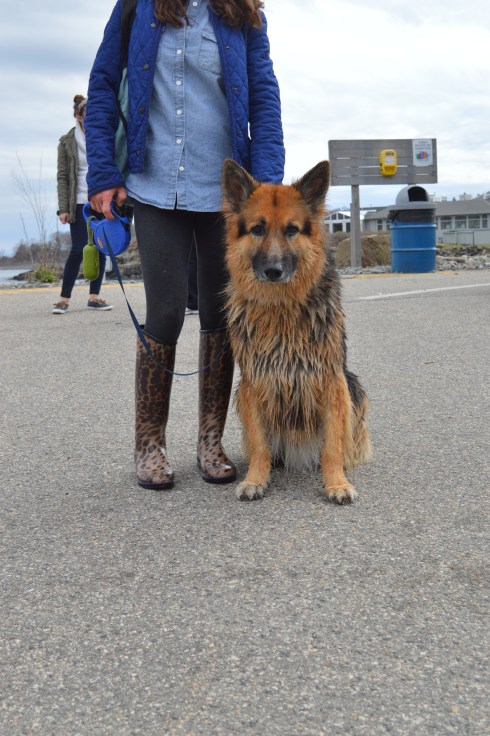
Kipper is a 9 year old German Shepherd.  He got to play in the water and he loves to play catch.  And his mom’s boots were pretty cool.

DSC_0266DSC_0264

Gracie is a 7 and a half year old Boxer with a very broad smile.

DSC_0229DSC_0239DSC_0240

Below is a video of the waves at York Beach Saturday.

Please stop by and like my Facebook page for extra photos and videos:

New England Nomad


Burnside Fountain (Worcester, MA)

Date Visited: March 19, 2016

Location: next to Worcester Common, 455 Main St.

DSC_0856

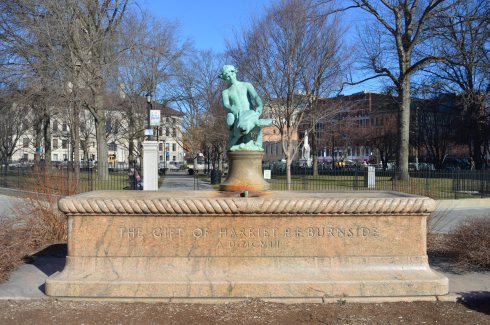
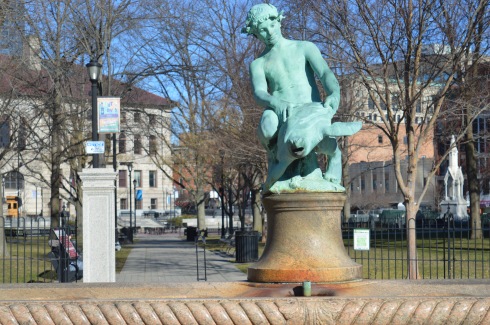
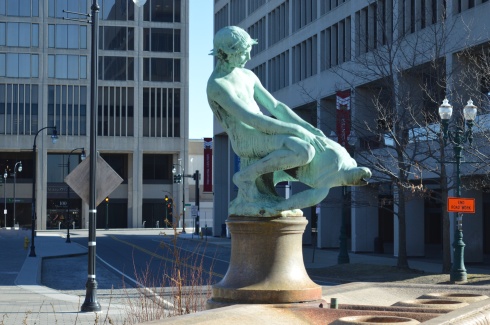
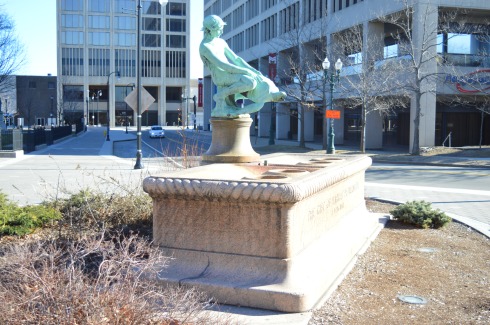
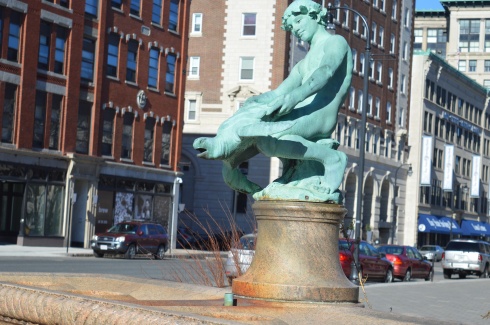
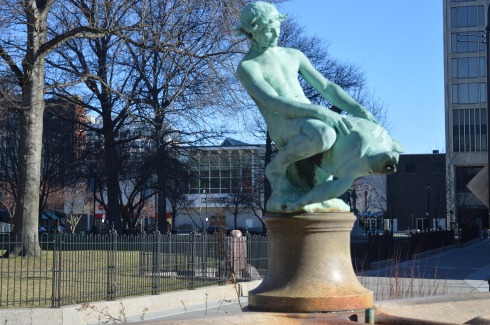
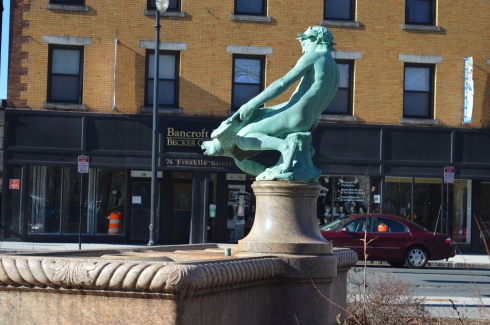
Just outside of Worcester Common, at 455 Main St, sits an unusual monument.  Also known as “Turtle Boy”, the Burnside Fountain looks like a cross between a Roman sculpture and a high school prank gone wrong.  But, this statue is no prank.  It is a very real monument.  In fact, it is a gift from Harriet Burnside,  a philanthropist and the daughter of a prominent lawyer in Worcester; Samuel Burnside.  In her will, Harriet donated $5,000 to the city to build a fountain in memory of her father.  Harriet Burnside specifically requested the fountain be used as a drinking trough for horses and dogs.

Enter Charles Y. Harvey. Harvey was given the task of designing the fountain.  For some reason that is still unknown, he chose a design called “boy with turtle”.  Henry Bacon, who also worked on the Lincoln Memorial, designed the basin.

In an interesting turn of events, Harvey would take his own life, claiming before doing so that the half finished sculpture was telling him to do so.  Sherry Frye finished the sculpture.  The statue was completed in 1912.

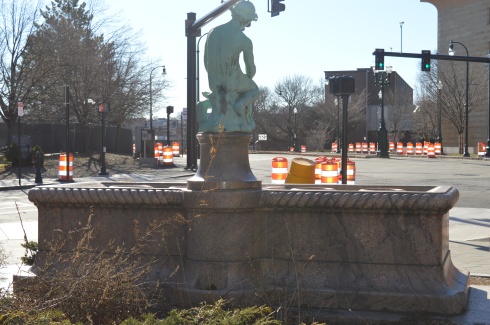
The bronze statue sits on a pink rectangular basin.   The basin has four bowls, two on each side of the statue.

Despite the various interpretations, the statue is not meant to be as controversial.  It was just meant to be a statue about a boy and his turtle.  It was a simpler time.

DSC_0854DSC_0860DSC_0857DSC_0862DSC_0861DSC_0863DSC_0865DSC_0871

Connect with me on Facebook here


Bronstein Park (Manchester, NH)

Date Visited: February 27, 2016

Location: Beech St, Manchester, New Hampshire (with access points on Union, St, Amherst St and Hanover St)

Cost: Free to the public

DSC_0710

Although a statue that is dedicated to the veterans of the Spanish American War, the Boxer Rebellion and the Phillipine-American War, Bronstein Park celebrates a hero from another war.

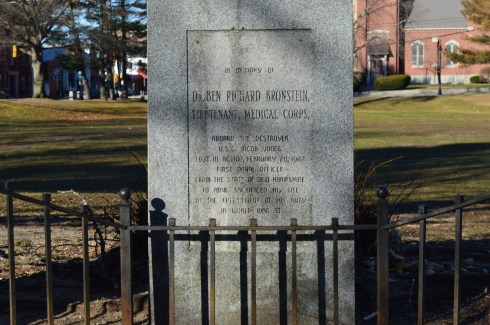
Although “The Hiker” stands prominently at the street entrance to the park, Bronstein Park (formerly known as Hanover Square) is actually named after a corpsman who died in World War II; Dr. Ben Richard Bronstein, the first Manchester, New Hampshire, resident to die during the war.  Dr Bronstein’s brother, Maurice Bronstein, donated the memorial to the park in 1990.

DSC_0734DSC_0731

The inscription on the memorial is hard to read in some parts.  It states:

“in memory of
Dr. BEN RICHARD BRONSTEIN,
LIEUTENANT, MEDICAL CORPS,
aboard the destroyer
U.S.S. Jacob Jones
Lost in Action, February 28, 1942
First Naval Officer
From the State of New Hampshire
To have Sacrificed his life
in the fulfillment of his duty
in World War II.

Another memorial pays tribute to Dr. Bronstein’s brother, Stephen Max Bronstein, who also served during the war.

DSC_0723

“The Hiker” was originally sculpted by Theo Alice Ruggles Kitson in 1906.  The original statue was made for the University of Minnesota.  However, 50 copies were made of her statue and were distributed all over America.  Manchester, New Hampshire was the recipient of one of the copies of her statue.  The statue is made of bronze on a base of granite, of course.

The name “hiker” was a moniker the American soldiers in the Spanish American War and Philippine-American War gave themselves because of the long hikes they took in the jungle.  Kitson said the hiker, “depicts a hero stripped of his parade uniform and shown as a soldier reacting to the challenges of the battlefield.”

Leonard Sefing, Jr., a Spanish-American War veteran, was the model for the statue.

A close inspection of the statue shows a weary soldier clad in civilian type apparel.

DSC_0709

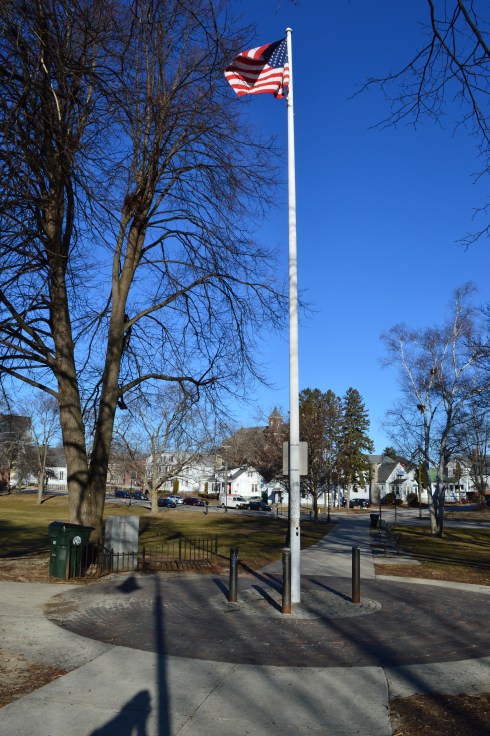
An American flag stands in front of the memorial for Dr. Ben Bronstein.

DSC_0743

One strange thing I noticed is a warning posted that prohibits people from hanging out at the park during school hours.  So that is something to bear in mind if you do visit.  I’m not sure why this restriction is in place.  I can only imagine you would be the talk of the town in prison if you ever got convicted of it “Don’t mess with that guy.  He’s in here for loitering.” (I know it’s probably just a fine)

Below are some additional photos of the park from different angles.

This slideshow requires JavaScript.

Please connect with me on Facebook: New England Nomad


Anne Sullivan Memorial (Feeding Hills/Agawam, MA)

Dates Visited: July 11, 2015 and August 22, 2015

Parking: there is a parking lot located next to the memorial with over a dozen or so parking spaces.  There are also parking lots and off street parking nearby.

DSC_0025

Although she is known more for her success as a teacher and most notably working with Hellen Keller in Tuscumbia, Alabama, and Boston, Massachusetts, Anne Sullivan is actually a product of Feeding Hills (a sub section of Agawam), Massachusetts.

I especially like how the trees still have leaves and the flowers are in bloom since I originally took these photos in the summer of last year.  It makes me yearn for the long spring and summer days.

I am never completely satisfied with my photos.  So, I made two trips to this memorial.  My biggest gripe with the first set of photos was there were too many cars and people in the background.  But, even when I went back another day earlier in the daytime there was still a lot of activity.  It is located by a busy intersection so it was unavoidable.  You can see the difference in the shadowing and angle of the sun from my two visits.

Sullivan lost her vision at an early age due to an infectious eye disease.  She would receive a series of treatments which considerably improved her vision while she was a student at Perkins School for the Blind in Boston.  This undoubtedly inspired her to work with other people who were visually impaired and challenged in other ways.

The centerpiece of the park is the monument of Anne Sullivan sitting with Helen Keller. The intensity in her stare is palpable. The sculpture, created by the Romanian-American sculptor Mico Kaufman, captures the moment Anne Sullivan successfully teaches Helen Keller her first word – “water.” The statue was dedicated on June 28, 1992.

DSC_0066DSC_0033DSC_0030DSC_0065DSC_0671DSC_0669

DSC_0666

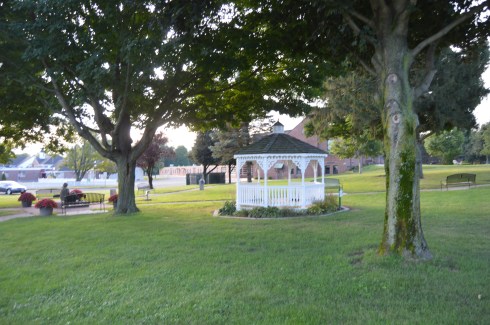
The park is well kept and there are many places to sit.  A gazebo stands off to the side as well.  It would be a peaceful place to relax and unwind, except the fact it is located at a busy intersection.

DSC_0039DSC_0662DSC_0064

There are additional monuments in the park.

This memorial is another tribute to Anne Sullivan’s work with Helen Keller.  The inscription reads, “Anne Sullivan…Teacher of Helen Keller.  Heroic friend of the deaf and blind.  Native of Feeding Hills.”

DSC_0063

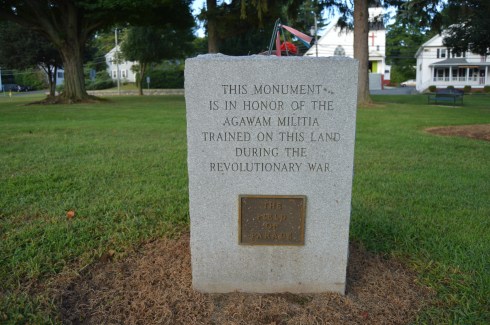
This memorial is a tribute to the Agawam Militia who trained on this land during the revolutionary War.  I am always fascinated at how seemingly ordinary places like a busy intersection has so much history and significance.  In fact, the land you are standng on, or the land your house or apartment building was built upon most certainly has a hidden history you are not privy to.

DSC_0047

DSC_0045

The trees at the Anne Sullivan memorial Park are very impressive, particularly when they still have their leaves.

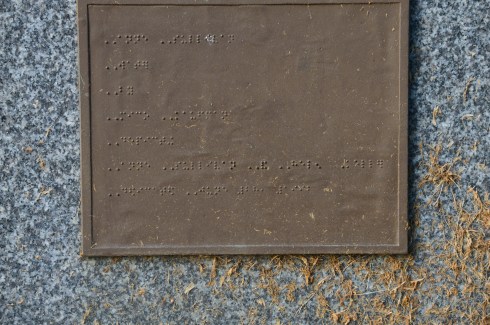
The last monument I photographed at the park names the people on the memorial committee.  If you look closely, you may notice the inscription is also written in braille.

DSC_0676DSC_0013


City Of Presidents (Quincy, MA)

In the annals of presidential history, Quincy, Massachusetts, holds a special place.  The birthplace of two U.S. Presidents; John Adams and John Quincy Adams, Quincy, MA, has earned earned the nickname “City of Presidents.” (originally, both Adams’ were born in Braintree MA but their birthplace became Quincy after Quincy split from the town of Braintree in 1792, John Hancock was also from Braintree before the area was renamed Quincy).  In fact, the high school sports teams have adopted the menacing moniker, “Presidents.”

On this frigid Presidents Day, I decided to take a visit to the Old House At Peace Field, the retirement home of John and Abigail Adams as well as John Quincy Adams, when Presidents were really Presidents.  The Adams’ and their future generations would call this home  until 1927.

DSC_0726

The Stone Library located adjacent to the Adams House.

DSC_0733

The house is much prettier during the spring and summer.  Flowers of a wide spectrum of colors adorn the walkway and throughout the estate.  It is closed to the public until spring time.  But the front gate was open, as though they were expecting me.

DSC_0717DSC_0714

DSC_0721

Further down the road on Hancock Street, in front of City Hall, stands John Adams.

DSC_0754

I was wondering why he was looking off into the distance (wary of the British perhaps?).  Then, I noticed a statue of Abigail and little John Quincy Adams was situated across the street.

DSC_0775

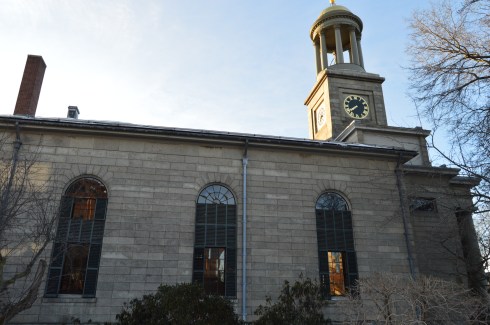
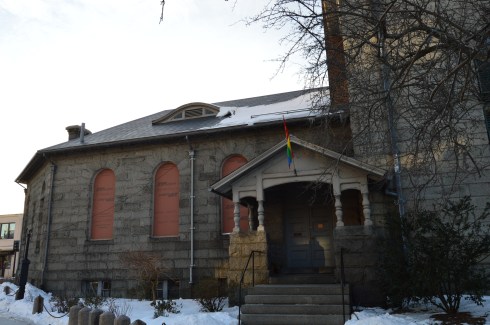
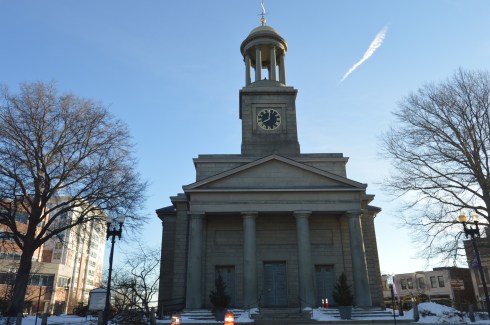
Both of the Adams’ are buried in the United First Parish Church, located directly across from City Hall and, inconveniently for the drivers of Quincy, in the middle of the busy roadway.  It is also the church I almost got into a fight at as a child until the other kid said he, “didn’t fight in churches” pffft.  Oh, the memories.

DSC_0829DSC_0779DSC_0782DSC_0845

There are other Adams’ residences and historical places, such as his original birthplace, also in Quincy, MA, that I will cover in later posts.

Happy President’s Day!