Category Archives: New England

The Old Drake Hill Flower Bridge (Simsbury, CT)

Date Of Visit: September 10, 2017

Location: 1 Old Bridge Rd, Simsbury, CT (about half an hour northwest of Hartford, CT)

Hours: Available 24 hours a day

Cost: Free (but donations are appreciated)

Parking: There is room for about a dozen or so cars in the parking lot off Old Bridge Rd

Handicapped Accessible: No, There are some poles at the entrance to the bridge to prevent vehicles from driving onto the bridge and I am not sure if wheelchairs could get past them (see photo below).

IMG_2292

Dog Friendly: Yes

Highlights: flowers strategically placed on a bridge, scenic, historical landmark

Website: Old Drake Hill Flower Bridge

Tips:

  • parking is located on located on Old Bridge Rd off Drake Hill Rd.  There’s no parking located at the entrance by Riverside Rd
  • popular place for weddings, engagements and portrait photography

IMG_2304

IMG_2181

There’s more than one “bridge of flowers” in New England.

Inspired by the Bridge Of Flowers in Shelburne, MA, the Old Drake Bridge Of Flowers, is by no means as long or as flowery as the Bridge Of Flowers in Shelburne, MA.  Yet, what it lacks in length and variety of flowers it makes up for in charm.

Each panel of the bridge is decorated with various flowers.  The bridge has 32 baskets and 48 boxes, some of which were built and added by an Eagle Scout, filled with flowers of an array of colors. The flowers bloom from late May to October.

During my visit, I met a woman who stops by every other day to water, trim and keep after the plants.  Clearly, she’s doing a wonderful job.

The bridge, originally built in 1892,  is an example of 19th century metal-truss bridge construction.  It spans 183 feet and includes a 12-foot roadway suspended 18 feet over Farmington River.  And it has been much traveled over the years.

The Old Drake Flower Bridge was originally built to be a one lane, one way bridge for vehicular traffic.  It was later replaced by a 2 lane bridge in 1992.  Finally, in 1995, it was restored as a pedestrian bridge.   It was added to the National Register of Historic Places in 1984

There are also plants and flowers by the sides of  each entrance to the bridge.

At the entrance to the bridge, off to the left side, there is a memorial dedicated to the original bridge (the Weatogue Bridge) that was built there before it was replaced by the Old Drake Flower Bridge.

The inscription on the historical marker reads reads:

A toll bridge was built here 
in 1734 by order of 
the General Assembly 
it was the first 
highway bridge across 
the Farmington River

The Old Flower Bridge is a popular place for weddings, portrait photography shoots and engagements.  In fact, I turned around from the parking lot the first day I went there because there was a wedding or wedding shoot taking place and I didn’t want to disrupt them.  The second day I went I ran into a couple who had just gotten engaged.  The beaming couple asked me to take their photo and went on their merry way of future bliss.

The Old Flower Bridge is dog friendly.

Lisa (on the right) is a 5 year old Havanese.  I love seeing how happy and proud dog guardians are in their photos.

Tucker Jones is a 2 year old Corgi.

Leila is a 9 year old Bernese and Beagle mix.

Below is a link to The Flash Lady Photography.  The Flash Lady Photography conducted an engagement photo shoot on the bridge in 2015.  You may notice many of the flowers are not on the bridge when these photos were taken as it was the end of October when the photos were taken.  I hope they’re both very happy now!

Please stop by my Facebook page!


Granby D.O.G.G.S. Park (Salmon Brook Park, Granby, CT)

Date Of Visit: September 10, 2017

Location: Salmon Brook Park, 215 Salmon Brook Street Granby, CT (20 minutes northwest of Hartford, CT)

Cost: Free

Hours: open daily, sunrise to sunset

Parking: There are several parking areas.  The best place to park for the dog park is behind the big soccer field at the end of the road at the main entrance.

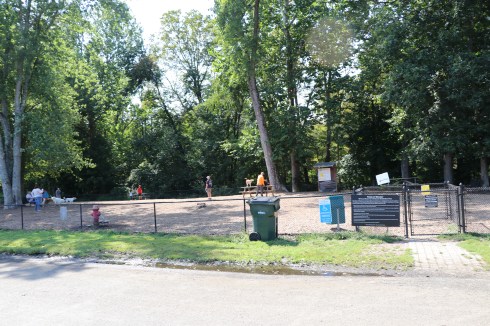
Highlights: table, chairs and bench, 1 acre for the dogs to play in, water source, two entrances/exits, double gated entrance

Website: Granby D.O.G.G.S. Park

Tips:

  • each visitor is allowed to bring 3 dogs each visit
  • No children under 8 are allowed in the dog park
  • The dog park is located in Salmon Brook Park

IMG_2791The D.O.G.G.S. part of Granby D.O.G.G.S. Park may stand for Dog Owners of Granby Getting Social.  But, it seems like the dogs that tend to get social there!

The one acre park, which has been open since November of 2005, has tables, chairs and a bench for dog sitter and guardians to sit and lovingly watch their dogs.  The park also has toys and a water source.  While dogs are allowed off leach at the park, they must be able to follow voice commands.


The large park, which has mulch over most of the park, gives dogs of all shapes and sizes lots of room to roam and chase each other and trees to play hide and seek.


During my visit to the dog park, there was a “Canine Swim” fund raiser at the pond in Salmon Brook Park, just a short walk from the dog park.

A $10 fee was charged for each dog that wanted to play in the water at the pond.  The funds were being raised to put toward maintenance of the dog park.

The dogs loved running around and into the pond.


Some of the many beautiful dogs I met at the dog park and fundraiser are shown below:


Roxy is a 12 year old mixed breed.  She is a therapy dog who likes to visit children, the elderly and anyone else who needs a little “dog therapy.”

IMG_2389

Cooper is a 7 month old Boston Terrier.  Cooper has complete heterochromia; he has two different colored eyes (his left eye is blue, his right eye is brown).


Gabe is a Great Pyrenees.  His guardian wasn’t sure what his age was exactly.  He and his parents found him on the side of the road and decided to take him in.


Heidi is an 8 year old Golden Retriever.  She loves to “retrieve”.  Get it!?


Molly the is a 5 year old Collie.


The aptly named Bear is a one and half year old Newfoundland.


From left to right, Ruby (named after Ruby Tuesday) is a 3 year old Saint Bernard.  Her brother, Ollie (named after Olive Garden) is a 2 year old Saint Bernard.  Anybody else getting hungry for lunch?

Please follow me on Facebook!

Today’s featured link is a blog post by Out And About Mom about Salmon Brook Park, where the dog park is located.  I have featured Out And About Mom on my blog before.  She tends to blog about Connecticut attractions exclusively  and she does a great job in her posts.  Her post about the playground area at the park can be found here.


Ogunquit Dog Park (Ogunquit, ME)

Date Of Visit: August 25, 2017

Location: Spring Hill Rd, off Berwick Rd., Ogunquit, ME

Hours: Open daily, dusk to dawn

Parking: There is room for about 4 or 5 cars by the entrance with additional parking on the side of the road to the park.

Handicapped Accessible: Yes

Highlights: spacious park for dogs to play, kiddie pool, balls to throw, seating

Tips:

  • The park is located on a side road (Spring Hill Rd) with no other businesses or buildings, so there is ample parking on the side of the road if you can’t find a spot in the main parking area
  • I had some difficulty finding the park.  The website says to use this in your GPS as the address: 323 Berwick Rd. Ogunquit.  You will see a sign on Berwick Rd for the park.  It is the turn after Meadow Lane if you are coming from the east.  Or, if you are coming from the west and you see Meadow Lane you have gone too far.

Website: Ogunquit Dog Park


IMG_0667

Since its opening on January 15, 2011, Ogunquit Dog Park has been a play land for dogs of all breeds.  But, it may be it’s hidden history and a very special dog that makes the park so special.

Ogunquit Dog Park is spacious enough for lots of dogs to run around and play.  There are also benches and chairs to sit at while your dog enjoys the park.  And, of course, trees.

The one acre park is has a pool, shed, hydrant and tennis balls to throw to the dogs.  The shed at the entrance was built by the students at the local vocational high school in Wells, Maine.  The wood shavings on the ground give the park a pretty look.

Perhaps the highlight of the park is the memorial to Perkins, and all beloved dogs, that is set up inconspicuously near the center of the park by a tree.

IMG_0631 After Perkins, a golden retriever who used to frequent the park, passed away on Monday, October 26th, 2015, the pet’s guardian (Martin) and some other people came together to set up a memorial for him.  Perkins, whose “nana” worked in Perkins Cove, used to act as the “greeter” standing outside the door greeting customers and being cute.  Eventually, Perkins’ dad would decided to look into opening the park.  And, from there, the idea began to snowball.    There is also a note from the dog’s guardian and some photos of him.  I wish I could have met him.

For safety purposes during entry and exit of the park, the dog park is fully fenced with double gates.  There is a separate section for small dogs and a small trail to thee side of the park. Water that is piped in from a 3 year old, 600 foot deep well at the Transfer Station is available from April 1 to mid-November.  Also, the area is sprayed for ticks every 2 months with an organic solution.

IMG_0607

There was a steady flow of four legged visitors during my visit.

Ruby is a 7 year old Wheaton Terrier.  She also played an instrumental role in the opening of the dog park as she helped pull the yellow ribbon on the gate of the park to formally open the park.

Dice is an 11 month old Husky and Blue Heeler.  If you look closely, you may notice he has one brown eye and one blue eye.

Drisky is 7 months old.  Love his white socks!

Delaney is a mixed breed from South Carolina.

Rudy, the brown and white dog in the photos above, is a 9 year old Brittany Spaniel.

Today’s New England related link of the day is a poem dedicated to Perkins written by Richard W. Perkins:

Farewell Dear Friends

Please consider following me on Facebook to view photos, links, stories and other content not included in my blog!


Marginal Way (Oguinquit, ME)


Date Of Visit: August 26, 2017

Location: Shore Rd, Ogunquit, ME  (2 hours and 45 minutes south of Bangor, ME and 1 hour and 15 minutes northeast of Concord, NH)

Hours: daily, sunrise to sunset

Cost: Free

Parking: There are several parking lots in the area and limited street parking is also available.  I parked at a lot on School St which is directly across from the entrance to Marginal Way.  The lots usually charge by the hour.  Below is a link to the municipal parking lots in the area:

Parking Lots Near Marginal Way

Distance/Difficulty: 1.25 miles (2.5 miles round trip)/easy

Handicapped Accessible: Yes, although some areas are narrow, it is handicapped accessible

Dog Friendly: Yes, but only during certain times of the year.  Dogs are permitted on the Marginal Way from October 1st to March 31st

Fitbit Stats: 2,5 miles, 4,768 steps, 752 calories

Highlights: scenic views, easy path, steps on the trail that lead to the beach

Website: Marginal Way Preservation Fund

Trail Maps: Marginal Way Trail Maps

Tips:

IMG_0182

Located Marginal Walk is anything but.  With its scenic views along the rocky coastline, access to Ogunquit Beach and pretty flowers and trees, Marginal Way is  a must see for anyone residing in or visiting Maine.

From the beginning of the walk, Marginal Way serves up some pretty views and a wide spectrum of colorful flowers.  The flowers from Sparhawk, the hotel located next to the entrance.

There are some stunning views along the way.

The path along the walk is generally wide with some narrow areas.  Most of the path is paved and I did see people with strollers.  There is also a bridge that is wide enough for two traffic and also seems to be handicapped accessible.

One of the unique things about this cliff walk is that you can walk down to the beach.  I noticed a few surfers ( I wish I learned how to surf in my younger days – maybe next year!)and sun seekers enjoying this part of the beach.  The rocks on the beach gave the beach a more natural feel.  There are also a few sandbars which allow you to walk out pretty far in the water.

Perhaps the best part of the walk, or at least the most rewarding part, is Perkins Cove at the end of the walk.  There  are a few eateries, several shops and a bridge.  The arts and crafts shops, coffee shop and candy store (which I highly recommend) give the area a quaint feel.

Sadly, dogs were not allowed on Marginal Way during my visit since they are only allowed on the walk during the fall and winter seasons.  But, I did see lots of dogs on the way to my car and at the end of the walk.

Gus, a 5 year old English Bulldog, was dressed to the nines for his photo shoot.

Landon, a 7 year old mixed hound retriever, showed me his pearly whites.

Below are some videos from my walk.  Just listening to the surf is so soothing.

Please connect with me on Facebook!


ICA-Part II (Boston, MA)

*This is Part II of my 2 part series about the ICA Museum in Boston, MA.  To view the first part please click here*

In addition to the works of Nari Ward, the ICA displayed art exhibits from a variety of other artists.  One of these artists is Dana Shutz’s.

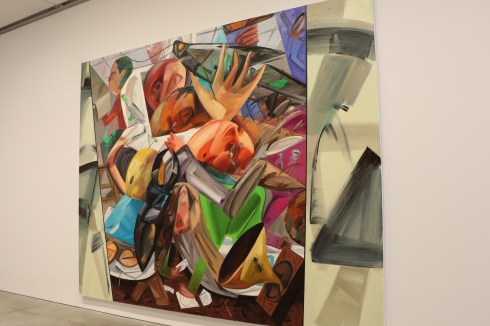
Dana, an American artist based out of Brooklyn, is widely known for injecting humor into her gestural paintings.  She  has studied art extensively , even studying abroad at the Norwich School of Art and Design in Norwich, England.  While not all of her work had a description of their meaning or intent, I think many of them are fairly self-explanatory or, at the least, left to our own interpretation.

IMG_0071

Elevator On Canvas, 2017, oil on canvas.  This work is part of a series of paintings of an imagined struggle between larger than life figures and giant insects glimpsed between the gleaming doors of an elevator.  Besides addressing people’s claustrophobia, the art may speak to the current heated debate, inner struggles or struggle for attention within the public arena.

IMG_0074

Conflict, 2017, oil on canvas.  This work portrays a quarrel, possibly between lovers, The couple in the painting are both embracing and fighting at the same time.

IMG_0076

To Have A Head, 2017, oil on canvas.

IMG_0081

Shame, 2017, oil on canvas.

IMG_0078

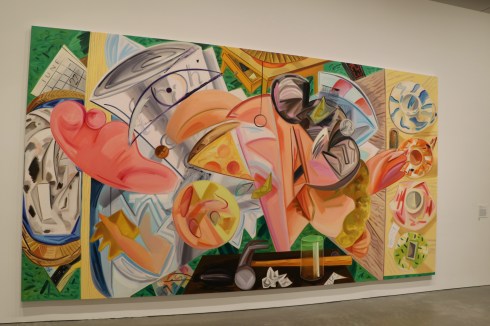
Shaking Out The Bed, 2015, oil on canvas.  This 18 foot wide canvas recalls the Western tradition of history painting.  This painting differs from most history paintings in that it does not highlight noteworthy men and women in our history.  Rather, her painting consists of everyday items that revolve around people in bed.  All of the things we use and, dare I say, rely upon on a daily basis.  A calendar, an alarm clock, day old pizza (a must) and a glass of water are some of the items Dana included in her painting.  Dana said she “wanted the whole painting to feel like a book that was being opened, like you were shaking out of bed and all of the objects contained within are falling and suspended in front of the scene.”  She went on to say she wanted to convey the feeling that “you just missed the alarm and the world is coming back to you in pieces.”

IMG_0083

IMG_0110

Flasher, 2012, oil on canvas.

In addition to Shutz’s work, there were a number of other artist’s work being displayed at the ICA.

IMG_0080

IMG_0102

Trace, 1980, by Nancy Graves made of bronze, steel, polychromed patina and paint.  Trace depicts a dynamic, wind-blown tree with its bright-green forked trunk rising from a red and brown ground and curving toward the top.  The amorphous crown of leaves is composed of layered, multicolored sheets of steel grating punctuated with geometric lines and grids.  Graves likes to inject nature and the natural world into her works.

Hidden Relief, 2001, by Sarah Sze made of a halogen work lamp on tripod stand, rulers, spring clamps, levels, plastic, styrofoam, bamboo, toothpicks, branches, bottle caps, string, artificial plants, artificial moss, T-square, Alligator clamps, T-pins, cotton swabs, pushpins, dried plants, paint and glass (or pretty much everything but the kitchen sink).

Sarah uses everyday items, like the items included in this display, to create site-specific sculptures and installations that take on the character of landscapes, architecture and improvisational systems.  She used a sample palette of white, orange, yellow, blue and black throughout the work which is brightened by work lights.  Sarah also drew diagram-like lines using pins and string in this work of art.


IMG_0104

Depose II by Keith Sonnier made of nylon sailcloth, metal.  This inflatable design balanced a ready made aesthetic with painted geometric elements.  The inflatable part of the sculpture assumes an anthropomorphic form that, when mixed with air from the blower, suggests a living being.  Initially a limp sack, the sculpture must breathe and expand to assume its final form. The title references the act of being deposed, wherein a person is required to give oral out-of-court testimony. The person being deposed is often asked exceedingly personal questions. Perhaps the pinched or pressed inflatable alludes to the feeling of duress that might arise from having to tell the truth in a compromising situation.

IMG_0100

Untitled (Topanga, CA, Umbrella 17) by Sam Falls made of nylon.  Untitled displays the fabric of an umbrella without the support and pinned to the wall.  Sam exposed some of the umbrella’s nylon panels in the California sun for a prolonged period of time.  Then, he interspersed the faded panels with panels that had been kept out of the sun causing a contrast in the colors of the sculpture.  Sam’s work of art invites speculation about the elements of time and change in art and nature.

The intermediate-Inceptive Sphere, 2016, by Haegue Yank made of artificial straw, steel stand, powder coating, artificial plants, artificial fruits, plastic twine, Indian bells and casters.

The Intermediate-Inceptive Sphere is an anthropomorphic sculpture that belongs to a series of woven straw works titled The Intermediates.  The sculpture is adorned with items such as bells that are meant to hang from the necks of cows in India and Korean bridal headpieces.  The work of art also invokes Asian folk cultures, shamanic figures and their rituals.  Haegue used plastic straw to foreground the tension between the organic and synthetic in contemporary life.

Ashes, 2017, is a video by acclaimed director Steve McQueen.

Ashes presents footage on two sides of a freestanding screen. One of the sides, originally shot on soft, grainy Super 8 film, shows a young, carefree fisherman named Ashes balancing playfully on a boat. The other side shows a second projection, shot in 16 mm film, that shows Ashes’s unexpected fate. The videos conjure an easy vitality and a vivid description of place against the darker forces of society and fate.

The last, but not least, attraction at the museum is the view.  Full length glass windows give stunning views of Boston Harbor.  I bet it must be spectacular during sunsets.

On the way to the train station, we met these dogs taking a stroll along the boardwalk at Fort Port Channel.

Emmerson, a 13 year old Shetland, was very comfortable in his stroller

Archie, a 10 year old Yorkie peeking out from behind Emmerson, decided to get out and walk around.

There were also some pretty views of Boston at night along the way.

Today’s featured blogger is The Culture Club.  The Culture Club visited the ICA recently.  I thought his post would be a good companion to my post since he may have photographed pieces I may have missed or weren’t on display when I visited the museum.  You can find his post here.  The Culture does reviews, writes about music and entertainment and he’s got a cute dog!


ICA-Part I (Boston, MA)

Date Of Visit: August 25, 2017

Location: 25 Harbor Shore Drive, Boston, MA

Hours:

Tuesday + Wednesday: 10 AM – 5 PM
Thursday + Friday*: 10 AM – 9 PM
*First Friday of every month: 10 AM – 5 PM
Saturday + Sunday: 10 AM – 5 PM

Closed Mondays, except on the following national holidays, when admission is FREE for all: Martin Luther King Jr. Day, Presidents’ Day, Memorial Day, Labor Day, and Columbus Day.

Closed on Patriot’s Day, Independence Day, Thanksgiving, Christmas, and New Year’s Day.

Cost:

General Admission: $15
Seniors: $13
Students: $10
Youth 17 and under: FREE

Admission is FREE for all eve

Parking:There are several parking options that are listed at their ICA parking info

Highlights: creative art displays, info sessions about the art

Tips:

  • parking is very limited in this area.  The museum recommends using public transportation.
  • The museum only has art on the 1st and 4th floors of the building (mostly the 4th floor)

Website: ICA

*I had to split this post into two parts, as it was too big for WordPress to save.  Part I of this post will center upon the works of the featured artist Nari Ward.  The second part of this post will focus on some of the other art at the museum.  I have also included half of the number of the cute dogs I photographed during this visit*
 

IMG_9998

Always at the intersection of art and social issues, he ICA (The Institute of Contemporary Art/Boston) recently highlighted the works of an artist who uses his art to make various statements about our social, economic and political climate.  Even if you may not agree with or see his points of view, I am sure you will enjoy his artistic aptitude.

During my visit, Jamaican and American Nari Ward’s work was being featured in his “Sun Splashed” exhibit at the museum.

IMG_0041

Sunsplashed, 2015, is the centerpiece of the art exhibit.  The second work of art is called, Scandal Bag: History Feeds Mistrust.

Nardi, born in 1963 in Jamaica and currently based in New York City, uses everyday items to create works of art that play on the history, economy and social issues surrounding his environment.  He also embraces cultural diversity.

Nari uses wood, metal, iron and other materials with everyday items such as soda bottles.  Nari hits on some hot button issues such as migration, citizenship and economic disparity in his works.

One of the things that struck me about these works of art is the thought and creativity that went behind all of them.

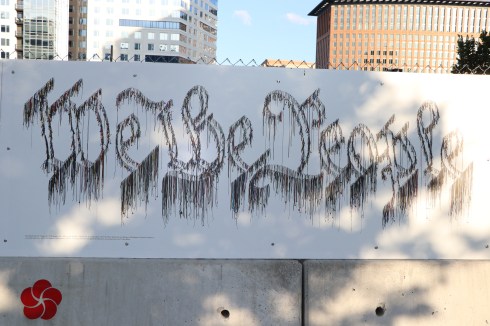
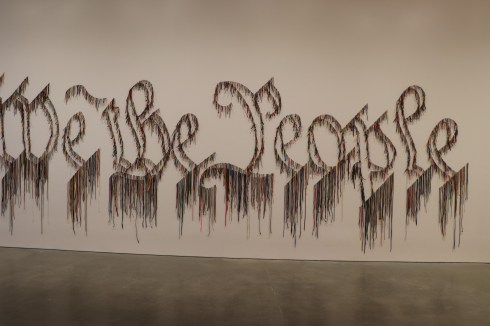
The We The People exhibit by Nari Ward was one of the main works of art at the ICA.  In fact, many of his works of art are being featured
IMG_0008

If you look very closely, you may notice it is not written in ink.  Rather, it is spelled out in artistic dangling shoelaces.  This exhibit was being displayed a block away from the museum.  It surely created a lot of interest and lured in quite a few visitors eager to learn more about Nari’s works of art.


Below are Nari’s works of art that were being displayed with a brief description and explanation of their meaning.  Sadly, his art is no longer there as the exhibit’s last day was September 3.  The first work of art is rather unconventional.  But, it was very interesting.


Jacuzzi Bed by Nari Ward is made of headboards arranged around heating lamps and fans.  The work of art is meant to produce an approximation of the Caribbean breeze.  The name is meant to conjure association with pleasure and comfort.  Nari says the work conveys his sense of nostalgic displacement.


Sky Juice, 1993, is made of an umbrella, iron fence, plastic soda bottles, photographs, Tropical Fantasy soda and sugar.  The soda bottles, hanging from the umbrella, have photos inside of them.  His goal was to create a work of art with disparate things from everyday life to create a work of art everyone can relate to.  “Sky Juice” is the name of a Bahamian drink made from coconut milk and gin (yum).

During my visit, one of the museum guides led an open discussion about the work of art where visitors and she discussed the deeper meaning of the work of art and what the work of art means to them.  She did this several different works of art during my visit.


Mango Tourist, 2011, by Nari, are “snowman-like” sculptures are made of burnt foam spheres that he decorated with mango seeds and small electrical parts.  The small capacitors bear traces of the economic and industrial history of New England and of course the snowmen are a staple of our winters.  The organic mango seeds resonate with his memories of Jamaica.


Happy Smilers: Duty Free Shopping, 1996, by Nari is made of awning, plastic soda bottles, fire hose, a fire escape, salt, sand, household elements, an audio recording, speakers and an aloe vera plant.  Party music and background conversation from the speakers gave the display a feeling of sitting on a fire escape on a hot summer night.

This exhibit was inspired by a candy store not far from where he lives in Harlem, New York.  While the store appeared to be a convenience store, it was really the site of a small scale gambling site.  This gave Nadir the idea of making an exhibit that shows you can’t judge a place, person or thing by outside appearances.

The name Happy Smilers was derived from a band that was led by Nadir’s uncle that entertained tourists in Jamaica in the 1970’s.  The fire escape and discarded furniture wrapped in fire hoses suggest an urban tableau.  The salt and sand, aloe vera plant, speakers and bright yellow walls are drawn from the cultural context of Jamaica.  The salt evokes a common Jamaican expression about the devil not being able to step over salt.  The succulent symbolizes healing.  Lastly, the soundtrack symbolizes one of the artist’s earliest childhood memories of lying in bed at night while he listened to rain fall on his tin roof in Jamaica.


The Naturalization Table is an exhibit based on Nari’s personal experience of becoming a naturalized U.S. citizen, this interactive artwork gives museum visitors a better understanding of that process. During certain days, visitors could add their photo to the display.


Radha Liquorsoul, 2010, is a metal and neon sign made of PVC tube, artificial flowers, shoelaces and shoe tips.  This was part of a work made from out of use liquor store signs that Nari removed from building facades in New York.  Ward was interested in the many uses and impact liquor has in our lives.  Nari also used shoe tips (which Nari considers a a signature material that symbolizes human presence), shoelaces and artificial flowers.  Nari was partly inspired by impromptu street or roadside memorials.


Homeland, Sweet Homeland, 2012, is made of cloth, plastic, megaphones, razor wires, feathers, chains and silver spoons.  The “Miranda Rights” which are listed on this work have appeared as a running theme on many of Nari’s works.  The combination of razor wire, megaphones, leather and gold thread with feathers were meant to evoke a kitschy domestic memento and a heraldic government edict.


Rock, Booked, Scissor, Vice, 2010, is made of book, rock, scissors and vice.  This exhibit was spawned from a mistake.  When Nari first saw the “Black’s Law Dictionary” as a child he thought there were different law dictionaries for white and black people.  Although his brother corrected, his initial thought stuck with him and inspired his work.    To create this work, Nari cinched the dictionary with a vice, pierced it with scissors and weighted it with a stone.  It is meant to symbolize a violent reenactment of the game “rock, paper, scissors.”  It is meant to represent the seemingly arbitrary application of the law experienced by people in many of the communities in America.


Savior, 1996, is made of a shopping cart, plastic garbage bags, cloth, bottles, metal fence, earth, wheel, mirror, chair and clocks.  Nari constructed the sculpture by utilizing the shopping cart, a common item, and using items to bling it up.  In the blue bag you can see clocks.  The sculpture had an accompany video titled, “Pushing Savior.”
IMG_0046

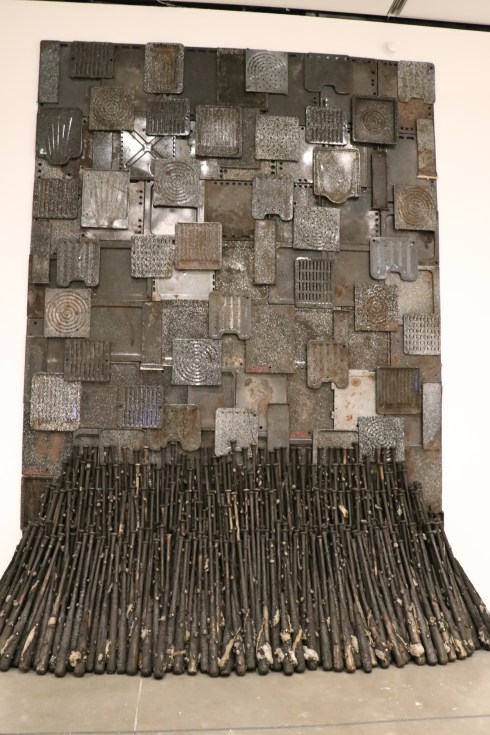
Iron Heavens, 1995, made of metal pans, cotton and wooden bats came from Nari’s observation that the holes dotting the the metal surfaces of certain baking pans look like stars.  Nari collaged pans together on a wall to evoke the night sky.

Nari used baseball bats to form a ground to the heaven above.  The bats were burned, sterilized and had cotton applied to their surfaces.  This was meant to convey violence and healing.  The materials were also used to signify the American South, especially the older south.  The cotton was used to signify slavery as that was the main crop slaves used to pick.  The baseball bats were used to signify the violence many blacks suffered.  The overall arrangement recalls the yard assemblages and sculptural folk traditions of the region.


Glory, 2004, consists of an oil barrel, fluorescent and ultraviolet tubes, computer parts, DVD audio recording, Plexiglas, fan, camera casing elements, paint cans, cement, towels and  rubber roofing membrane.

The tanning bed is made out of old oil barrels.  As this work of art was built one year after the Iraq attack, he used the oil barrels represent the political debates over the connection between oil and patriotism.

The oil barrel also signifies the issues related to identity and race.  While in some cultures, a tan is viewed as a mark of leisure and privilege.  However, “pigmentocracy” can ascribe a higher value to lighter skin tones in some societies.

As you stand by the Glory sculpture, you can hear recordings of voices and people talking in hushed tones.


Afroochase, 2010, made of ink, a found vinyl banner, cowrie shells, Afro picks and felt weatherstripping is built from a Chase Bank banner that he found mixed with various materials each of which have a symbolic meaning.

The cowrie shell has several possible meanings.  The shell has been used as a form of currency,  It is also used in divination ceremonies in African and North African and South African religious contexts.

Afro picks have been used as a symbol of black cultural identity and the shapes of the particular picks (the raised fist of the Black Power movement) refers to black nationalism and resistance.
IMG_0061

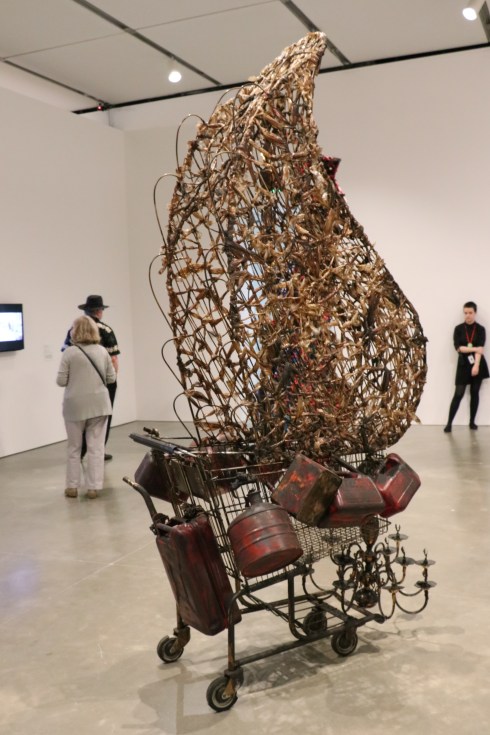
Crusader, 2006, is made of a shopping cart, chandelier, trophy elements, metals, plastic bags and plastic containers.

Crusader has been described as  a radiant poetic work that mixes the personal and political.  Nari used comedy to make a political statement about his feelings concerning the second Gulf War.  Oil plays a central theme in many of his works, evident by the oil canisters in this work.

IMG_0067

Beat Box, made of an old New York City payphone, a drum and a fire extinguisher was made as a way of showing the different ways people have communicated.  The old (the drums which have been used as nonverbal communication in some traditions ) with the modern (the payphone).  After Ward had modified the pay phone he put it back outside where it had originally came from.  Imagine the looks on the people’s faces when they tried to make phone calls!


I noticed how Nari likes to incorporate audio and videos into his exhibit.  This is only one example of this.  Those chairs look very comfortable!

IMG_0062

Den, 1999, made of wood, chain-link fence, metal pole, tacks, rug and wooden furniture legs

IMG_0063

Chrysalis, 2010, made of mirror, rope, foam, and a found paper bag

IMG_0065

Vertical Hold, 1996, made of yarn and bottles. This sculpture was made from old, used glass bottles Nari found at a dump site and some bottles he found while he was in residence at a Shaker community in Sabbathday Lake, Maine.  He wove the bottles together with string thus creating a web that he described as a quilt.  This work was inspired by bottle trees, a traditional African, Caribbean and Southern black sculptural form that was believed to protect against evil spirits.

IMG_0116

Canned Smiles, 2013, explores the intersection of art history and identity.  Nari was influenced by another artist, Piero Manzini.  Piero created Merda d’artista (Artist’s Shit) that consisted of 90 small cans labeled with the title that he sold.  The art exhibit by Piero was a sarcastic way of saying that anything that belongs to an artist is worth value.  It also was a commentary about how not all art may have merit.

Ward’s art display aims to question people’s perceived stereotypes and the reality of constructed values.  Nari used the Black Smiles idea to play on the minstrel shows which used to be popular in America during the 19th century.  The work inspires us to ask whether the notion of a smile trapped in a can is any more or less strange than the ideas we construct around identity.

During my visit, the ere was a social gathering on the desk of the museum.  Music, food and refreshments were being served and there were a number of therapy dogs at the event.

A “cuddle zone” was created by visual artist J.R. Uretsky.  The “Cuddle Zone” featured nine therapy dogs from Dog B.O.N.E.S. There was also quilted works for people to use as comfort aids.  You will also some of the dogs wore or sat on these quilted comfort aids.

IMG_0138

Hey, we all can use this kind of therapy!

In fact, the dogs were so popular and in such high demand, I was only able to photograph two of these special dogs.

IMG_0136

Spider is a 5 year old chihuahua.

IMG_0132

Ruby Pearl is a 4 year old pitbull.

Please connect with me on Facebook to view videos, links, articles, photos and other content not included on my blog.  Thank you!


Hermann’s Royal Lipizzan Stallions (Woodstock, CT)

Date Of Event: August 19, 2017

Location Roseland Cottage, 556 Route 169, Woodstock, CT

Handicapped Accessible: Yes

Website: Hermanns Royal Lipizzan Stallions

Highlights: stallions performing tricks and ridden by their trainers

Tips:

  • bring your own chair or a towel as they do not provide them at the venue.
  • visitors are allowed to enter one hour before the scheduled event
  • be sure to take in a tour of Roseland Cottage if you have the time

IMG_9609

There was a lot of horsing around going on at the Roseland Cottage in Woodstock, Connecticut last month.

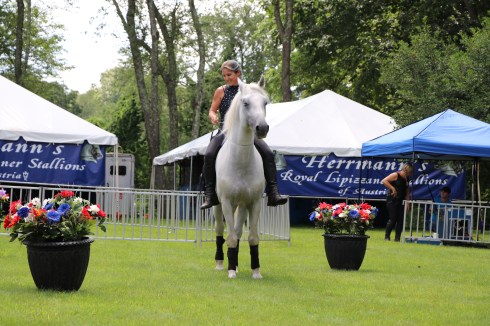
The Lipizzan Stallions galloped into the Roseland Cottage for a day of professional horse riding and horse tricks.

The Lipizzan Stallions traveled all the way from Myaka, Florida to entertain the one hundred or so visitors at Roseland Cottage.

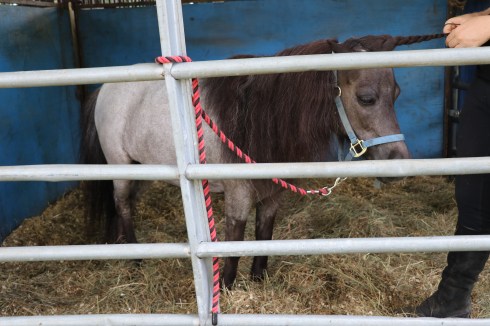
Not all of the horses and animals kept at the Lipizzan Stallions shelter are Royal Lipizzan Stallions. For instance, Willie The Rescue Pony, seen here getting ready for the show, is one of the horses they have taken in.  He even performs at the show.  They also take in dogs, cats and any other animal that finds its way to their shelter.

IMG_9486

The highlight of the show were the Royal Lipizzan Stallions. The horses performed tricks and trotted in formations.

The horses are such beautiful animals.  The way they moved and the way the horse trainers and riders controlled their every movement was a joy to watch.

The Lipizzan breed is considered the rarest and most aristocratic breed of horses in the world.  They were first established by Archduke Charles at Lipizza which is now part of Yugoslavia.

Since only a few hundred Lipizzan Stallions have ever existed at any one time, their future lineage is somewhat in question.  But, they may have General Patton to credit for their continued bloodline.

During World War II General George Patton authorized a secret plan to save the Lipizzans.  The stallions, who would surely have been killed if the Russians arrived before their rescuers, were saved during this secret mission. Two of the people involved who played a key role in their rescue were Colonel Herrmann and his father, Colonel Ottomar Herrmann,  A movie by Disney titled, Miracle Of The White Stallions depicts their rescue.

The Lipizzan horse show was held at the Roseland Cottage.  We didn’t have time for a tour.  But, the grounds are very pretty.

While dogs are not allowed at the show, I did see Yog,i, a 3 and a half year old Cavanese (part Cavalier King Charles Spaniel and part Havanes), and his dad watching from the sidewalk.  Yogi also barked out his approval from time to time.

IMG_9983

Below are some videos of the Royal Lipizzan Stallions event


Wheels & Waffles (West Springfield, MA)

Date Of Visit: August 19, 2017

Location: Eastern States Exposition Center,  Avenue Of The States, 1305 Memorial Ave, West Springfield, MA

Cost: Free

Parking: There is ample parking located at the entrance

Dog Friendly: Yes

Website: Wheels N Waffles

Highlights: classic cards dating back to the early 1900s, waffles

Tips:

  • The “Avenue of the States” (where the event was held) got the name because it has a replica of each state’s house of each state in New England on its premises
  • The Wheels & Waffles event is usually held at the Eastern States Exposition Center twice each summer, annually

IMG_9244

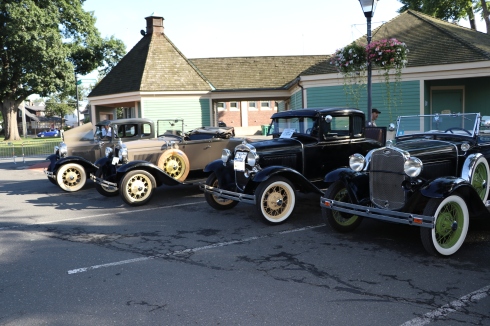
What goes better together than wheels and….waffles?  Well, that was what was on the menu at the Eastern Exposition Center last month.

There were some novelty card there too like this “General Lee” Dukes Of Hazzard replica car.

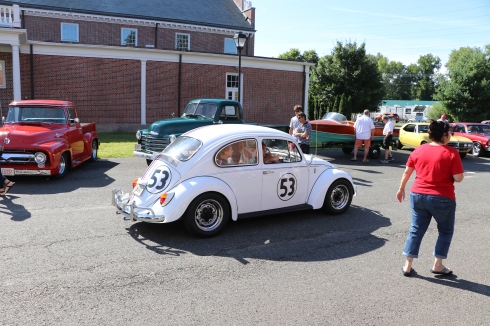
And this replica of Herbie The Love Bug

IMG_9389

If only I was better at identifying cars with the years they were built.  Unfortunately, that’s not my forte.  But, I still appreciate the curves, style and power of these vehicles.

Look at those fins and designs.  Those beautiful, beautiful fins…

Not all of the cars were from the 50’s and 60’s.  In fact, some of you may have owned some of these more recent classics.

I’ve always loved long, shapely cars.  So, of course this was my favorite.

Of course, as the name of the event suggests, there waffles provided by the Storrowton Tavern.


The “Avenue Of The States” didn’t get its name by accident.  The grounds have a replica of each original state house for each of the six New England states.  Below is the original state house of Massachusetts.

Here is what the Boston State House actually looks like (courtesy of everstockphoto.com)

Wheels & Waffles is a dog friendly event and I’m really not sure what I thought were more beautiful, the dogs or the cars.  OK, it was the dogs.

CJ is a 5 or 6 year old Jack Russell Terrier.

Lola is a 3 year old Lab.

Gunner is a 2 and a half year old Lab mix.

Below is a video of the Wheels & Waffles event

Please like me on Facebook.


Governor John Langdon House (Portsmouth, NH)

Date Of Visit: August 26, 2017

Location: 143 Pleasant Street, Portsmouth, N.H.

Hours: (summer hours listed)

Friday – Sunday
June 1 – October 15
11:00 a.m. – 5:00 p.m.

Tours on the hour.

Last tour at 4:00 p.m.
Closed July 4 (as well as other major holidays)

Cost:  $8 for adults, $7 for seniors, $4 for students

Free for Historic New England members and Portsmouth residents.

Parking: There is free parking in the lot on Pleasant St next to Citizens Bank and metered  or 2 hour parking throughout the city

Website: Governor John Langdon House

Tips:

  • tours start on the hour from 10:00 a.m. until 4:00 p.m.

IMG_1031

One of the oldest homes in the Portsmouth, New Hampshire area, the Governor John Langdon House remains one of the most popular homes to visit in the historic homes in the Portsmouth area.

Built in 1784 by the three time governor (at the time called “President”) of New Hampshire as well as General in the American revolution and signer of the United States Constitution, John Langdon, the Langdon House has 4 rooms on both of its floors.  Many of the elaborate interior designs are attributed to prominent woodworker Ebenezer Clifford.

It was very interesting hearing about how little subtle things that we may not notice meant a lot to the dwellers of the house.  Such as the ornate architecture which signalled someone’s wealth and station in life.

Another indication of wealth in terms of decor and design of a house at that time is doors.  Yes, doors.  The more doors you had in your home was considered a sign of wealth.  The funny thing is that in the photo below one of the “doors” (the one on the left) is actually a false door.  It gave the impression that the house is of

Although his father did own slaves and servants were afforded meager living quarters, Governor John Langdon did not own slaves (according to historian and site manager of the Langdon House) Peter Michaud.  Langdon also reportedly opposed slavery and even went so far as to send letters to politicians in Washington expressing these sentiments.  But, working and living in the Langdon House was not an easy life.  The servants quarters were located in the third floor above the living and sleeping quarters on the second floor.  The tour does not show these rooms.  But,

If you look closely you will see how the house follows the rules of symmetry (another hallmark of a house owned by a person of wealth). If there is one window in one room, then the room across the hall would have the same.  If there were two windows, the room adjacent or across from it would have two, etc.  And some of the windows are ver ornate.  If toy look through the window, you may notice there was a wedding during our visit.  Periodically, during out tour of the house we would hear applause from outside of the house.

It’s hard to believe but on both sides of the house there was a clear view of the city and water.  Trees and buildings as well as other developments know obscure these views.

The rooms of the Langdon House show, what was considered at the time, luxury and opulence.

It was also interesting to view and learn about the various items in the rooms such as this humidor and a liquor serving device.

No details were spared in the construction of the house.  For one, unlike many houses at the time, the steps were wide and not as steep as most houses of the time.  Also, the design of the  The column, spiral and baluster shaped sequence was a sign of wealth as well.  In some cases, if the home owner did not have a lot of wealth, he would often have this sequence of railings pictured below until about half way through the staircase.  Then, he would have only the cheaper column railings until the end of the staircase.  This is not the case at the Langdon House.

IMG_1011

The kitchen area was, for its time, advanced.

The contraption shown below was used to let the servants know when a meal was ready to be served.

As you can see in the second photo, the straight line (vertical) to the right in the top section of the machine went to an up and down (horizontal) in the same part of the machine.  This alerted the servants that the food was ready to be served.

Much like the house itself, the grounds of the Langdon House are also well kept.

Dogs aren’t allowed in the Langdon House (an exception may be made for service pets).  But, I did see this smarty pants named Einstein, a 4 and a half year old Lab, Retriever and Chow mix, while I walked back to my car from the house.

IMG_1043

Today’s featured New England related blog post is Eric McCallister Photography.  The Portsmouth based photographer photographed a wedding at the Langdon House some years ago.  You can find him on Facebook here.


“Sea to Shore: Sculpture Inspired by the New England Seacoast” (Portsmouth, NH)

Dates Of Visits: July 29, 2017 & August 26, 2017

Location: Governor John Langdon House, 143 Pleasant St, Portsmouth, NH

Cost: Free unless you want to photograph the statues inside the Langdon House

Parking: There are several parking lots (notably the free parking lot next to Citizens Bank on Pleasant St) and street parking available throughout the city

Handicapped Accessible: The outdoor exhibits are but the Langdon House is not handicapped accessible.

Dog Friendly: No

Website:

Highlights: sculptures displayed on the grounds of the Langdon House

Tips:

  • You can photograph or view some of the statues outside of the Langdon House.  If you want to view all of them (there are about 20 to 30 more inside the house), you have to pay the admission price to enter the house – I highly recommend paying for the tour even if only so you can view the sculptures inside the house
  • If all the lots are full which is common this time of the year, (free) street parking and some metered parking near the center of town can be found on some of the side streets such as Parrot Ave.
  • All of the sculptures shown in this post are available for sale

IMG_3716

Land meets shore at the latest sculpture exhibit at the Governor John Langdon House in Portsmouth, Hew Hampshire.  The “Sea To Shore” sculpture display currently on display on the grounds and in the Langdon House.

The exhibit, which is on display until October 15, uses stone, metal, wood and other materials from the New England area with many of the themes of the New England seacoast.  The exhibit includes 45 pieces from

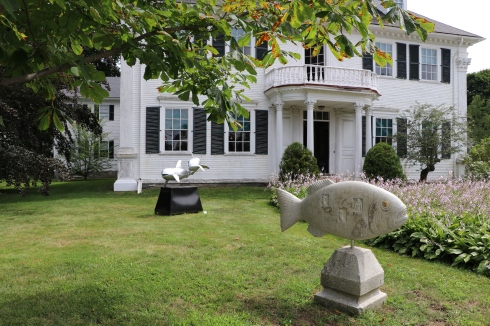
This sculpture titled “Fish With Travelers”was made out of granite by stone art enthusiast Thomas Berger. Talk about a fish out of water.

There are 10 more sculptures shown below that are on display on the grounds at the Langdon estate.

IMG_4313

Fisherman by Madeleine Lord made of welded steel.

Backstroker by David Adilman is made of Vermont gray marble.

Flotsam And Jetsam by Morris Norvin made form reclaimed steel barrels.

Serpentine by Irene Fairley made from Vermont marble.

Fragrant Flow by wood artist Jeffrey Cooper made of teak and bluestone.

IMG_4358

Moon Swings by Douglass Gray  made of steel.

Brown Crab by Thomas Berger made of fieldstone.

Urchin Sphere by Karin Stanley made of granite.

Genetically Modified Squid by Thomas Berger made of fieldstone.

Vertical Water” by Karin Stanley was not being displayed when I took the photos of the outdoor sculptures.

Inside the Governor John Langdon House there are many more sculptures.  You have to buy a ticket to view the sculptures (a tour of the house is included…blog post about the tour to follow soon).  I gladly forked over the $15 for the both of us to view them.

There are 34 sculptures displayed in the first floor parlor, hallway and dining areas.

Net by Amanda Sisk is made of mixed media.

Forever Free by Pete Spampinato made of bronze with an alabaster base.  Pete tends to feature animals in his work.  He says he did not begin sculpting until he retired.  He was inspired by the hardships animals had to endure during a trip to Africa.

Colossal Shell Goddess by Lindley Briggs made of resin and apoxie.  Lindley, in contrast to Pete, says her interest in the human figure has been rekindled.  Lindley says, “the boundaries between fantasy, reality and surreality are not necessarily firm.” She enjoys exploring these boundaries in her work.

Carousel Lobster by Jeffrey Briggs is made of fiberglass and resin.  Jeffrey builds carousels of all varieties as well as other works of art.  His latest work can be found at the carousel on The Rose Kennedy Greenway in Boston.  He often collaborates with Lindley (the sculptor featured above his sculpture).

Birds Of a Feather by Douglass Gray made of steel.

Gull by Alan Weinstein made of plaster and paint with a granite base.  Alan mainly paints.  But, he has branched out with his sculptures.

IMG_0972

Madonna 3 With Gorilla by Jeffrey Cooper made of cherry wood.  Sounds good enough to eat.

Sirena & Consorts With Sea Of Shells by Lindley Brigss made of apoxie and cast marble.  I especially like how the gorilla appears to be looking at the woman quizzically in the statue in the last photo.

Slaveship HMS Brookes by Martin Ulman made of mixed media.  The 43.5″ high ship sculpture was modeled after the British slave ship, “Brookes.”  The slave ship was used during the 18th century and it was said to carry 484 people, although it carried many more than that according to ship records and stories told by sailors.  The conditions were dreadful as Maya Angelou’s quote expresses.

Neptune by John Vasapoli made of oak.  John says is love of sculptures and his love for music have been the main factors for driving his creative energy.  John has sculpted many statues of iconic musicians and singers such as Miles Davis and Duke Ellington.

Secrets Of The Sea by Nancy Diefenbach is made of marble and glass.  She says her joy is creating one-of-a-kind artworks in marble.  She likes to shape her thoughts through her carvings.

IMG_0949

Water Muse by David Adilman is made of limestone.

IMG_0943

Water Nymph by Elise Adams made of alabaster.  Elise began her career as a sculptor after working 30 plus years as a chiropractor.  Art had always been a love of hers.  But, she was discouraged from following this career path while she was growing up.  I think it’s fair to say we’re all happy she did change her career path.

A Vineyard Excursion by William Bloomfield made of alabaster.  After taking a stone carving course in the 70’s, William says he was hooked.  However, “life got busy” as he put it and he did not take up sculpting until 2006 when he enrolled in some classes at The Chautauqua Institution’s School of Art.  He says that from his initial exposure to stone carving more than 30 years ago he discovered that an essential element of my creative process is to let go of any preconceptions he might have of what the stone might evolve into before I put chisel to stone.

Turtles  by Pete Spampinato made of bronze with an alabaster base.

IMG_0929

Approaching Storm by Judith Morton made of steel and fiberglass.  Judith says she “loves to come face to face with a cold hard block of stone.”  She describes the process of sculpting as a “give and take” until the block of stone is warm and yielding from all of her carving.  She also describes the process as being sensual for both the eyes and the hands.

IMG_0928

Pastry Chef by Susan Neet Goodwin made of clay and multimedia.  Susan says her first piece that included the human face was a response to the Iranian hostage crisis. Since then many of her sculptures have become vehicles for political and humanitarian concerns.  As you may notice by herr other works of art, Susan’s art has a certain theme through it.

IMG_0917

Mermaid With A Trident by Mara Sfara made of bronze and marble.  Mara says her art offers a glimpse into the lives and feelings of the gods and goddesses from Greek mythology.  She also likes to inject humor into her pieces.

IMG_0916

Valley by Danielle Gerber made of copper.  A native of New Hampshire who moved to Maine, Danielle says her body of work is spurred from her love of forming metal and the natural patterns created through water and wind erosion.

Rolling Wave by Judith Morton made of steel, wood and sand.

IMG_0906

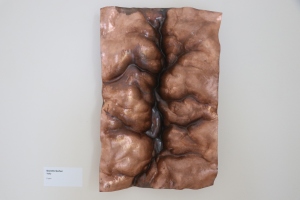
Hump  by Derrick Te Paske madde of butternut.  A professor at Framingham State University, Derrick says he is  primarily concerned with theoretical principles and digital production/reproduction methods. His art involves wood and other common tangible materials while employing tools and processes which are decidedly low tech, and results in unique and very physical objects.

Follow Your Dream by Melanie Zibit made of bronze and marble.  Melanie compares the sculpting process as being similar to writing a thoughtful essay or cooking a good meal for those you care about.  She says the process of creating art is like an act of love because you are sharing something deeply personal from one human being to another and sharing something personal spiritual and beautiful.

Circle Sea by Dan Rocha made of wood, metal, metal leaf and plastic.  A Massachusetts resident, Dan has won a number of awards for his works of art.

IMG_0894

Eagle Ray by Irene Fairley made of red Tenneessee marble.

IMG_0891

Eastport Cannery Worker  by Susan Neet Goodwin made of clay and multimedia.


Canyon by Danielle Gerber is made of bronze, brass and spray paint.  This sculpture shares the same theme as her other sculpture, Canyon.

Synthesis  by Kathleen Brennan made of hydrocal plaster.  Kathleen has several exhibitions currently on display throughout Massachusetts and New Hampshire.

Seahorse Green by Mara Sfara made of lucite and gemstone.

Binocular Beasts by Derrick Te Paske made of cast bronze and glass eyes.

IMG_0860

IMG_0865

Aureus Piscari  by Kimberly JB Smith made of multimedia items (it is a 2 sided display).  A resident of New Hampshire, Kimberly is most known for her 2d and 3d compositions that include recycles and repurposed materials.  She uses paint, paper pulp and collage to create traditional and nontraditional materials in her creative process.  When she isn’t creating art, she enjoys teaching and publishing educational articles.

Homer’s Boat With Siren by Dan Rocha made of wood, metal, metal leaf and plastic.

Colossal Shell Goddess by Lindley Briggs made of resin and apoxie.

Wave by Valery Mahuchhy made of resin.  Valery says he knew from an early age he wanted to be a sculptor.  His art is on display all over the world.

Eve On The Beach by Josie Campbell Dellenbaugh made of bronze.  Originally from Albany, NY, Josie is best known for her stone carving.  One of her more prominent carvings is the Monument For Our Native Peoples in West Rutland, Vermont.


Heron Annoyed by James Pyne made of composite materials.  A resident of Maine, James focuses on birds in his art.  He describes birds as, “the most beautiful creatures on Earth.”

Dogs are not allowed in the Langdon House.  But, I did see a few dogs while I walked to the house.

This little cutie named Izzie is a 6 year old Havanese.

Today’s featured New England based photographer is Eric Gendron. Based out of Portsmouth, New Hampshire, Eric photographs all over the New England area.  But, he primarily shoots in the New Hampshire and Maine area.  What I like most about his photography is that he can take the ordinary, like a park bench for instance, and turn  it into something beautiful and majestic.  You can follow him on Facebook here.