Tag Archives: sculptures

SculptureNow (Lenox, MA)

Date Of Visit: June 4, 2017

Location: The Mount, 2 Plunkett St, Lenox, MA

Dates and Hours of Exhibit: June, 2017 – October, 31, 2017, The Mount is open daily from 10:00 am to 5:00 pm through October 31st, except on early closing days (please see below). The Mount is open from 10:30 am – 3:00 pm most weekends in November through February. Please call 413-551-5100 to confirm hours.

Cost: $18 for adults, $17 for seniors (65 and older), $13 for students, children and teens (18 and under) get in free, $10 for military personnel (cost includes a tour of the Edith Wharton house and if you return within 10 days you can get in free again with your receipt)

Parking: There is ample parking available at The Mount.

Handicapped Accessible: Yes.  The trail is dirt bit wide and even for the most part.

Dog Friendly: No, except for service dogs possibly

Highlights: art on a easy trail, scenic views

Website: SculptureNow
IMG_0549

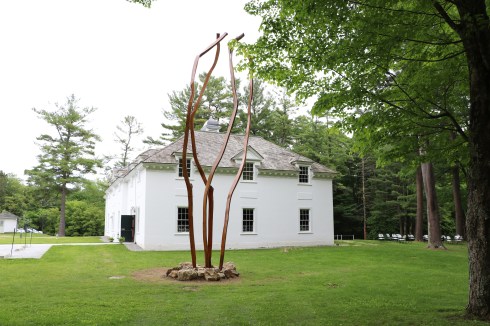
As if the Mount wasn’t beautiful enough, there are 30 amazing sculptures to compliment its beauty.

There are 30 sculptures along the trail.  But, when I went to visit in early June, not all of the sculptures were up.  I did the best I could to photograph as many as I could find.  But, I didn’t have a map or any other guide at the time to find them.  So, it was something like a “scavenger hunt” when I did visit the sculptures.  It looks like I found 22 of the 30 sculptures.  The art has a modern feel to it.  All thirty sculptures should be up now for your viewing pleasures.

The numbers next to the descriptions correspond to the descriptions in the map of the trail where the sculptures are located.  The link to the trail map is attached above in the website link.

1. The first sculpture is called Stall by Nancy Winship Milliken.  Nancy describes her sculpture as the following:

“This site-specific memorial honors the activities and architecture of a New England past. The horsehair gestures towards the building at The Mount which was at one time Wharton’s stable.”

2. The second sculpture is called Day’s End by James Kitchen.  James says his sculpture this way:

“Does our fast-paced, distraction filled world allow time to think, read and reflect, enjoy art in all its forms? Exhausted, we let media affirm our feelings rather than inform us.”

3. The third sculpture is by Harold Grinspoon.  According to Grinspoon, his art is:

“Giving new meaning to objects that have aged out of their original purpose, I invoke nostalgia for the familiar and an appreciation of new forms of beauty.”

4. 3. “Fallen Sky” by Coral Penelope Lambert is the next sculpture.  Coral explains her art this way:

“My work explores forces of nature and seeks to address the darker issues related to Earth’s resources such as mining and contamination where traces of the process remain.”

5. Stack C by Lydia Musco is a combination of nature and architecture:

“Architecture and elements of nature, such the work of gravity, influence this work. The form is built in one additive action, line by line, like layers of stories within memories.”

6. James N Burnes’ sculpture Nine Piece Ring is the next sculpture.  Burnes described his art this way:

“I create forms from nature that express our intimate relationship with Mother Earth. I am drawn to the tension between the natural and organic, man and nature, time and decay.”

7. Biomorphic by Michael Thomas is the next sculpture.  According to Michael, Biomorphic is:

“An undulating, sensual, and playful organic form, often encountered on the periphery of the natural world, realized here in steel. Biomorphic is the fluid movement of mass, coupled together with the visceral experience of color and texture.”

8. Distant by Philip Marshall is, according to Marshall:

“The nude model at a figure drawing held his pose for hours, eyes fixed on a distant point, maintaining his mental distance under prolonged scrutiny; he and the chair becoming one.”

9. Off The Rails by Lucy Hodgson:

“Our country: how we got here and is there a way forward? This is a comment on the decline of infrastructure—among many other things.”

10. Sheep by Madeleine Lord is:

“A pile of galvanized scrap metal sheering implied the subject: Steel Wool. I work the skeletal to the surface and the surface to the skeletal. Pulse arrives after I finish.”

11. Joseph Carpineto’s Walkabout

“This sculpture is inspired by a memory of the coarse undershirts my mother made for me from flour sacks. The rough feel of the rope is reminiscent of those undershirts.”

12. Bench I by Peter Barrett:

“Please, have a seat! I’ve wanted to incorporate some stone into my work since visiting a friend’s marble quarry, and here you have my first attempt.”

13. Anabasis by Chris Plaisted:

“I like to work with steel for its strength and powerful emotion. The subject is the human spirit. I was inspired by the sea and the concept of an upward journey.”

14. Yellow Peril by Setsuko Winchester:

“In 2015 & 2016, these 120 handpinched tea bowls traveled to ten U.S. concentration camps where 120,000 persons (mostly U.S. citizens) were imprisoned during WWII. Their crime was to be Japanese.”

15. Reflective Change by Martina Angela Muller:

“The undulating lines of music and the sculptural force of the wind informed these shapes. Both are continuous game changers that generate inner and outer movement leading to reflective change.

16. Avoidance Attractor by Matt Crane:

“Avoidance Attractor in its first iteration explores structure and materiality with a shift in scale and orientation. An empty piece of signage that invites projection, while remaining stoic and silent.”

17.  Netting For Water by Ann Jon:

“My work is an adventure, exploring new forms and media, hoping the viewer’s eye, mind, and heart will experience the sculpture visually, creating their own narrative or message.”

18. Fenestral by William Carlson:

“This sculpture is intended to pull the audience into the small portals of light as the sun rises and sets. The piece acts like a clock while controlling the viewer’s perception of the landscape.”

19. Blue Pulse by Murray Dewart:

“I want my sculptures to convey both the momentum of ritual pilgrimage and the stasis of meditative mandalas. They gesture in their various ways as resolute guardian forms, protective and consoling.”

20. Gnomon 1 by Christopher Curtis:

“Much of my work seeks context for humankind’s place in the natural world. Gnomon 1, made with stone, stainless steel, and gold leaf, is a good example of this investigation.”

21. Waterstone by Dove Bradshaw:

“Waterstone is a time-sculpture: For a slow action of water boring a hole, limestone was used; for fast boring, salt boulders and granulated salt mounds. Outdoors in winter, vodka replaced water.”

22. Poet’s Cry by Colleen O’Donnell:

“Weepings of unsound. A poet’s cry of light. Reflecting back into herself.”

23. Bittern by Robin Tost:

“The Bittern is a marsh bird who, when alarmed, stretches up its neck so that the striations on its breast give it perfect camouflage in the reeds.”

24. Twelve Cuboid Stack, I by David Teeple:

“My work centers on water as a subject, a material, and an idea. In this sculpture, I am interested in how the reflections and refractions create a new perceptual experience.”

25. Yellow Dakota + River by Stuart Farmery:

“Through abstract forms I reference a passage of time combining art historical sources, such as stone circles and constructivist concepts, with my awareness of current political, environmental, and communal issues

26. Hedge by Gary Orlinsky:

“Inspired by the two rows of linden trees that link the Mount’s gardens, Hedge creates a provocative dialogue between the organic movement of the saplings and the geometry of the boxes

IMG_0887

27. Gilavar by William Brayton:

“This abstract sculpture developed in response to a range of sources, including indigenous wind patterns, Polynesian stick charts, wooden boat building methods, storm tracking data, and chance-based fabrication systems.”

28. Gene by Eric Stein:

“Representing cause and effect, the cast concrete units of molecular design are stacked, colliding randomly. They present an undetermined beginning and illustrate the natural selection of options of creativity, form, and life

29. Tree With Spheres Jacque Metheny

“My sculpture juxtaposes geodesic spheres with the yet more complex structure of a tree. Geometric systems are the foundation of all material form. In nature we understand this as beauty.”

30. Caterpillar Bridge II by Roe Osborn:

“My sculpture combines construction materials in contextual mathematical formulas. This piece joins sections of drainage pipe in a dimensional sequence that captures and defines space in an engaging, yet playful manner.


Salem’s So Sweet (Salem, MA)

Dates Of Event: February 10-12, 2017 – usually the second weekend in February of each year (photos taken February 11)

Locations: Throughout the city of Salem

Hours:Visible 24 hours a day, until they melt

Cost: Free

Parking:Metered street parking is available and there are two big parking garages on New Liberty St and Congress St

The Downtown Garage (New Liberty St) costs $0.75 per hour.

The Waterfront Garage (Congress St) costs $0.25 per hour.

Both garages operate from 7:00 AM to 10:00 PM Sunday through Wednesday and from 7:00 AM to 2:00 AM Thursday through Saturday.

Public Transportation: The MBTA’s Commuter Rail has a stop which deposits its passengers right at Washington St.  $15 for a round trip ticket from North Station (fares vary depending upon where you leave from and where you are going)

MBTA Commuter Rail

Handicapped Accessible: Yes, but some roads and sidewalks are not shoveled well

Dog Friendly: Yes

Highlights: 26 Ice Sculptures scattered throughout the city of Salem, many sculptures are lit up at night, some shops and businesses offer discounts as part of the event

Web Site: Salem’s So Sweet

dsc_0847

Proving once again they are not exclusively a Fall destination, Salem Massachusetts has outdone itself with a sweet display of ice sculptures.

Widely known for their Halloween festivities, Salem has been trying to make their city a year round attraction for some time.  In fact, this weekend’s festivities were the 15th annual “Salem’s So Sweet” event.

The Salem’s So Sweet festivities began Friday night, February 10, with a chocolate and wine tasting at Colonial Hall at Rockafellas ($30 tickets).  Yum!

The sculptures look so much better when they are illuminated.  This was only the second year they illuminated the sculptures (at 5 p.m.) and not all of them were illuminated during my visit.  I was able to photograph all of the sculptures (except for the Han Solo sculpture which was not completed when I visited) and I photographed almost half off the illuminated sculptures.

The illuminated sculptures look better the later and darker it gets.  So, I stayed as late as I could to capture the beauty of the lighting against the dark background.  I also thought the holiday lights (still up in February) and of course the snow gave the photos a nice touch.

Since we had some inclement weather and the roads were snowy and icy, I elected to take the train into Salem.  It took a little longer than driving (not taking into account any accidents that may occur) but the transfers can be a hassle, especially having to cross the street from Park Street to get the train at North Station.

In any event, the train ride is comfortable and there are some pretty views along the way.

The 26 ice sculptures (25 not including the missing sculpture) are scattered around Salem although many of them are located in about a mile or two mile radius (on Essex, Washington and Hawthorn streets/boulevard).  The trickiest part is trying to get to the sculptures that are located on the outskirts (such as Bridge St and Derby St.  A trolley was planned to transport visitors to each of the sculptures but due to the inclement weather that plan was scrapped this year.

It’s a great activity for families and I saw quite a few parents and children looking for each sculpture and excitedly checking the sculpture off their list.  The children especially seemed to like hunting for each one.  Each sculpture is clearly marked and pretty easy to find if you use the map.  The Visitor Center also has bigger maps than the one on the web site and they are of course very helpful.

While they are generally located near each other by number, sometimes it’s easier to map out your own route and find them on your own regardless of the number of the sculpture which is what I did. I have included photos of the sculptures lit up as well if I was able to see them illuminated.  They look so much better when they are lit up!

The first set of photographs were located at or near Lappin Park, near the Bewitched Statue.  The first ice sculpture is Globe, sponsored by The Journeymasters

Han Solo is the second sculpture on their list.  Unfortunately, Han’s Falcon got stuck in traffic so his sculpture was not available to be photographed.

As if you haven’t seen enough of them yet, the third sculpture is a snowflake sponsored by Laura Lanes Skin Care.

Some of the lighted sculptures changed colors like this one sponsored by Salem State University; Opening of Sophia Gordon Center.

Accross from Lappin Park, on Washington St, is the ice sculpture at Rockafella’s.  The Rockafella’s Ice Bar is like a frozen patio.  The cold weather and icy bar didn’t stop them from grilling and enjoying the fresh air. At least you didn’t have to worry about your beer getting warm.

Farther down Washington St is Champagne sponsored by Adriaatic Restaurant & Bar.

Sponsored by Creative Salem, Hawthorne Hotel and Retonica and located on Front St is the ice sculpture Reflections.  This one was cool because you could stand behind the sculpture and act as though you are the reflection.

Next to the Reflections sculpture is Cinderella’s Carriage, also on Front St,sponsored by  Maria’s Sweet Somethings.  From a distance, if you look at a certain angle, you can almost see some driving the carriage with a top hat on.  Go on, let me know if you see it too.

The next ice sculpture on the list is Fish sponsored by Koto and located on Washington St.

The next ice sculpture is Lobster Love located at Turner’s Seafood on Church St.  This sculpture also changes colors when illuminated.

This sculpture is located by the Salem Cinema.  It is called Salem Film Fest 2017.

On St Peter St at Bit Bar is Arcade.

The next group of sculptures are all located on the Essex Street Pedestrian Mall and one on Central St which is an alley off the pedestrian mall walkway.

Green Tara, sponsored by Coon’s Card and Gift Shop, Penelope’s Pet Boutique and Tibet’s Art & Healing.

On the other side of the walkway, very close to Tara is Bella The Goat sponsored by Bella Research Group.  Bella’s sculpture also changed colors while it was lit.

Off Essex St on Central St is the Steampunk Heart ice sculpture.

The next two sculptures are both back on Essex St Pedestrian Mall.  This ice sculpture is located in front of the Peabody Essex Museum.  It is called Red Stiletto with Honda Engine and it was sculpted by David Crow.

On the other side of the walkway in front of the Museum Mall Place and very close to the red stiletto sculpture is the Winnie The Pooh ice sculpture.  Winnie doesn’t look very happy!

The next sculptures are located on Hawthorne Blvd and Essex St.  Sweet Jane’s Sweet Savings is located on Hawthorne Blvd.

dsc_0564

Queen Of Hearts is located across the street on Essex St.


The following ice sculptures are located on or off Derby and New Derby St.  Mug is located at the Notch Brewery and Tap Room.

These two sculptures are located at the Waterfront Hotel and Regata Ice Bar.  t first glance, it looks like one sculpture but they are actually two separate sculptures.

Across the street from the Waterfron Hotel is the Rumson’s Rum ice sculpture.

Candy is located in front of the House Of The Seven Gables and, aptly, across the street from Ye Olde Pepper Company (America’s oldest candy company).  Yes, those are real candies.  No, I did not eat any of them.

From Derby St, you would have to backtrack towards N. Washington St, near the Salem Commons to find Ruby Slippers located at the Salem Witch Museum.  And, yes, I agree.

The next ice sculpture is a little bit of a walk.  Bakery is located in the parking lot of Coffee Time Bake Shop (96 Bridge St).  In fact, you may want to drive to this sculpture.

And, yes, of course, there were lots of dogs in Salem checking out the sculptures.

Emmett is a 4 year old Cockapoo.  Look at those cute shoes!

Mattie is 7 years old.  She was bundled up for the cold weather!  She is also very well trained.

All of the dogs in Salem were prepared for the cold weather.  These dogs had some beautiful sweaters on keeping them both warm and fashionable.

I am not sure how long the sculptures are being displayed.  Between our erratic weather and hooligans who seem to get their kicks smashing ice art, I would suggest going soon to check them out before they’re gone!

Below is a video of the Bella The Goat ice sculpture changes colors.

Please connect with me on Facebook


The Nature of Glass: Contemporary Sculpture at Chesterwood 2016 (Stockbridge, MA)

Date Visited: July 16, 2016

Location: Chesterwood, 4 Williamsville Rd, Stockbridge, MA (413)298-3579

Hours: Open Saturday of Memorial Day Weekend to the Monday of Columbus Day Weekend. May 28 – October 10 of this year from 10am to 5pm daily. Self-guided tours only. Residence closed daily from 12:30pm – 2:00pm

Cost: Adults, $18.00; Seniors, $17.00; Grounds ONLY fee, $10.00; NTHP Members, Military & Children, 13-17, $9.00; Friends of Chesterwood & Children Under 13, Free

Parking: There is ample parking in the various parking areas for at least a couple hundred cars

Time To Allot For Visit: 1 hour to 2 hours (less if you don’t appreciate art)

Dog Friendly: No

Highlights: lots of art, statues, scenic trails

Nature Of Glass: Contemporary Sculpture

DSC_0496

Named after one of America’s foremost sculptor, Chesterwood is home to  the works of Daniel Chester French.  French’s work can be found on multiple continents.  His most prominent works include designing the Abraham Lincoln and the Minute Man statue in Concord, MA among many other works of art.

In addition to statues and replicas of French’s work, Chesterwood also shows off exhibits on its spacious grounds.  The latest exhibit, on display until September 18, is a bit of a break from the traditional pieces of French.  The Nature Of Glass shows a variety of unusual works of art for the entire family.

This blown gas display called Optic Lens Installation (2016) is by Richard Royal.  Part of the Optic lens series, this art evolved from his fascination with water or being near water as well as lighthouses and the Fresnel lens.  On the description plaque for this design, Royal said safety and security are recurring themes.  he finds glass and light as instruments of safety to be inspiring and he finds the system of glass and light to be metaphor for simple concepts and a reminder that basic things in life are sometimes the most important and have the strongest impact.

Throughout the exhibition, I found the artists to have a such depth and insight into what may seem to be simple displays.  This is a recurring theme throughout the displays.  It does make sense that the artists would have a deeper meaning to their work.  One does not put so much time and effort into a work of art without having some deep significance to their work and inspiration.

This sculpture by John Kiley is called Clear Cut (2016).  Kiley made this 8 foot sculpture out of glass, steel and Douglas fir.  According to the information on the sign next to the display, Kiley described his work as using circular openings to show interior divisions of space to alter their sense of space and light.  Depending on your point of view, the overlapping circles can focus your attention in different ways.  The Douglas fir is meant to connect the ground through a natural material to the sky using material engineered by humans, evoking a sense of history, place and reflection.

Martin Blank created Crystal Reveil (2012) from hot sculpted glass. The segments of the sculpture are curled and hollow so you can look through the sculpture and see a different form of negative space. The individual forms are very delicate and skin-like, similar to the madrone tree which is prevalent in the pacific Northwest.

Depending on where you stand and the time of day that you view Time Of Day – Blue Moment (2016), by Richard Jolley, looks different.  As you can see by the photos above, you see different things from each angle.  The work of art is of a veiled form of a human figure that changes color at specific times of the day.  The passage of light through the small portal will shift the light transmission and wash the figure in a blue light referencing daily time sequencing and change.  The intent, according to Jolley is to not only mark a specific, finite time of day but also to address the significance of the passage of time and awareness.  He went on to say how it addresses in a deeper sense time and the effect it has on every aspect of our existence.

I did photograph Time of Day again later in the day after viewing the other sculptures about an hour later to see any changes in the work.  Unfortunately, it was an overcast and misty day.  So, since there was a lack of light, the changes in the art work were very minor.  The photos are shown below

One In One (2014) by Thomas Scoon is a cast glass and granite sculpture.  Just short of 5 feet (57 inches to be exact), the figures are meant to show people rising from the external landscape.  He tried to choose rocks that evoked the feeling and gesture of human forms, specifically torsos and heads.  The layering of kiln-cast glass and stone allows light to pass through the figures and embodies the spiritual and physical essence of human nature into the sculpture.  He felt the combination of the materials expresses both the fragility and the enduring qualities and humanity.

Scoon continued with his granite and glass theme with Companion Series I-IV (2016).  Similar to the One In One sculpture,this work shows human figures made of cast glass and granite.  I suppose he didn’t want his other sculpture to feel lonely.

Earth/Sky (2016) by Tom Patti is one of the more unusual works at the exhibit.  Patti wanted to show the ambiguous condition between the literal and the phenomenal.  Patti felt the unique quality of the reflection combines the transparency of glass in his design.  This combination results in an ambiguous sense of space that obscures any references to the physical solidity of the materials, revealing the natural essence of the environment.

This work of art, like many more in the exhibit, was not as provocative because of the lack of light on the day of my visit.  If the sun had been out the shadows would have played off the work of art more dramatically.

One of the more unique works of art, Remember What (2016) by Marko Remec is 128 thirty two inch dome acrylic mirrors.  Also made of aluminum, steel hardware and twine, Remec’s work is described as a “chess pattern gone awry.”  The mirrors reflect 180 degrees of Chesterwood.  The work is a reconfiguration of the installation Can’t Hear You that had been displayed at MASS MoCA in North Adams, MA.

Another piece of work that would have benefited from sunlight, Vitro Muralis (2016) by William Carlson is made of granite, metal and glass.  The sculpture shares a common area of overlap.  The edges have a visual noise as they collide into shared space.  The transparent components are meant to offer a language of design as a text of spiral repetition and marks that are more musical than linguistic, according to Carlson.

Another design by William Carlson, Sine Nomine (Without A Name) (2014) is another sculpture made of metal and glass. The “x” in the middle of the sculpture is meant to reference missing identity.  It has also been used as a mark for those who cannot sign their name or in equations in algebra as an unknown in the equation.  Other interpretations include a reference to something that has been eliminated from a list.  The historical use of the x also makes it a powerful graphic symbol universally understood.  The exact meaning is not made clear in the plaque next to the sculpture.

Icebergs and Paraphernalia 117 (2007) was inspired by traveling through the Polar Regions, specifically a small stranded iceberg off the shore of Greenland that looked like a bird.  Created by Peter Bremers, the work of art is made of kiln-formed glass cut and polished and outdoor glass.  The almost marble structure pays tribute to the marble sculptures of the French.

Also made of kiln-formed glass cut and polished and outdoor glass, Movement II (2007) depicts a window moving forward.  The concept of the work is that we perceive “reality” as a dynamic image that changes in time and as a result of the viewer’s change in perception as well as how we rewrite history as our understanding of the past transforms the present and vice versa.

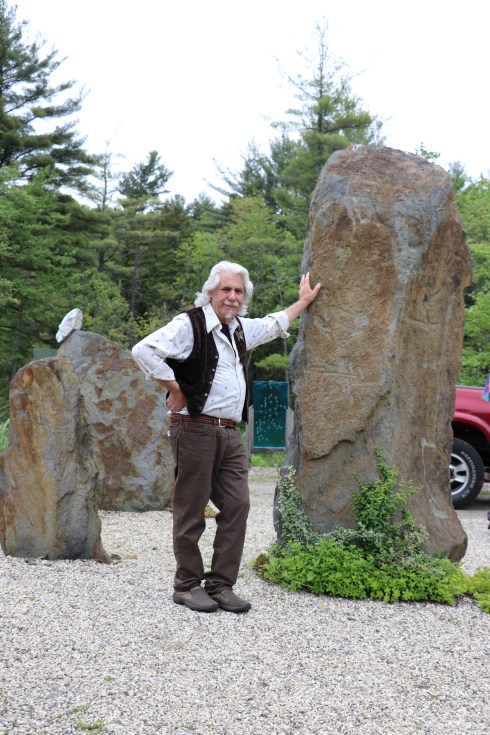
Daniel Clayman’s North 41.47 West 71.70 Copper (2016) may just look like an ordinary rock but there’s much more to this boulder.  The name coincides with the GPS coordinates where the boulder was found.  Copper refers to the interior treatment of the piece.  While on a jobsite excavation, Clayman observed large boulders being carted away to make room for a new landscape design. Clayman was struck with the idea of reformatting an ordinary boulder into a magical object.   When the sun is out, the sun reflects off the copper boulder making it a highly detailed surface (I had to use a flash to gain the same effect).

Julia’s Garden (the pieces range from 2010 to 2016) includes pieces from Nancy Callan’s Orbs And Winkle’s signature series.  The design consists of geometric forms (spheres and cones).  Callan strived to create a sense of infinity complexity with lines that wrap and fold around the shapes.  Each orb is like a world in itself.  The shapes of the orbs are said to represent planets.  The cones are meant to be like stocking caps – a reference to Rip Van Winkle – which gave the name Winkle to the pieces.  The cones also add a vertical element that echoes the growth of plants and trees – straight towards the sun as in White Spiral Cone or gently unfurling as in Ivory Winkle.

DSC_0474

Trigonal  (2016) by Kait Rhoads was inspired by a trip Rhoads took to  the Joshua Tree National Park in California after her the mother’s death.  Rhoads was struck by the beauty in the contrast of the quartz seams running through the fields of granite rock in the landscape.  Her search for healing and cleansing within a natural habitat largely untouched by man drew her to create the work of art.  She placed the color of the desert sky onto the form of the quartz crystal in a wash of opaque white ranging to intense transparent blue.

There is another work of art that I somehow missed.  Sidney Hutter’s Louie’s Electric Two (1976, revised in 2016) is sandblasted mirror glass design.

Dogs are not allowed at Chesterwood.  But, I did find this friendly cat.

Connect with me on Facebook to view photos, videos and other posts not included in this blog

New England Nomad


Clipper City Rail Trail (Newburyport, MA)

Date Visited: June 18, 2016

Location: Off Low St, Newburyport, Massachusetts

Parking: I entered the trail from Low St and free parking is available at Cushing Park on Kent St (2 blocks away from the entrance to the park) and parking was ample there.  There are several other trailheads and depending upon where you join the trail there are various parking areas.  You can find parking at the local MBTA station on Parker St and some other designated places.  it is best to check their website for specific parking areas.  You may also find off street parking.

Hours: open everyday, dawn until dusk

Cost: Free

Dog Friendly:  Yes

Distance: 1.1 miles each way

Time To Allot:  Half an hour to an hour

Highlights: bridges, trails for cycling, running and walking, art, artifacts, flowers, trees, historical and other surprises along the trail.

The Clipper City Rail Trail is not just your ordinary run of the mill paved trail.  The 10 foot wide trail which eventually spills out on the Newburyport Harborwalk, is lined with various works of art and other surprises.  The great thing about the art and items on the trail is that they have special meaning and represent the people and times of the area.

DSC_0767DSC_0770

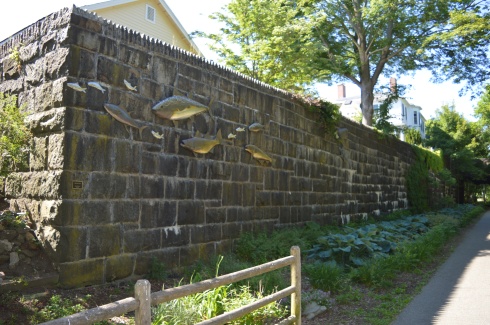
“Native Fish” by Bob Kimball (2010).  The sculpture consists of eleven stainless steel fish mounted on a large granite block wall on the edge of the Rail Trail.  The group of fish consist of half a dozen foot-long herring, two three-foot tuna, a five-foot cod and striped bass, and a seven-foot bluefin tuna.  The artist, Bob Kimball, is a brick and stone mason who specializes in working with copper, brass, glass and stainless steel.  He is based in the state of Washington.

DSC_0772DSC_0774

The “Great Blue Heron” piece was also created by Bob Kimball in 2010.  It was commissioned in memory of John Soward by his family and friends.  According to the plaque placed on the wall the work of art was dedicated to John Soward who lived on the other side of the wall where it is so prominently displayed.  The sculpture is based on John’s painting of the great blue heron.  John’s painting is below.  It’s a pretty accurate rendition.

soward watercolor

Around every corner and stretch of trail there is something interesting or fun to keep your interest peaked.  In fact, waiting to see what is next on the trail is enough to keep you going along the trail.

DSC_0784

“Wishbone” by James Irving (2010) is an interactive statue crafted by the Vermont based artist.  And, yes, you can sit on the seat there!

DSC_0796

DSC_0802

DSC_0792

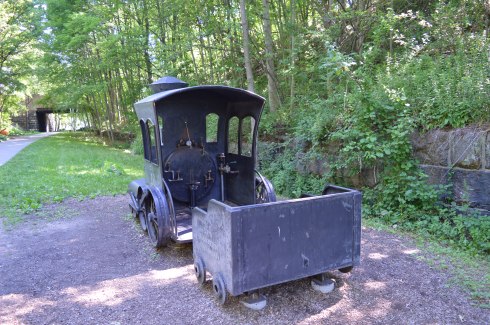
“Steam Loco” by Scott Kessel and Matt Niland (2010).  Kessel and Niland, both from Middletown, CT, created this play locomotive train to resemble the locomotives of the time.  It is a magnetic interactive destination for young children and their families.

The 19th century granite blocks pictured above once supported the Old Railroad Bridge Embankment at the Merrimack River (a mile or so from their current location).  The blocks were relocated during the building of the rail trail.  They are purposefully displayed in a star pattern.

There also a couple of bridges along the trail.

DSC_0808DSC_0811

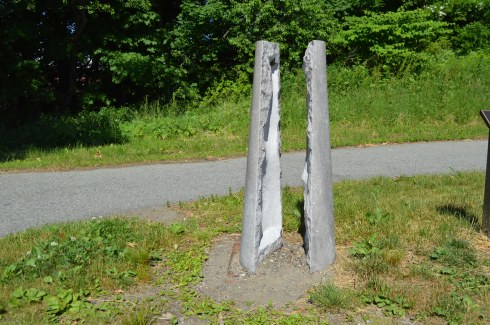
Unfortunately, some of the works of art have either been vandalized or disturbed by nature.  As I often say, this is why we can’t have nice things.This work of art “Will He” by Simon LaRochelle, based out of Quebec, is supposed to have a bicycle wheel in between the two slabs of limestone.  See the actual sculpture below.

Will He

Some surprises along the trail are less artistic than others.

DSC_0819

DSC_0838DSC_0836DSC_0835

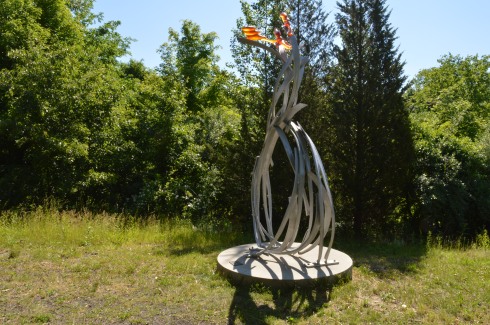
“Torrential Flight” an aluminum sculpture by Brian Russell (2010) from Tennessee.

“Eclipse” by Rob Lorenson (2010) is a stainless steel.  Rob is based in Middleborough, Massachusetts.

Rob has two sculptures on the trail.  Closer to the harborwalk at the end of the trail stands his sculpture “Brushstrokes” a  red powder coated aluminum

DSC_0909

Newburyport purchased a horse sculpture called “Clyde” from artist Jamie Burnes based out of Weston, Massachusetts and Santa Fe, Mexico. Jamie specializes in making sculptures of horses, bulls and other land based animals.  Originally displayed on the waterfront as part of the sculpture park, Clyde is made of corten weathering steel and black locust wood and was made specifically for the trail.

DSC_0928

“Sparrows” by Dale Rodgers (2011) based in Haverhill, Massachusetts.  “Sparrows” is a 16-foot corten weathering steel sculpture of two sparrows, naturally.

“G-Swirl” by Dale Rogers (his second sculpture on the trail) (2010) is a scaled up stainless steel abstract sculpture.

DSC_1024

“Peace Offering” (2012) is not just a bronze sculpture.  It is actually a bench by Michael Alfano of Hopkinton, Massachusetts.  The bench acts as  a functional bench featuring a dove, in which the tail becomes the head of a hawk and the wings become hands that invite two people to sit down and discuss their differences.  The sculpture, which now sits at the harborwalk, down a flight of stairs from the rail trail, was purchased by Newburyport for the Rail Trail, in bronze.  There are also additional castings of the sculptures.  One of the additional castings was a gift of the 2012 Hopkinton High School graduates and is still at the high school.


Many of the models and structures are relevant to the history of the area like this rail.  The rail on the bridge is from the original rail trail that was in place during the train wreck on May 23, 1873.  The accident was due to a misplaced switch that forced a freight train onto a dead end side track.  Interestingly, no one was injured during the accident (the two passengers- a fireman and an engineer – jumped out of the train before it crashed) and the train was back on the track two days later.  But, it became famous, in part because many of the onlookers and the aforementioned engineer and fireman requested their photo be taken at the wreck.  The trail is also popular with skate and long boarders as you can see in the final photo.

DSC_0994DSC_1000DSC_1027

At the end of the southern most side of the trail is “Archway”by Mark Richey Woodworking.  The archway, made of white oak, leads to the commuter train, fittingly, at the end of the rail trail.

DSC_0942

There are also several well manicured and cared for plants, trees, graffiti and grassy areas on the trail.

This slideshow requires JavaScript.

As an added bonus (I know some of you who will really appreciate this), there is a pathway cut through the trees and brush to an ice cream shop with a handy sign to point the way.

There was also a PanMass Challenge when I was visiting.  The bike ride is actually a 5 mile loop that ends at the harborwalk.

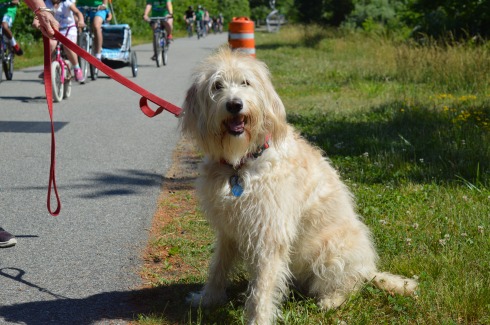
With its long, wide trails and grassy areas, the Clipper Rail Trail is a great place to walk your dog.  Rufus, a 5 year old sheepdoodle, enjoyed the cloudless, sunny day on the trail.

DSC_0936DSC_0931

And Savannah, a 4 year old Lab mix, took a break to pose for me.

DSC_0887DSC_0879


Rotary Common Park (Nashua, NH)

Date Visited: March 5, 2016

Location: 315 Main St, Nashua, NH

Reflection Garden & Labyrinth

DSC_0169

Located next to the New Hampshire Holocaust Memorial on Main Street across from a strip mall and busy roadway, the Rotary Common Park is a most unlikely place to find an art display.  But, the Rotary Common Park is just that; an outdoor art museum.  And this isn’t just some tourist attraction.  The art here is very thought-provoking and amazingly crafted.

DSC_0202DSC_0203DSC_0206DSC_0198

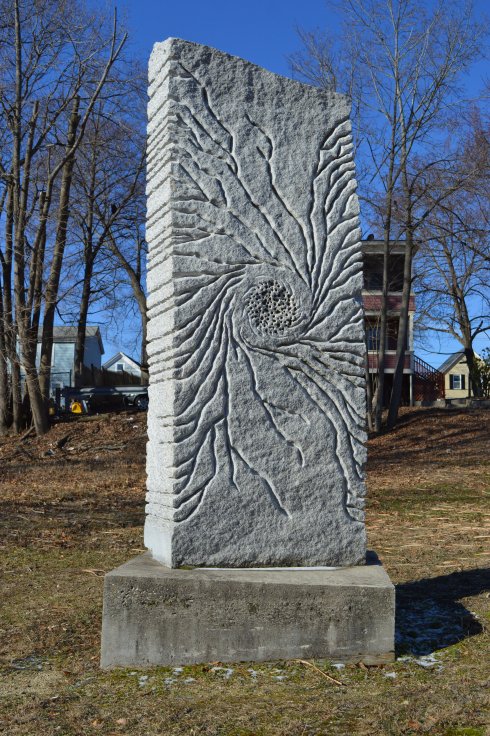
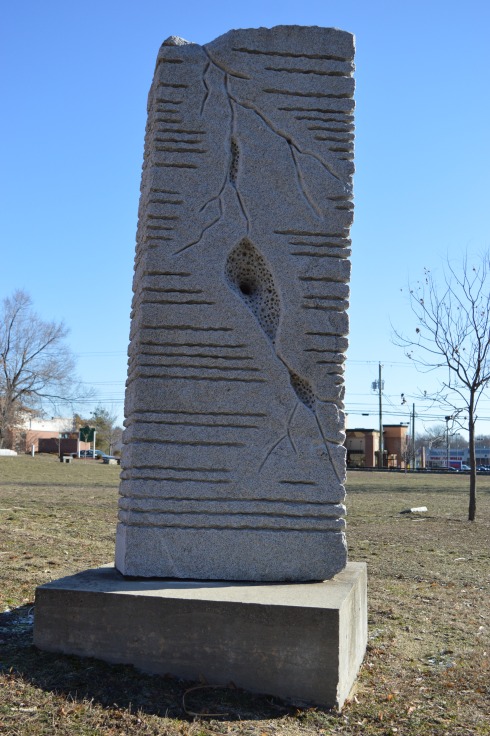
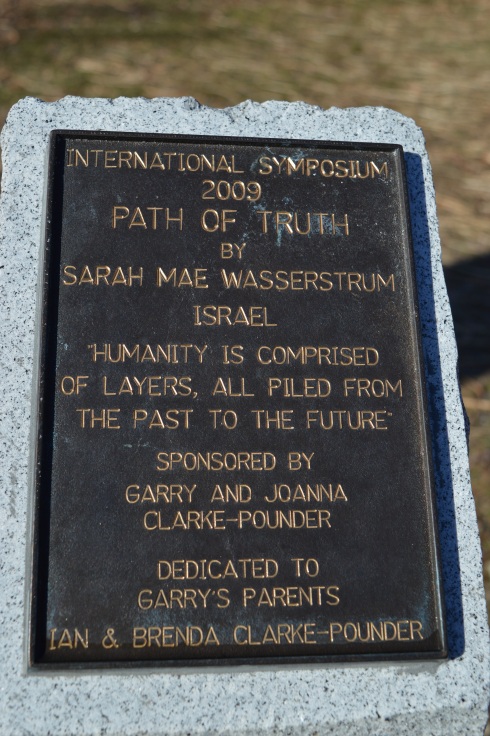
The “Path Of Truth” is a memorial to the “layers of humanity”.  Or, as Sarah Mae Wasserstrum said;

“From the Origin layers of Humanity, we are connected by a common denominator.”

She imagines humanity as like layers, some thicker and some modest, all plied from the past to the future.  The stone signifies the immense power of people and our ability to grow and change.


DSC_0162

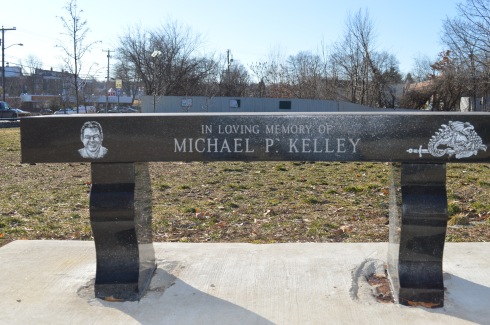
A bench dedicated to Michael Kelley.  Who was Michael?  What was he like?

Since it is located directly across from the Holocaust Memorial, the Reflection Garden & Labyrinth is the most popular spots at the park.  Benches, sculptures, tiles with words of inspiration and works of art dot the circular reflection area.

DSC_0228DSC_0222DSC_0218

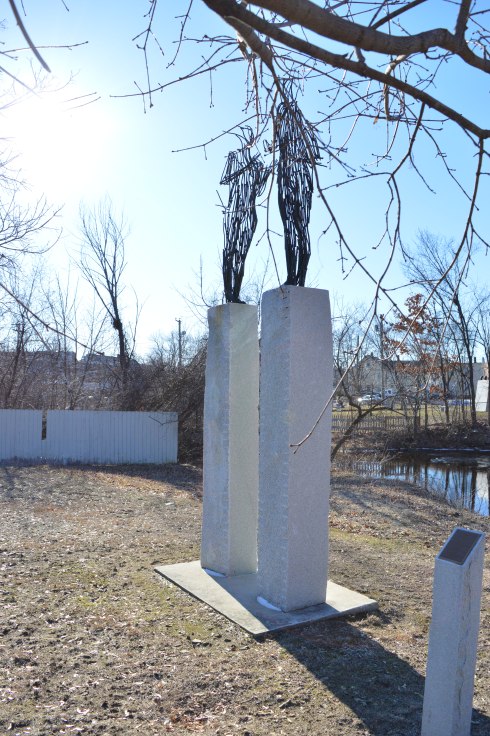
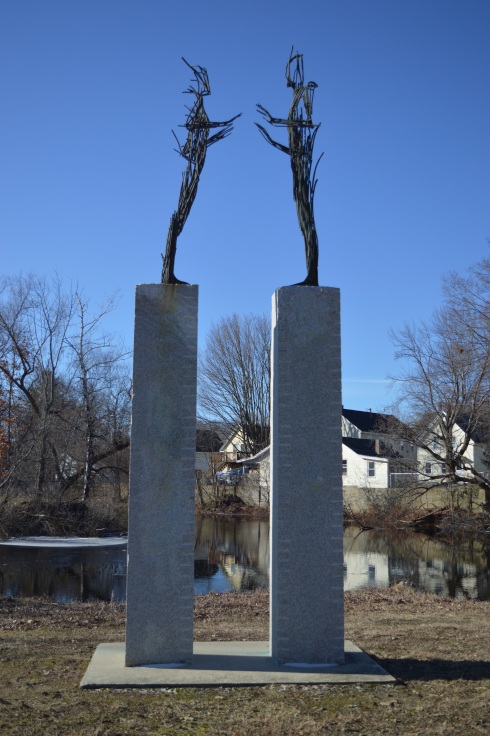
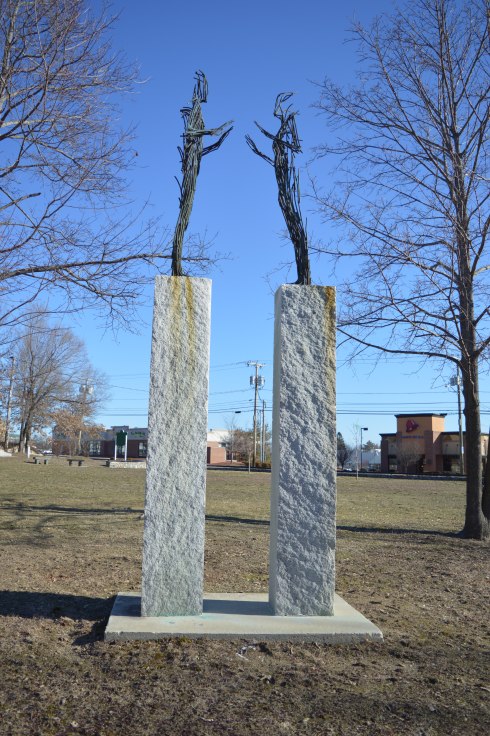
The “Encounter” sculpture by Luben Boykov,

Boykov described it as, “The present moment of meeting becoming a place in the future.”

Boykov explains the sculpture as a moment just before people meet that are so quick but also last forever.  It represents an encounter that can begin a lasting relationship.

There was also a surprising amount of animal activity in the area like this bird and a thirsty cat.

DSC_0156DSC_0115

The displays at the Rotary Park change on a regular basis so keep an eye out if you’re in the area!

Please stop by my Facebook page and like my page.

New England Nomad


Dr. Seuss National Memorial Sculpture Garden (Springfield, MA)

Date visited: January 16, 2016


Located on the grounds of the Springfield Museums, the Dr.  Seuss National Memorial Sculpture Garden pays homage to one of Springfield’s most famous people, Theodor Seuss Geise (aka Dr. Seuss), and some of his characters.

This slideshow requires JavaScript.

The grounds are accessible to the public during the museum’s normal hours without a fee.  You only need to pay if you want access to the museums.  The garden does not only have sculptures and art work related to Dr. Seuss’ characters.  There are statues and other pieces of art and buildings on the grounds.

This slideshow requires JavaScript.

I will be posting about the Springfield Museums in a later post.  Here is a quick preview: