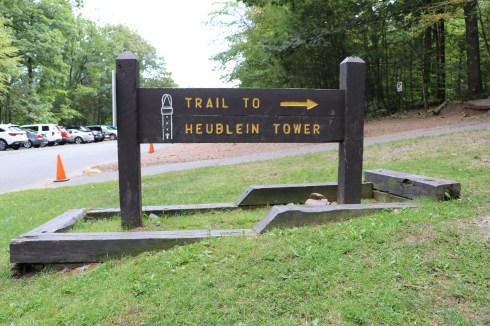
There is no parking lot at the park. Parking is allowed on the side of the road at and near the trail to the tower
Don’t forget to check out the scenic views on the way up to the tower by taking the trail closest to the ledge (the trail on the right after the trail splits
The trail has a steep incline at the beginning but evens out and becomes easier about halfway to the tower
If using a GPS: Parking is located on Summit Ridge Dr. Simsbury, CT 06070
Once the home of Gilbert Heublein (pronounced “High-Bline”), Heublein Tower offers some of the most pretty views in the Connecticut River Valley.
As legend has it, during a hike of Talcott Mountain with his fiance Louise M. Gundlach, he promised her that one day he would build her a castle there. He would make good on his promise in 1914 with the Heublein Tower.
Heublein manufactured such delicacies as A1 Steak Sauce and Smirnoff Vodka. Anyone else hungry for some steak and vodka? A barbecue, perhaps?
Heublein Tower is located along a trail that begins at Talcott Mountain State Park. Parking is available along the sides of the road to the tower.
Along the trail to the tower, you can take the trail on the right to see some pretty views of the Farmington River Valley. As you can also see by some of the photos, the trail does have some inclines. There are also some benches along the trail at the beginning of the trail.
During certain days you can enter the tower and view the rooms in the tower. The at times arduous hike is worth it for the views of the tower and the self guided tower of the inside of the tower.
The views from Heublein Tower are stunning.
The trails are not too hard for man nor beast. Dogs of a variety of sizes and breeds were on the trail during my visit.
Hiro is a 7 month old Cobberdog
Monte is a 2 year old Tibetan Terrier.
Kaiser is a 2 year old Airedale.
Roscoe (on the left) is a 3 year old Rottweiler. Love his bandanna!
Hours: Open daily, 9:00 – 5:00 (hours may vary depending on the season)
Cost:
Adult – $28.95
Senior (ages 65+) – $26.95
Youth (ages 4-14) – $18.95
Children (3 and younger) – Free
Parking: there is a free parking lot across the street from the Seaport Museum. There is also additional parking across the street from the parking lot for overflow
Handicapped Accessible: Yes, but not all of the buildings are accessible to the handicapped. Approximately one-third of our buildings have wheelchair-accessible entrances; interior access varies. The village’s unpaved roads are generally firm and stable suitable for wheelchairs and strollers. All roads are basically level with a few slight inclines located near the Children’s Museum, Treworgy Planetarium and Membership Building. (see link below for more info)
Highlights: living museum with character actors, boats, replicas of historic homes, figureheads, lighthouse replica, play area for children
Tips:
For an after museum viewing treat, Mystik Village, an open area shopping mall is a mere.9 miles away on Coogan Blvd
the museum’s main parking lot can fill up quickly if you don’t get there early. Additional parking can be found in the lots off Rossie St on the other side of the main parking lot
In my previous posts about Mystic Seaport, I shown you the figureheads and the ships and boats of Mystic Seaport.
In this final installment, part three, I am going to focus on some of the buildings and historical items at the museum. I hope you enjoy!
The first exhibit room at the Thompson Exhibition Hall has many interactive exhibits and artifacts and exhibits from a bygone era.
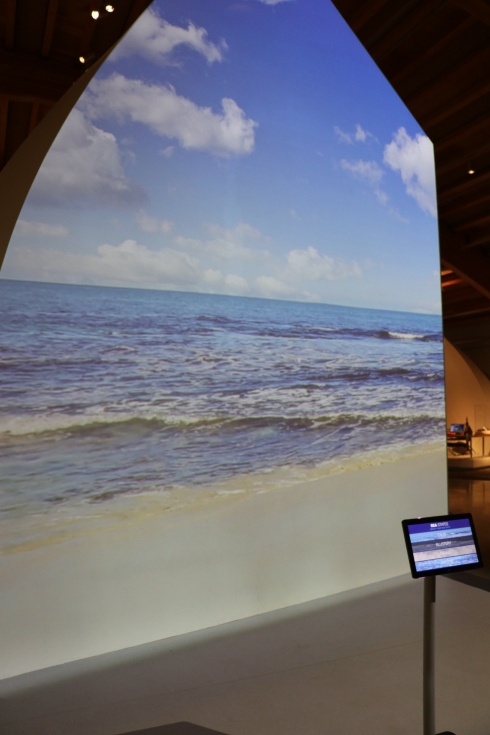
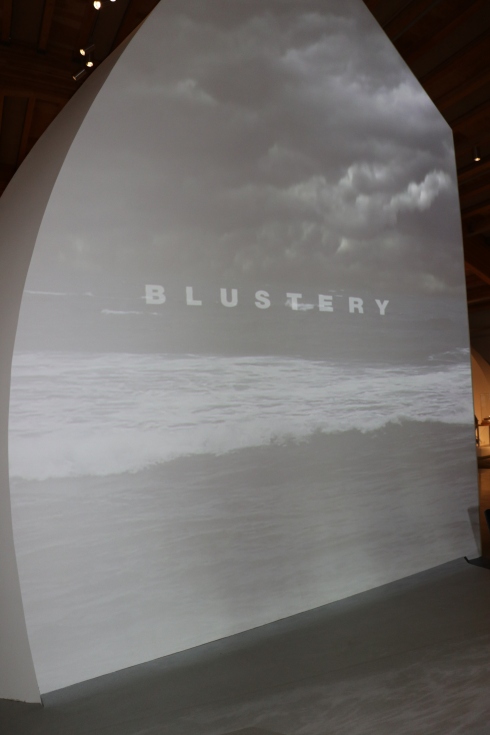
The first interactive exhibit is called “Sea States.” At this exhibit, you can watch video of the water from calm
to blustery
and every other weather condition you can think of.
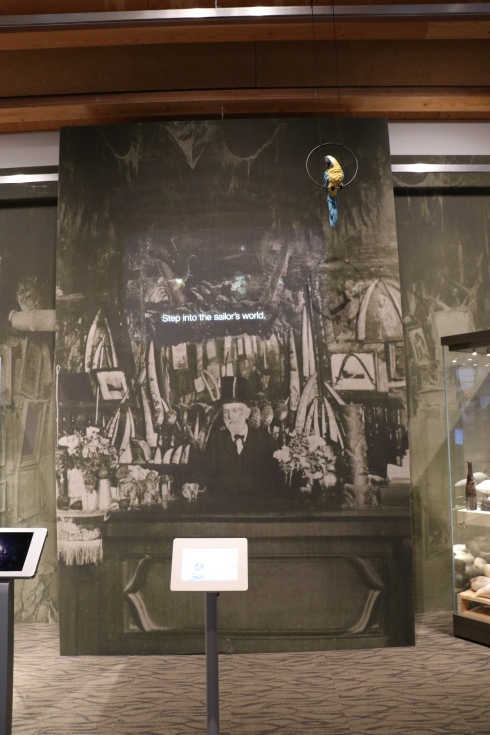
In the Thompson Building is a very large room packed with lots of historical items. And many of these exhibits and items have interactive devices that give more information and historical context to the items.
These carved etchings were made on teeth and bones of whales.
People may think captains and other sailors were not attached to their families, being away from them for so long and because of traditional family dynamics. However, nothing could be further from the truth. Sailors seemed to have a very strong connection to their families, especially their children.
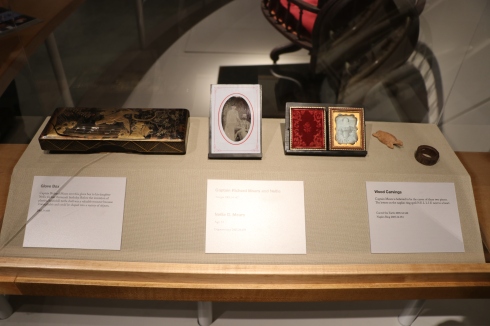
Pictured below are a glove box, photo of Captain Richard Columbus Mears and his Nellie, his daughter (Nellie Goodsell Mears Van Valkenburgh) and some wood carvings he made.
Captain Mears, born in Accomack County, Virginia in 1829, was a merchant ship captain based mainly out of New York.
The black and gold item on the left is a glove box that Captain Mears sent to Nellie for her 13th birthday. Believe it or not before plastics were invented people made these objects out of turtle shell. This particular glove box was made out of a hawksbill turtle shell.
The photo next to the glove box is a photo of Captain Mears with Nellie. To the right of the display are wood carvings by Captain Mears. The napkin ring, also carved by Captain Mears has the letters N E L L I E with a heart next to it.
This crib also has turtle shell in its design. In the second photo you can see the turtle shell reflected in the mirror under the crib.
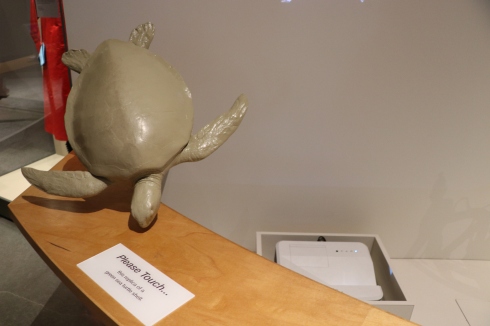
Most museums do not want you to touch their exhibits. But, the Seaport Museum has this replica of a turtle for people to touch to see what they felt like that. It was smooth and silky. I want one. A real one.
This bed from that era, pictured below, had some interesting designs on it.
These carvings are miniature figureheads. They are models of life sized figureheads that adorned ships of those days.
There are also several models of boats from the earlier days of the seaport.
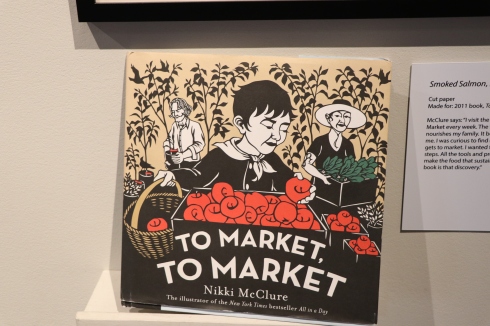
Nikki McClure’s book To Market, To Market was on display at the Mallory Building. McClure, a papercut artist based out of Olympia, Washington, is an author and illustrator who mainly writes children’s books with an environmental theme. I love her art!
The were other works of art from her books Waiting For High Tide and Life In Balance.
I liked these pieces from her exhibit best.
I also loved the educational historical buildings with the re-enactors. The people in these buildings are very knowledgeable and friendly.
In this building, The Cooperage, coopers (barrel makers) were making barrels. The old fashioned way.
This is the Nautical Instruments Shop. They have many clocks and timepieces as well as nautical devices such as compasses in this building.
The Mystic Print Shop is a true to life replica of the print shops of the 1800’s. If you look closely at the photos in the corner, you will see how the template or blocks on the metal pad match up with the words on the printed sheets.
The people at the Shipsmith Shop and Hoop Shop reenact ship and mast builders.
There is also a replica of a lighthouse that you can enter. A short documentary plays on a loop in the lighthouse.
There are also several shops that are replicas of the buildings of the 1800’s.
The Geo. H. Stone & Co store is a replica of the stores of the time.
Of course no living history museum would be complete with a school house.
The drug store had some interesting remedies of the time.
The Seamen’s Friend Society was a place the seamen could go to read, learn to read or have a book read to them. Since sailors spent a lot of time at sea and began working at a very early age sometimes they were not literate. They came to places like to be tutored or just to have someone read to them.
Formerly located in Saybrook, Connecticut, the Buckingham-Hall House is a two story building with two bedrooms and several sitting and family rooms. Being self-sufficient people, there was also a sewing and quilting area with a variety of fibers. The house was owned by William Hall Jr., from the estate of Samuel Buckingham. I love how they used to design the windows in those days. They weren’t big as many windows are these days. But, they were much more fancy and, despite their small size, allowed for a good amount of light. There was also an open hearth cooking demonstration in the kitchen during my visit.
One of the other homes at the Seaport Museum is the Thomas Greenman House. The house was originally built for Thomas and Charlotte Greenman in 1942. THomas Greenman was originally from Westerly, Rhode Island but made his way to Mystic later in his life.
The kitchen and the second floor are not accessible to visitors. But the rooms on the first floor are decorated and furnished in the Victorian style of the 1870’s. I always think I want to live in these types of houses because of their ornate designs and their charm. Then I realize just how oppressive it must have been during the hot summers and frigid winters. Not to mention they didn’t even have WI-FI.
The Burrows House is a very small home, yet almost as big as my apartment, that stands as an example of many of the homes of that era. The house, which is said to have been built between 1805 and 1925, was the home of storekeeper Seth Winthrop Burrows and his milliner wife, Jane. That is some tight stairwell.
The Stillman Building has a variety of interactive displays and historical items collected over the years of the seaport’s history. My favorite part of their exhibits in this building are the notes children wrote about whales and the sea.
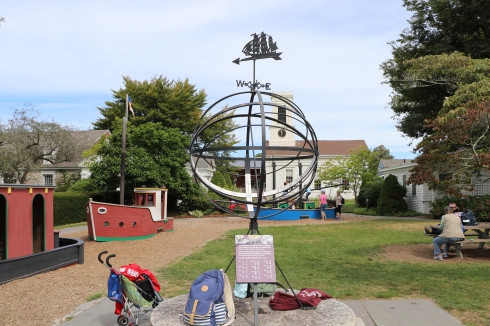
This timepiece, found by the children’s play area, acts like a sundial and gives precise times throughout the day. But, people seemed more interesting in using it for coat and backpack storage. I was tempted to check out that boat there.
Lastly, the walkways to the different buildings is level and handicapped accessible (although some of the older historic buildings are not). And there are lots of pretty views along the way. I love the old pumper, which had to be moved manually.
Mystic Seaport is a dog friendly museum (although they are not allowed in the buildings). These two cute curly dogs were hanging out by the bench with their guardians.
Fuzzy (the white dog on on the left) is a 4 year old female Goldendoodle.
C-Doo (short for Colossus of Doodle), on the right, is a 1 year old Goldendoodle
Hours: Open daily, 9:00 – 5:00 (hours may vary depending on the season)
Cost:
Adult – $28.95
Senior (ages 65+) – $26.95
Youth (ages 4-14) – $18.95
Children (3 and younger) – Free
Parking: there is a free parking lot across the street from the Seaport Museum. There is also additional parking across the street from the parking lot for overflow
Handicapped Accessible: Yes, but not all of the buildings are accessible to the handicapped. Approximately one-third of our buildings have wheelchair-accessible entrances; interior access varies. The village’s unpaved roads are generally firm and stable suitable for wheelchairs and strollers. All roads are basically level with a few slight inclines located near the Children’s Museum, Treworgy Planetarium and Membership Building. (see link below for more info)
Highlights: living museum with character actors, boats, replicas of historic homes, figureheads, lighthouse replica, play area for children
Tips:
For an after museum viewing treat, Mystik Village, an open area shopping mall is a mere.9 miles away on Coogan Blvd
the museum’s main parking lot can fill up quickly if you don’t get there early. Additional parking can be found in the lots off Rossie St on the other side of the main parking lot
In part I of my blog posts about Mystic Seaport I showed you all of the figureheads and some other decorations and statues at the Seaport Museum. Since there were so many interesting things to see and photograph there, I decided to break the blog post into two or three installments . In this installment I will include photos of the boats and ships from the Seaport Museum (it is a seaport museum after all). I hope you enjoy!
The ship pictured above and the staple of the Seaport Museum is the Charles W. Morgan,the last of an American whaling fleet that once numbered more than 2,700 vessels. The Morgan, built and launched in 1841, is presently America’s oldest commercial ship still afloat. In fact, it is only second to “Old Ironsides”, the USS Constitution, in terms of age. It’s also very hard to fit the entire vessel in the frame of your camera’s view.
As I travel all over New England, I have become more aware of how all of the states in this region are interconnected. Evidence of this is how the Morgan was launched in 1841 in the city of New Bedford, Massachusetts, an area that enjoys a prominent role in American fishing and whaling history.
Clocking in at 106 feet, 11 inches in length on deck and a beam measuring 27 feet, 9 inches, the Morgan was and still is one of the larger vessels in the New England area. Her main truck is 110 feet above the deck and fully-rigged, and her sail measures in at 7,134 square feet.
But, lest you think the Seaport Museum is a one trick pony, there are lots of other sea worthy watercraft at the museum.
The Calypso stretches 23′ in length with a 7’4” beam with a 2’5″ centerboard up. It is made of fiberglass in an old French wooden boat design. Built in 2004 at Latitude 46 Yachts, Ile de Re, France, the Calypso has a 9 horsepower Yanmar diesel engine. Yeah I don’t know what that means either.
Calypso spent a decade racing and day-sailing along the South Shrewsbury and Navesink Rivers in New Jersey. After being damaged during Hurricane Sandy in 2012, the boat was fully restored. The boat is on exhibit and used for museum programs.
Designed by Nathanael G. Herreshoff, Aida was built in 1926 by Herreshoff Manufacturing Co in Bristol, Rhode Island. Aida measures out to 33’6″ in length with a beam of 9’2″ and it has a draft of 3’1″.
Aida was owned by author Maynard Bray who used it to sail the waters of Maine. She is planked with Longleaf yellow pine and Douglas fir and is framed with white oak. She is fastened with bronze. She is available for charter.
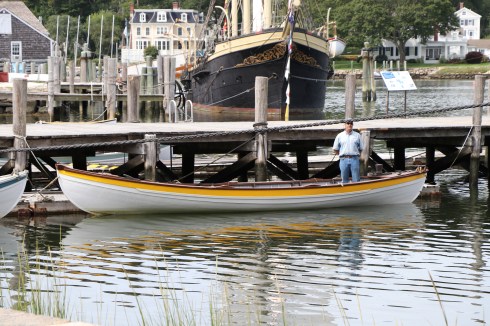
While there are other boats both on exhibit and available for charter, some of them were not available for photography. I did find this Smallboat Exhibit.
Originally launched as George Stage, the Joseph Conrad, an iron hulled sailing ship, is also docked at the Seaport Museum. She served as a training ship for American and Denmark sailors, separately, and has been used as a yacht in the past. She 100’8″ on her deck, her bean is 25’3″ and her draft is 12′.
They were raising her sails when I began photographing the vessel.
Speaking of figureheads and masts, check out the figurehead on the Joseph Conrad.
You never know what you’ll see at the museum. Randomly, a man who works at the museum began singing on this boat.
This boiler is from an old ship that was once sea worthy.
There is also a replica of a Verande which was used in the planning of a much longer Viking longship. The Verande would be sea tested by towing, rowing and sailing to test its seaworthiness, ease of handling, safety and speed.
In the Stillman Building, there is a replica of a captain’s quarters for the 1883 ship Benjamin F. Packard. It felt pretty cool being able to access the living quarters of a captain without actually having to go out on a boat.
It looks cozy for sure. The articles in the last photo are the figurehead, a billethead, and some of the other items that would be on the ship.
This concludes the ships and boats installment of my blog posts from Mystic Seaport. Next, I will post about the buildings and some of the historical items on exhibit at the museum. Thank you for reading!
Outside of the Stillman Building, I saw these two adorable Longhaired Dachshunds.
Hours: Open daily, 9:00 – 5:00 (hours may vary depending on the season)
Cost:
Adult – $28.95
Senior (ages 65+) – $26.95
Youth (ages 4-14) – $18.95
Children (3 and younger) – Free
Parking: there is a free parking lot across the street from the Seaport Museum. There is also additional parking across the street from the parking lot for overflow
Handicapped Accessible: Yes, but not all of the buildings are accessible to the handicapped. Approximately one-third of our buildings have wheelchair-accessible entrances; interior access varies. The village’s unpaved roads are generally firm and stable suitable for wheelchairs and strollers. All roads are basically level with a few slight inclines located near the Children’s Museum, Treworgy Planetarium and Membership Building. (see link below for more info)
Highlights: living museum with character actors, boats, replicas of historic homes, figureheads, lighthouse replica, play area for children
Tips:
For an after museum viewing treat, Mystik Village, an open area shopping mall is a mere.9 miles away on Coogan Blvd
the museum’s main parking lot can fill up quickly if you don’t get there early. Additional parking can be found in the lots off Rossie St on the other side of the main parking lot
Once a major seaport, Mystic Seaport no longer functions as the busy hub of commerce and fishing or transportation. But, they have preserved some of the historical atmosphere while still incorporating modern technology.
Since Mystic Seaport is such a big attraction, I am posting my blog posts in three or possibly four installments. My first installment deals with the Viking ship display which was being featured at the museum as well as the figureheads, decorations and other sculptures at the museum.
During my visit, there was a Viking ship docked at the museum. Tours were being provided for a small charge.
By far, my favorite part of the museum is the figurehead museum. The dimly lit room, which made photography challenging, in the Wendel Building added to the mystique of these treasured works of art.
This scroll billethead figurehead is the oldest one in the museum. Many ships used these billetheads in lieu of figureheads because they were easier to carve and less expensive than the full sized figureheads.
There are several other figureheads in the museum which stood out to me.
This scary cat timber was used while lifting the anchor and keep it away from the ship so it would not damage the vessel.
Most of the figureheads are of people, though.
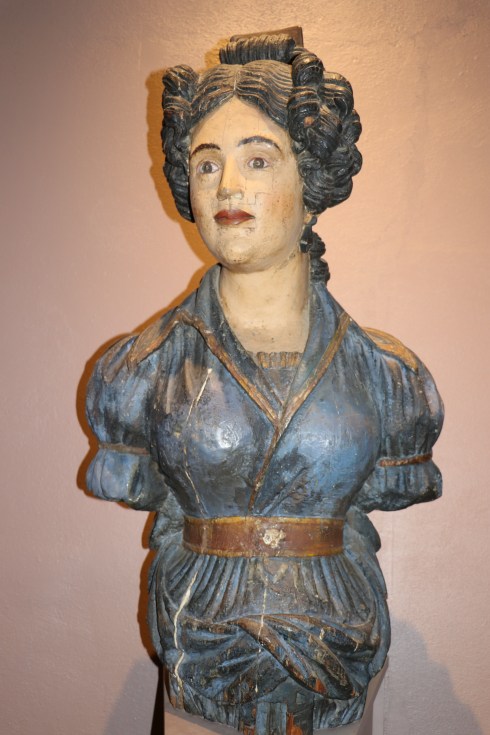
This figure titles Woman With A Comb. Although it’s hard to tell when some of these figureheads were made, it appears this figurehead was made during the 1820’s. This figurehead shows a hairstyle and clothing style that was popular during the 1820’s. Unlike some of the figureheads you may have seen previously where the figurehead leans forward and under the bowspirit, this figurehead stands upright, which was common until the 1840’s when they changed to the design that leans forward.
Woman With Roses has an interesting historical background. This figureheads, which resembles a portrait more than an actual figurehead, was originally called Belva Lockwood when it first came to the seaport museum. Belva Ann Bennet Lockwood, who this figurehead resembles, was a leader in the women’s suffrage movement during the late 1800’s. She was nominated for President of the United States in 1884 and 1888. Despite her historical significance and the likelihood that a ship would have been named after her, there are no records that show her name on any vessel.
Donald McKay is a figurehead made for the 1855 clipper ship Donald McKay. Named and designed after the famous ship builder and designer Donald McKay, this figurehead was broken off its vessel and stood unprotected, outdoors in the Cape Verdes islands off the coast of Africa. It was restored and repainted but it still shows the effects of being exposed to the conditions. The first figurehead for the vessel was lost at sea and this figurehead which replaced the original one was believed to have been carved by the ship’s carpenter while the ship was out at sea.
Seminole decorated the ship vessel of the same name for over 40 years. The figurehead, which was built by Maxon Fish & Co in 1865 in Mystic, CT, is believed to have been carved by James N. Colby and James Campbell. Colby and Campbell were prominent ship and sign carvers and decorators in the Mystic area from the 1850’s until 1877. Seminole, an offshoot of the Creek Confederation, means “separatist” or “runaway.”
Seminole carried cargo from New York to San Francisco and vice versa for over 20 years. It was captained by another Mystic, CT, native Joseph Warren Holmes. Holmes would go on to make 84 passes by Cape Horn, a record among captains at that time. Eventually, the Seminole ended up in the west coast lumber trade and was finally broken up at Port Adelaide, Australia, in 1904. The figurehead was salvaged and, 50 years later, Mystic Seaport acquired it.
Magdalena is the largest figure of the collection. Magdalena once adorned the bow of the 421 feet long British Royal Mail steam packet Magdalena which launched in 1889 in Glasgow, Scotland.
Iolanda is considered the second figurehead for the steam yacht of the same name. The industrialist Morton F. Plant of New York and Groton, Connecticut, had this figurehead adorned to his yacht when he made his 33,000 mile voyage to India, China, Japan and the Mediterranean.
After Plant, the figurehead had many more owners including a Russian Princess and the British Navy where she saw service in both World Wars.
The figured pictured above called Aleppo could not be identified since there are no records or photographs to match it to any vessel. I find this makes the figureheads even more mysterious and interesting.
This figurehead once adorned the Rhine shipping vessel which was built in Scotland in 1886. The harp and caduceus necklace are said to portray her as a classical figure rather than a portrait or national symbol. It is typical of the British sail and steam vessels of the late 19th century.
The Rhine transported laborers from India and China, jute from Calcutta and lumber from Boston. After being damaged by a fire after World War I, she was sold to a junk dealer for $925. Shen then became a barge in New York.
This ghost-like carving called White Lady is not a figurehead, despite its strikingly similarities to other figureheads. One of the reasons the museum was able to determine it is more likely a decoration or sign are because the posture is too erect. Figureheads were carved to fit the curving shape of the vessel’s bow. Another reason this was not a figurehead is that her outstretched arm would have been particularly vulnerable to damage at sea. Also, her elaborate scrollwork base is very unusual for a figurehead. Lastly, there is no evidence of the wooden or iron fastenings that would typically have held the carving to a ship’s bow. You know, the obvious reasons.
Cover your eyes! This unidentified figurehead which has been named Women With Goblet by the museum is said to have been the victim of well intentioned but overdone restoration. The flowers around the bae were reconstructed and the outstretched right arm with the goblet is not original. Typically, carvers made the arms close to the body because it reduced the possibility of damage by the sea.
This figured, The Great Admiral, was craved in the honor of and dedicated to Admiral David G. Farragut. Farragut was an Admiral in the United States Navy during the Civil War. In 1869, a new clipper ship, The Great Admiral, was commissioned in his honor with this figured on the bow.
The figurehead was eventually salvaged after the ship was wrecked off the coast of Oregon in 1906 and it eventually made its way all the way to Mystic.
Woman With Beads was carved in the classical British figurehead style. It is said to represent one of Victorian England’s literary or historic characters.
Abigail is believed to have been carved for the vessel of the same name which was named after the ship’s owner’s wide, Abigail Chandler. The figurehead was found after the ship crashed along the coast of Massachusetts in 1817.
Great Republic once adorned the largest American ship of its day, if only for a few weeks. This figurehead was once on Donald McKay’s clipper ship The Great Republic. Built in 1853, the 335 feet long The Great Republic is the largest cargo ship ever built in the United States.
The eagle, which was carved by S.W. Gleason & Sons of Boston, was on the ship for a few weeks when the ship was damaged by a fire. The eagle was then removed and kept by Captain Nathaniel Palmer of Stonington, CT. Captain Palmer had the burned out hull of The Great Republic removed and built into a smaller ship. A new bow carving was replaced on The Great Republic when it was repaired.
This bust of a woman is believed to be from the mid 19th century. Although it is not clear who the woman is portrayed in this bust, it is most likely a wife, girlfriend or relative of a captain or ship builder.
The Gray Man is a bust of a man from around the 1830’s. It really isn’t a bust. It was originally a figurehead on a ship. However, after it was removed from its original vessel, it was painted blue-gray and the base was altered which makes it look more like a marble statue than a figurehead
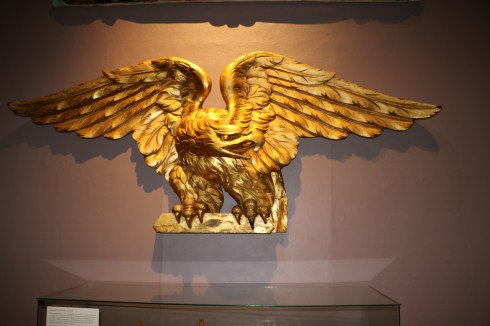
This carved gold leafed pine eagle pictured above is believed to be carved by William Rush but this claim has yet to be verified.
While this eagle with its arms extended may have been originally intended to be posted on the flat transom at the stern of the ship, it is also very similar to the décor on public buildings during the 1800’s. It is something that looks familiar to me as I have noticed decorations and sculptures like this on or inside older buildings while visiting the historic homes and area of New England.
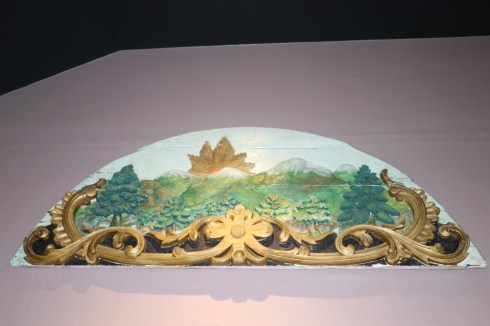
This carving of a mountain sunrise, Mt Washington Lunette once adorned the steamship The Mount Washington, a steamship on Lake Winnipesaukee in New Hampshire. This fan-shaped panel, called a lunette, was located at the center of one of the boxes that covered the steamboat’s paddle wheels. The half round paddle boxes served two purposes. They helped to protect the wheels from damage while shielding passengers from the turning wheels as well as the water that was thrown up by their blades.
There are other statues and decorations scattered through out the living museum.
These sculptures above, I believe of a sea mammal, were located outside one of the buildings.
This horsehead, located outside one of the historical homes, may have been used to tie the reigns of your horse.
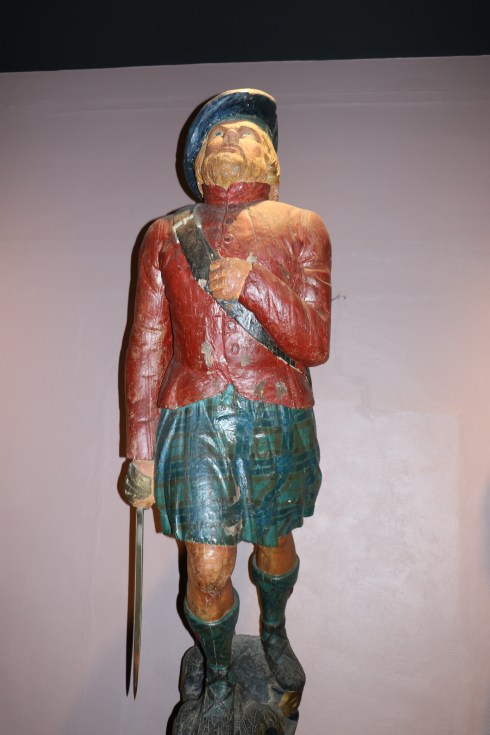
This outdated statue was located outside a cigar and supply shop. It is displayed, I am sure, simply to give an accurate display of what the shops at that time looked like. The craftsmanship is impressive regardless.
The Carver’s Shop is one of the shops replicated to show how statues and other carvings were made and sold. The carving in the last photo (bottom right) may look similar to the cat carving at the figurehead museum.
These are two other cute decorations I noticed at the museum during my visit.
There were several dogs at the museum. Who knew dogs were so fond of the sea?
Since I am posting these blog posts as a series, I will post one set of photos for each dog or group of dogs I saw there.
I saw Brandi (On the left) and Colby (on the right) sitting by a bench with their guardian before I entered the museum. They are both 6 year old Chihuahua and Japanese Chin mix breeds.
See you soon with the next installment from my visit here!
Below is a short video of the figureheads and the restoration of figureheads from Mystic Seaport’s website.
***WordPress ate my original post (either that or I goofed up). So, I have reposted my blog post. Thank you for reading!***
Date Of Visit: September 9, 2017
Location: 149 Farms Village Road (Route 309), Simsbury, CT
Hours: open daily, sunrise to sunset
Cost: On weekends and holidays, admission tot he park costs $9 for residents of Simsbury and $15 for non residents. There is no charge during weekdays and during the off season.
Parking: There are a few parking areas with ample parking
Trail Size/Difficulty: The main hiking and biking trail is 1.2 miles (2.4 round trip). The trail is easy.
Highlights: trails, covered bridge, beach, lake, swimming, fishing, cycling trails
Tips:
admission to the park is free during the weekdays and after Labor Day (or at least it was free during my visit the week after Labor Day)
Stratton Brooks is considered the first “completely wheelchair accessible” park in Connecticut
The nature center is open on certain days (it was closed during my visit)
There’s a reason why the Connecticut tourism website calls September the “second summer.” With the last vestiges of summer lingering and the sparks of autumn blooming, this is perhaps the best time of the year to visit the parks and attractions of New England.
The trails at Stratton Brooks are easy and level with hardly any inclines. The main trail goes past some residential homes. So, it’s important to stay on the trail.
Brooks Stratton, originally called Massacoe State Forest, was originally used to demonstrate forest fire control adjacent to railroads. The railroad tracks have since been replaced by a biking and hiking trail. White pines line the main hiking trail.
The covered bridge at the park was built in 1985, spans 45″. It offers pretty views of Stratton Brook.
The beach at the park is a popular destination during hot summer days. It has a decent sized beach area and enough room for everyone to splash around.
In 1996, this park became Connecticut’s first state park that is completely accessible by wheelchair. But, I think some areas, such as the main hiking trail which can be rocky and the beach area, may be hard to maneuver around.
Besides hiking, cycling, running and swimming, the park also offers an area for fishing, trout is the main fish people catch. During the winter ice fishing, cross country skiing, snow shoeing and ice skating are popular activities at the park. Besides the trout that swim in the pond, there are other inhabitants of the pond such as ducks and a few frogs.
There is lots of room for dogs to roam around and play. I saw quite a few cute dogs during my visit at Stratton Brooks.
Adisson is a playful one and a half year old Terrier mix,
Juju (short for Jujube) is a Chihuahua mix. Fun fact: Juju doesn’t care for other dogs but she likes cats and people!
Sage is a rescue dog. His guardian wasn’t sure what his breed or age is. But, he’s a sweetheart!
Location: 1 Old Bridge Rd, Simsbury, CT (about half an hour northwest of Hartford, CT)
Hours: Available 24 hours a day
Cost: Free (but donations are appreciated)
Parking: There is room for about a dozen or so cars in the parking lot off Old Bridge Rd
Handicapped Accessible: No, There are some poles at the entrance to the bridge to prevent vehicles from driving onto the bridge and I am not sure if wheelchairs could get past them (see photo below).
Dog Friendly: Yes
Highlights: flowers strategically placed on a bridge, scenic, historical landmark
parking is located on located on Old Bridge Rd off Drake Hill Rd. There’s no parking located at the entrance by Riverside Rd
popular place for weddings, engagements and portrait photography
There’s more than one “bridge of flowers” in New England.
Inspired by the Bridge Of Flowers in Shelburne, MA, the Old Drake Bridge Of Flowers, is by no means as long or as flowery as the Bridge Of Flowers in Shelburne, MA. Yet, what it lacks in length and variety of flowers it makes up for in charm.
Each panel of the bridge is decorated with various flowers. The bridge has 32 baskets and 48 boxes, some of which were built and added by an Eagle Scout, filled with flowers of an array of colors. The flowers bloom from late May to October.
During my visit, I met a woman who stops by every other day to water, trim and keep after the plants. Clearly, she’s doing a wonderful job.
The bridge, originally built in 1892, is an example of 19th century metal-truss bridge construction. It spans 183 feet and includes a 12-foot roadway suspended 18 feet over Farmington River. And it has been much traveled over the years.
The Old Drake Flower Bridge was originally built to be a one lane, one way bridge for vehicular traffic. It was later replaced by a 2 lane bridge in 1992. Finally, in 1995, it was restored as a pedestrian bridge. It was added to the National Register of Historic Places in 1984
There are also plants and flowers by the sides of each entrance to the bridge.
At the entrance to the bridge, off to the left side, there is a memorial dedicated to the original bridge (the Weatogue Bridge) that was built there before it was replaced by the Old Drake Flower Bridge.
The inscription on the historical marker reads reads:
A toll bridge was built here in 1734 by order of the General Assembly it was the first highway bridge across the Farmington River
The Old Flower Bridge is a popular place for weddings, portrait photography shoots and engagements. In fact, I turned around from the parking lot the first day I went there because there was a wedding or wedding shoot taking place and I didn’t want to disrupt them. The second day I went I ran into a couple who had just gotten engaged. The beaming couple asked me to take their photo and went on their merry way of future bliss.
The Old Flower Bridge is dog friendly.
Lisa (on the right) is a 5 year old Havanese. I love seeing how happy and proud dog guardians are in their photos.
Tucker Jones is a 2 year old Corgi.
Leila is a 9 year old Bernese and Beagle mix.
Below is a link to The Flash Lady Photography. The Flash Lady Photography conducted an engagement photo shoot on the bridge in 2015. You may notice many of the flowers are not on the bridge when these photos were taken as it was the end of October when the photos were taken. I hope they’re both very happy now!
Location: Salmon Brook Park, 215 Salmon Brook StreetGranby, CT (20 minutes northwest of Hartford, CT)
Cost: Free
Hours: open daily, sunrise to sunset
Parking: There are several parking areas. The best place to park for the dog park is behind the big soccer field at the end of the road at the main entrance.
Highlights: table, chairs and bench, 1 acre for the dogs to play in, water source, two entrances/exits, double gated entrance
each visitor is allowed to bring 3 dogs each visit
No children under 8 are allowed in the dog park
The dog park is located in Salmon Brook Park
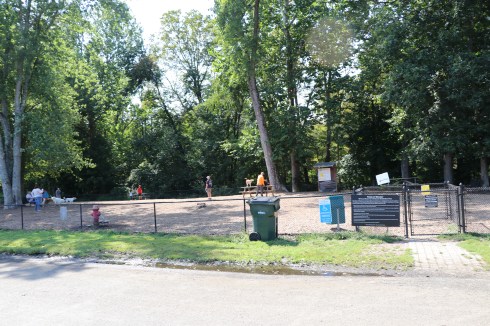
The D.O.G.G.S. part of Granby D.O.G.G.S. Park may stand for Dog Owners of Granby Getting Social. But, it seems like the dogs that tend to get social there!
The one acre park, which has been open since November of 2005, has tables, chairs and a bench for dog sitter and guardians to sit and lovingly watch their dogs. The park also has toys and a water source. While dogs are allowed off leach at the park, they must be able to follow voice commands.
The large park, which has mulch over most of the park, gives dogs of all shapes and sizes lots of room to roam and chase each other and trees to play hide and seek.
During my visit to the dog park, there was a “Canine Swim” fund raiser at the pond in Salmon Brook Park, just a short walk from the dog park.
A $10 fee was charged for each dog that wanted to play in the water at the pond. The funds were being raised to put toward maintenance of the dog park.
The dogs loved running around and into the pond.
Some of the many beautiful dogs I met at the dog park and fundraiser are shown below:
Roxy is a 12 year old mixed breed. She is a therapy dog who likes to visit children, the elderly and anyone else who needs a little “dog therapy.”
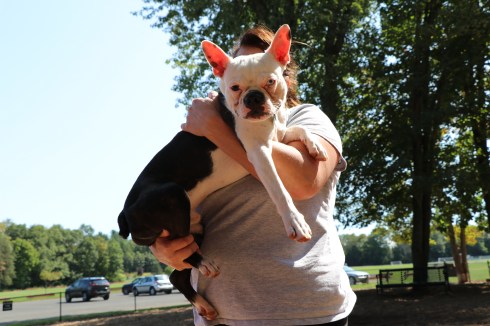
Cooper is a 7 month old Boston Terrier. Cooper has complete heterochromia; he has two different colored eyes (his left eye is blue, his right eye is brown).
Gabe is a Great Pyrenees. His guardian wasn’t sure what his age was exactly. He and his parents found him on the side of the road and decided to take him in.
Heidi is an 8 year old Golden Retriever. She loves to “retrieve”. Get it!?
Molly the is a 5 year old Collie.
The aptly named Bear is a one and half year old Newfoundland.
From left to right, Ruby (named after Ruby Tuesday) is a 3 year old Saint Bernard. Her brother, Ollie (named after Olive Garden) is a 2 year old Saint Bernard. Anybody else getting hungry for lunch?
Today’s featured link is a blog post by Out And About Mom about Salmon Brook Park, where the dog park is located. I have featured Out And About Mom on my blog before. She tends to blog about Connecticut attractions exclusively and she does a great job in her posts. Her post about the playground area at the park can be found here.
Location: parking lot of Avon Free Public Library, 281 Country Club Road, Avon, CT
Highlights: A life size sculpture of Amy reading a book and clutching a teddy bear
Tips:
The sculpture is located in the parking lot next to the left side of the library
Sixteen years. Who could imagine so much time has passed?
One hundred and fifty six people with ties to Connecticut died on that tragic day. A memorial rests on the grounds of the Avon Free Public Library to memorialize one of these, and indeed all of the victims of this day.
Amy Toyen, a resident of Connecticut and employee of Thomson Financial in Newton, Connecticut. As a side note, when I researched this memorial and Amy, I never knew she worked at the very same corporation I used to work at. It’s amazing how we all seem to be connected in some way.
Amy, a 1995 Avon High graduate, was killed Sept. 11 while she set up her company’s display booth for a trade show on the 106th floor of the World Trade Center’s north tower.
Dedicated by the 2001-2002 Avon High School Student Government and the Avon community, the 22″ bronze statue depicts a young child, Amy Toyen, on a granite bench reading a book, a teddy bear resting in the crook of her elbow.
To help create the sculpture, Amy’s parents selected a group of photos that portray their daughter as they remember her.
The sculpture shows Amy in daisy print dress, her favorite sneakers and ponytails tied with pompom rubber bands
A scholarship was also started in Amy’s name. The first recipient of the annual Amy E. Toyen Memorial Scholarship went to Christine Bialaski, an Avon High senior and honors student who is active in community service, music and field hockey.
Coincidentally, the Bialaski family lives down the street from the Toyens. As a young child, Amy Toyen often waited for the morning school bus at the Bialaskis’ home after her mother left for her teaching job at Renbrook School.
The sculptor, Marilyn Parkinson Thrall of Canton, Connecticut, stops by every once in a while to polish and clean up the sculpture.
The statue, a reminder of all that was lost that day, remembers Amy in a younger, more carefree time.
Highlights: stallions performing tricks and ridden by their trainers
Tips:
bring your own chair or a towel as they do not provide them at the venue.
visitors are allowed to enter one hour before the scheduled event
be sure to take in a tour of Roseland Cottage if you have the time
There was a lot of horsing around going on at the Roseland Cottage in Woodstock, Connecticut last month.
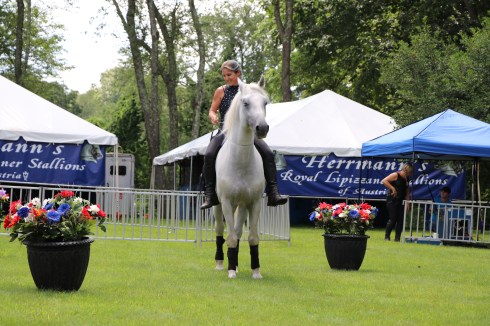
The Lipizzan Stallions galloped into the Roseland Cottage for a day of professional horse riding and horse tricks.
The Lipizzan Stallions traveled all the way from Myaka, Florida to entertain the one hundred or so visitors at Roseland Cottage.
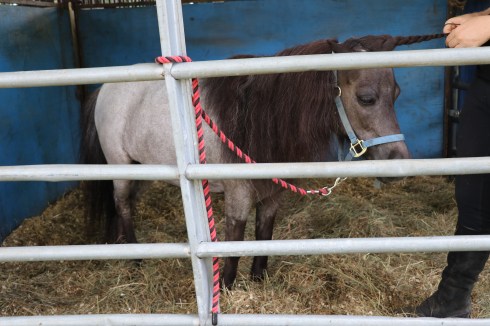
Not all of the horses and animals kept at the Lipizzan Stallions shelter are Royal Lipizzan Stallions. For instance, Willie The Rescue Pony, seen here getting ready for the show, is one of the horses they have taken in. He even performs at the show. They also take in dogs, cats and any other animal that finds its way to their shelter.
The highlight of the show were the Royal Lipizzan Stallions. The horses performed tricks and trotted in formations.
The horses are such beautiful animals. The way they moved and the way the horse trainers and riders controlled their every movement was a joy to watch.
The Lipizzan breed is considered the rarest and most aristocratic breed of horses in the world. They were first established by Archduke Charles at Lipizza which is now part of Yugoslavia.
Since only a few hundred Lipizzan Stallions have ever existed at any one time, their future lineage is somewhat in question. But, they may have General Patton to credit for their continued bloodline.
During World War II General George Patton authorized a secret plan to save the Lipizzans. The stallions, who would surely have been killed if the Russians arrived before their rescuers, were saved during this secret mission. Two of the people involved who played a key role in their rescue were Colonel Herrmann and his father, Colonel Ottomar Herrmann, A movie by Disney titled, Miracle Of The White Stallions depicts their rescue.
The Lipizzan horse show was held at the Roseland Cottage. We didn’t have time for a tour. But, the grounds are very pretty.
While dogs are not allowed at the show, I did see Yog,i, a 3 and a half year old Cavanese (part Cavalier King Charles Spaniel and part Havanes), and his dad watching from the sidewalk. Yogi also barked out his approval from time to time.
Below are some videos of the Royal Lipizzan Stallions event
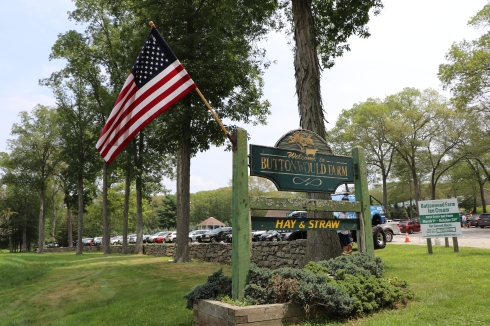
Once the site of a dairy farm, Buttonwood Farm is so much more now. Not only do they have a sunflower garden with a maze and a famous ice cream shoppe, they also are the site of one of the more popular charity events each year.
Funny thing is I didn’t find one button the entire time I was there.
During my visit, the sunflowers were in bloom and Buttonwood Farm was holding a fundraiser for their Sunflowers For Wishes charity.
The dirt trails in the sunflower maze are easy to navigate. The path is only about half a mile long. Due to the showy outer ray petals of the sunflowers, bees and other insects, like this beetle, are attracted to the nectar and pollen.
In addition to the sunflowers, people (big and small) could ride their cow train or tractor tour. All proceeds, of course, went to the charity.
At the end of the sunflower maze, there is a hill on a short incline where you can view the sunflowers.
There were also some performers at the top off the hill. A man was playing music and there was a local painter, Jacqueline Jones, who was preparing to paint the sunflower garden.
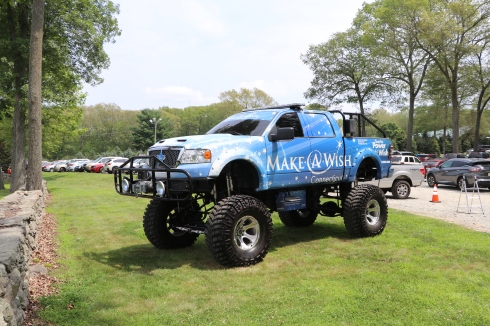
Since it was a charity event, there were charitable organizations like the “Make A Wish” foundation. They had my dream car there!
The cows at Buttonwood are so docile and beautiful.
Sunflowers aren’t just for people. Dogs also like to walk along the sunflower maze.
Tunken (on the left) is an 8 year old Chocolate Lab mix and Duncan (On the right) is a 3 legged Harrier, fox and hound mix
Alie is a 12 year old Mini Pinscher.
Ian is a 5 month old Golden Retriever who is in training to be a service guide dog.
Below is a video of the maze at the sunflower garden. What struck me is, despite the large crowd that was there, how peaceful and quiet the place seemed. It seems like a wonderful place to go and just have some peace and quiet.
Today’s featured website is Jacqueline Jones’ Paintings From The Open Air. Jackie was painting a portrait of the sunflower garden during my visit. You can find her painting of the sunflower garden on her website.
Based out of New Haven, CT, Jackie specializes in painting the nature of the New England area. She also enjoys painting in other areas outside of New England such as the Colorado and New York areas. Jackie has also won a variety of awards and has studied with some of the accomplished artists in the New England area.






















 The D.O.G.G.S. part of Granby D.O.G.G.S. Park may stand for Dog Owners of Granby Getting Social. But, it seems like the dogs that tend to get social there!