Date Of Visit: October 18, 2025
Location: Park Hill Orchard, 50 Payson Ave, Easthampton, MA
Cost: Free
Universally Accessible: Yes. The staff at Park Hill Orchard offer a Accessible Art Cart for those who need assistance.
Dog Friendly: Yes
Summary: Art In The Orchard featured dozens of works of art from local artists.
Raise you hand if you’re sick of this cold and wintry weather. Since I still have lots of photos from events and places I have visited last year, I thought it would be a good time for a change of pace and post some photos from a milder, more colorful time.
Nature and art go hand in hand. Hence, the Art In The Orchard exhibit. The aim of Art In The Orchard is to blend art with horticulture. Two of my favorite things!
Created in 2011, Art in the Orchard is a juried outdoor sculpture and installation exhibit showcasing the work of local and regional artists. Set on the grounds of Park Hill Orchard, the Art In The Orchard event is nestled among apple trees, small fruit gardens and landscaped farmland.
Because there were so many art installations (well over 30) and in some cases lengthy descriptions of each exhibit, I am posting this event in parts. In fact, I have photographed this event in years past. But, it was too overwhelming and time consuming to post all of the photos from the exhibit. Maybe, in the future, if I can find those photos I took I can post photos from those other years. Also, since this was a “meet and greet” event, you may notice artists posing next to some of their works. As an added note, some of the names of the artists were very familiar as I have photographed some of their works in the past. For instance, Harold Grinspoon, the artist of the first work of art has many works of art installed throughout western MA, namely at the Big E Fair at the Eastern Exposition Center in West Springfield, MA, and at Mittineague Park, also in West Springfield, MA.
One of the things that stood out to me was how all of New England was represented in the art. From Vermont to Connecticut, people came from all over New England to show their art.
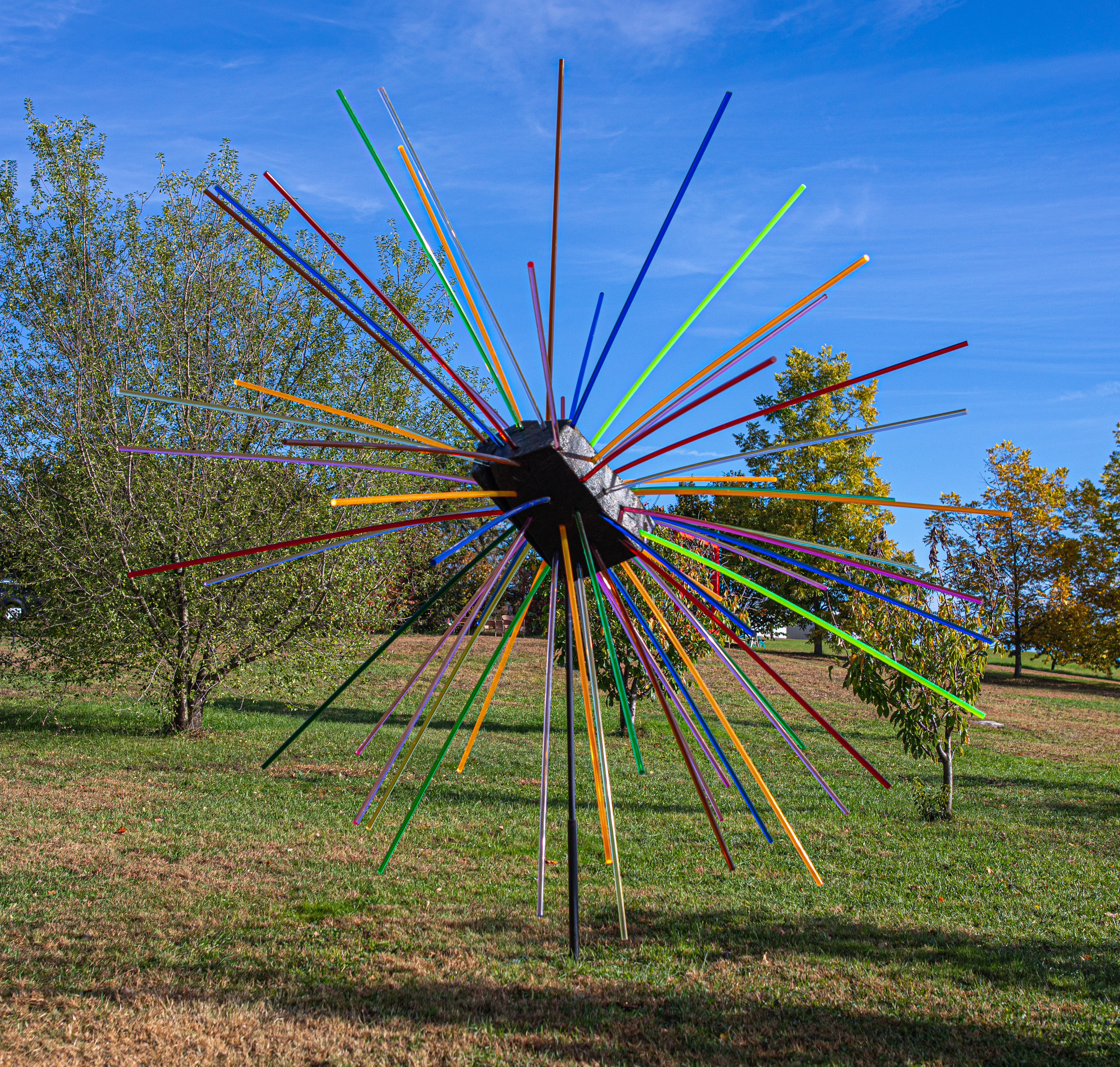
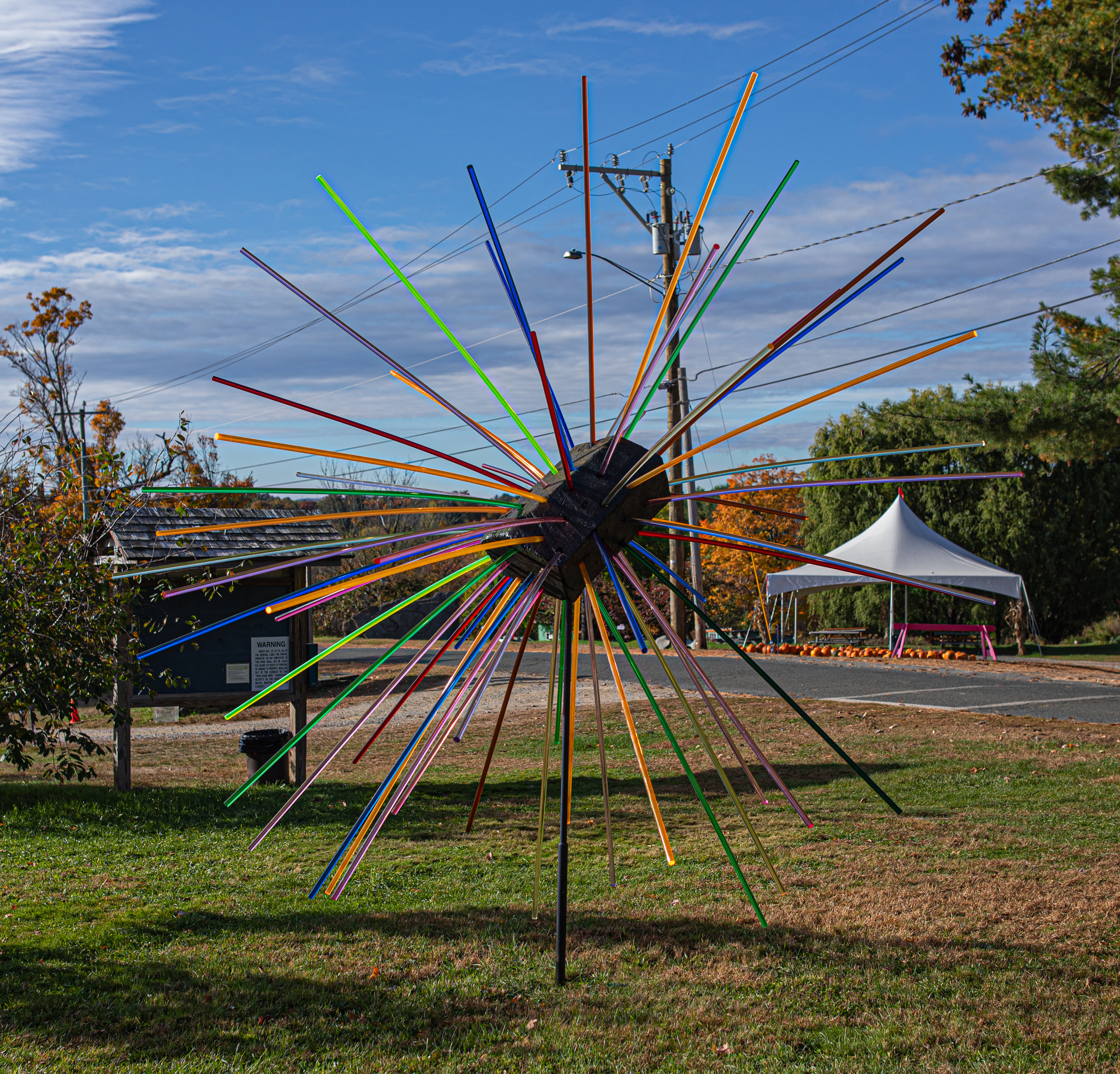
The first work of art at the event was “Big Bang” by Harold Grinspoon of Agawam, MA. “Big Bang” is made of charred wood center and acrylic rods. It is meant to be a celebration of special occasions and to remind us to be joyful of life. The rods individually capture light and reflect it back. But, together with others it creates an impact and good feelings in us.
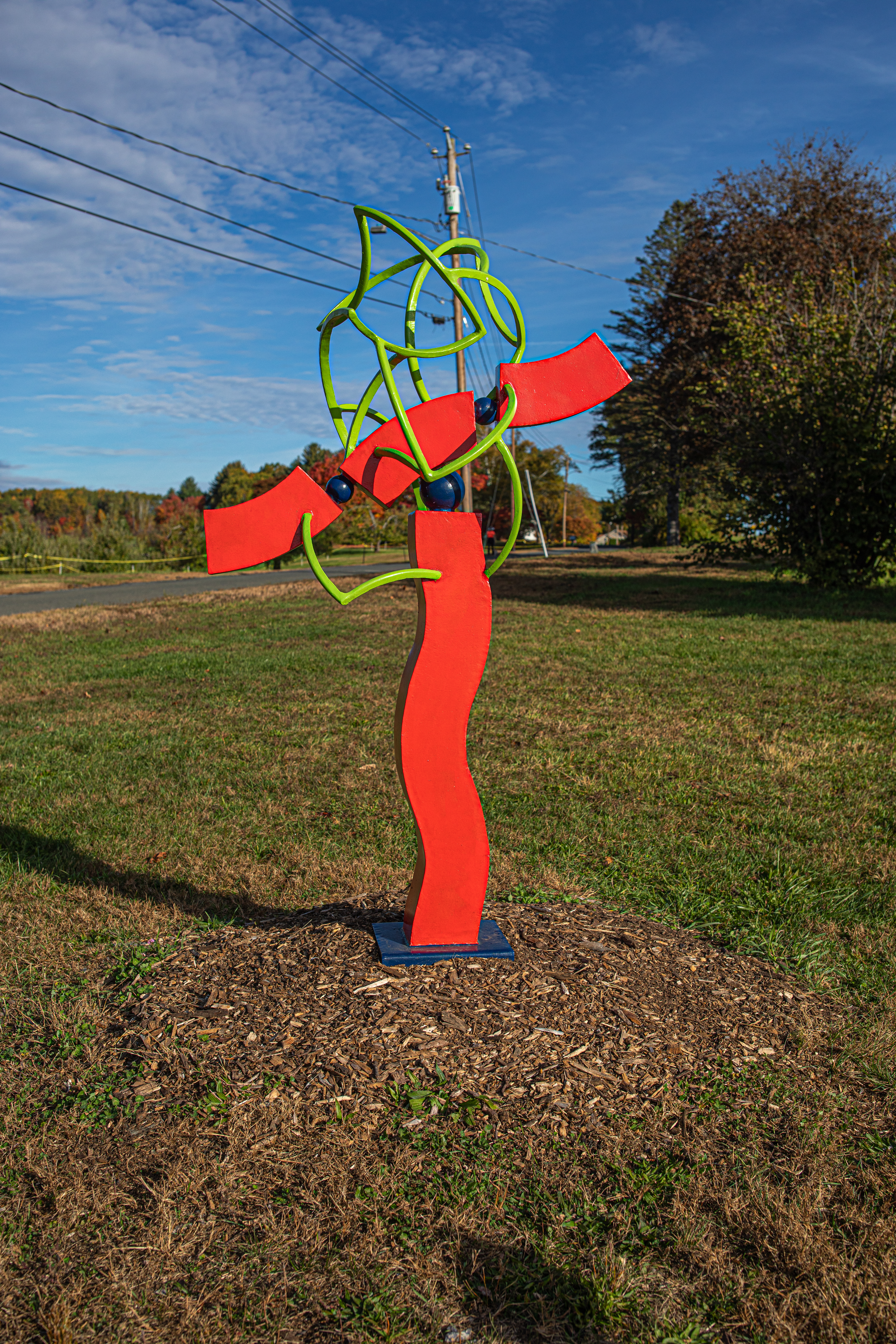
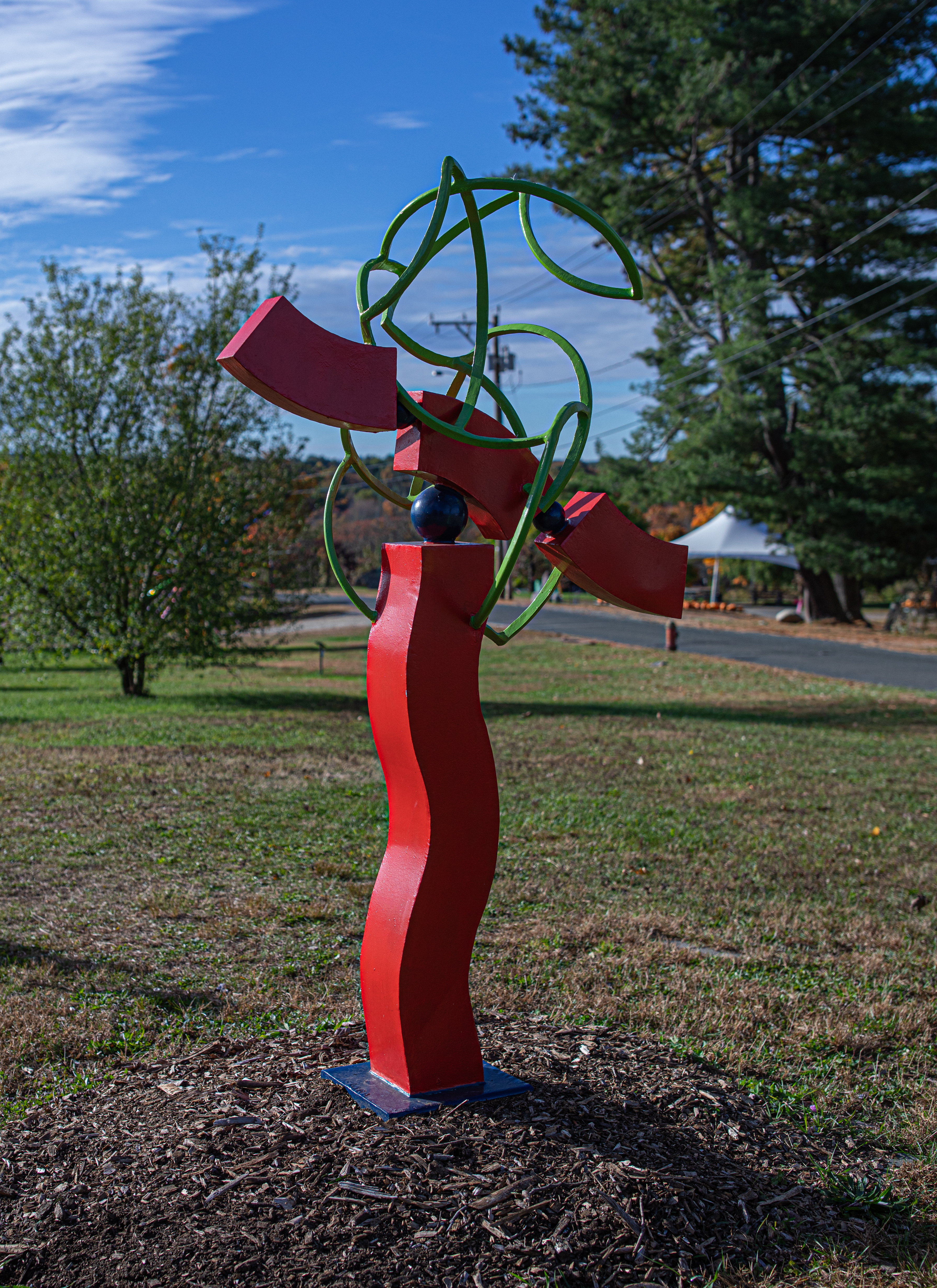
“Baroque Composition, Standing Figure” by David Skora of New Hartford, CT, made of welded polychromed steel, is the next exhibit. Created in the modernist tradition, “Baroque Composition, Standing Figure” was a welded fabricated metal sculpture of abstracted forms. The sculpture attempts to appropriate the energy and exhilaration of David’s interpretation of the Baroque style of art and architecture he observed while visiting Spain.
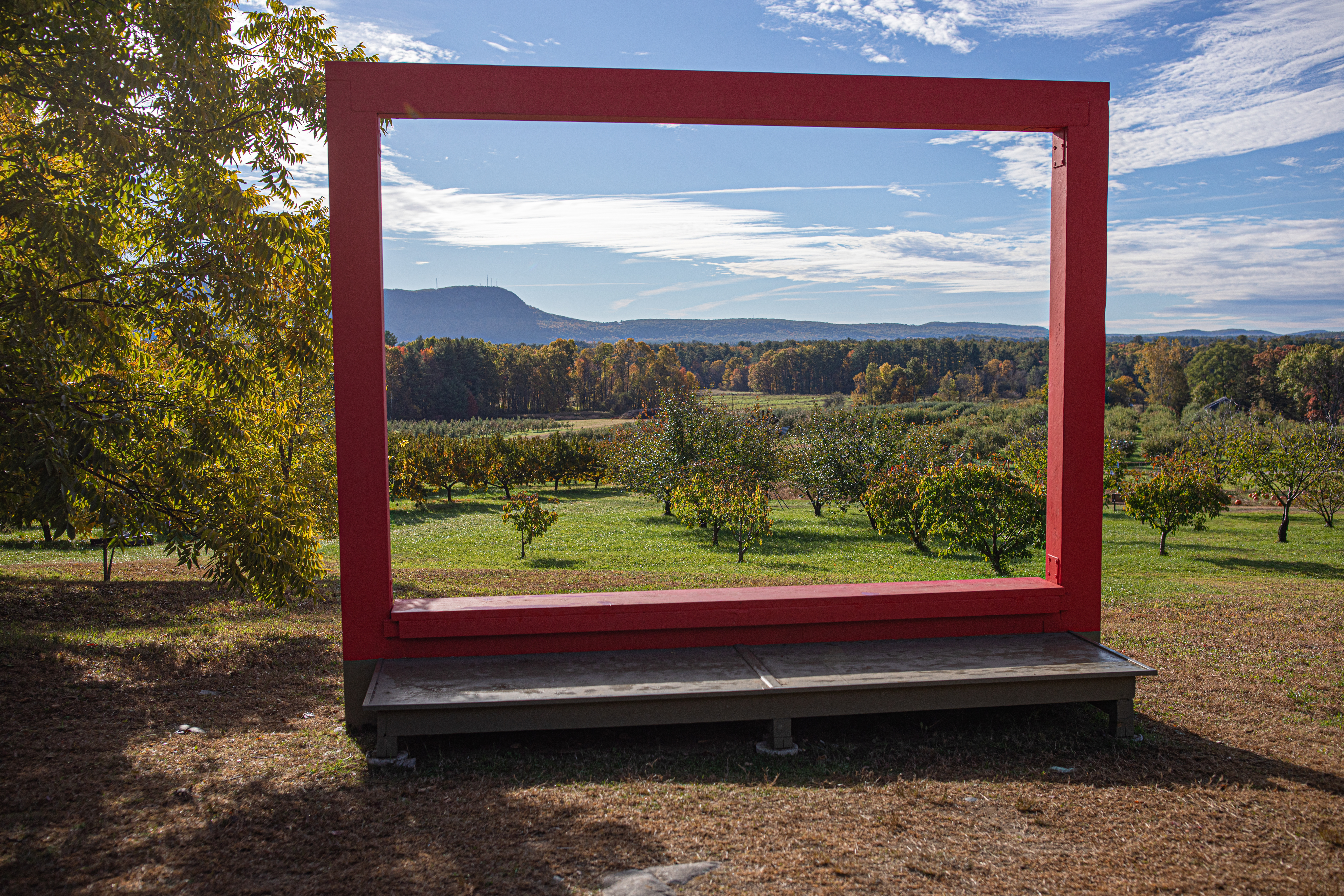
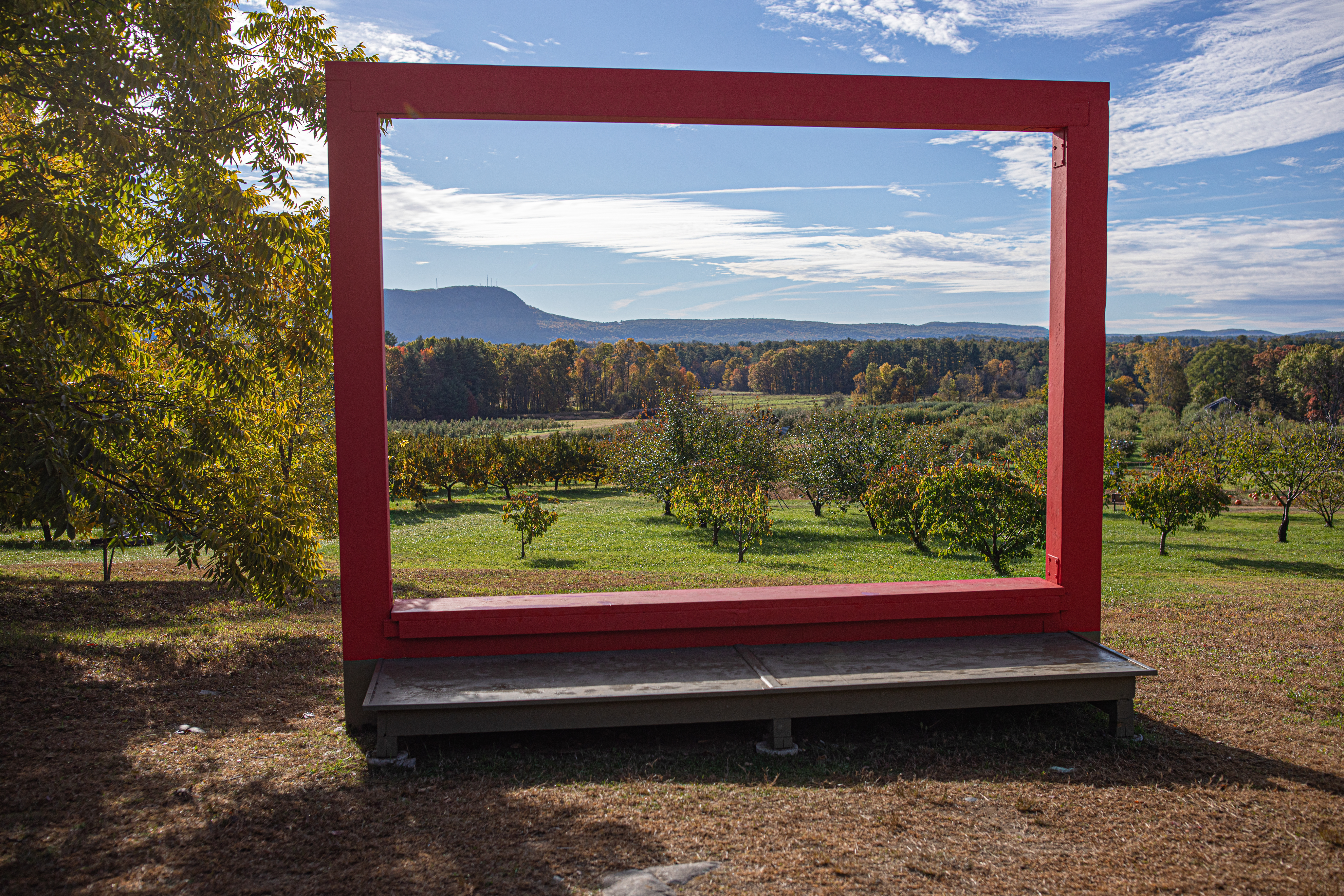
The next piece is not really a work of art. The red frame is often used for people to take selfies or photos with friends and loved ones. The hills and trees make for a beautiful backdrop, especially during foliage. It is installed at every Art In The Orchard event.
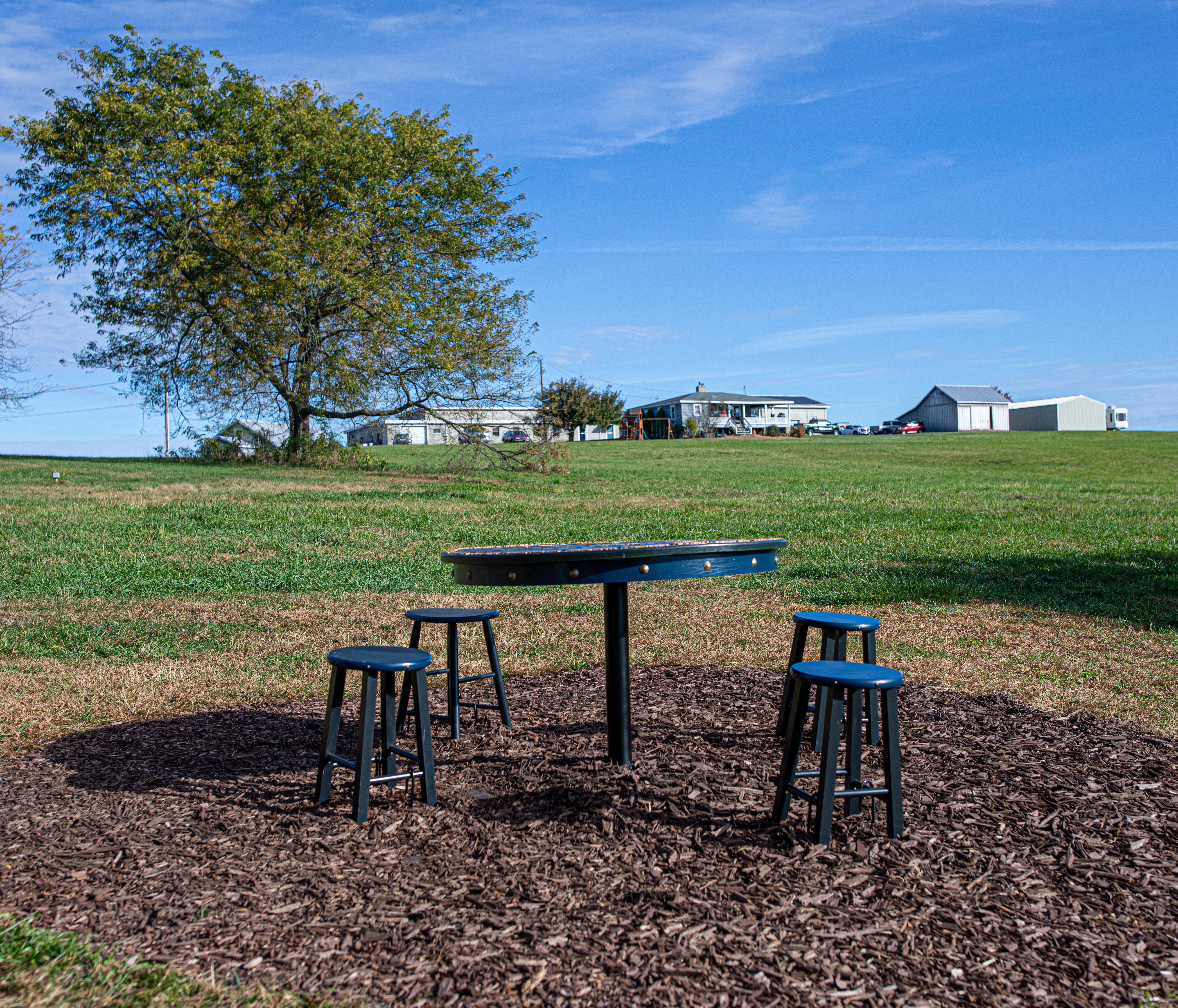
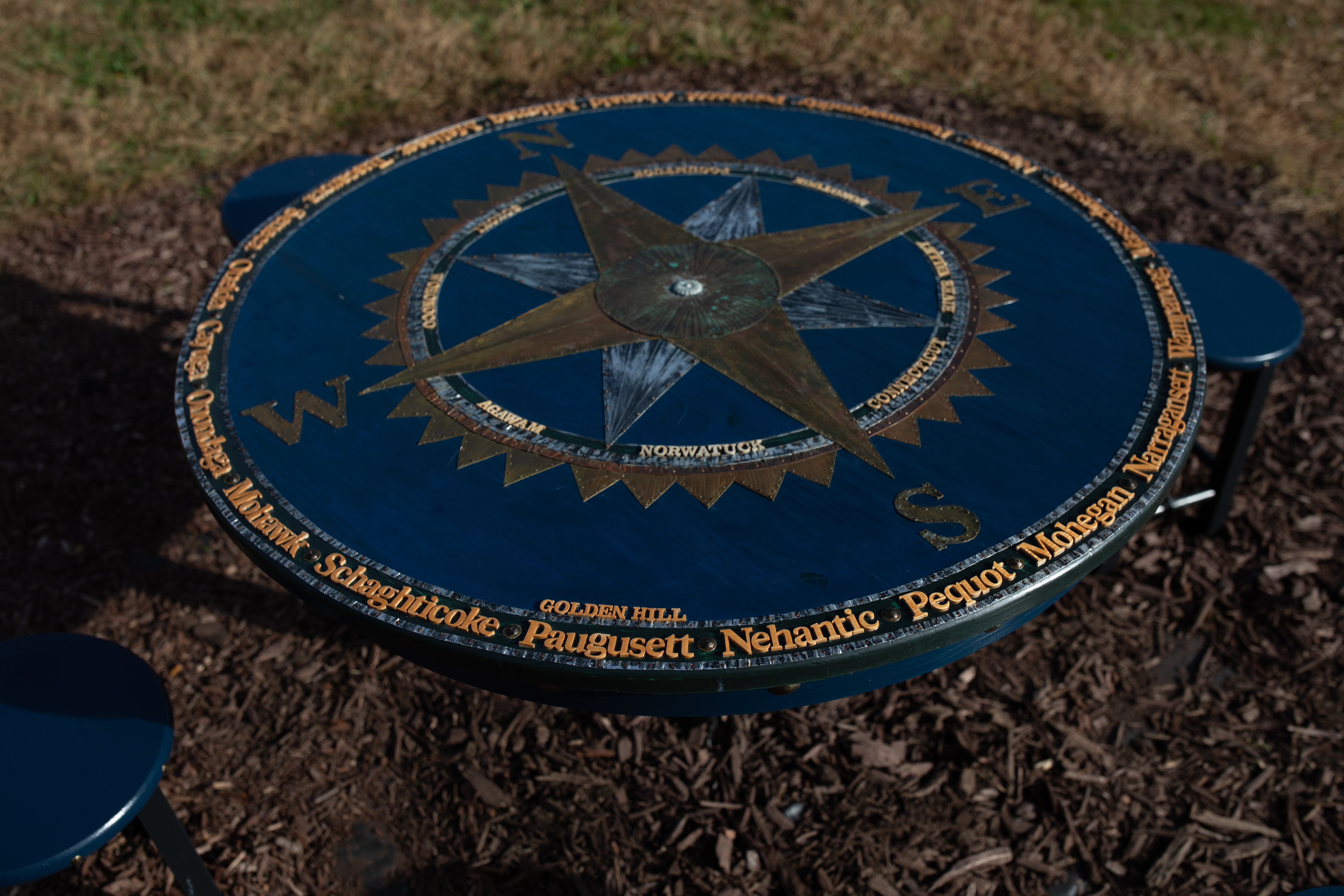
“Acknowledgement” “by Diane Travis of Northampton, MA, is a nod to “land acknowledgement.” You may have seen some signs or markers on the ground acknowledging “native land” or other forms of land acknowledgement (I’ve seen several of them in Boston and Salem, MA). This installation, made of a found table, brass copper, aluminum, paint and wood letters, is meant to be a tangible. interactive sculpture situated on the land people to refer to during “land acknowledgements” at meetings and gatherings. It also pays tribute to the original people of the land.
A compass rose set upon the table orients the viewer in the landscape of Mt. Tom, short for “Tomhoganompekut.” Say that three times fast. I dare you. This name roughly translates to “Tomahawk Stone Place.” For millennia, Indigenous people used the unique stone there to make tomahawks.
Stools set at North, South, East and West invite people to sit and contemplate the land in all directions. Visitors are encouraged to sit and contemplate the land and history in all directions. The compass has an inner and outer circle of names; the inner circle refers to the Ancestral names of original people in the area. The outer circle names and acknowledges the continuous and current presence of Native people in the wider region of Dawn Land now called New England. “Acknowledgement” is meant to confront tropes of the “Disappeared Indian”, asserting, “We are here.”
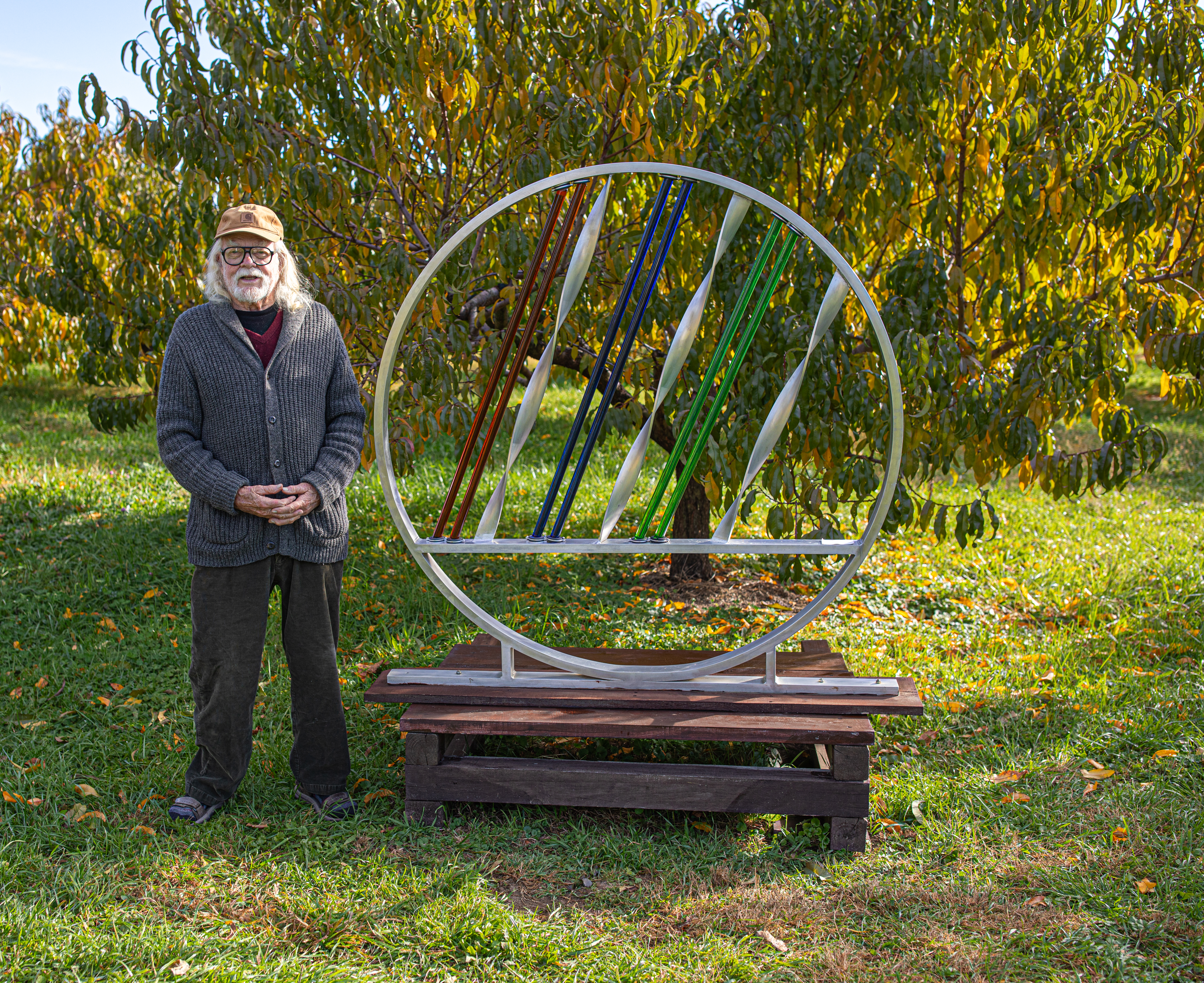
“Big Mama With Glass ” by Robert Osborne of Athol, MA is the next art installation. I was fortunate enough to meet the artist of this work of art during the event. Robert told me the “Big Mama With Glass”, which is made of solid aluminum bar and solid glass rods, was the largest of his “Mama” sculptures. He said the “Dia generation” which is Michael Kimmelman’s label for minimalists and conceptualists many of which are on view at the Dia in Beacon, NY, to be the most relevant today. Their work, according to Robert, is about optics, light, architecture and a unique philosophical approach to seeing and thinking. Robert is also intrigued by the string constructions of Fred Sandback because of his exploration of volume and space. Robert hopes to make people question and really look closely and think about the images and their interactions with his art.
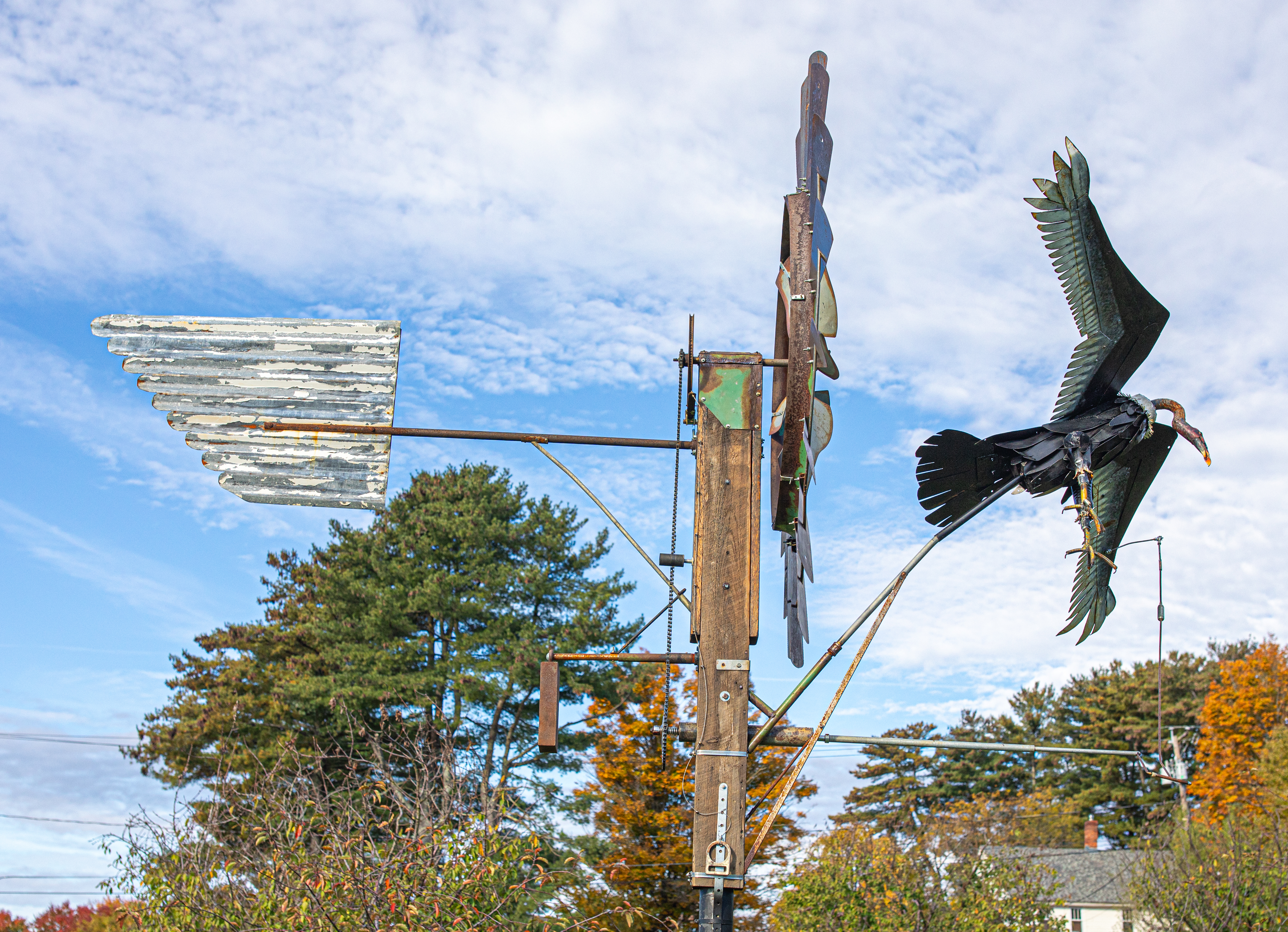
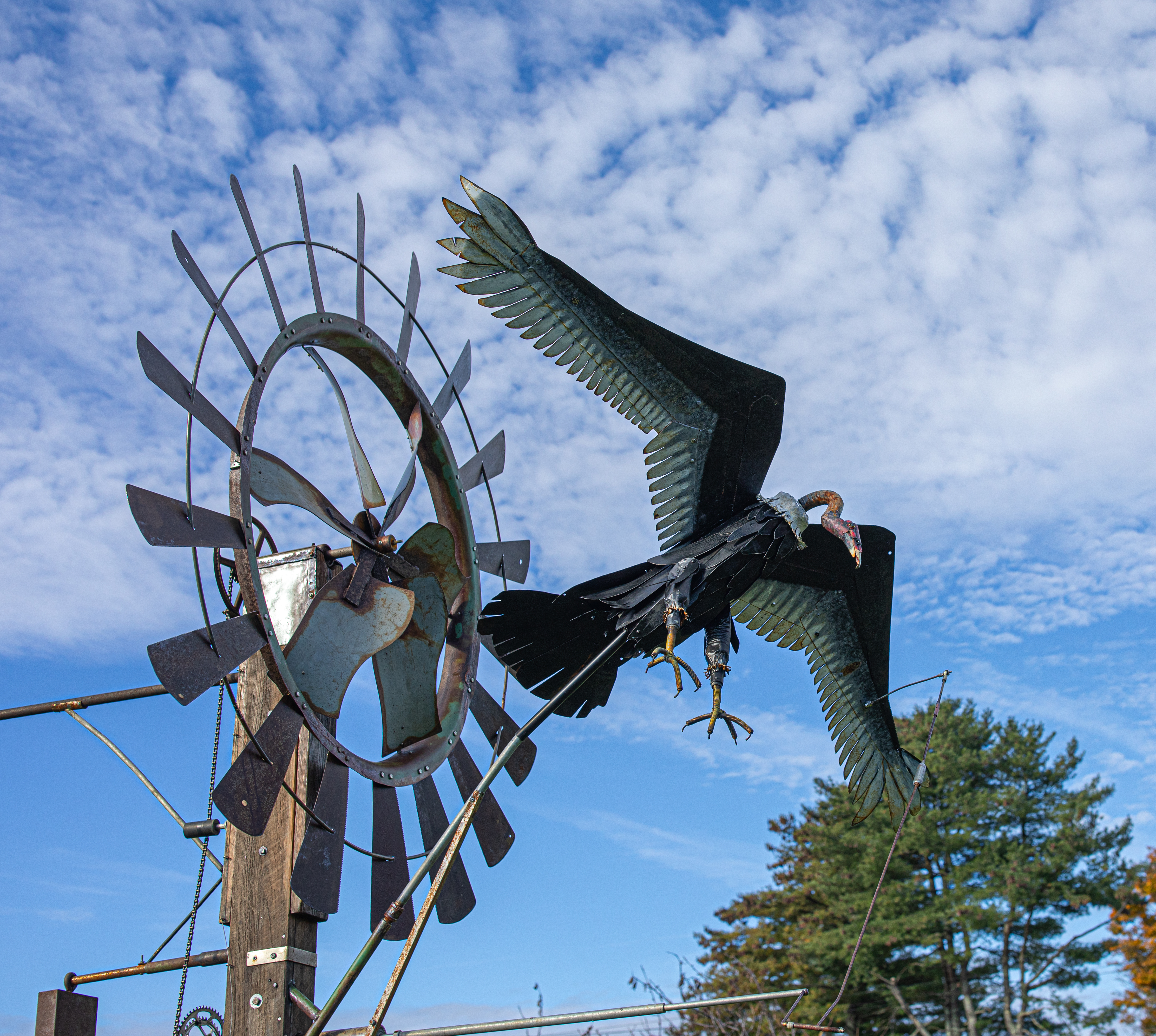
“Coming Home To Roost” by Easthampton resident Christopher Woodman was inspired by some unsavory looking guests in his backyard. The art installation, which is made of a factory fan hub, multiple hand saws and other found metals and wooden beams, was inspired by turkey vultures. The previous Fall, the trees in Christopher’s yard were the chosen home for dozens of turkey vultures. Christopher was taken by the calamity in their process. He observed that for masters of the wind, they don’t always stick their landings. At one point, Christopher counted 60 buzzards, which was close to 400 ft of wingspan.
When choosing a focal point for his piece, the vulture idea hit a lot of themes for Christopher. He especially liked using discarded parts and appreciated the balance of nature and renewal. He also wanted to show the ominous and foreboding specter of the future.
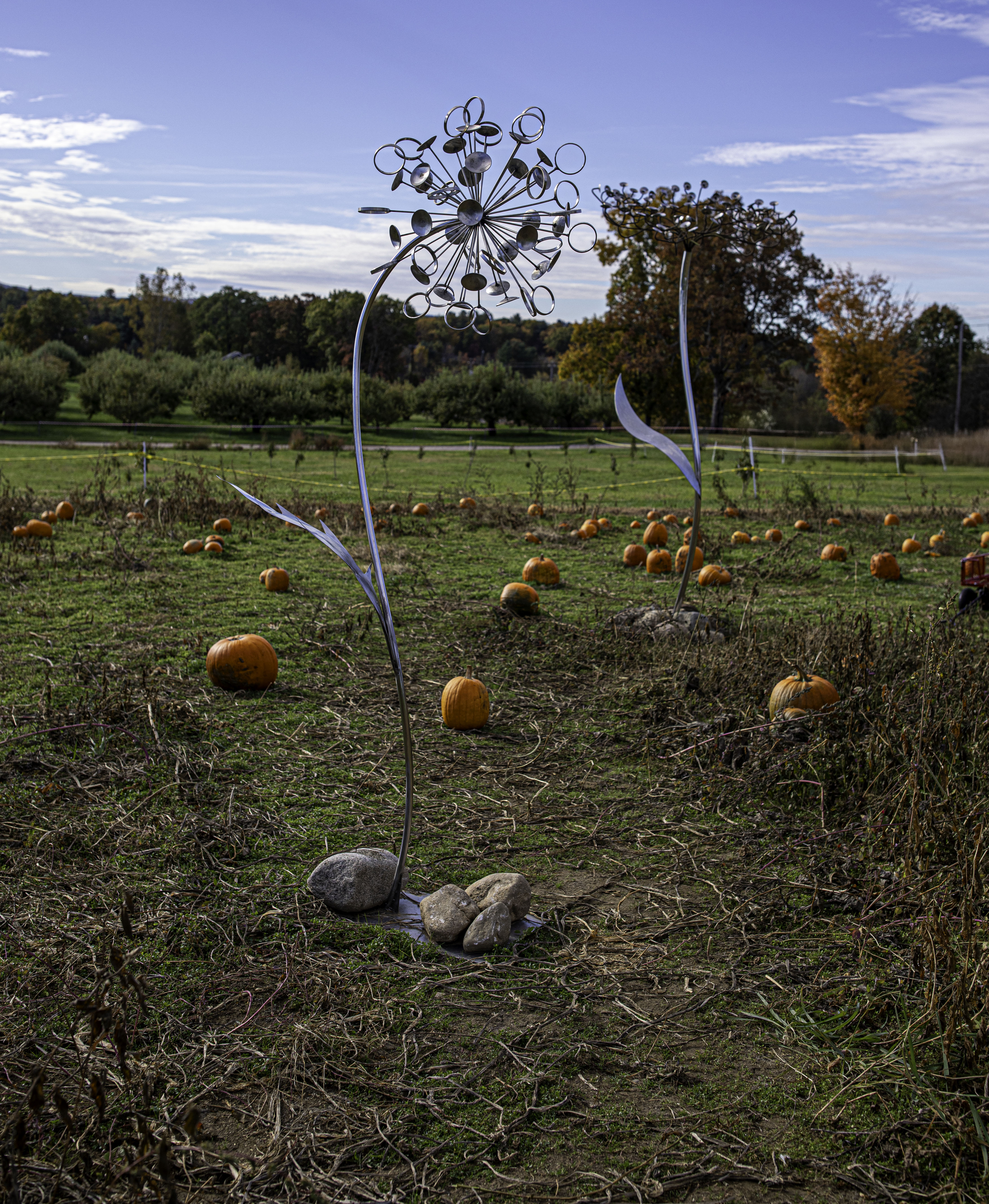
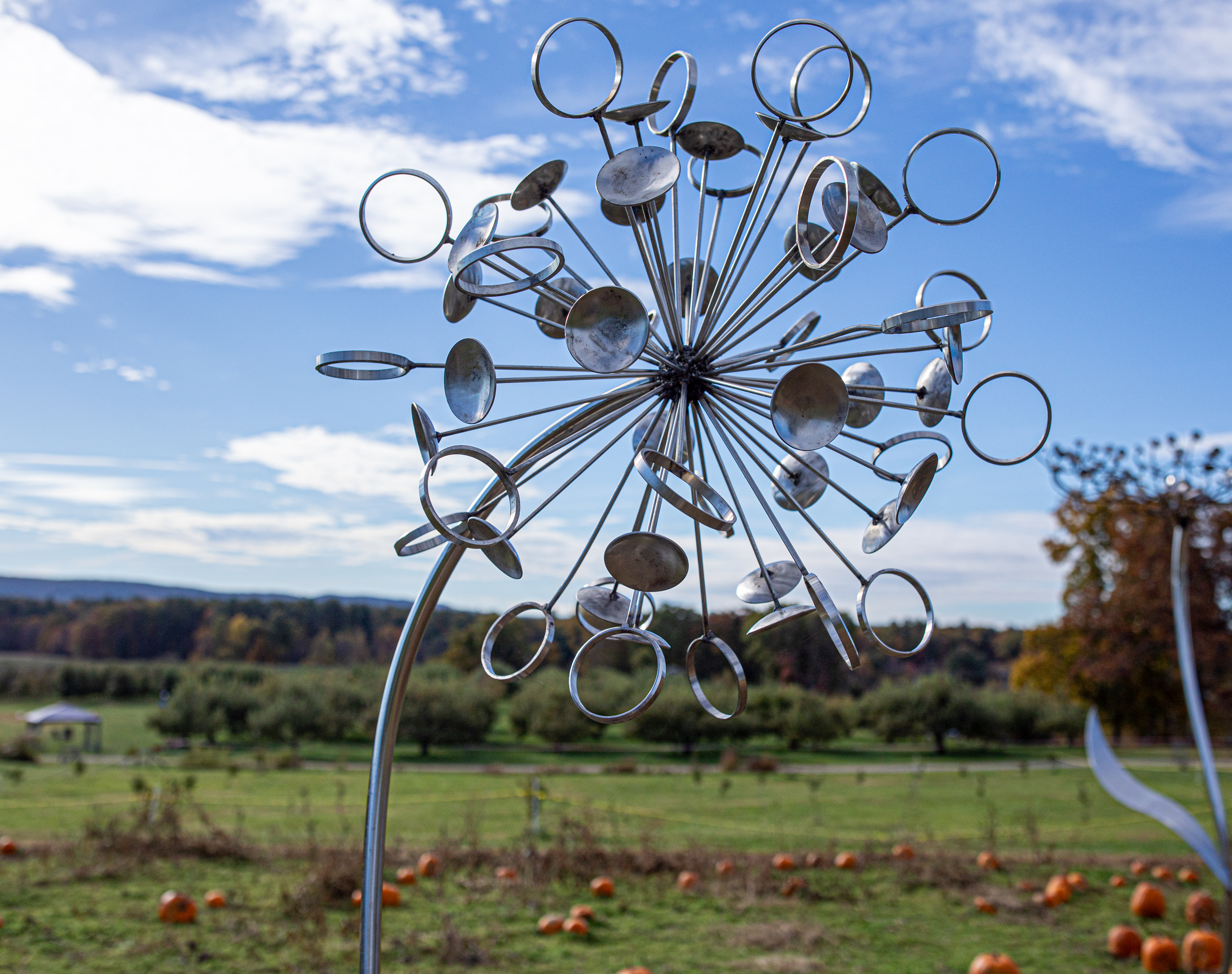
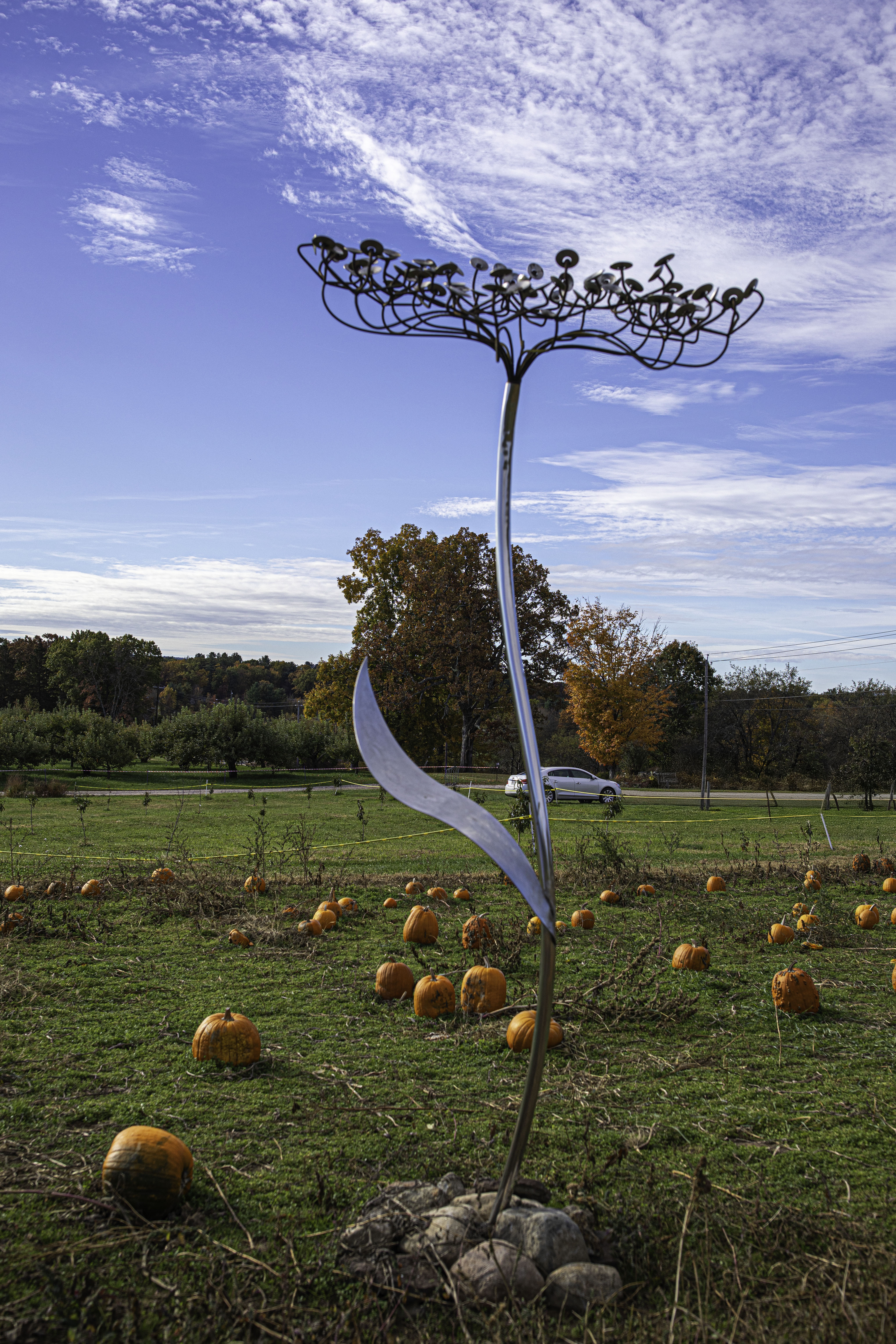
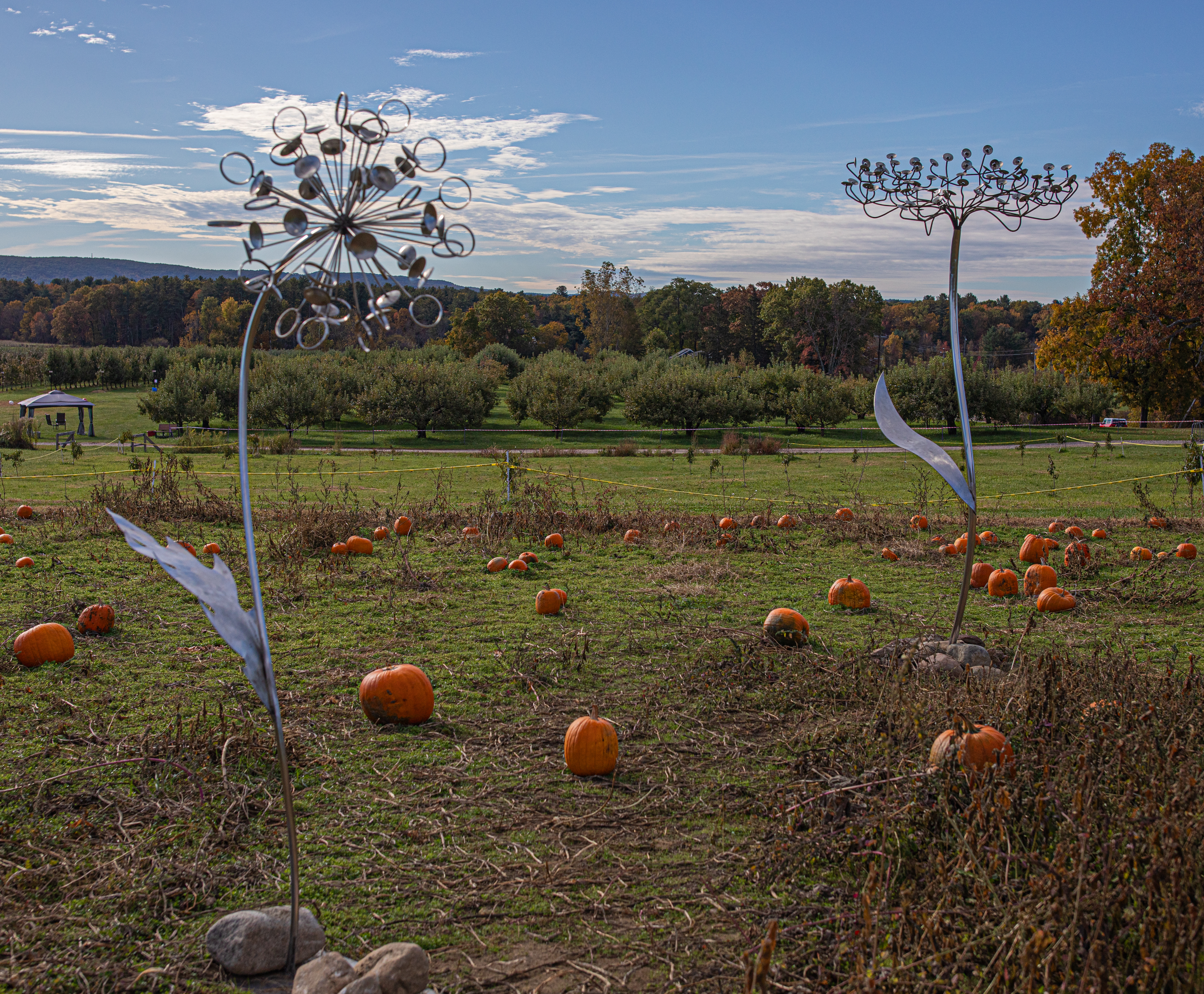
Gints Grinbergs of Dedham, MA created “Queen Anne’s Lace” with stainless steel tubing found metal rods, bent landscape spikes and cast off stainless steel washers. It strives to depict forms and structures found in nature as it reaches for the sky, turning it’s head towards the sun. The backdrop of foliage and pumpkins made the installation look prettier.
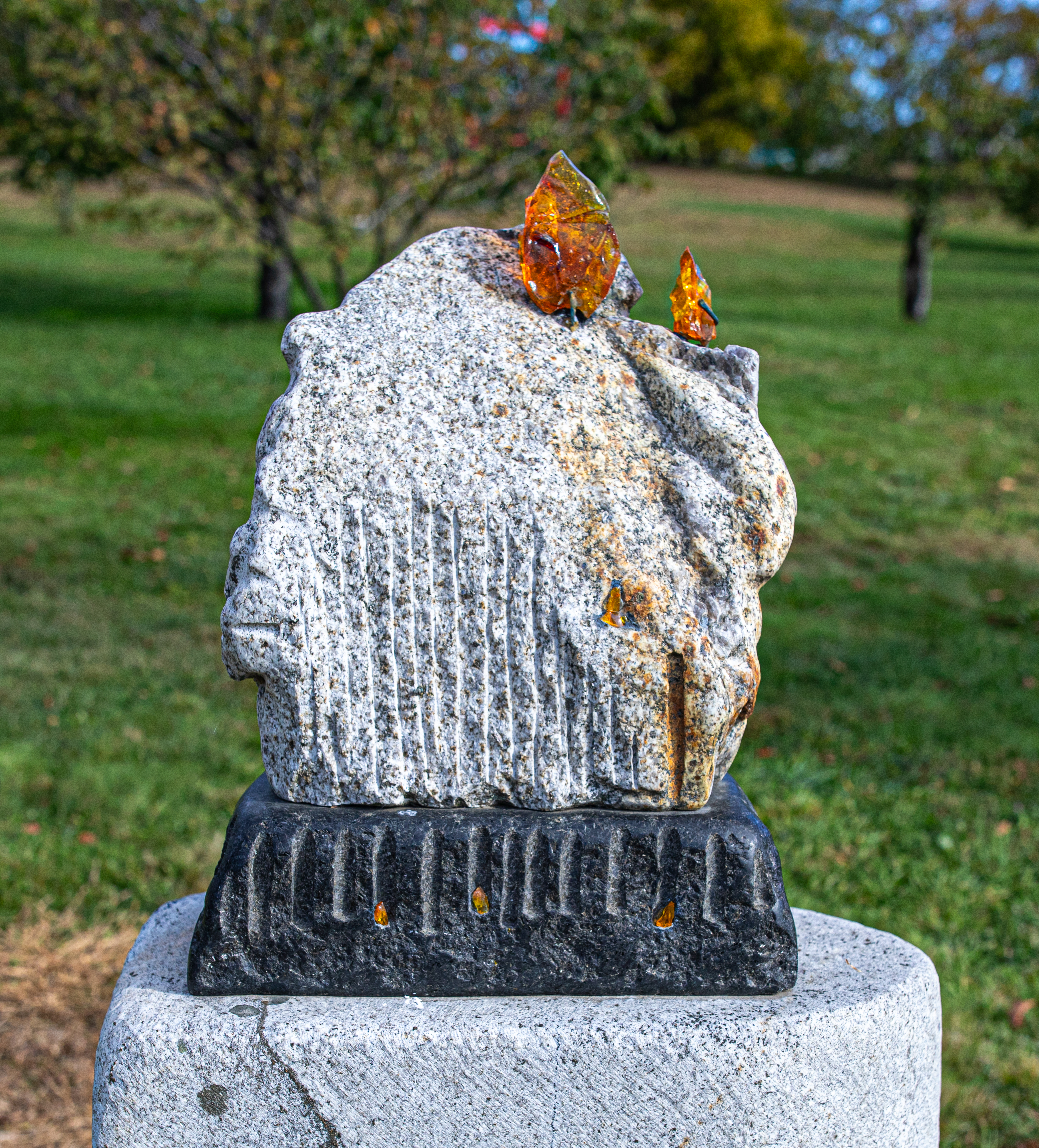
“Three Small Flames” by Antoinette Schultze of Eliot, ME, is the next art installation. The work of art, which was made of granite and glass, was a work of nostalgia. It represented her nostalgia for place, specifically home, with the candles burning. The three small flames can be found at the bottom of the granite installation.
Antoinette began her art career in 1961 when she auditioned for an Impressionist class at Columbia College in New York. Antoinette learned that an artist can express their feelings, not just copy nature. The materials and process of creating her sculptures are a manifestation of herself. Antoinette can carve stone and wood, coupled with glass into a marriage seeking light. Although the work is dirty, time consuming and laborious, Antoinette finds it to be meaningful and rewarding. The work brings order and insight into what she calls a chaotic world. Calling herself the “singing sculptor”, Antoinette said she often sings and speaks to herself as she works.
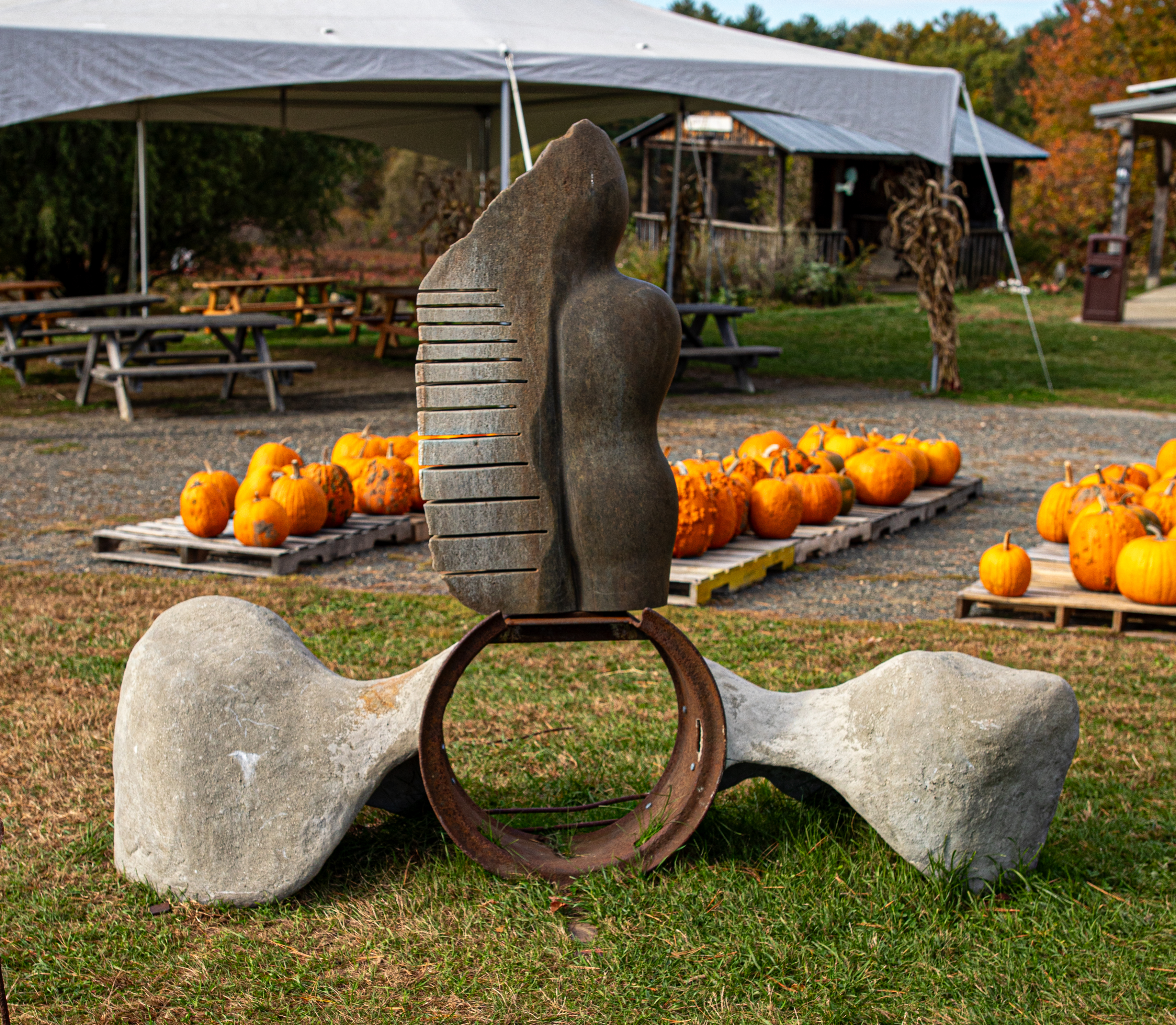
The next sculpture “River Siren” by Joshua Ruder of Greenfield, MA, is a little unusual. It is interactive. The sculpture made of stone, metal and concrete has a stone attached by a string to the other side of the sculpture. And yes, it does make a “siren song sound.
Joshua found the perfect curved contour in the stone while he was wading in a river. He felt compelled to carve the stone and continue the process of carving that nature had begun.
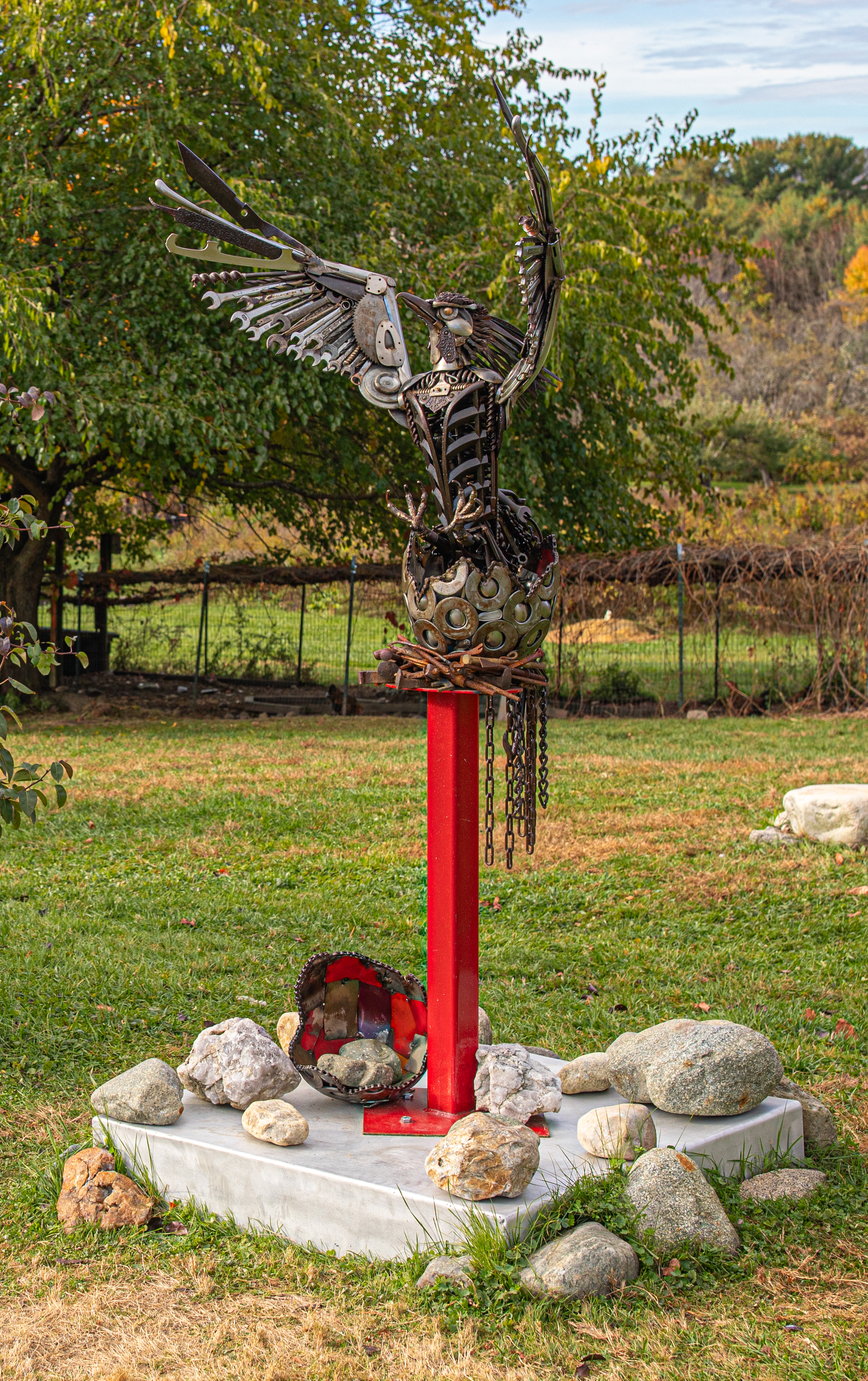
“Rebirth” by Gregory Didyoung of Wilmington, VT, is a sculptural interpretation of the phoenix myth. Reborn from its own ashes, the phoenix symbolizes renewal, resurrection and immortality. The sculpture was made of found metal and reused and reborn into something new. Cracking the nested egg into two halves the phoenix rises and flaps his wings for the first time.
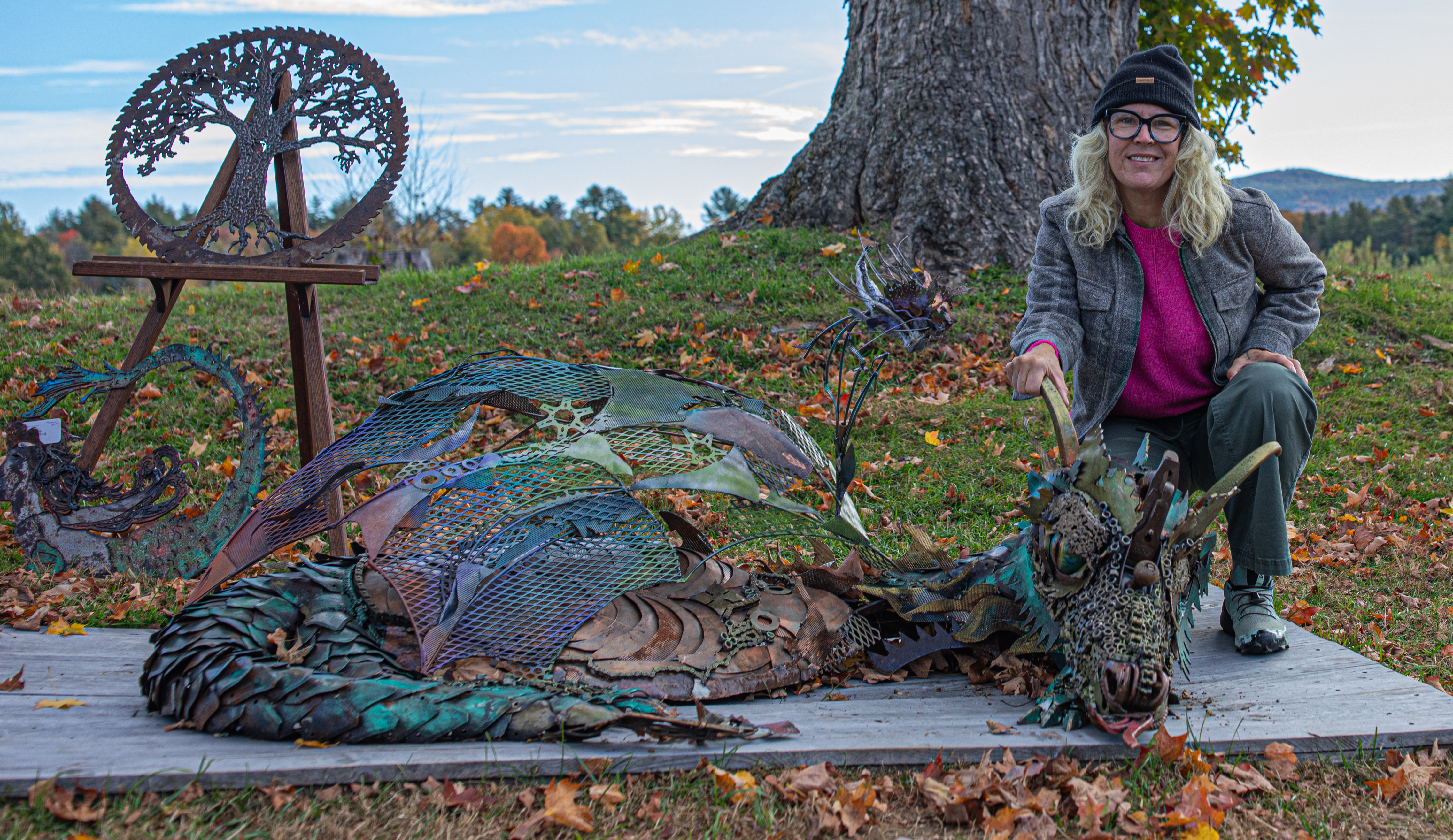
While the meaning of “Erebus” by Trisha Moody may seem straightforward, it has a deeper meaning. The sculpture which is made of steel, iron and recycled tools is actually a commentary of human beings. The sleepy dragon which looks beautiful and dangerous, is similar to how we are often asleep and how we all react differently when woken. The dragon is playfully being tapped by the fairy to join her in the woods. It shows how two very different creatures can play together. It also shows how we have the ability to act together in a community and how we can choose to be the gentle giant or the fire thrower.
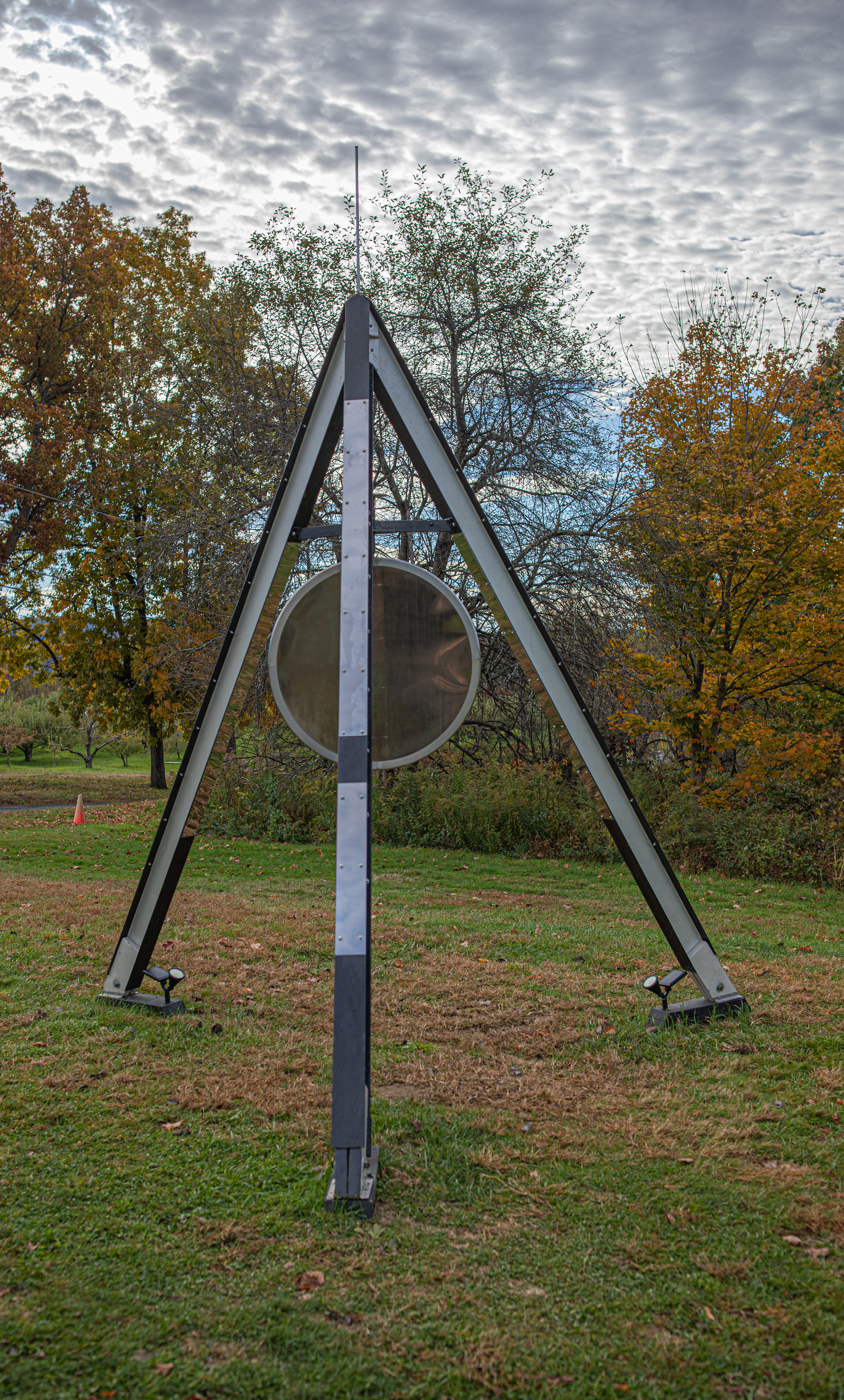
Brendan Stechini of Belchertown, MA, described his sculpture as being like a scientific instrument. He described it as being like a lighthouse with a round mirror that projects and reflects light, turning 360 degrees, oscillating like a weathervane. The mirrors on the outside legs capture the sky and the tops of the trees. The mirrors on the inside reflect the ground and our footprints. At the top of the sculpture, the steel rod points to the heavens. Brendan suggests looking at the sculpture with “new eyes” and “holding a mirror up to it” This sculpture represents how we can look at the same facts from an alternative perspective.
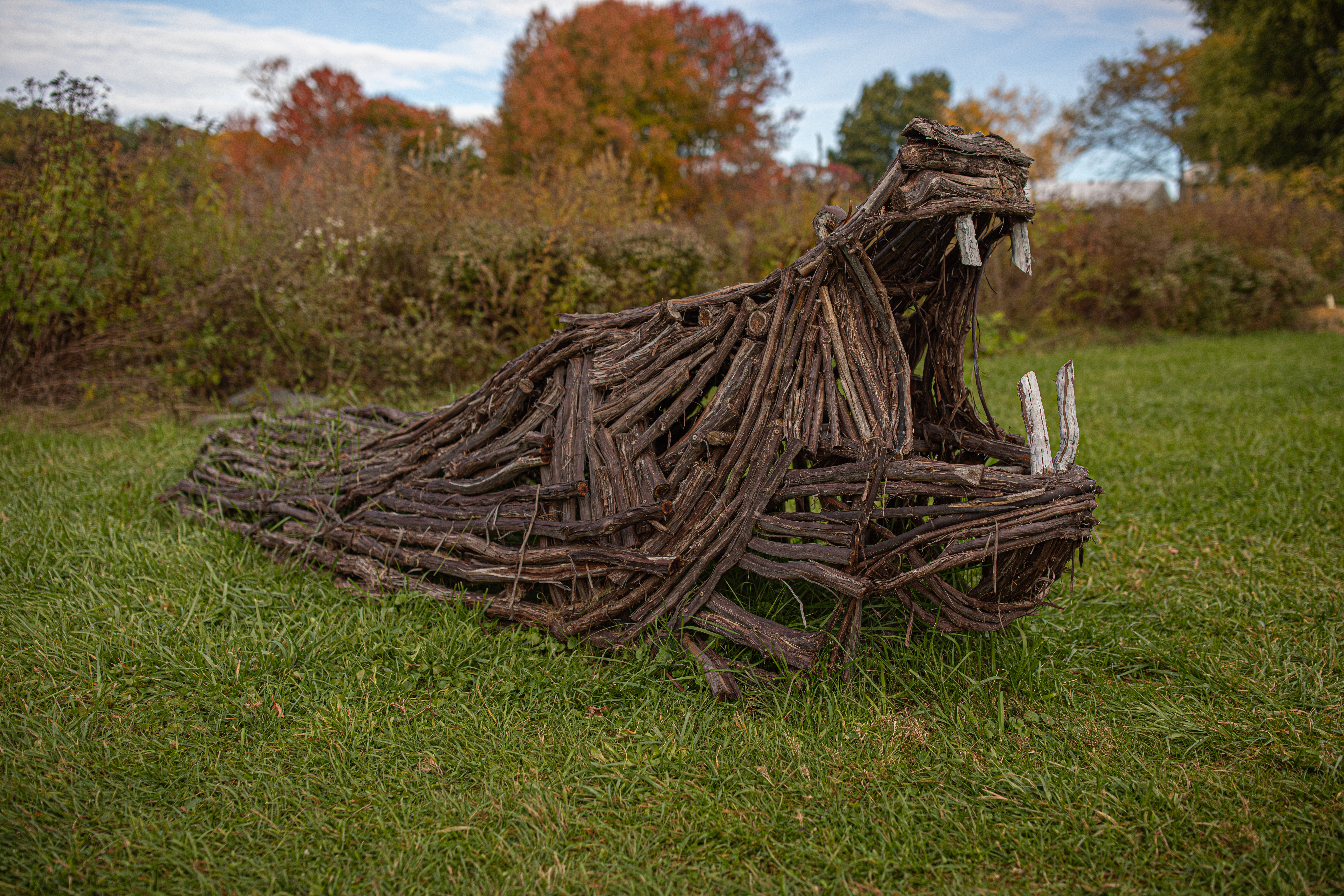
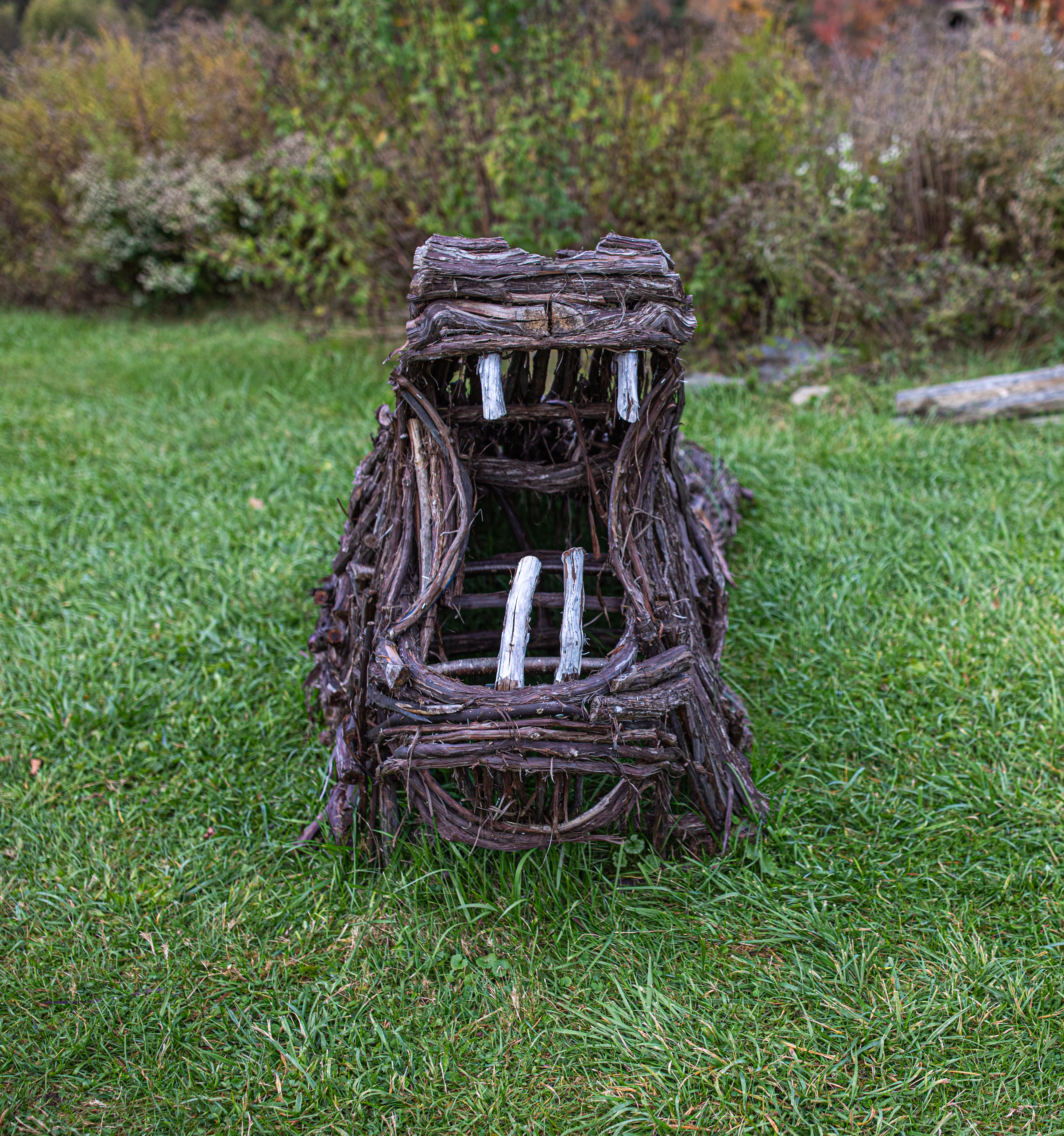
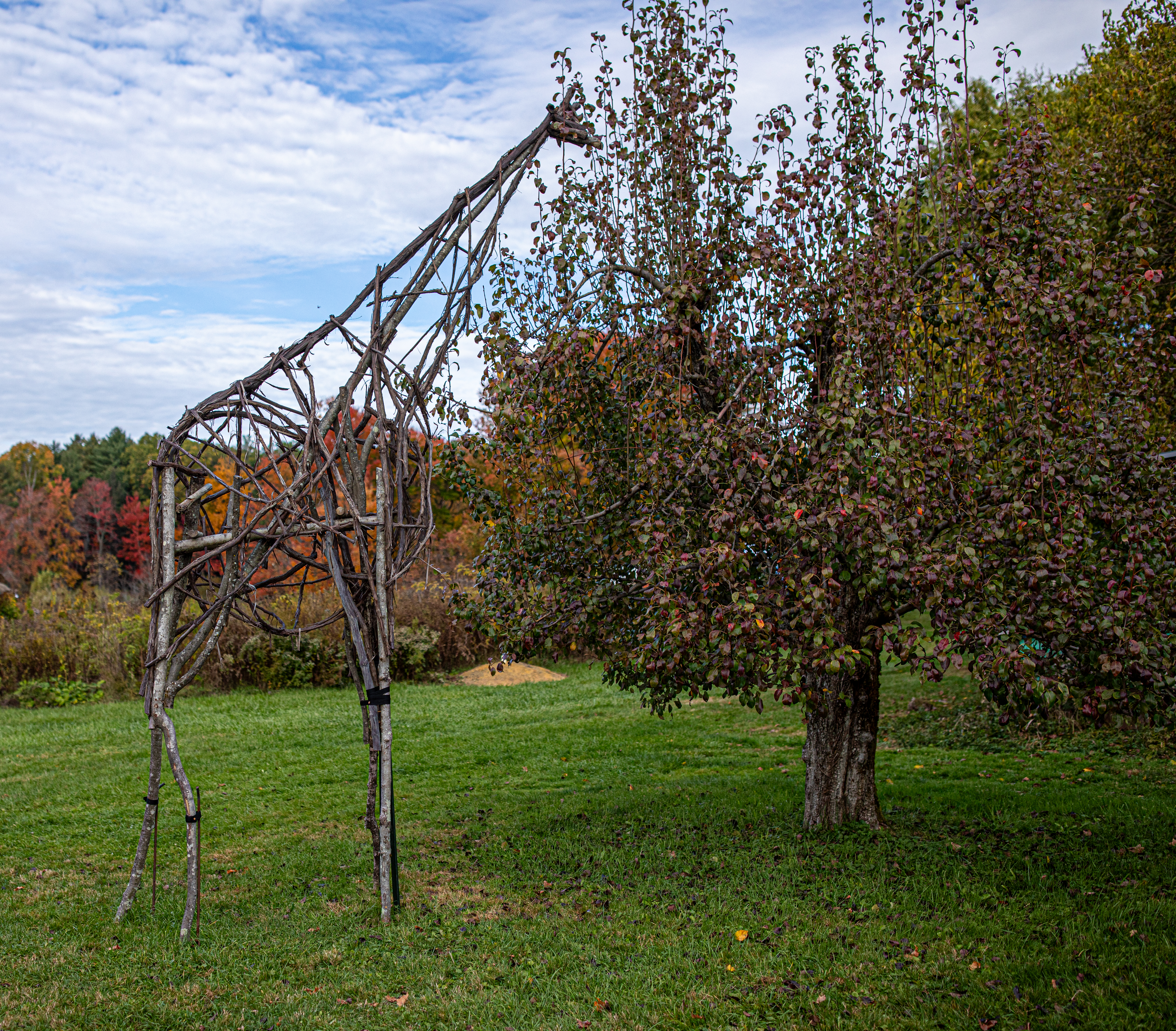
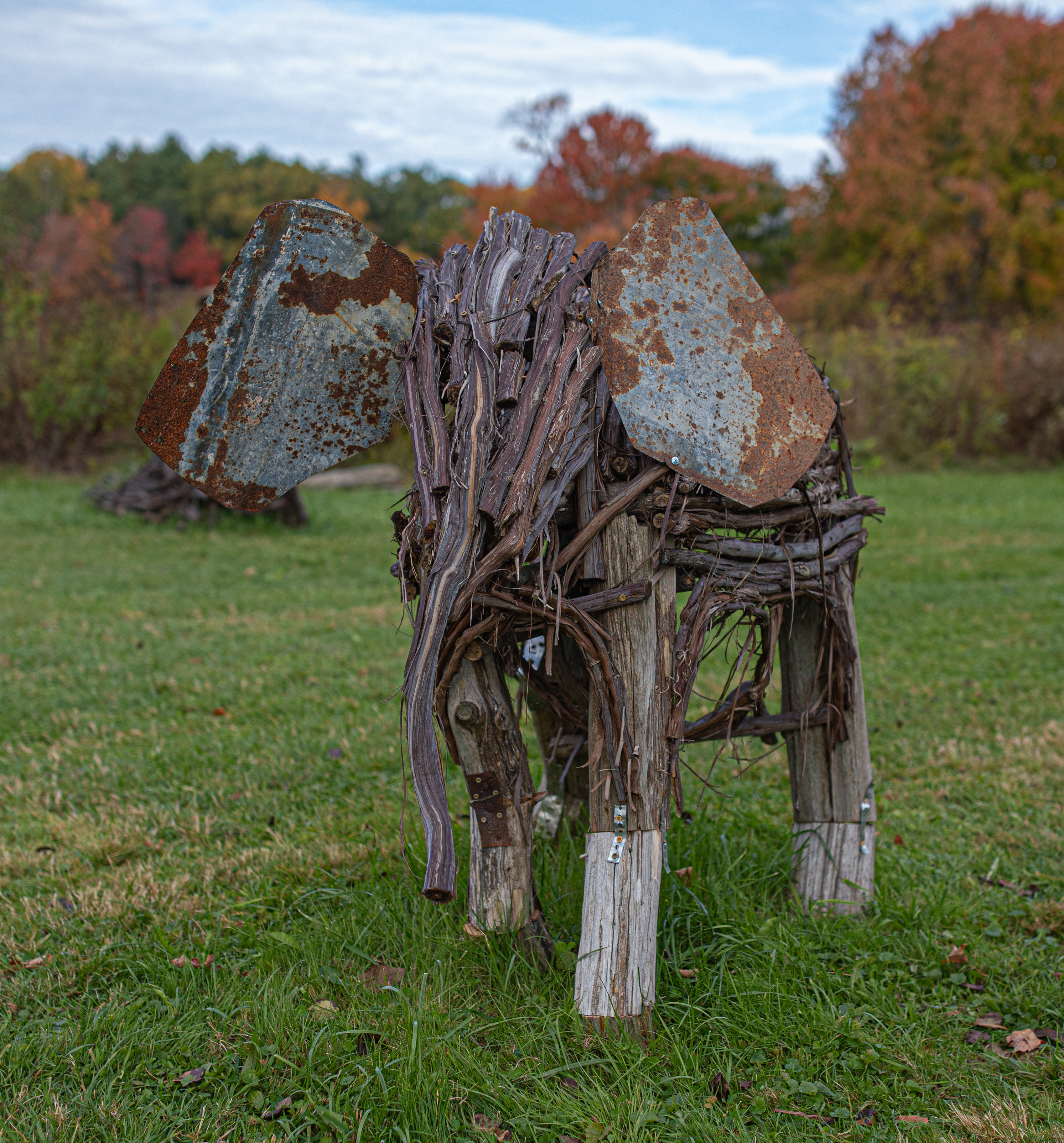
Malcolm White of Leeds. MA made some impressive sculptures all out of grape vine. Perhaps you heard about them through the…well you know.
Malcolm’s installations consisted of Pegasus the hippo, Long Tall Sally the giraffe and Atlas the elephant.
Malcolm has two objectives for his work: making a connection and bringing some joy to those who view his work. Malcolm uses material found in the landscape where he lives and which will decay into the same landscape without harm to the environment. He feels joy and a connection to the environment when he is making his works of art. If viewers feel the same connection and joy, Malcolm feels he has succeeded in his goals.
Malcolm was inspired by Greek mythology when making these sculptures. For instance, Pegasus was a flying horse from Greek mythology and hippos, or as the Greeks proclaimed them “river horses”, fly about in the watery world. So, the hippo is worthy of the name Pegasus. If you have seen a hippo gracefully swimming underwater you can see why he named it Pegasus.
Stay tuned for parts 2 and 3 (and maybe 4)!






 New England Nomad