Location: Barney’s Joy Road, Dartmouth, MA (about 1.5 hours south of Boston and 45 minutes southeast of Providence, RI)
Hours: The park is generally open from Memorial Day to Labor Day. Park hours in season are 10 am to 6 pm weekdays and 8 am to 6 pm weekends and holidays. You can park at the entrance (a gate prevents access in the off season) and walk the roughly half a mile to the beach
Cost: $12 MA Vehicle, $14 non-MA Vehicle, see website for additional fees for boating
Parking: there is ample parking near the beach after you pay at the entrance.
Handicapped Accessible: Yes
Dog Friendly: Yes, but they are not allowed on the beach from April 1st to September 15th, unless they are service pets
Located along the southern coast of Massachusetts, Demarest Lloyd State Park has some of the prettiest views of any state park I have visited. Its abundant bird population, scenic views and sandbars make Demarest one of the truly special places to visit and get away from it all.
Demarest is a bird lovers paradise, especially during the off season when there are less people, cars and other disturbances to scare them away.
The views at Demarest are truly breath taking.
I kept thinking to myself, sometimes the world is indeed a very beautiful place. It’s important to have places like this treasure to observe and appreciate pure beauty. Demarest was easy to photograph. The hardest part was deciding which photos to post. All I had to do was check my settings and point and click. The beauty was already there, all courtesy of Mother Nature.
It was low tide during my visit. So, I was able to walk out onto some of the sandbars and get up close to some of the gulls at the park.
There were also several lobster pots and other cage-like devices that had washed up along the shore or were being stored there for safe keeping
If you do walk past the beach area, as I did, you should remember to pack or wear an extra pair of walking shoes (flip flops and sandals won’t be adequate) because the path turns from sand to pebbles and seashells. It is worth the walk, though.
One of the few creepy things at the park were these spiders. And they were everywhere. I must have seen dozens of them. So, if you do lie out there on a beach blanket, I’m just saying…but they have a purpose and place here as well.
Parking: There is a free parking area across the street from the reserve for about 50 cars. Since the daffodils are a big attraction there, it filled up by the time I left and people had to wait to get the next available spot
Handicapped Friendly: No, the dirt trails have some slight inclines and the wooden planks used to walk over the streams are very narrow
Dog Friendly: Yes
Highlights: daffodils, wildlife, family friendly, easy trails, vernal ponds
Lowlights: Parking is very difficult unless you leave early on the weekends during daffodil season or go during the weekdays. It is not as busy after the daffodil season has ended
Undoubtedly the highlight of your trip to Parson Reserve has to be the sea of yellow and white daffodils. The short daffodil season (the season usually begins the second week of April and ends the first week of May) is one of the busiest times of the year at Parson.
The entrance to parson Reserve is not easy to find if you don’t know where to look, So, keep your eyes open and use the address listed above in your GPS.
A stream empties at the entrance to Parson reserve. A nondescript entrance is located just past the rocky stream. A short walk (about half a mile) along a well defined trail with a gentle incline and signs pointing to the daffodil field as well as a bench for weary travelers leads to the daffodil field.
Rows and rows of daffodils greet you at the end of the trail.
Bunny, a 6 year old Chocolate Lab who was adopted during Easter, enjoyed the daffodils!
One of the great things about my visit to Parsons is that there are also lots of trails to explore at the reserve which I had not expected. The easy flat trails have some pretty trees and, I assume when they bloom, flowers.
There is also a vernal pool. The staff who were there handing out maps, said they are supposed to be tadpoles there this time of the year. I did not see any. But, I am sure they’re there!
There were lots of critters at Parsons. I saw this cute little guy, a garter snake, as I was leaving the reserve. This is why I always take the less used trails (or go off trail). A lot of wildlife gets scared by the crowds and noise and consequently, you have to explore a little to find the good stuff.
There were also a lot of birds at the sanctuary.
Just to re-emphasize the issue of parking. Try to arrive at Parsons by 10 on the weekends during daffodil season. I am an early riser. So, I found a spot with no problem. The parking area has room for about 50 cars and it fills up quickly on the weekends this time of the year. When I did leave around 10:30, there was already a line of cars waiting to get in to the lot.
When I drove by even later (around 3) the entire side of the road was full of cars and the lot was full. So, the best time to go is early in the morning or on a weekday. But, it’s definitely worth getting up early for!
Parking I saw about 50 or so spots in the parking lot area
Handicapped accessible: Yes, but not on the hiking trails
Dog Friendly: Yes
Size of park and trails: 160 acres, 3 mile loop
Highlights: 9/11 memorial, ponds, trails, birds, playground, wildlife, big and pretty trees, “Woman With The Shoe”, “The Gorilla House”
Formerly known as Benson’s Wild Animal Farm and later New England Playworld, Benson Park was once a vast zoo that entertained countless visitors with their animals and attractions. The zoo may no longer be there but Benson Park still entertains visitors with its natural beauty.
Benson Parkwas bought by the state of New Hampshire and then transferred to the town of Hudson in 1998. It has since been converted to a play area and nature center. However, some remnants of the zoo remain which you will see later in this post.
The trails at Benson Park are easywith a few inclines.
The park now boasts a 3 mile loop and several ponds and streams. The ponds were partially frozen due to the cold weather and snow that was falling. It created some interesting shapes on the ice.
The park is a wonderful place for birding. There are a wide variety of birds at the park from egrets to much smaller birds like cardinals and robins. Cute birdhouses are scattered throughout the park to attract birds.
It snowed earlier in the day and it was still snowing when I arrived at Benson Park. The snow made the views at the park even prettier than usual.
I hope momma bird took her chicks out before all the snow.
While I didn’t see any wildlife, I did see lots of evidence of them in the snow. I would have loved to see just one of them up close.
The first thing you’ll notice as you enter Benson Park is the tasteful and somber September 11th memorial. Since some of the planes involved in that fateful day left from Boston’s Logan International Airport, some families in New Hampshire were directly affected. In fact, David Kovalcin, a resident of Hudson, was on Flight 11, the plane that crashed into the North Tower at the World Trade Center.
The memorial consists of several stone markers with the times and locations of each attack. A clock with the accurate time of each attack is engraved at the top of each monument. There is also a monument to each branch of the military that works to keep us safe.
There are benches surrounding the memorial to sit and reflect.
A steel beam from an elevator shaft at the World Trade Center is also at the memorial site. The nine-ton beam is from an elevator shaft on the 21st floor of the North Tower. Another bam stands next to it, representing the two towers at the site.
On a happier note, just beyond the September 11 memorial, there is a play area for children.
Just past the playground area is the “Gorilla House.” Tony the Gorilla used to live in this cage when the park was a zoo. The sign on the wall at the Gorilla House states that he used to watch tv and play in the Gorilla House when the area was a zoo. But, I couldn’t feel anything but a little sad and bothered by it. I know that is how we treat animals (which is a whole other issue for me) and he most likely was treated well enough. But, I always find it bothersome to see a majestic animal like that confined in such a way. The perspective you get from looking out through the bars from his view is poignant. In any case, children enjoy playing inside the cage and I think Tony would have liked it that way. A mural of what appears to be Tony is painted on the wall.
Fun fact: Colossus (aka Tony the Gorilla) ran for President against Jimmy Carter and Ronald Reagan in 1980. Rumor has it voters didn’t agree with his pro banana free trade stance.
Another fun attraction for children (or young at heart adults) is the Old Woman In The Shoe, baased on the nursery tale of the same name. The attraction is actually considered a historical monument. It’s slightly larger than my apartment.
Benson Park is a great place to take your dog. I saw a bunch of cute dogs during my visit.
Kuma (Japanese for “bear”), a 10 month old Akita from Maine, had fun playing in the snow.
Issy (short for Isabel), a 1 year old Lab mix, posed perfectly for me!
On my way to my car I saw this cutie. Daisy is a 4 year old Yellow Labrador.
Please connect with me on Facebook to view photos, videos and other content not included in this blog: New England Nomad
Location Robinson State Park, 428 North St, Feeding Hills Rd (Agawam), MA
Parking: about 10 parking spots are avaiilable in the back entrance on Feeding Hills Rd. There is additional parking in the main entrance and by the beach area.
Cost: Free this time of the year when the park is unstaffed, $8 MA vehicle, $10 non-MA vehicles during “season”
Size: 1,025 acres
Handicap Accessible: Yes, but some parts of the main trail, which is paved, have sharp inclines.
Thanksgiving in Western Massachusetts. What could be more emblematic of New England? As it turned out, I’m not the only onr who feels this way.
As I approached the back entrance to Robinson State Park, every parking spot was taken (some spaces were parked 2 cars deep). I did find a spot just in front of the main entrance )the gates were closed on this holiday, however). Who knew a park would be so busy on a holiday? At least that is how I used too think. Now, it makes complete sense.
In the past, I never understood why people would spend Thanksgiving Day, or part of their Thanksgiving, at a park or some other outdoor attraction. People should be home with their family, watching football or the parade and stuffing their faces, the younger me would say to myself. But, now I get it. What better place to spend the early mornings of Thanksgiving? What better way and what better place to be thankful, especially at one of my favorite paarks. In fact, I like it there so much I have posted about Robinson Park in the past. But, I took a few different trails that I had never hiked on before this time. At 1,025 acres, Robinson State is so big it could take days to thoroughly walk or even bike all of the trails. So, I figured I would work up an appetite for my Thanksgiving dinner with a jaunt there.
The trees were barren and leaves carpeted the ground. Only a few months ago these brooks were teeming with frogs and other amphibians.
I always love to see that one plant that has survived the elements.
Theere is also a lot of eviddence of what the park used to be like. A beam stands in the Westfield River, a reminder of the railroad bridge that once ran through the area.
This looks like a damn or some other waterflow management system that is now dry save for a brook that dribbles on by below.
I came across this falcon during my hike. I was surprised at how close I got before the bird flew away.
I also came across lots of squirrels. This one was resting ona tree limb enjoying a snack
Robinson Park is a dog friendly paark. I saw and heard lots of cute dogs during my time there. All of the dogs I photographed happened to be rescues. It was very refreshing to see so many rescued dogs there.
Annie, a mixed breed rescue, struck a pose for me.
Jessie, on the left, is a 3 year old Lab mix. Shadow, on the right, is a 13 year old Lab mix as well. They are both rescues.
Daisy, a yellow Lab rescue from Tennessee, had fun playing with her stick.
I hope everyone had a safe and happy Thanksgiving!
Please connecwith me on Facebook to vieew photos, videos and other content not available on this blog: Facebook
Location: 1361 Middleboro Ave, East Taunton, MA (about 45 minutes south of Boston, MA)
Cost: Free this time of the year. Seasonal prices are not posted on the web site or at the park.
Hours: Open Daily 7:00 a.m. – 4:30 p.m. (hours may vary depending upon the season)
Parking: There were roughly 50 to 60 parking spots in the lot
Handicap Accessible: No. The side trails can be very rocky and, in some areas difficult to navigate. The main road is paved but cars and other vehicles do travel along the road often.
Dog Friendly: Yes
Time To Spend During Visit: 2 to 3 hours
Highlights: pretty trees, pretty views, bodies of water, dog and horse friendly, cranberry bogs, boat launch (the seasonal camping sitees have not been opened since the 2008camping season)
Named after the sachem, or leader, of the Wompanoag Confederacy, Massasoit State Park boasts 1,207 acres of trails, 5 bodies of water and a beach area. Add to that some pretty sweet views.
The first thing you’ll notice, and perhaps the main attraction, at Massasoit State Park are the cranberry bogs. The colors of the cranberry and the trees clash to make some pretty contrasts, particularly during foliage season.
The trails at Massasoit State Park are mostly easy with a few moderate inclines. There were a few boardwalks and makeshift bridges made out of trees and other debris.Many of the trails were carpeted with leaves.
Signs of foliage were everywhere. Trees burst with orange, red, yellow and green this time of the year.
Massasoit has 5 ponds and a beach area. The bodies of water are surrounded by pretty trees and vegetation.
Swans and other birds inhabit the ponds.
As you can tell by the photos, the weather changed about, oh, 16 times during the day. In other words, it was your typical New England day. It rained, hard at times, for short periods of time and the sun crept out as well.
Another thing I noticed at Massasoit State Park are the rocks. There are white rocks placed throughout the park and other big rocks with crystal-like elements in them.
The park is also popular with cyclists. I saw dozens of cyclists during my visit. This friendly cyclist was nice enough to let me photograph him.
With its wide paved trail and abundant side trails, Massasoit is the perfect place to bring your dog and I saw several dogs enjoying the fall weather during my visit.
Rex is a 6 and a half year old Blue Tick Coon Hound. Never heard of a Blue Tick Coon Hound? Join the club. Apparently, Blue Tick Coon Hounds are hunting dogs that are prevalent in West Virginia, which is where Rex is from.
Granger is a 4 year old Black Mouth Cur.
Cocoa is a 10 year old Chihuahua and terrier mix breed. He lives nearby and visits the park often.
I also saw these two playmates at Massasoit.
Grace, a 2 year old Doberman and Sydney , a 1 year old Golden Doodle, affectionately played at the park.
Please connect with me on Facebook to view photos, videos and other content that is not posted in this blog: New England Nomad
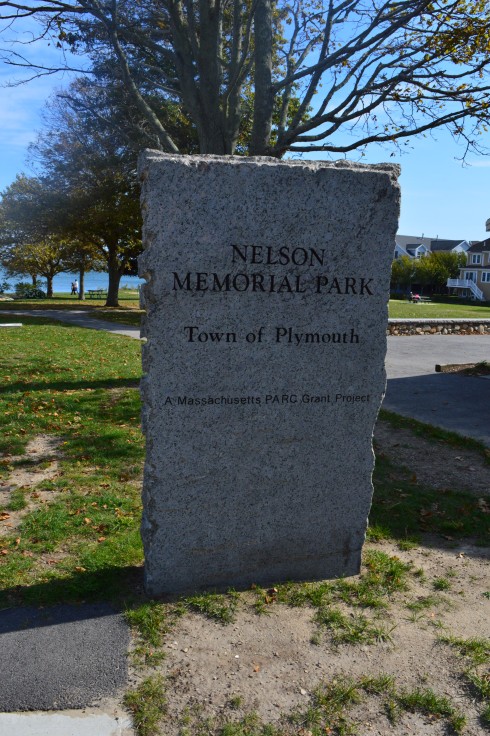
When people think of Plymouth Massachusetts certain places automatically come to mind; Plimoth Plantation, Plymouth Rock, Nelson Memorial Park. No, that’s not a typo. In fact, Nelson Memorial Park may be one of the best kept secrets in Plymouth (except may be the Grace Trail).
Located approximately a mile from the aforementioned rock, Nelson Memorial Park is a family friendly park with activities for children, pretty views and ample parking.
The water activity area, called a “splash pad” is an area that shoots out water for children, and probably even a few adults and dogs, to play in. A sign states that due to water restrictions the pad will be on only on days when the air temperature is above 80 degrees. There’s little threat of that happening for some time, although we have had some unseasonably warm weather lately.
The park is relatively small but it still offers some very pretty scenery. I’ve always marveled at how clouds, even wispy clouds, can really accentuate the beauty of an area, especially by bodies of water.
Some kayakers took advantage of the warm weather and calm water.
There is also a bike path from Nelson Memorial Park that goes all the way to North Plymouth (roughly 1.5 miles from Nelson Memorial Beach or over 2 miles if you start from Grace Trail which is located behind the park’s parking lot).
Although it is a small park, Nelson Memorial is a wonderful, peaceful area just minutes from the busy waterfront and downtown areas and a must-see if you’re in the Plymouth area.
A boy and his dog take in the views at Nelson Memorial. This is why dogs are so great. No matter how bad your day is or how lonely you might feel, you always have your dog.
There were many other dogs at Nelson Memorial Park and I was able to get some great shots of a few of them.
Remy is a 13 year old Lab, Boxer and Rottweiler. He had head and leg injuries when he was adopted. But, he looks fine right now!
Stella is a 7 year old Boston Terrier with a special talent. She likes to chase balls and hit them with her head, soccer style.
Location: 246 Dudley Road, Newton Centre, MA (there is also an entrance on Farina Rd)
Hours: open daily, dawn to dusk
Cost: Free
Parking: There is a designated parking area for about 6-8 cars. People park on the side of the entrance when the regular spots fill up (see below for photo of parking lot)
Park Size: 100 acres (conservation area is 32.2 acres)
Trail Difficulty: Easy
Highlights: Easy trails, sculptures displayed around the park (until Nov. 11th, 2016), wildlife, pretty trees and flowers
As if Kennard Park wasn’t pretty and interesting enough on its own, sculptures have invaded the park. The Kennard Park Sculpture Trail is a diverse display of art with social , personal and political messages. But, hurry if you want to view it. It is scheduled to be on display until November 11th of this year.
I want to give credit to 52 Sundays-Halpern Blog for posting a blog about this amazing exhibit. Stop by and check out halperns’ blog!
The sculpture trail includes sculptures from 15 different artists. There are sheets of paper hanging from the exhibits or near the exhibits which give information about the artist and some of his or her inspiration behind the sculptures or art. The sculptures may not seem to go in order numerically if you start the trail from the parking area because there are several sculptures and works of art on the front lawn. I am listing the sculptures and pieces of art in numerical order based on the map key which is available at the park. Free handouts for the trail are located on one of the tables at the entrance.
The first sculpture by Jean Blackburn is called Kennard Web. She states she is fascinated by the age of trees and their ability to adapt or effect their environments. She also states she would like to create a “weave of connections” through this art work. The work of art would make visible the singular configuration of the community of trees at this time and place.
The second set of sculptures, by Paul Walker, are called the Nattural Balance Benches and Bridge Bench. These tables and bench are a combination of rough and refined, accordiing to Walker’s write up. They are natural and hand made. They are comprised of black walnut is in Newport Bay and sediment stone with stainless steel posts.
Murray Dewart’s sculptures are the third work of art on the trail. His sculpture entitled, “Pavilion Of The Sun” is meant to convey something aspirational, both spiritual and monumental. The Sun Pavilion has the promise of something ceremonial and celestial, open to the sky.
The welded aluminum 15 foot gate is powder coated and installed in three sections. On the inner face of each column inside the pavilion is a mirrored surface of stainless steelthat reflects the sunlight with the faces and bodies of the visitors.
Dewart also has a bright red aluminum gate as part of his exhibit.
The Propeller Bench by Kit Clews is the fourth exhibit on the sculpture trail. The Bench Propeller is an ultralight cooling station. Kit imagined a tree branch with a gently spinning propeller in place of leaves which are create cooling breezes whilst they lounge together under the kinetic propeller tree. As the spinning wheel turns, visitors are free to visualize “whirled peace” and perhaps, someday, “the wheel thing.”
The fifth exhibit is a “Reflection on the Ornithology of Naturalist-Conservationist Frederick Kennard and Memorial to Extinct Species” by Charlet Davenport. As the name suggests, the exhibit honors Frederick Kennard’s interest in birds and to the extinct species of birds who used to roam these woods.
The exhibit includes eggs with names of extinct species on them (the very same eggs, except they are not real, that Kennard would collect) as well as porcelain forms in the shapes of Japanese lanterns which are meant to mimic the paper lanterns which were used as ornaments during the times of Frederick Kennard. A stoneware birdbath is located next to each tree.
Biomimicry Rain Harvester by Allison Newsome is the 6th exhibit on the trail. Her sculpture is made of steel, cast bronze rain chains, aluminized steel culvert and garden hose. It is a functional sculpture that harvests rain water. It holds up to 700 gallons of water and it has a hose attached that can be used for gardening and help in conserving the use fo town water by using the water it collects instead. Biomimetrics is the immation of nature to solve complex human problems. Biomimetrics is a combination of “bios” which is Greek for life and “mimesis” which means to imitate.
Marek Jacisin’s “Visual Playground” (the 7th exhibit) is meant to transform that part of the park into a visual playground. The sculpture recreates elements of a board game. The pieces of the exhibit are the player pieces of the game and the park is the board, according to Jacisin. Jacisin was aiming (no pun intended) to provide a stark contrast with the black and white spinning circles and the asymmetrical shapes. Jacisin goes on to explain that “nothing is ever as it seems.”
Once your eyes refocus, you can make your way to the next exhibit (exhibit number 8). Zoe Friend’s exhibit may be hard to find if you don’t look hard enough. Somewhat off the main trail, past the parking area and closer to the office, Zoe Friend’s exhibit “Bromeliads” is a tribute to her mother. While researching charm bracelets, Zoe came across her mother’s old charm bracelet and she wanted to create something that would showcase some of the things her mother loved such as fuschia flowers. Specifically, Zoe remembered how the rain cascaded off the flowers and how they clung to the very ends of the stamens after a shower, cementing them as the perfect crux between the rain chain and the her mother’s charm bracelet.
The ninth exhibit by Caroline Bagenal is called “Strata.” If, like me, you begin the trail at the area closest to the parking area, this may be the first sculpture you see. The elements of the Strata sculpture were inspired by the park itself. Bagenal states she was first attracted to the land of the park and the apple trees in front of the house as she first came into the park. She was also attracted by an old well on the corner of the property and the old stone walls she passed by while walking through the park. She also learned part of the park used to be used as a landfill which lead her to the idea of making an exhibit with levels of both “man-made” and “natural” levels. As you can tell the sculpture includes natural things as well as man made materials. Layers of thought, time and place are included in her sculpture. She specifically chose the perennial garden to display her art because it suggests a clearing but with encroaching woods. Even the books she chose to include in the sculpture such as a book by Robert Frost and a building construction book seem to add meaning to the exhibit.
“Color Notes” by Anne Spalter is the tenth sculpture on the trail. Spalter’s exhibit includes three pieces; digital wallpaper, video work and exterior sculpture.
Digital Wallpaper is meant to be a main conference room with a large-scale kaleidoscope composition that integrates images of the wooded area during winter. The video work is a “color piano” video that uses color notes from winter and fall creating an abstract piece that calls attention to the changing seasons. The exterior sculpture aspect of the sculpture are meant to highlight the transparency of the “keys” with the colors of nature showing through.
Peter Diepenbrock’s sculptures are the eleventh part of the trail. Peter’s art consists of four pieces. His collection, called “Buddhati’s Dream: The Transference”, includes
“The Lost Boy”
“Spirit Ship”
Spectral Shift II
and “Pegasus”
Peter’s intent was to create a strange otherwordly environment of alien-esque artifacts with fragments of alien intelligence or presence set in an otherwise perfectly quiet, natural environment.
To my surprise and delight, Peter was there to discuss his art and some of the details about his sculptures. In fact, the artists may be appearing from time to time at the park to meet people and discuss their works.
The twelfth exhibit is “Totems” by Deborah Putnoi. “Totems” is in part an interactive exhibit. Rocks and signs with words and phrases of good advice such as “breathe”, “imagine and “be open” are strewn throughout the trail and on trees. People are encouraged to draw their own art based on the nature they see on the totems and on paper which provided.
Putnoi, who grew up in Newton and presently lives there, wanted to make a piece that is subtle and doesn’t detract from the nature. The stones are meant to reflect aspects of the layered and embedded history in the toen as well as the history of the trail and space.
The next exhibit (number thirteen on the sculpture tain) is by Marco Vargas. Marco’s sculpture was inspired by Ehecatl; the Aztec god of wind whose breath gave movement to the sun and gives life to the lifeless. His love is symbolized by a tree that grows in the place where Ehecatl arrived to Earth. Since Kennard Park is a natural zsetting, Vargas wanted to use natural materials to his sculpture. He used red mud where graffiti hexagons draw the god of wind. He also used branches and logs.
The fourteenth exhibit on the trail is “Sacred Space” by Carolyn Kraft. Carolyn’s work of art is a reflection the beauty of nature and how we can appreciate it in our life. She loves to make dwellings of nature from nature. Carolyn thinks we can find contentment and be more connected to earth through her art. Inside the hut are chairs made of stone with moss on them. The beads which hang in the area change color based on the direction of the sun.
The fifteenth and final work of art is “Silent Spring” by Mary Dondero. As the title would suggest, Mary’s art is based largely on Rachel Carson’s ground breaking book, “Silent Spring” which revealed the indiscrimate use of pesticides and how it affected our environment, particularly birds. Mary’s exhibit includes 200 shimmering white objects at the base of the tree, all silent. Most of the bird objects are clustered near an almost dry brook or stream. She included ceramic hands in the stream-bed. The hands may appear to be ripples of water when the water returns to the area. Her goal was to imply that it is by our own hands that these songbirds have diminished in population. Although it is explicitly explained in the paper explaining the art hanging near the exhibit, I interpreted the cloths on the rocks on the ground to be dead birds, perhaps due to the use of pesticides and other detrimental human made causes.
Besides, the works of art, there were many other pretty and interesting things at the park.
And, of course, there were dogs at Kennard Park. With its easy trails and spacious areas to roam, Kennard is an ideal place to take your dog for a quick walk.
Frederick, a 4 year old Chihuahua rescue, had to take a big stretch before he began his walk..
Sally, a 3 year old Golden retriever, walks the trail almost everyday. She was more interested in playing with her stick than looking at the art.
Truffles, a 6 year old Italian Waterdog, lied down and took in the art at the park.
Pika is a 12 year old Border Collie. The name Pika is derived from the name of the pica font style.
Below is a video of Peter Diepenbrock’s Spectral Shift sculpture. In the background, you can hear him discussing his art.
Trails:
Tues-Sun, & Mon holidays, dawn to dusk
Closed Mondays
Cost:
(MA Audubon) Members: Free
Nonmembers:
$5 Adults
$4 Children (2-12)
$4 Seniors (65+)
Parking: There are about 50 0r so parking spaces in the parking lot
Trail Difficulty: Easy to moderate
Size: 9 miles of trails
Time To Allot For Visit: 2 to 3 hours
Highlights: abundant wildlife, clearly defined trails, lookouts and bridges, several pond areas
Lowlights: One of the ponds (Little Farm Pond) is only accessible via motor vehicle and is not accessible from the sanctuary, according to one of the staff workers at the sanctuary
From the moment I drove into the parking lot for Broadmoor Wildlife Sanctuary (a MASS Audubon sanctuary), I could tell it was going to be a special place. The pretty trees and stocks of grass reminded me of some rural, country farm.
The 10 trails at Broadmoor are fairly easy to negotiate (the Charles River Loop is probably the most challenging). There are a few trails that cross over ponds and marsh land.
Overall, the trails are easy with a few moderately difficult trails such as The Charles River Loop. The trail on the Charles River Loop is somewhat narrow in some places and it can be hard to follow the trail (look for the yellow and blue marked trees).
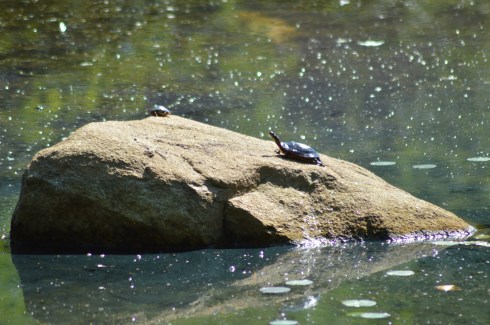
There was a lot of activity, such as turtles, in the ponds. Can you spot the turtles in this photo? There are three.
What if I get closer?
How about now?
Broadmoor is teeming with wildlife. I found these critters during my hike.
There is also a lookout area where you can sit and look out upon the pond where I found this heron hiding.
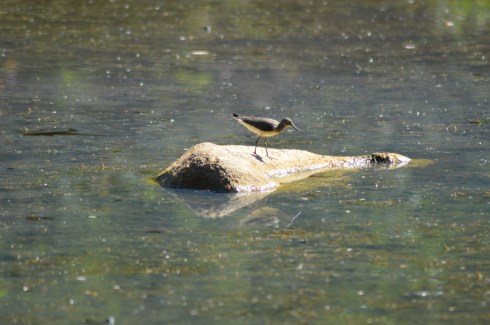
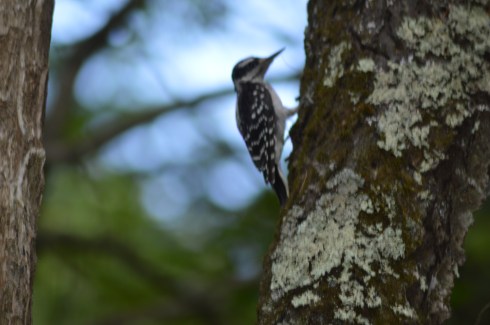
There is a lot to see at Broadmoor. There are lots of turtles, butterflies, birds and evidence of other wildlife.
I found this beautiful swan as I was walking along the park.
All that swimming and looking for food can make you tired. So, she decided to take a nap.
There are also beautiful views of the park. The flowers, plants and trees make for a beautiful backdrop.
Broadmoor Wildlife Sanctuary is the perfect visitors of all ages (I even saw some visitors in strollers). It can be buggy but, as lucky would have it, that won’t be a problem for much longer in New England as fall descends upon us.
Cost: $4 for adults, $2 for children (ages 6-11), children 5 and under get in for free, NH residents 65 and older are also admitted free of charge
Hours: Open daily, sunrise to sunset, campground schedule: May 6 -Oct. 29 (2016), Sun-Thu 8 a.m. – 8 p.m., Fri 8 a.m. – 10 p.m.
Size: 10,000 acres
Time To Allot For Visit: 2 to 3 hours
Parking: There are about 50-60 parking spaces in the main parking area (see photo below)
Additional parking can be found at Hayes Field (see attached map)
Dog Friendly: Yes
Highlights: Very popular with cyclists, several large ponds and marshes, teeming with wildlife, campgrounds, archery target area, fishing (fly fishing only)
A haven for cyclists and nature lovers, Bear Brook State Park in Allenstown, New Hampshire is the largest developed state park in New Hampshire. Boasting 10,000 acres, over 40 miles of trails, several ponds and other bodies of water and marsh lands, Bear Brook is the biggest state park I have hiked.
Although there were many frogs and turtles visible at Bear Brook, birds, deer and other wildlife proved to be more elusive.
Bear Brook also has a fishing area, two of them actually. There is the Archery Pond, which also has an archery target area. Only fly fishing is allowed in the pond.
The archery target practice area is to the right of the pond.
Across the paved road from Archery is a kids fishing pond for children 12 years old and younger. A fishing pond for children! How cute is that?
What my visit to Bear Brook lacked in deer, birds and other more typically photographed wildlife, it made up for in smaller critters.
I did see a few runners and hikers but the overwhelming majority of the visitors at Bear Brook were cyclists. The trails vary from flat and easy to steep, rocky and challenging. I would consider some trails to be very challenging even for the advanced cyclist and I did not see any cyclists on some of the more steep and rocky trails.
You never know what you’ll find at Bear Brook State Park. While walking along the main trail, I came across this grave site for an unknown soldier from the Civil War. There is no marker for the Union or Confederacy. The only flag or designation displayed is an American flag.
There is also a stream running under a bridge at the entrance
There are also several ponds, marshes and creeks.
There are also beautiful, vividly colored trees, plant life, spiderwebs (ok, maybe that’s not so beautiful) and a sign that summer is soon ending.
Speaking of beautiful trees and plants, one that thing is hate to see at parks is the cutting down of trees or, as the parks call it”sanitation timber harvest.” However, in the case of Bear Brook, and most state parks, there was good reason for this sanitation. Because of an infestation of red pine scale, many of the red pine plantations had to be cut down. The sanitation began in 2013 and was completed in 2014. For whatever reason, it’s always sort of sad to see so many open spaces and stumps.
The trail for Hayes Farm does not lead to a farm but rather what used to be a farm. You can see remnants of the stones which surrounded the farm from the trail.
This is my only gripe about the park. There are long swaths of land without much there. It’s very pretty and largely untouched by humans. In fact, it is such a big park that I was unable to get to one of the bigger attractions, Catamount Trail that is supposed to have pretty scenic views. But, after 6 hours of hiking and photographing the park I didn’t have the energy for that hike. But, keep it in mind if you do go.
There is also a campground with a place to park your camper or rent one of their own. Check their website for fees and availability.
There were not many dogs at Bear Brook. In fact, Jack, a 9 year old rat terrier from Rhode Island, is the only dog I saw during my trip.
Parking: There are about 30 parking spots at the entrance to the park. There is also off street parking and parking available down the street at Kasabuski Arena (201 Forest St).
Cost: Free
Hours: Open everyday sunrise to sunset
Size: 640 acres
Time To Allot For Visit: At least 1 to 3 hours
Trail difficulty: Easy to Moderate in some areas
Dog Friendly: Yes
Fun For One: Yes
Highlights: scenic views – especially from Eagle Rock, beach, play area for children, trails for cycling and running, fishing is allowed
Lowlights: side trails end without warning, some rocky terrain
Once a hunting ground and camp area for Paleo Indians as far back as the Archaic and Woodland eras (roughly 1000 – 2000 BCE), Breakheart Reservation boasts two grand lakes, scenic vistas, a beach, a play area for children and miles of trails.
The trails are mostly easy with some moderately difficult trails and inclines. The side trails can be challenging more because of the rocky and narrow terrain rather than the inclines. The one downside to taking the side trails is that some of the side trails end without warning, such was the case with the Saugus River Trail which is one of the first side trails you will see when you enter the park. The Cedar Glen Golf Course abuts the park. So, you’ll hear and see golfers whacking their golf balls around. Also, one side trail leads to the children’s camping site which you’re not supposed to access and yet another trail just ends near a store’s parking lot. So, you end up walking long distances only to have to turn around. If you want to avoid walking on trails that end suddenly, it’s best to stay on the main trail and the trails that loop around the lake.
The two lakes at Breakheart Reservation, Pearce Lake and Silver Lake, have trails that loop around the bodies of water.
Pearce Lake (considered the lower pond) has a beach and some very pretty views. It runs along the main trail and along some of the side trails. It is the larger of the two lakes and it is where the beach is loacted.
Although Lake Pearce is the larger of the two lakes, I found Lake Silver (the upper pond) to be more intriguing than Lake Pearce.
Lake Pearce has two smaller islands in the lake. One of the islands is accessible via a makeshift walking bridge of branches, sticks and anything else that you can walk on to get to the island. Except for some pretty views there wasn’t much on the island.
At an elevation of 206 feet, Eagle Rock offers scenic views of the Boston skyline and surrounding areas. One suggestion I would make if you do try to climb up to Eagle Rock (it’s a moderate climb) is to use the “back” way to the vista (aptly names Eagle Rock Trail). I went straight up along the rocky edge along the Pearce Lake Trail and it was more challenging than it would have been if I had gone up via the trail on Eagle Rock Trail. There are other points of higher elevation on other trails such as Castle Rock and Crow Hill.
There are many other beautiful and interesting things along the trails at Breakheart Reservation.
This slideshow requires JavaScript.
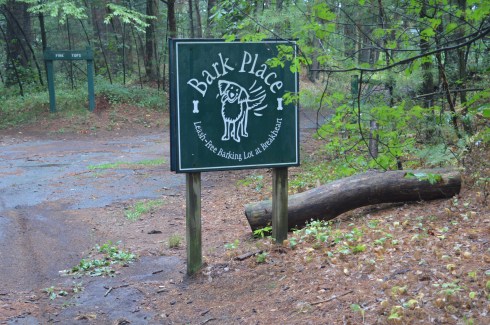
Breakheart has a paved main trail which is usually packed with runner, cyclists and people walking their dogs, especially at the Bark Place where dogs are allowed off leash for a section of the trail.
Breakheart Reservation stopped allowing vehicles on the trails some time ago. It was great not having to look over your shoulder or carefully turn a corner worrying if a car or other vehicle might be coming your way. It also allows lots of room for all the walkers, runners and, of course, the dogs that frequent the park.
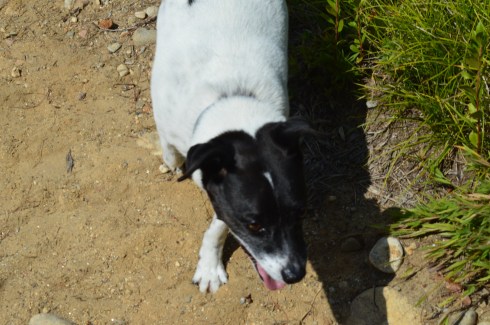
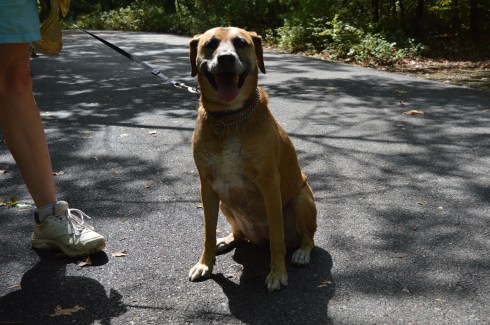
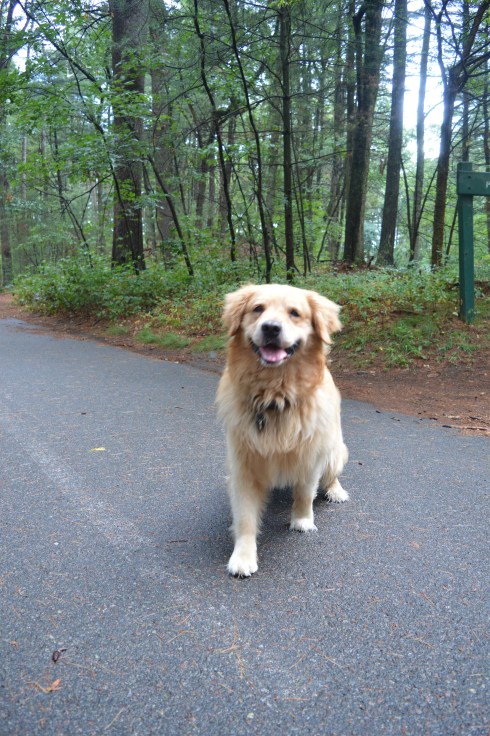
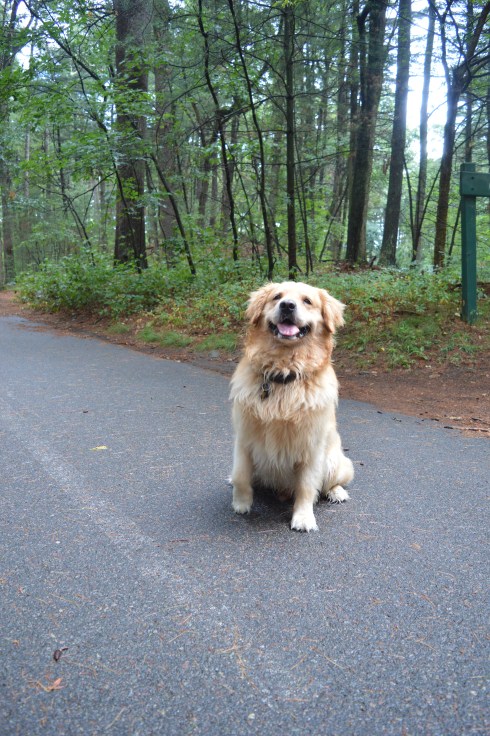
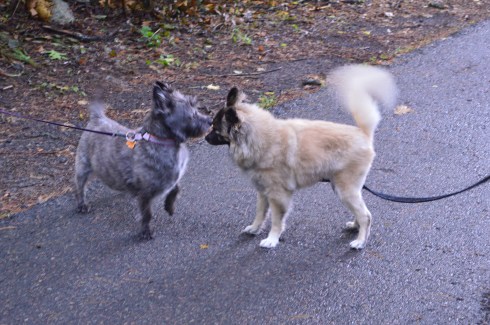
These dogs had a great time at Breakheart Reservation during my visit…






















 New England Nomad