Category Archives: art

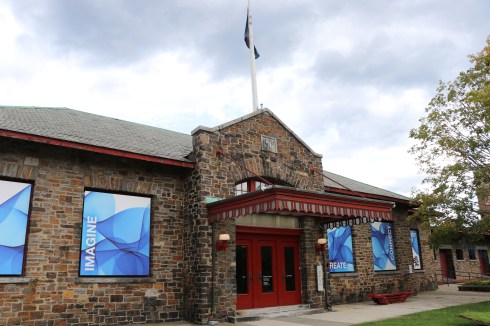
Brattleboro Museum & Art Center (Brattleboro, VT)

Date Of Visit: August 6, 2017

Location: 10 Vernon Street, Brattleboro, VT

Hours: The galleries are open every day except Tuesdays, 11-5 (closed January 1, July 4, Thanksgiving Day, and December 25). On the first Friday of each month, the galleries stay open until 8:30 p.m., with free admission after 5:30 p.m.

Cost:  $8 for adults, $6 for seniors, $4 for students, free for BMAC members and youth 18 and under. Free admission for all on Thursdays, 2-5 p.m.

Parking: There are about a dozen parking spots in front of the museum and next to the

Handicapped Accessible: BMAC is wheelchair-accessible, and a guest wheelchair is available. Upon request and with advance notice, we will provide an ASL interpreter.

Website: Brattleboro Museum And Art Center

Highlights: the following exhibits: “Free Fall”, “The Boomer List”, “Boundaries, Balance and Confinement”, Spaceship Of Dreams”, “Lost Porches”, “Density & Transparency” are all on display until Oct. 8.

Tips:

  • parking in front of the museum is limited – there is street parking available in the area
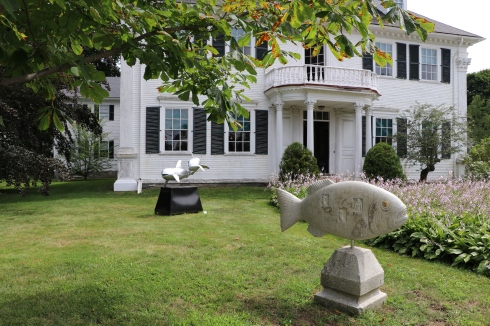
  • The art isn’t only in the museum itself: there are additional works of art on the grounds of the entrance to the museum


IMG_8141

Have you ever dreamed of spaceships?  Do you ever wonder if a piece of art can be dense and transparent?

Then the  Brattleboro Museum And Art Center is just the place for you.

Brattleboro is a “non-collecting museum.”  So, the exhibits do not stay there permanently and they often switch out exhibits.

Although it is only one floor, technically two if you count the five stairs that lead to the “Spaceship Of Dreams” exhibit, the Brattleboro Museum And Art Center (BMAC) has a wide variety of art to view and appreciate.  The small size of the museum is actually comforting for people like me who can be overwhelmed by museums with a lot of art.  You can certainly look through all of the seven exhibitions currently on display, without rushing, in about an hour or hour and a half.

My favorite exhibit is “Spaceship Of Dreams” by William Chambers.

Formerly titled “Spaceship York”, “Spaceship Of Dreams” began as a window display at a vacant storefront in York, PA.   For two moths during the summer of 2015, William built and displayed this exhibit for all to visit for free.   The “Spaceship York” project culminated with a countdown and blast off day, reports of travel, and return of the ship.

As people began to visit the exhibit, the work of art transformed into more than just a rocket display.  People were able to connect with the artist and the work of art by working on the ship, using the space library and sharing ideas for change in York and the world.   The ship became a metaphor for imagining possibilities and realizing dreams.  Most significant was the chance to write or draw personal visions to be sent up with the ship.  William would incorporate this as well as other family friendly aspects to the exhibit.  It was great to see the messages and drawings the children left to be placed into the ship.

The exhibit is stopping off at the museum as part of its national museum tour.  It will be on display until October 8.

Also on display is the “Density And Transparency” art display by Wolf Khan.

Wolf Kahn, who has macular degenerative, experiments with new methods and materials.  He begins each painting by scrubbing in the basic composition and colors.  Then, he uses a variety of oil sticks to produce bold forms and densely filled, saturated forms colors.

“Scrub, scub, scrub” that is how Wolf describes the process of making this art.  Wolf uses this method to create layers of thinned paint.

Below is a sample of his work.

IMG_8017

Pink Tangle Painting (2007) – oil on Canvas

IMG_8020

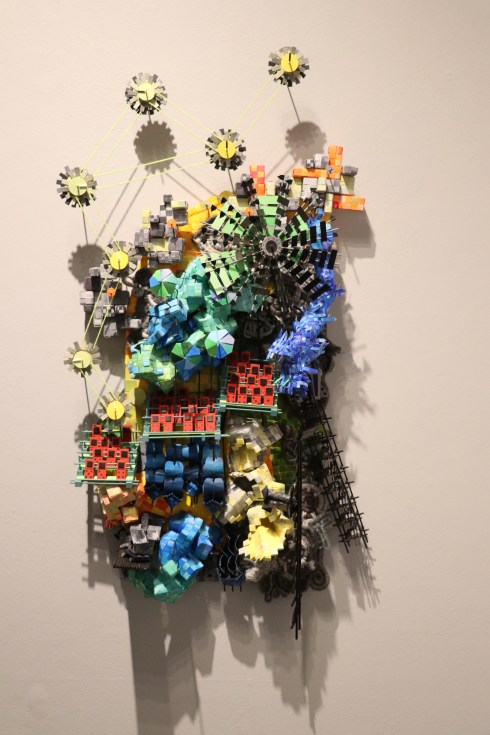
Nathalie Miebach’s “Lost Porches” exhibit combines everyday items (such as paperclips). Her sculptures use designs that resemble weather maps and  what she calls “numeral logic.”  Her sculptures are meant to mirror our weather and the unfortunate consequences of some of our extreme weather patterns.  I couldn’t help but think of a weather doppler or meteorological radar screen as I looked at her work (given the earlier mentioned intentions of her art).

This sculpture called, “Build Me A Platform, ” she asked, “high In The Trees, So I May See The Water.”  It is made of wood, paper, string and data.

IMG_8069

She describes this piece as being about four different flooding events that have impacted the Louisiana area since Hurricane Katrina.  This is what makes Nathalie’s work so interesting.  Many of us may not have known there were other flooding events since Katrina.

Nathalie used weather data from each of the flooding events while asking how we can come to terms with and perhaps prevent these flooding events in the future.

The sculpture below titled, “The Last Show Was For The Bleachers.”  This sculpture, completed in 2016, is made of wood, paper, data and string.

IMG_8065

This sculpture is based on an aerial view of the New Jersey/New York shoreline.  The piece translates Hurricane Sandy data.  The domino pieces represent retired hurricanes that are sitting on bleachers, looking on and waiting for Hurricane Sandy to join them on their benches.

The last sculpture titled, “Lost Porches” is meant to represent the front porches which is considered a traditional gathering place for the people in New Orleans.  However, when Hurricane Katrina hit the New Orleans area this important social element was lost for many people.   This sculpture tracks the redevelopment of a small section of the Lower Ninth Ward during the last 10 years.  If you look closely, you may see what looks like houses and other housing structures – without porches.

IMG_8072

I’m always in awe of how artists can make great art of out seemingly ordinary materials.  This is the case with “Boundaries, Balance And Confinement: Navigating The Elements Of Nature And Society”, an art exhibit by Vermont resident Mary Admasian that explores the physical boundaries between objects as well as the implicit boundaries of familial and social covenants and conventions.

Barbed wire is considered the border between the natural world and cultivated land.  Admasian uses barbed wire as a unifying material in her work.  She incorporates barbed wire with feathers, butterflies and branches among other natural materials with manufactured materials.

“The Nest”, completed in 2015, uses goose egg, Vermont birch log and stove trivet in its design.

“Go Cut Yourself A Switch”, also completed in 2015, combines pine plank, willow branches, barbed wire (Of course) and acrylic paint.

IMG_8085

To the left in the photo below is  “Lessons That You Won’t Forget” which combines fencing, barbed wire, willow switches and gold wire.  it was completed in 2015.

Created in 2015, “Dowsing For Center” (to the right in the photo below) is made of maple branch, barbed wire, a rusty metal ring and white paint.

IMG_8080

“The Hive”, completed in 2016, uses barbed wire, powder coating and a rusted steel chain.

“Progression”, from 2015, is a barbed wire and bank plank construct.  Imagine getting spanked with that!

IMG_8099

Mary’s last addition to her exhibit is located outside of the museum, hanging from the eaves of the art museum.

“Weighted Tears” is made of barbed wire, aluminum rods, wire and powder coating.  The five teardrops vary in size and are stabilized by spherical weights.  The smallest form is lit 24 hours a day as a symbol of hope during difficult times.

“Free Fall” is an art display by Barbara Garber.

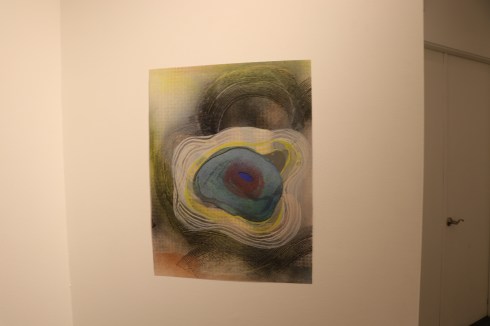
Barbara says she often starts from a “place of not knowing” when she begins her works of art.  You can see the theme of falling in many of her photos.

Below are Barbara’s paintings that are featured as part of her Free Fall exhibit.

IMG_8116

Ripples, 2017, acrylic and colored pencil on drafting film

Free Fall, 2017, acrylic paint and colored pencil on drafting film

IMG_8120

Out Of The Oven, 2017, acrylic paint and colored pencil on drafting film

IMG_8122

Spin, 2016, acrylic paint and colored pencil on drafting film

IMG_8123

Xocian, 2017, acrylic paint and colored pencil on drafting film

IMG_8125

From Nothing, 2016-2017, acrylic paint and colored pencil on drafting film

IMG_8127

I Don’t Know, 2016, acrylic paint and colored pencil on drafting film

IMG_8129

Notch, 2017, acrylic paint and colored pencil on drafting film

IMG_8131

Upside Down, 2016, acrylic paint and colored pencil on drafting film.

“The Boomer List: Photographs by Timothy Greenfield-Sanders” is a large portrait display of 19 “boomers” who were born between 1946 and 1964.  The 19 photos line the walls of the right hand side of the art museum in an area that seems more like an annex to the museum.   Timothy’s portraits have a short summary of the subjects as well as a short story or a lesson the person has learned.  The portraits are incredible.  While the subjects were certainly posing for the photos they also look remarkably natural.

The people included in the “Boomer List” are listed below:

1946: Tim O’Brien, Vietnam veteran/author
1947: Deepak Chopra, New Age guru
1948: Samuel L. Jackson, actor
1949: Billy Joel, singer/songwriter
1950: Steve Wozniak, co-founder, Apple Computer
1951: Tommy Hilfiger, fashion designer
1952: Amy Tan, author
1953: Eve Ensler, playwright
1954: Julieanna Richardson, The HistoryMakers
1955: Maria Shriver, journalist
1956: Kim Cattrall, actress
1957: Virginia Rometty, CEO, IBM
1958: Ellen Ochoa, director, Johnson Space Center
1959: Ronnie Lott, athlete
1960: Erin Brockovich, environmentalist
1961: Peter Staley, AIDS activist
1962: Rosie O’Donnell, entertainer
1963: David LaChapelle, artist
1964: John Leguizamo, actor

Little known fact (at least to new visitors to the museum): the museum is on the top floor of Brattleboro Train Station. An old ticket counter from the very same train station is located next to the “Spaceship Of Dreams” exhibit.

IMG_8025

Now, an Amtrak train makes stops each day at 1 o’clock and 5 o’clock, backing up traffic for quite some ways.

IMG_8022

As if that wasn’t art for one visit, there are also pieces of art outside of the building as well as decorative flowers and signs on the museum.

“Wrench Bench” is a bench made of cast fiber, resin and oil paint.  It was made by John Tagiuri.

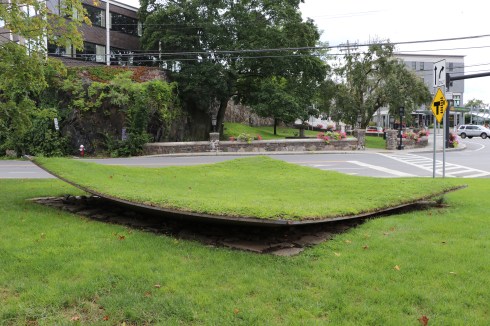
“Land Lift”, made by Vermont-based Bob Boemig, is made of turf, steel and stone.

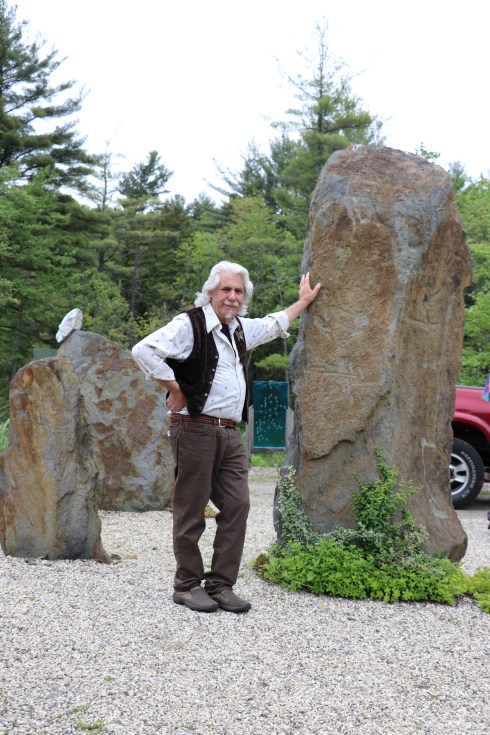
IMG_8136Located in between the Brattleboro Museum and the Marlboro College Graduate School, the Sculpture Garden has two rock displays.  A sign on the wall of the museum indicates the garden is dedicated to the memory of Dan Freea.

Today’s featured link is a link to a post about an exhibit by Chris Page that was displayed at the museum last year called “Eyes Toward Heaven.”  I wish I could have seen this in person!


Buttonwood Farm (Griswold, CT)


Date Of Visit: July 22, 2017

Location: 473 Shetucket Turnpike, Griswold, CT

Cost: Free

Hours:

March 1 – October 30

Current Hours
Mon – Fri
 12pm–9pm
Sat – Sun 11:30am–9pm

Parking: There are about 50 parking spots in the parking lot.  When they are busy, you can park on the side of the busy street (as I had to)

Handicapped Accessible:

Dog Friendly: Yes

Highlights: ice cream shoppe, sunflowers (seasonally), family friendly, cows

Website: Buttonwood Farm

IMG_2695

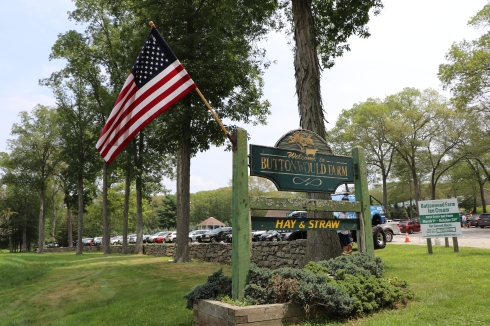
Once the site of a dairy farm, Buttonwood Farm is so much more now.  Not only do they have a sunflower garden with a maze and a famous ice cream shoppe, they also are the site of one of the more popular charity events each year.

Funny thing is I didn’t find one button the entire time I was there.

During my visit, the sunflowers were in bloom and Buttonwood Farm was holding a fundraiser for their Sunflowers For Wishes charity.


The dirt trails in the sunflower maze are easy to navigate.  The path is only about half a mile long.  Due to the showy outer ray petals of the sunflowers, bees and other insects, like this beetle, are attracted to the nectar and pollen.


In addition to the sunflowers, people (big and small) could ride their cow train or tractor tour.  All proceeds, of course, went to the charity.


At the end of the sunflower maze, there is a hill on a short incline where you can view the sunflowers.


There were also some performers at the top off the hill.  A man was playing music and there was a local painter, Jacqueline Jones, who was preparing to paint the sunflower garden.


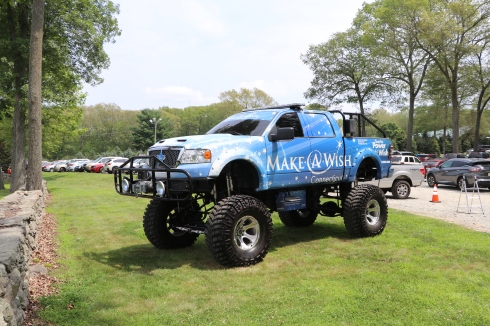
Since it was a charity event, there were charitable organizations like the “Make A Wish” foundation.  They had my dream car there!

IMG_2696

The cows at Buttonwood are so docile and beautiful.


Sunflowers aren’t just for people.  Dogs also like to walk along the sunflower maze.


Tunken (on the left) is an 8 year old Chocolate Lab mix and Duncan (On the right) is a 3 legged Harrier, fox and hound mix


Alie is a 12 year old Mini Pinscher.


Ian is a 5 month old Golden Retriever who is in training to be a service guide dog.

Below is a video of the maze at the sunflower garden.  What struck me is, despite the large crowd that was there, how peaceful and quiet the place seemed.  It seems like a wonderful place to go and just have some peace and quiet.

Today’s featured website is Jacqueline Jones’ Paintings From The Open Air.  Jackie was painting a portrait of the sunflower garden during my visit.  You can find her painting of the sunflower garden on her website.

Based out of New Haven, CT, Jackie specializes in painting the nature of the New England area.  She also enjoys painting in other areas outside of New England such as the Colorado and New York areas.  Jackie has also won a variety of awards and has studied with some of the accomplished artists in the New England area.


Tom Fiorini Sculpture Garden (Lenox, MA)

Date Of Visit: May 31, 2017

Location: Behind Joane Cornell Jewelry Store (63 Church St, Lenox, MA)

Hours: Art is available for viewing 24 hours

Cost: Free to view (unless you want to buy something)

Parking:  Free street parking is available on Church St (although it may have time limits).  There is also a parking lot on Franklin St that you may use for short term parking.

Handicapped Accessible: Yes

Dog Friendly: Yes

Highlights: Variety of unique art and decorative items made by New England artist Tom Fiorini

Website: Tom Fiorini – Sculptor

Tom Fiorini Facebook

IMG_8776

You interested in a doghouse covered with license plates?  (dogs sold separately)

How about a some carved fish? (at least you don’t need to feed them or buy a tank for them)

Perhaps you’re looking for boat?  I’m just not sure if she is sea-worthy.

IMG_8777

Tucked away behind the Joane Cornell Jewelry store at 63 Church St, Lenox, MA (at least for now), Tom Fiorino’s art, sculptures and other unique items offer an unusual brand of decorative items.

Tom Fiorini is not your orthodox artist.  He works mainly with metals and often times his choice of tool is a chainsaw.  Much of his art is made of normal, everyday materials reshaped and manufactured into a completely different.

Tom’s signs, with their offbeat slogans and designs, may be the highlight of his collection.

Tom also uses his creativity to make his art and create arrtful designs.

I don’t know about you but sometimes I could really use this really big bottle of wine.

IMG_8718

Other miscellaneous works of art are scattered around the lawn.

As you can see by his art, Tom has a great sense of humor.

Also, his prices may be negotiable based on the sign below.

IMG_8676

For now, Tom’s work can be viewed at the address listed above on Church St.  I am not sure where he stores his sculptures during the winter season.  You can contact him at his website listed above for more information.  Below is more information about him and his art.

Keeping with today’s theme of outdoor art, today’s New England featured link is the deCordova Sculpture Park & Museum in Lincoln, MA.  I’ve yet to go there.  But, it is definitely on my list.


Wonder Woman Rosey House (Lee, MA)

Date Of Visit: May 31, 2017

Location: 22 Robert St, on the corner of Center St. and Robert St, Lee, MA

Cost: Free

Hours: Accessible everyday, 24 hours a day.

Parking: You can park on Roberts St.

Handicapped Accessible: Yes

Dog Friendly: Yes

Highlights: House decorated with statues, designs and other decorative items

IMG_8783

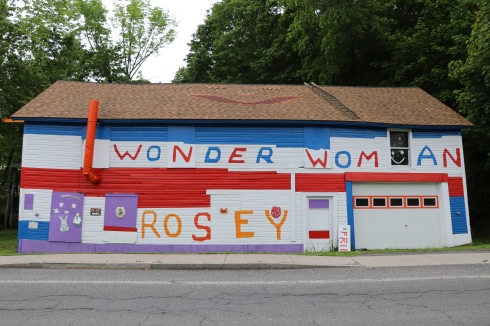
Most houses are decorated for the holidays, birthday parties or some other celebration.  But, the Wonder Woman Rosey House on the corner of East Center St and Robert St in Lee, MA is decorated all year round.

Without knowing the back story or reason for decorating the home, the house and property may seem crazy or a little bizarre.  However, it is more of a tribute and memorial than some random decorations.  Rosey (or Rosemarie) was the wife of painter and resident of the house, Bob Dupont, a professional painter.  He painted and decorated his home and property as a tribute to her.

The garage next to the house is decorated primarily in red, white and blue.


The decorations do not stop there at the garage, though.

The house and property are also decorated with decorations and statues ranging from Santa Claus to rabbits.


I would have loved living in a house like this when I was a growing up.  It looks like a real fun place to experience!

There are many randomly placed decorations scattered around the property.


The home owner doesn’t seem to mind having visitors.  I wasn’t bothered or questioned while I photographed the area.  But, it is private property.  So, visitors should be respectful of that.

The featured link of the day is another decorated home called The Crazy Christmas House in Coventry, RI.

Please follow me on Facebook


The Amazing World Of Dr. Seuss (Springfield, MA)

Date Of Visit: July 3, 2017

Location: 21 Edwards Street, Springfield, MA (2 hours west of Springfield, MA)

Hours:

Monday–Saturday: 10 am–5 pm
Sunday:
 11 am–5 pm

Holidays: Closed New Year’s Day, Easter, Memorial Day, Independence Day, Labor Day, Thanksgiving, Christmas Eve and Christmas Day.

Cost: One ticket gives you access to all 5 of the museum buildings (including the Dr. Seuss Museum).  You cannot buy one ticket for just one building.  Since it is such a popular attraction, tickets for the Dr. Seuss Museum are times for one hour and only 200 people during each hour time block are admitted at one time.  You can purchase advance tickets on their website (see below)

Adults: $25
Seniors (60+): $16.50
Youth 3–17: $13
Children Under 3: Free
Students: $16.50

Springfield Residents (with valid ID): Free – youth included

Parking: There is parking for about 50 cars in the main parking lot in front of the Springfield Museum and about 50 more in the lot across the street

Handicapped Accessible: Yes, there are elevators in the museum.

Highlights: art, statues and other items related to Dr. Seuss

Website: The Amazing World Of Dr. Seuss Museum

IMG_8324

Oh the places you’ll go and the things you will see at the Amazing World Of Dr. Seuss Museum in Springfield, MA.  The museum, which opened June 3 of this year, is like walking into a Dr. Seuss book.

The museum is a tribute to Theodor Seuss Geisel, more commonly known as Dr. Seuss, who was a Springfield, MA native.

From the moment you enter the museum, you are bombarded with vibrant colors, familiar characters and a sweeping sense of nostalgia.


The Amazing World Of Dr. Seuss is a two floors with a basement.  Each room on each floor has a theme. Fairfield St, Readingville and Oh The Places You’ll Go are a few of the rooms on the first floor.  The first floor of the museum is dedicated to many of Dr. Seuss’ characters and his books.  Children, and the occasional adult, get the opportunity to play games based on his works.


The first floor also has a section dedicated to Young Ted in Springfield which celebrates his time in Springfield, MA.


The basement floor has more Dr. Seuss memorabilia and artwork as well as an activity area where visitors can make their own Dr. Seuss works of art.


The second floor mostly has letters, mementos and photos from Dr. Seuss’ lifetime.  There must be hundreds of writings, cards, works of art and other memorabilia from his early days and from others writing to him  It’s very interesting seeing some of his early work before he became famous and hit his stride as an artist.


There is also a display that shows the process of how they make the statues located at the Dr. Seuss National Memorial Garden which is located just outside of the building on the museum’s property.


There is also a Dr. Seuss statue I missed when I first first photographed the statues at the museum.  This statue is tucked away to the side of the museum.

IMG_8671

Today’s Nomad link is Paper Clippings.  Paper Clippings is Denise Ortakale’s WordPress blog.  She recently had some of her work displayed at the Springfield (MA) Museum as part at the Cats In Hats exhibit.  I wanted to photograph this exhibit.  But, since it was the work of other artists and not their own exhibit, the museum did not permit people to photograph the exhibit.  I am glad that Denise has posted her work so I can share it with everyone else.


New England Carousel Museum (Bristol, CT)


IMG_7573

Date Of Visit: July 1, 2017

Location:95 Riverside Ave, Bristol, CT

Hours:

Monday: Closed
Tuesday: Closed
Wednesday: 10-5
Thursday: 10-5
Friday: 10-5
Saturday: 10-5
Sunday: 12-5

The Museum is available any day of the week for special tours and facility rentals; even when closed to the public. If you’re interested in visiting the Museum Monday – Friday please call (860) 585-5411

Cost:

Adults $6.00
Seniors $5.50
Children $3.50 (age 4-14)
Children $2.00 (age 1-3)

All admissions include one ride ticket for the indoor carousel.

Parking: There is parking for about 15 vehicles in front of the building.  There is also street parking available on Riverside Ave.

Handicapped Accessible: Yes

Highlights: carousel horses, working carousel, tours, family friendly

Website: New England Carousel Museum

IMG_7349

As a child, I always loved riding the Merry-Go-Round and looking at all of the beautiful horses on the carousel.  Living in the city, it was bout as close as I was going to get to a horse.  It was always the highlight of my trip to the amusement park, especially since I never was a fan of the roller coasters.

There is a place you can go so the very same kinds of carousel horses we rode on as children.  And, you might also get a chance to actually ride on a Merry-Go_Round while you’re there.  I’m not horsing around either.

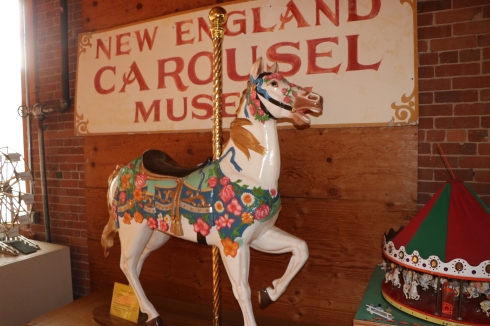
The New England Carousel Museum is deceivingly big.  From the outside, you wouldn’t even notice the museum was there.  In fact, I drove by it the first time I went looking for it.  The museum features hundreds of carousel horses and other types of carousel animals in their 10,000 square feet of space and several rooms with carousel horses and other items from carnivals and amusement parks.  Most recently, they added a carousel on their second floor.


Some of the carousel horses have been donated.  Others are being held while the owners are moving or while their homes are being worked on. Yes, some people actually have carousel horses in their homes!

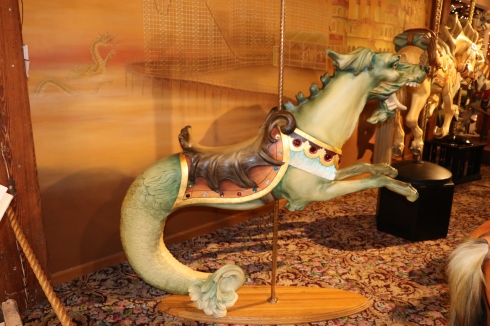
The carousel horses range from the traditional horse to swan, egret, giraffe and even a cat among other animals.


There are even some carousel horses in the form of mythical characters.

IMG_7367

The craftsmanship and attention to detail are incredible.  Most of the horses have placards that give a little background to their history and the artist who created the animal.  For instance, this “Irish Horse” was carved in 1917 by David Lightfoot for the Philadelphia Toboggan Company.  The Irish theme was indicative of the Irish Nationalism that was a major influence in the eastern part of the United States during that time.


This “Sweet Horse” was carved by Daniel Muller in 1895.  The horse, which is over 120 years old, is still in its original paint.  It also has all four legs in the air which is another unusual feature of the horse.

IMG_7444

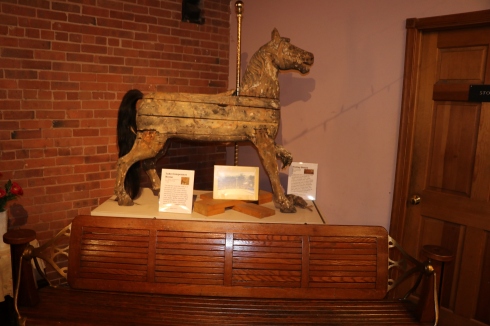
This particular carousel horse was originally part of the carousel at Lake Compounce in Bristol, CT.  Lake Compounce, which opened in 1846, is the largest water park and Connecticut as well as the oldest continuously running amusement park in the United States.   This horse was taken down from the carousel at the amusement park in 1911 when the carousel was replaced with a newer, more up to date (at that time) carousel.  It now resides in the Carousel Museum.

IMG_7425

There are many more interesting stories and facts about each carousel horse.

The carousel museum just doesn’t have horses.  They also have a swan, egret, dolphin, zebra, elephant, cat and rabbit among other carousel animals


Photos of carousels and amusement parks line the walls of the New England Carousel Museum and they have other items from amusement parks as well.


I even manged to photograph a dog there!  This realistic sculpture of a Siberian Husky is located near the carousel.  You may notice how one eye is brown and the other eye is blue.


The knowledgeable and friendly staff at the Carousel Museum give guided tours and explain how the horses were made.  Some of the factoids I learned during the informational session: those tails on the carousel horses…yup they’re real.  They are actual tails from horses.  It is true that some carouse horses do have wooden, carved tails.  But, the horses with actual tails most likely got their tails from a horse that had passed on.  Also, most carousel horses were only painted on the outside because that was the only side most people would see and that would save them money.


The highlight of the museum for many people, especially the little ones, is probably the carousel ride.  And, yes, I did go on it.   The carousel is located on the second floor (there is an elevator for those who can’t or don’t want to take the stairs).  It’s a great way to end a fun visit!


Below are two videos I took at the museum.  The first video is of a motorized replica of a carousel made entirely out of paper clips.  The work of art is called “Paper Clip Fantasy” and it was created by Eugene Burnstein of Lakewood, New Jersey.

The next video is a video of the fortune telling machine at the museum.  Yes, it still works and it even gives out fortunes.

Since some of you may be wondering what the fortune said, I have included some photos of it below.  The front side of the card said to hold the fortune in front of a mirror to read it.  I was able to decipher it without looking into a mirror.  It says “love me and the world is mine.”


The Nomad’s link of the day is faye_fares.   Faye is one of the tour guides at The New England Carousel Museum and she is also a very talented artist.  She’s an artist, photographer and model.  Some of her work takes 4 to 9 hours to complete.  You can follow her Instagram account here.

Please connect with me on Facebook and Instagram


Three Sisters Sanctuary (Goshen, MA)

Date Of Visit: June 4, 2017

Location: 188 Cape St (rt112), Goshen, MA (about 45 minutes northwest of Springfield, MA and an hour and a half southeast of Albany, NY)

Hours:  Open 7 days/week, 8:00 am – Dusk

Cost: a $10 donation is suggested.  Children under 12 are admitted free

Parking: The parking area next to Three Sisters can accommodate about 15-20 cars.

Handicapped Accessible: There is limited wheelchair access.

Dog Friendly: Service pets are allowed

Highlights: unique pieces of art in a natural setting

Website: Three Sisters Sanctuary


The sign at the entrance to Three Sister Sanctuary states, “Where nature and art merge.”  That’s a pretty apt description of the sanctuary if there ever was one.

Three Sisters Sanctuary is no run of the mill art sanctuary.  Every piece of art is made of rock, plants, water, iron and other parts of the land in its composition.  In fact, sanctuary is a very good way to describe the place.  Three Sisters is more than just a place to look at art or enjoy the beautiful nature which surrounds the sanctuary.  It is a place for reflection, meditation and peace.


Richard Richardson, the owner and on site artist at Three Sisters created the pieces of art to foster a feeling of serenity, inner peace and spirituality.

IMG_1157

The name “Three Sisters” comes from Richard’s three daughters.  His three daughters gave him so much joy and happiness he wanted to give this joy and happiness to others through his art.  He says he did not find the garden.  The garden found him.  It helped fill a void in his life and it has brought him a purpose and meaning.


Richard’s use of old machines as well as other tools and spare parts is indicative of the unique style of the art at the sanctuary.


One thing you’ll notice in Richard’s works are his emphasis on people, particularly children, in his work. Looking at these works of art, you can’t help but stop and consider the effort and creativity it took to create such interesting and meaningful works of art.  It certainly does make you think about the many forms of inspiration and how we express that inspiration.


From afar, some of the statues look a little like something might see in a zombie movie.  But, they are all pretty harmless.


Keeping with his themes of spirituality and peace, you will also see angels and other spiritual figures.


Richard feels the presence of his older brother and his eldest daughter, who he tragically lost.  He says the art and nature both work to provide healing and peace while keeping the spirit of his brother and daughter with him.  Whether you are a spiritual person or not I still think you can at least find inner peace among the statues and other works of art.


Another common theme of the art at the sanctuary is the use of animals in his work.  Dogs, horses, butterflies and even a few mythical creatures are a few of the animals and wildlife


You may even run into a few real wildlife.  While walking along the sanctuary, I noticed this rather unhappy goose.  Unsure why he or she was making faces and noises at me, I went to take a closer look.  It turns out the mommy or daddy was just being protective.  It seemed appropriate that life would begin here and share in the peacefulness around them.


Some of the rocks at the sanctuary are said to give up energy and even be a source of healing.  In fact, if you stand in between some of the bigger rocks, it i said you will feel a certain energy and healing power.  One of Richard’s daughters who was helping him during my visit said she feels rejuvenated after standing next to the rocks.


Jut when you think you’re at the end of the art sanctuary, there are pretty cool statues and other works of art at the front of the sanctuary.


Richard has succeeded in making a sanctuary that is not only a place for art lovers to seek out unique pieces of work.  He has also helped create a place for people to reflect and find an inner peace.

Three Sisters Sanctuary also provides accommodations for visitors as well as ceremonies on their grounds.  The Nomad’s link of the day is a blog post by Kristin Chalmers.  She recently attended a wedding as the photographer and posted about Nicole And Kilean’s Medeival LARP Wedding At Three Sisters Sanctuary.


The Mount (Lenox,MA)

Date Of Visit: June 4, 2017

Location: 2 Plunkett St, Lenox,  MA (about 2 hours west of Boston and 1 hour northwest of Springfield, MA)

Hours: The Mount is open daily from 10:00 am to 5:00 pm through October 31st, except on early closing days (please see below). The Mount is open from 10:30 am – 3:00 pm most weekends in November through February. Please call 413-551-5100 to confirm hours.

Cost: $18 for adults, $17 for seniors (65 and older), $13 for students with id, $10 for members of the military, free for teens and children (18 and younger)

Handicapped Accessible: Yes

Dog Friendly: Service pets may be allowed

Highlights: home of author Edith Wharton, trails, fountains, flowers

Website: The Mount

IMG_0860

Once the home to one of Massachusetts’ more prominent authors, The Mount is more than just a beautiful mansion.  The Mount, once the home of Edith Wharton, has colorful gardens, fountains, art, spectacular views and history around every corner.

The Mount, which was recently restored, is an elegant house that has kept much of its original charm.  What is great about the mansion is that you can see the entire home in half an hour or so.  Yet, it isn’t so much the quantity of time and space the tour (I took a self guided tour but there may also be guided tours as well) would take.  But, rather, it is the quality of time and space the tour takes.  Around each corner is one beautiful piece of furniture and architecture.  Yeah, I think I could live here.

I couldn’t use my flash when I took photos inside of the mansion.  But, I did my best.  Sometimes the lack of lighting gives the home a mysterious feel.  Sometimes it just makes the photos look crappy.  You decide.

The two floor building has about a dozen rooms and there is a handicapped accessible entry and elevator.

Some of my favorite rooms had the old, antiquated tools and appliances we used to use.

The grounds of the Mount is as beautiful as the inside of the building.

The Beaver Loop Trail, a gentle, short trail (about half a mile) that runs along the grounds of The Mount, offers some very pretty views.

Edith Wharton was fond of animals (well, mostly she was fond of dogs not so much cats – oh well she wasn’t purrfect I guess).  Along the trail around the mansion, a side trail leads too a pet cemetery.

There are also little critters along the trail outside of the home.

The Mount is also hosting a special art exhibit called SculptureNow on its trail.  If you missed it, you can view the blog post I posted a few weeks ago bout the art exhibit here.

Please connect with me on Facebook to view more New England area related content.


SculptureNow (Lenox, MA)

Date Of Visit: June 4, 2017

Location: The Mount, 2 Plunkett St, Lenox, MA

Dates and Hours of Exhibit: June, 2017 – October, 31, 2017, The Mount is open daily from 10:00 am to 5:00 pm through October 31st, except on early closing days (please see below). The Mount is open from 10:30 am – 3:00 pm most weekends in November through February. Please call 413-551-5100 to confirm hours.

Cost: $18 for adults, $17 for seniors (65 and older), $13 for students, children and teens (18 and under) get in free, $10 for military personnel (cost includes a tour of the Edith Wharton house and if you return within 10 days you can get in free again with your receipt)

Parking: There is ample parking available at The Mount.

Handicapped Accessible: Yes.  The trail is dirt bit wide and even for the most part.

Dog Friendly: No, except for service dogs possibly

Highlights: art on a easy trail, scenic views

Website: SculptureNow

IMG_0549

As if the Mount wasn’t beautiful enough, there are 30 amazing sculptures to compliment its beauty.

There are 30 sculptures along the trail.  But, when I went to visit in early June, not all of the sculptures were up.  I did the best I could to photograph as many as I could find.  But, I didn’t have a map or any other guide at the time to find them.  So, it was something like a “scavenger hunt” when I did visit the sculptures.  It looks like I found 22 of the 30 sculptures.  The art has a modern feel to it.  All thirty sculptures should be up now for your viewing pleasures.

The numbers next to the descriptions correspond to the descriptions in the map of the trail where the sculptures are located.  The link to the trail map is attached above in the website link.

1. The first sculpture is called Stall by Nancy Winship Milliken.  Nancy describes her sculpture as the following:

“This site-specific memorial honors the activities and architecture of a New England past. The horsehair gestures towards the building at The Mount which was at one time Wharton’s stable.”

2. The second sculpture is called Day’s End by James Kitchen.  James says his sculpture this way:

“Does our fast-paced, distraction filled world allow time to think, read and reflect, enjoy art in all its forms? Exhausted, we let media affirm our feelings rather than inform us.”

3. The third sculpture is by Harold Grinspoon.  According to Grinspoon, his art is:

“Giving new meaning to objects that have aged out of their original purpose, I invoke nostalgia for the familiar and an appreciation of new forms of beauty.”

4. 3. “Fallen Sky” by Coral Penelope Lambert is the next sculpture.  Coral explains her art this way:

“My work explores forces of nature and seeks to address the darker issues related to Earth’s resources such as mining and contamination where traces of the process remain.”

5. Stack C by Lydia Musco is a combination of nature and architecture:

“Architecture and elements of nature, such the work of gravity, influence this work. The form is built in one additive action, line by line, like layers of stories within memories.”

6. James N Burnes’ sculpture Nine Piece Ring is the next sculpture.  Burnes described his art this way:

“I create forms from nature that express our intimate relationship with Mother Earth. I am drawn to the tension between the natural and organic, man and nature, time and decay.”

7. Biomorphic by Michael Thomas is the next sculpture.  According to Michael, Biomorphic is:

“An undulating, sensual, and playful organic form, often encountered on the periphery of the natural world, realized here in steel. Biomorphic is the fluid movement of mass, coupled together with the visceral experience of color and texture.”

8. Distant by Philip Marshall is, according to Marshall:

“The nude model at a figure drawing held his pose for hours, eyes fixed on a distant point, maintaining his mental distance under prolonged scrutiny; he and the chair becoming one.”

9. Off The Rails by Lucy Hodgson:

“Our country: how we got here and is there a way forward? This is a comment on the decline of infrastructure—among many other things.”

10. Sheep by Madeleine Lord is:

“A pile of galvanized scrap metal sheering implied the subject: Steel Wool. I work the skeletal to the surface and the surface to the skeletal. Pulse arrives after I finish.”

11. Joseph Carpineto’s Walkabout

“This sculpture is inspired by a memory of the coarse undershirts my mother made for me from flour sacks. The rough feel of the rope is reminiscent of those undershirts.”

12. Bench I by Peter Barrett:

“Please, have a seat! I’ve wanted to incorporate some stone into my work since visiting a friend’s marble quarry, and here you have my first attempt.”

13. Anabasis by Chris Plaisted:

“I like to work with steel for its strength and powerful emotion. The subject is the human spirit. I was inspired by the sea and the concept of an upward journey.”

14. Yellow Peril by Setsuko Winchester:

“In 2015 & 2016, these 120 handpinched tea bowls traveled to ten U.S. concentration camps where 120,000 persons (mostly U.S. citizens) were imprisoned during WWII. Their crime was to be Japanese.”

15. Reflective Change by Martina Angela Muller:

“The undulating lines of music and the sculptural force of the wind informed these shapes. Both are continuous game changers that generate inner and outer movement leading to reflective change.

16. Avoidance Attractor by Matt Crane:

“Avoidance Attractor in its first iteration explores structure and materiality with a shift in scale and orientation. An empty piece of signage that invites projection, while remaining stoic and silent.”

17.  Netting For Water by Ann Jon:

“My work is an adventure, exploring new forms and media, hoping the viewer’s eye, mind, and heart will experience the sculpture visually, creating their own narrative or message.”

18. Fenestral by William Carlson:

“This sculpture is intended to pull the audience into the small portals of light as the sun rises and sets. The piece acts like a clock while controlling the viewer’s perception of the landscape.”

19. Blue Pulse by Murray Dewart:

“I want my sculptures to convey both the momentum of ritual pilgrimage and the stasis of meditative mandalas. They gesture in their various ways as resolute guardian forms, protective and consoling.”

20. Gnomon 1 by Christopher Curtis:

“Much of my work seeks context for humankind’s place in the natural world. Gnomon 1, made with stone, stainless steel, and gold leaf, is a good example of this investigation.”

21. Waterstone by Dove Bradshaw:

“Waterstone is a time-sculpture: For a slow action of water boring a hole, limestone was used; for fast boring, salt boulders and granulated salt mounds. Outdoors in winter, vodka replaced water.”

22. Poet’s Cry by Colleen O’Donnell:

“Weepings of unsound. A poet’s cry of light. Reflecting back into herself.”

23. Bittern by Robin Tost:

“The Bittern is a marsh bird who, when alarmed, stretches up its neck so that the striations on its breast give it perfect camouflage in the reeds.”

24. Twelve Cuboid Stack, I by David Teeple:

“My work centers on water as a subject, a material, and an idea. In this sculpture, I am interested in how the reflections and refractions create a new perceptual experience.”

25. Yellow Dakota + River by Stuart Farmery:

“Through abstract forms I reference a passage of time combining art historical sources, such as stone circles and constructivist concepts, with my awareness of current political, environmental, and communal issues

26. Hedge by Gary Orlinsky:

“Inspired by the two rows of linden trees that link the Mount’s gardens, Hedge creates a provocative dialogue between the organic movement of the saplings and the geometry of the boxes

IMG_0887

27. Gilavar by William Brayton:

“This abstract sculpture developed in response to a range of sources, including indigenous wind patterns, Polynesian stick charts, wooden boat building methods, storm tracking data, and chance-based fabrication systems.”

28. Gene by Eric Stein:

“Representing cause and effect, the cast concrete units of molecular design are stacked, colliding randomly. They present an undetermined beginning and illustrate the natural selection of options of creativity, form, and life

29. Tree With Spheres Jacque Metheny

“My sculpture juxtaposes geodesic spheres with the yet more complex structure of a tree. Geometric systems are the foundation of all material form. In nature we understand this as beauty.”

30. Caterpillar Bridge II by Roe Osborn:

“My sculpture combines construction materials in contextual mathematical formulas. This piece joins sections of drainage pipe in a dimensional sequence that captures and defines space in an engaging, yet playful manner.


Hanna-Barbera Exhibit (Stockbridge, MA)

Date Of Visit: May 28, 2017

Location: Norman Rockwell Museum, 9 Glendale Rd, Stockbridge, MA

Dates Of Exhibit: Unfortunately, the exhibit is no longer at the museum.  It was such a big attraction, I wouldn’t be surprised if it did come back at another time, though.

Handicapped Accessible: Yes, the Norman Rockwell Museum is one of the more handicapped accessible places I have been to

Highlights: animations, drawings and collectibles from the Hanna-Barbera cartoon collection

IMG_7642

Yogi, Fred, Richie and even Jabber.  They were all there at the Norman Rockwell Museum last month. as the Norman Rockwell Museum showed off some of the works of the Hanna-Barbera cartoon franchise.  Just as a warning, some of the photos may not look top notch because we weren’t allowed to use a flash in the museum.

As I walked along the various drawings of my childhood, it was like walking down memory lane.  I could envision the shows I loved so dearly.  All I needed was a bowl of Cap ‘N Crunch and a glass of O.J.  and my footie pajamas and it would have been just like my childhood.  OK, I still might have a pair of footie pj’s.

The popular shows were represented of course.

But, what was great about the exhibit is how they showed some of the more obscure shows in the exhibit.  At least they were obscure to me.  In fact, I didn’t even remember some of the shows they featured until I saw them at the museum.

There was also a television playing a short documentary about Hanna-Barbera playing on a loop for visitors to watch as they checked out the comics and there was a scavenger-like game kids could play with their parents to find certain characters in the drawings at the exhibit.  Also, an employee gave an informative tour of the drawings and collectibles.

IMG_7560

Another cool thing about the exhibit was that some people offered to lend their collectibles to the exhibit for display.  Some people have quite a few collectibles!

Here’s a fun fact.  Well, it;s a fact.  Not sure if it is “fun” our tour guide told us how Jackie Gleason almost stopped the Flintstones from happening.  Apparently, Gleason watched an episode and he noticed how the story lines, the shows basic setup and characters were essentially the same as his show, The Honeymooners.  But, even though he would have had a case in court, he stopped short of stopping the show because he didn’t want to be known as the guy who stopped the Flintstones show.  Nowadays, every show seems to mirror The Honeymooners.

The exhibit was organized so neatly.  It encompassed three spacious rooms and each inch of the walls seemed to be covered with a drawing or card with information on it.  Yet, the art work didn’t seem cramped.

I would have to say seeing some of the drawings from the more obscure shows like “Jabber Jaws” and “The Ed Grimley Show” brought back some of broadest smiles if “I must say” (I actually liked the Joe Flaherty segment of the show when he played the “Count Floyd” character best).

I hope I was able to make you smile on this Tuesday!

What were some of your favorite shows from the drawings above?