Tag Archives: art

ICA-Part I (Boston, MA)

Date Of Visit: August 25, 2017

Location: 25 Harbor Shore Drive, Boston, MA

Hours:

Tuesday + Wednesday: 10 AM – 5 PM
Thursday + Friday*: 10 AM – 9 PM
*First Friday of every month: 10 AM – 5 PM
Saturday + Sunday: 10 AM – 5 PM

Closed Mondays, except on the following national holidays, when admission is FREE for all: Martin Luther King Jr. Day, Presidents’ Day, Memorial Day, Labor Day, and Columbus Day.

Closed on Patriot’s Day, Independence Day, Thanksgiving, Christmas, and New Year’s Day.

Cost:

General Admission: $15
Seniors: $13
Students: $10
Youth 17 and under: FREE

Admission is FREE for all eve

Parking:There are several parking options that are listed at their ICA parking info

Highlights: creative art displays, info sessions about the art

Tips:

  • parking is very limited in this area.  The museum recommends using public transportation.
  • The museum only has art on the 1st and 4th floors of the building (mostly the 4th floor)

Website: ICA

*I had to split this post into two parts, as it was too big for WordPress to save.  Part I of this post will center upon the works of the featured artist Nari Ward.  The second part of this post will focus on some of the other art at the museum.  I have also included half of the number of the cute dogs I photographed during this visit*
 

IMG_9998

Always at the intersection of art and social issues, he ICA (The Institute of Contemporary Art/Boston) recently highlighted the works of an artist who uses his art to make various statements about our social, economic and political climate.  Even if you may not agree with or see his points of view, I am sure you will enjoy his artistic aptitude.

During my visit, Jamaican and American Nari Ward’s work was being featured in his “Sun Splashed” exhibit at the museum.

IMG_0041

Sunsplashed, 2015, is the centerpiece of the art exhibit.  The second work of art is called, Scandal Bag: History Feeds Mistrust.

Nardi, born in 1963 in Jamaica and currently based in New York City, uses everyday items to create works of art that play on the history, economy and social issues surrounding his environment.  He also embraces cultural diversity.

Nari uses wood, metal, iron and other materials with everyday items such as soda bottles.  Nari hits on some hot button issues such as migration, citizenship and economic disparity in his works.

One of the things that struck me about these works of art is the thought and creativity that went behind all of them.

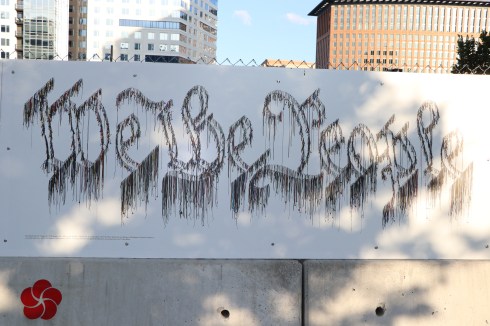
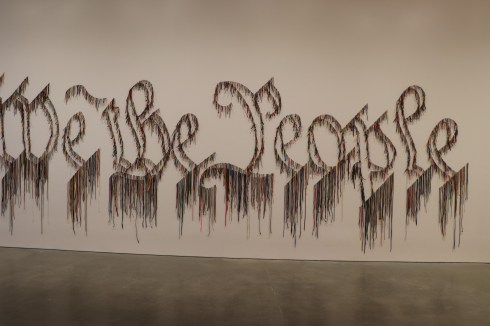
The We The People exhibit by Nari Ward was one of the main works of art at the ICA.  In fact, many of his works of art are being featured
IMG_0008

If you look very closely, you may notice it is not written in ink.  Rather, it is spelled out in artistic dangling shoelaces.  This exhibit was being displayed a block away from the museum.  It surely created a lot of interest and lured in quite a few visitors eager to learn more about Nari’s works of art.


Below are Nari’s works of art that were being displayed with a brief description and explanation of their meaning.  Sadly, his art is no longer there as the exhibit’s last day was September 3.  The first work of art is rather unconventional.  But, it was very interesting.


Jacuzzi Bed by Nari Ward is made of headboards arranged around heating lamps and fans.  The work of art is meant to produce an approximation of the Caribbean breeze.  The name is meant to conjure association with pleasure and comfort.  Nari says the work conveys his sense of nostalgic displacement.


Sky Juice, 1993, is made of an umbrella, iron fence, plastic soda bottles, photographs, Tropical Fantasy soda and sugar.  The soda bottles, hanging from the umbrella, have photos inside of them.  His goal was to create a work of art with disparate things from everyday life to create a work of art everyone can relate to.  “Sky Juice” is the name of a Bahamian drink made from coconut milk and gin (yum).

During my visit, one of the museum guides led an open discussion about the work of art where visitors and she discussed the deeper meaning of the work of art and what the work of art means to them.  She did this several different works of art during my visit.


Mango Tourist, 2011, by Nari, are “snowman-like” sculptures are made of burnt foam spheres that he decorated with mango seeds and small electrical parts.  The small capacitors bear traces of the economic and industrial history of New England and of course the snowmen are a staple of our winters.  The organic mango seeds resonate with his memories of Jamaica.


Happy Smilers: Duty Free Shopping, 1996, by Nari is made of awning, plastic soda bottles, fire hose, a fire escape, salt, sand, household elements, an audio recording, speakers and an aloe vera plant.  Party music and background conversation from the speakers gave the display a feeling of sitting on a fire escape on a hot summer night.

This exhibit was inspired by a candy store not far from where he lives in Harlem, New York.  While the store appeared to be a convenience store, it was really the site of a small scale gambling site.  This gave Nadir the idea of making an exhibit that shows you can’t judge a place, person or thing by outside appearances.

The name Happy Smilers was derived from a band that was led by Nadir’s uncle that entertained tourists in Jamaica in the 1970’s.  The fire escape and discarded furniture wrapped in fire hoses suggest an urban tableau.  The salt and sand, aloe vera plant, speakers and bright yellow walls are drawn from the cultural context of Jamaica.  The salt evokes a common Jamaican expression about the devil not being able to step over salt.  The succulent symbolizes healing.  Lastly, the soundtrack symbolizes one of the artist’s earliest childhood memories of lying in bed at night while he listened to rain fall on his tin roof in Jamaica.


The Naturalization Table is an exhibit based on Nari’s personal experience of becoming a naturalized U.S. citizen, this interactive artwork gives museum visitors a better understanding of that process. During certain days, visitors could add their photo to the display.


Radha Liquorsoul, 2010, is a metal and neon sign made of PVC tube, artificial flowers, shoelaces and shoe tips.  This was part of a work made from out of use liquor store signs that Nari removed from building facades in New York.  Ward was interested in the many uses and impact liquor has in our lives.  Nari also used shoe tips (which Nari considers a a signature material that symbolizes human presence), shoelaces and artificial flowers.  Nari was partly inspired by impromptu street or roadside memorials.


Homeland, Sweet Homeland, 2012, is made of cloth, plastic, megaphones, razor wires, feathers, chains and silver spoons.  The “Miranda Rights” which are listed on this work have appeared as a running theme on many of Nari’s works.  The combination of razor wire, megaphones, leather and gold thread with feathers were meant to evoke a kitschy domestic memento and a heraldic government edict.


Rock, Booked, Scissor, Vice, 2010, is made of book, rock, scissors and vice.  This exhibit was spawned from a mistake.  When Nari first saw the “Black’s Law Dictionary” as a child he thought there were different law dictionaries for white and black people.  Although his brother corrected, his initial thought stuck with him and inspired his work.    To create this work, Nari cinched the dictionary with a vice, pierced it with scissors and weighted it with a stone.  It is meant to symbolize a violent reenactment of the game “rock, paper, scissors.”  It is meant to represent the seemingly arbitrary application of the law experienced by people in many of the communities in America.


Savior, 1996, is made of a shopping cart, plastic garbage bags, cloth, bottles, metal fence, earth, wheel, mirror, chair and clocks.  Nari constructed the sculpture by utilizing the shopping cart, a common item, and using items to bling it up.  In the blue bag you can see clocks.  The sculpture had an accompany video titled, “Pushing Savior.”
IMG_0046

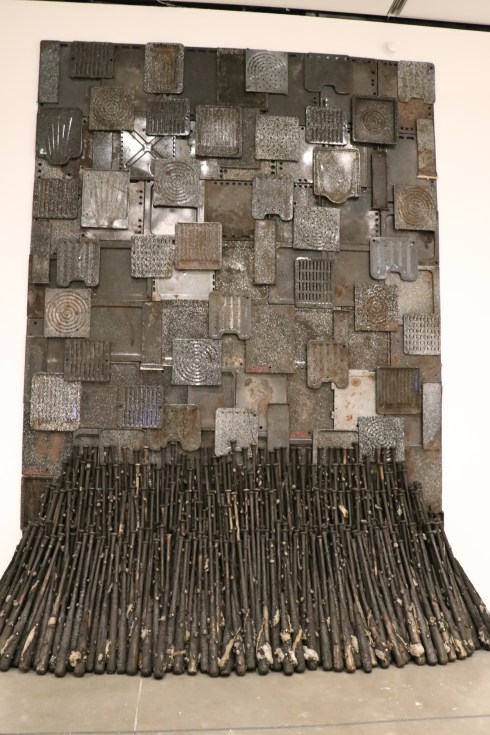
Iron Heavens, 1995, made of metal pans, cotton and wooden bats came from Nari’s observation that the holes dotting the the metal surfaces of certain baking pans look like stars.  Nari collaged pans together on a wall to evoke the night sky.

Nari used baseball bats to form a ground to the heaven above.  The bats were burned, sterilized and had cotton applied to their surfaces.  This was meant to convey violence and healing.  The materials were also used to signify the American South, especially the older south.  The cotton was used to signify slavery as that was the main crop slaves used to pick.  The baseball bats were used to signify the violence many blacks suffered.  The overall arrangement recalls the yard assemblages and sculptural folk traditions of the region.


Glory, 2004, consists of an oil barrel, fluorescent and ultraviolet tubes, computer parts, DVD audio recording, Plexiglas, fan, camera casing elements, paint cans, cement, towels and  rubber roofing membrane.

The tanning bed is made out of old oil barrels.  As this work of art was built one year after the Iraq attack, he used the oil barrels represent the political debates over the connection between oil and patriotism.

The oil barrel also signifies the issues related to identity and race.  While in some cultures, a tan is viewed as a mark of leisure and privilege.  However, “pigmentocracy” can ascribe a higher value to lighter skin tones in some societies.

As you stand by the Glory sculpture, you can hear recordings of voices and people talking in hushed tones.


Afroochase, 2010, made of ink, a found vinyl banner, cowrie shells, Afro picks and felt weatherstripping is built from a Chase Bank banner that he found mixed with various materials each of which have a symbolic meaning.

The cowrie shell has several possible meanings.  The shell has been used as a form of currency,  It is also used in divination ceremonies in African and North African and South African religious contexts.

Afro picks have been used as a symbol of black cultural identity and the shapes of the particular picks (the raised fist of the Black Power movement) refers to black nationalism and resistance.
IMG_0061

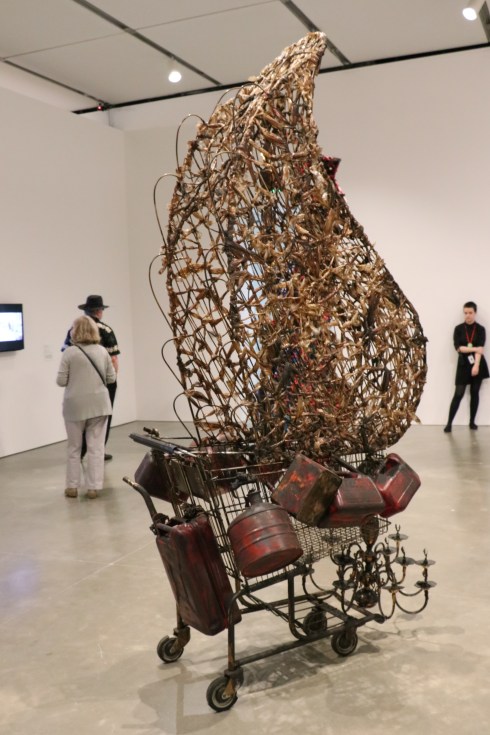
Crusader, 2006, is made of a shopping cart, chandelier, trophy elements, metals, plastic bags and plastic containers.

Crusader has been described as  a radiant poetic work that mixes the personal and political.  Nari used comedy to make a political statement about his feelings concerning the second Gulf War.  Oil plays a central theme in many of his works, evident by the oil canisters in this work.

IMG_0067

Beat Box, made of an old New York City payphone, a drum and a fire extinguisher was made as a way of showing the different ways people have communicated.  The old (the drums which have been used as nonverbal communication in some traditions ) with the modern (the payphone).  After Ward had modified the pay phone he put it back outside where it had originally came from.  Imagine the looks on the people’s faces when they tried to make phone calls!


I noticed how Nari likes to incorporate audio and videos into his exhibit.  This is only one example of this.  Those chairs look very comfortable!

IMG_0062

Den, 1999, made of wood, chain-link fence, metal pole, tacks, rug and wooden furniture legs

IMG_0063

Chrysalis, 2010, made of mirror, rope, foam, and a found paper bag

IMG_0065

Vertical Hold, 1996, made of yarn and bottles. This sculpture was made from old, used glass bottles Nari found at a dump site and some bottles he found while he was in residence at a Shaker community in Sabbathday Lake, Maine.  He wove the bottles together with string thus creating a web that he described as a quilt.  This work was inspired by bottle trees, a traditional African, Caribbean and Southern black sculptural form that was believed to protect against evil spirits.

IMG_0116

Canned Smiles, 2013, explores the intersection of art history and identity.  Nari was influenced by another artist, Piero Manzini.  Piero created Merda d’artista (Artist’s Shit) that consisted of 90 small cans labeled with the title that he sold.  The art exhibit by Piero was a sarcastic way of saying that anything that belongs to an artist is worth value.  It also was a commentary about how not all art may have merit.

Ward’s art display aims to question people’s perceived stereotypes and the reality of constructed values.  Nari used the Black Smiles idea to play on the minstrel shows which used to be popular in America during the 19th century.  The work inspires us to ask whether the notion of a smile trapped in a can is any more or less strange than the ideas we construct around identity.

During my visit, the ere was a social gathering on the desk of the museum.  Music, food and refreshments were being served and there were a number of therapy dogs at the event.

A “cuddle zone” was created by visual artist J.R. Uretsky.  The “Cuddle Zone” featured nine therapy dogs from Dog B.O.N.E.S. There was also quilted works for people to use as comfort aids.  You will also some of the dogs wore or sat on these quilted comfort aids.

IMG_0138

Hey, we all can use this kind of therapy!

In fact, the dogs were so popular and in such high demand, I was only able to photograph two of these special dogs.

IMG_0136

Spider is a 5 year old chihuahua.

IMG_0132

Ruby Pearl is a 4 year old pitbull.

Please connect with me on Facebook to view videos, links, articles, photos and other content not included on my blog.  Thank you!


“Sea to Shore: Sculpture Inspired by the New England Seacoast” (Portsmouth, NH)

Dates Of Visits: July 29, 2017 & August 26, 2017

Location: Governor John Langdon House, 143 Pleasant St, Portsmouth, NH

Cost: Free unless you want to photograph the statues inside the Langdon House

Parking: There are several parking lots (notably the free parking lot next to Citizens Bank on Pleasant St) and street parking available throughout the city

Handicapped Accessible: The outdoor exhibits are but the Langdon House is not handicapped accessible.

Dog Friendly: No

Website:

Highlights: sculptures displayed on the grounds of the Langdon House

Tips:

  • You can photograph or view some of the statues outside of the Langdon House.  If you want to view all of them (there are about 20 to 30 more inside the house), you have to pay the admission price to enter the house – I highly recommend paying for the tour even if only so you can view the sculptures inside the house
  • If all the lots are full which is common this time of the year, (free) street parking and some metered parking near the center of town can be found on some of the side streets such as Parrot Ave.
  • All of the sculptures shown in this post are available for sale

IMG_3716

Land meets shore at the latest sculpture exhibit at the Governor John Langdon House in Portsmouth, Hew Hampshire.  The “Sea To Shore” sculpture display currently on display on the grounds and in the Langdon House.

The exhibit, which is on display until October 15, uses stone, metal, wood and other materials from the New England area with many of the themes of the New England seacoast.  The exhibit includes 45 pieces from

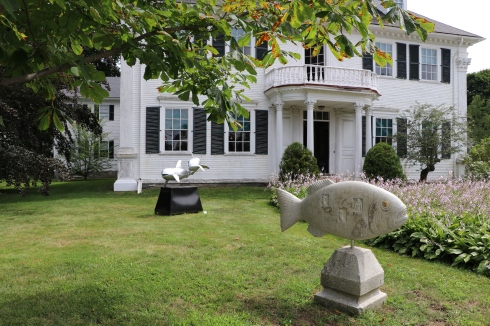
This sculpture titled “Fish With Travelers”was made out of granite by stone art enthusiast Thomas Berger. Talk about a fish out of water.

There are 10 more sculptures shown below that are on display on the grounds at the Langdon estate.

IMG_4313

Fisherman by Madeleine Lord made of welded steel.

Backstroker by David Adilman is made of Vermont gray marble.

Flotsam And Jetsam by Morris Norvin made form reclaimed steel barrels.

Serpentine by Irene Fairley made from Vermont marble.

Fragrant Flow by wood artist Jeffrey Cooper made of teak and bluestone.

IMG_4358

Moon Swings by Douglass Gray  made of steel.

Brown Crab by Thomas Berger made of fieldstone.

Urchin Sphere by Karin Stanley made of granite.

Genetically Modified Squid by Thomas Berger made of fieldstone.

Vertical Water” by Karin Stanley was not being displayed when I took the photos of the outdoor sculptures.

Inside the Governor John Langdon House there are many more sculptures.  You have to buy a ticket to view the sculptures (a tour of the house is included…blog post about the tour to follow soon).  I gladly forked over the $15 for the both of us to view them.

There are 34 sculptures displayed in the first floor parlor, hallway and dining areas.

Net by Amanda Sisk is made of mixed media.

Forever Free by Pete Spampinato made of bronze with an alabaster base.  Pete tends to feature animals in his work.  He says he did not begin sculpting until he retired.  He was inspired by the hardships animals had to endure during a trip to Africa.

Colossal Shell Goddess by Lindley Briggs made of resin and apoxie.  Lindley, in contrast to Pete, says her interest in the human figure has been rekindled.  Lindley says, “the boundaries between fantasy, reality and surreality are not necessarily firm.” She enjoys exploring these boundaries in her work.

Carousel Lobster by Jeffrey Briggs is made of fiberglass and resin.  Jeffrey builds carousels of all varieties as well as other works of art.  His latest work can be found at the carousel on The Rose Kennedy Greenway in Boston.  He often collaborates with Lindley (the sculptor featured above his sculpture).

Birds Of a Feather by Douglass Gray made of steel.

Gull by Alan Weinstein made of plaster and paint with a granite base.  Alan mainly paints.  But, he has branched out with his sculptures.

IMG_0972

Madonna 3 With Gorilla by Jeffrey Cooper made of cherry wood.  Sounds good enough to eat.

Sirena & Consorts With Sea Of Shells by Lindley Brigss made of apoxie and cast marble.  I especially like how the gorilla appears to be looking at the woman quizzically in the statue in the last photo.

Slaveship HMS Brookes by Martin Ulman made of mixed media.  The 43.5″ high ship sculpture was modeled after the British slave ship, “Brookes.”  The slave ship was used during the 18th century and it was said to carry 484 people, although it carried many more than that according to ship records and stories told by sailors.  The conditions were dreadful as Maya Angelou’s quote expresses.

Neptune by John Vasapoli made of oak.  John says is love of sculptures and his love for music have been the main factors for driving his creative energy.  John has sculpted many statues of iconic musicians and singers such as Miles Davis and Duke Ellington.

Secrets Of The Sea by Nancy Diefenbach is made of marble and glass.  She says her joy is creating one-of-a-kind artworks in marble.  She likes to shape her thoughts through her carvings.

IMG_0949

Water Muse by David Adilman is made of limestone.

IMG_0943

Water Nymph by Elise Adams made of alabaster.  Elise began her career as a sculptor after working 30 plus years as a chiropractor.  Art had always been a love of hers.  But, she was discouraged from following this career path while she was growing up.  I think it’s fair to say we’re all happy she did change her career path.

A Vineyard Excursion by William Bloomfield made of alabaster.  After taking a stone carving course in the 70’s, William says he was hooked.  However, “life got busy” as he put it and he did not take up sculpting until 2006 when he enrolled in some classes at The Chautauqua Institution’s School of Art.  He says that from his initial exposure to stone carving more than 30 years ago he discovered that an essential element of my creative process is to let go of any preconceptions he might have of what the stone might evolve into before I put chisel to stone.

Turtles  by Pete Spampinato made of bronze with an alabaster base.

IMG_0929

Approaching Storm by Judith Morton made of steel and fiberglass.  Judith says she “loves to come face to face with a cold hard block of stone.”  She describes the process of sculpting as a “give and take” until the block of stone is warm and yielding from all of her carving.  She also describes the process as being sensual for both the eyes and the hands.

IMG_0928

Pastry Chef by Susan Neet Goodwin made of clay and multimedia.  Susan says her first piece that included the human face was a response to the Iranian hostage crisis. Since then many of her sculptures have become vehicles for political and humanitarian concerns.  As you may notice by herr other works of art, Susan’s art has a certain theme through it.

IMG_0917

Mermaid With A Trident by Mara Sfara made of bronze and marble.  Mara says her art offers a glimpse into the lives and feelings of the gods and goddesses from Greek mythology.  She also likes to inject humor into her pieces.

IMG_0916

Valley by Danielle Gerber made of copper.  A native of New Hampshire who moved to Maine, Danielle says her body of work is spurred from her love of forming metal and the natural patterns created through water and wind erosion.

Rolling Wave by Judith Morton made of steel, wood and sand.

IMG_0906

Hump  by Derrick Te Paske madde of butternut.  A professor at Framingham State University, Derrick says he is  primarily concerned with theoretical principles and digital production/reproduction methods. His art involves wood and other common tangible materials while employing tools and processes which are decidedly low tech, and results in unique and very physical objects.

Follow Your Dream by Melanie Zibit made of bronze and marble.  Melanie compares the sculpting process as being similar to writing a thoughtful essay or cooking a good meal for those you care about.  She says the process of creating art is like an act of love because you are sharing something deeply personal from one human being to another and sharing something personal spiritual and beautiful.

Circle Sea by Dan Rocha made of wood, metal, metal leaf and plastic.  A Massachusetts resident, Dan has won a number of awards for his works of art.

IMG_0894

Eagle Ray by Irene Fairley made of red Tenneessee marble.

IMG_0891

Eastport Cannery Worker  by Susan Neet Goodwin made of clay and multimedia.


Canyon by Danielle Gerber is made of bronze, brass and spray paint.  This sculpture shares the same theme as her other sculpture, Canyon.

Synthesis  by Kathleen Brennan made of hydrocal plaster.  Kathleen has several exhibitions currently on display throughout Massachusetts and New Hampshire.

Seahorse Green by Mara Sfara made of lucite and gemstone.

Binocular Beasts by Derrick Te Paske made of cast bronze and glass eyes.

IMG_0860

IMG_0865

Aureus Piscari  by Kimberly JB Smith made of multimedia items (it is a 2 sided display).  A resident of New Hampshire, Kimberly is most known for her 2d and 3d compositions that include recycles and repurposed materials.  She uses paint, paper pulp and collage to create traditional and nontraditional materials in her creative process.  When she isn’t creating art, she enjoys teaching and publishing educational articles.

Homer’s Boat With Siren by Dan Rocha made of wood, metal, metal leaf and plastic.

Colossal Shell Goddess by Lindley Briggs made of resin and apoxie.

Wave by Valery Mahuchhy made of resin.  Valery says he knew from an early age he wanted to be a sculptor.  His art is on display all over the world.

Eve On The Beach by Josie Campbell Dellenbaugh made of bronze.  Originally from Albany, NY, Josie is best known for her stone carving.  One of her more prominent carvings is the Monument For Our Native Peoples in West Rutland, Vermont.


Heron Annoyed by James Pyne made of composite materials.  A resident of Maine, James focuses on birds in his art.  He describes birds as, “the most beautiful creatures on Earth.”

Dogs are not allowed in the Langdon House.  But, I did see a few dogs while I walked to the house.

This little cutie named Izzie is a 6 year old Havanese.

Today’s featured New England based photographer is Eric Gendron. Based out of Portsmouth, New Hampshire, Eric photographs all over the New England area.  But, he primarily shoots in the New Hampshire and Maine area.  What I like most about his photography is that he can take the ordinary, like a park bench for instance, and turn  it into something beautiful and majestic.  You can follow him on Facebook here.


Brattleboro Museum & Art Center (Brattleboro, VT)

Date Of Visit: August 6, 2017

Location: 10 Vernon Street, Brattleboro, VT

Hours: The galleries are open every day except Tuesdays, 11-5 (closed January 1, July 4, Thanksgiving Day, and December 25). On the first Friday of each month, the galleries stay open until 8:30 p.m., with free admission after 5:30 p.m.

Cost:  $8 for adults, $6 for seniors, $4 for students, free for BMAC members and youth 18 and under. Free admission for all on Thursdays, 2-5 p.m.

Parking: There are about a dozen parking spots in front of the museum and next to the

Handicapped Accessible: BMAC is wheelchair-accessible, and a guest wheelchair is available. Upon request and with advance notice, we will provide an ASL interpreter.

Website: Brattleboro Museum And Art Center

Highlights: the following exhibits: “Free Fall”, “The Boomer List”, “Boundaries, Balance and Confinement”, Spaceship Of Dreams”, “Lost Porches”, “Density & Transparency” are all on display until Oct. 8.

Tips:

  • parking in front of the museum is limited – there is street parking available in the area
  • The art isn’t only in the museum itself: there are additional works of art on the grounds of the entrance to the museum


IMG_8141

Have you ever dreamed of spaceships?  Do you ever wonder if a piece of art can be dense and transparent?

Then the  Brattleboro Museum And Art Center is just the place for you.

Brattleboro is a “non-collecting museum.”  So, the exhibits do not stay there permanently and they often switch out exhibits.

Although it is only one floor, technically two if you count the five stairs that lead to the “Spaceship Of Dreams” exhibit, the Brattleboro Museum And Art Center (BMAC) has a wide variety of art to view and appreciate.  The small size of the museum is actually comforting for people like me who can be overwhelmed by museums with a lot of art.  You can certainly look through all of the seven exhibitions currently on display, without rushing, in about an hour or hour and a half.

My favorite exhibit is “Spaceship Of Dreams” by William Chambers.

Formerly titled “Spaceship York”, “Spaceship Of Dreams” began as a window display at a vacant storefront in York, PA.   For two moths during the summer of 2015, William built and displayed this exhibit for all to visit for free.   The “Spaceship York” project culminated with a countdown and blast off day, reports of travel, and return of the ship.

As people began to visit the exhibit, the work of art transformed into more than just a rocket display.  People were able to connect with the artist and the work of art by working on the ship, using the space library and sharing ideas for change in York and the world.   The ship became a metaphor for imagining possibilities and realizing dreams.  Most significant was the chance to write or draw personal visions to be sent up with the ship.  William would incorporate this as well as other family friendly aspects to the exhibit.  It was great to see the messages and drawings the children left to be placed into the ship.

The exhibit is stopping off at the museum as part of its national museum tour.  It will be on display until October 8.

Also on display is the “Density And Transparency” art display by Wolf Khan.

Wolf Kahn, who has macular degenerative, experiments with new methods and materials.  He begins each painting by scrubbing in the basic composition and colors.  Then, he uses a variety of oil sticks to produce bold forms and densely filled, saturated forms colors.

“Scrub, scub, scrub” that is how Wolf describes the process of making this art.  Wolf uses this method to create layers of thinned paint.

Below is a sample of his work.

IMG_8017

Pink Tangle Painting (2007) – oil on Canvas

IMG_8020

Nathalie Miebach’s “Lost Porches” exhibit combines everyday items (such as paperclips). Her sculptures use designs that resemble weather maps and  what she calls “numeral logic.”  Her sculptures are meant to mirror our weather and the unfortunate consequences of some of our extreme weather patterns.  I couldn’t help but think of a weather doppler or meteorological radar screen as I looked at her work (given the earlier mentioned intentions of her art).

This sculpture called, “Build Me A Platform, ” she asked, “high In The Trees, So I May See The Water.”  It is made of wood, paper, string and data.

IMG_8069

She describes this piece as being about four different flooding events that have impacted the Louisiana area since Hurricane Katrina.  This is what makes Nathalie’s work so interesting.  Many of us may not have known there were other flooding events since Katrina.

Nathalie used weather data from each of the flooding events while asking how we can come to terms with and perhaps prevent these flooding events in the future.

The sculpture below titled, “The Last Show Was For The Bleachers.”  This sculpture, completed in 2016, is made of wood, paper, data and string.

IMG_8065

This sculpture is based on an aerial view of the New Jersey/New York shoreline.  The piece translates Hurricane Sandy data.  The domino pieces represent retired hurricanes that are sitting on bleachers, looking on and waiting for Hurricane Sandy to join them on their benches.

The last sculpture titled, “Lost Porches” is meant to represent the front porches which is considered a traditional gathering place for the people in New Orleans.  However, when Hurricane Katrina hit the New Orleans area this important social element was lost for many people.   This sculpture tracks the redevelopment of a small section of the Lower Ninth Ward during the last 10 years.  If you look closely, you may see what looks like houses and other housing structures – without porches.

IMG_8072

I’m always in awe of how artists can make great art of out seemingly ordinary materials.  This is the case with “Boundaries, Balance And Confinement: Navigating The Elements Of Nature And Society”, an art exhibit by Vermont resident Mary Admasian that explores the physical boundaries between objects as well as the implicit boundaries of familial and social covenants and conventions.

Barbed wire is considered the border between the natural world and cultivated land.  Admasian uses barbed wire as a unifying material in her work.  She incorporates barbed wire with feathers, butterflies and branches among other natural materials with manufactured materials.

“The Nest”, completed in 2015, uses goose egg, Vermont birch log and stove trivet in its design.

“Go Cut Yourself A Switch”, also completed in 2015, combines pine plank, willow branches, barbed wire (Of course) and acrylic paint.

IMG_8085

To the left in the photo below is  “Lessons That You Won’t Forget” which combines fencing, barbed wire, willow switches and gold wire.  it was completed in 2015.

Created in 2015, “Dowsing For Center” (to the right in the photo below) is made of maple branch, barbed wire, a rusty metal ring and white paint.

IMG_8080

“The Hive”, completed in 2016, uses barbed wire, powder coating and a rusted steel chain.

“Progression”, from 2015, is a barbed wire and bank plank construct.  Imagine getting spanked with that!
IMG_8099

Mary’s last addition to her exhibit is located outside of the museum, hanging from the eaves of the art museum.

“Weighted Tears” is made of barbed wire, aluminum rods, wire and powder coating.  The five teardrops vary in size and are stabilized by spherical weights.  The smallest form is lit 24 hours a day as a symbol of hope during difficult times.

“Free Fall” is an art display by Barbara Garber.

Barbara says she often starts from a “place of not knowing” when she begins her works of art.  You can see the theme of falling in many of her photos.

Below are Barbara’s paintings that are featured as part of her Free Fall exhibit.

IMG_8116

Ripples, 2017, acrylic and colored pencil on drafting film

Free Fall, 2017, acrylic paint and colored pencil on drafting film

IMG_8120

Out Of The Oven, 2017, acrylic paint and colored pencil on drafting film

IMG_8122

Spin, 2016, acrylic paint and colored pencil on drafting film

IMG_8123

Xocian, 2017, acrylic paint and colored pencil on drafting film

IMG_8125

From Nothing, 2016-2017, acrylic paint and colored pencil on drafting film

IMG_8127

I Don’t Know, 2016, acrylic paint and colored pencil on drafting film

IMG_8129

Notch, 2017, acrylic paint and colored pencil on drafting film

IMG_8131

Upside Down, 2016, acrylic paint and colored pencil on drafting film.

“The Boomer List: Photographs by Timothy Greenfield-Sanders” is a large portrait display of 19 “boomers” who were born between 1946 and 1964.  The 19 photos line the walls of the right hand side of the art museum in an area that seems more like an annex to the museum.   Timothy’s portraits have a short summary of the subjects as well as a short story or a lesson the person has learned.  The portraits are incredible.  While the subjects were certainly posing for the photos they also look remarkably natural.

The people included in the “Boomer List” are listed below:

1946: Tim O’Brien, Vietnam veteran/author
1947: Deepak Chopra, New Age guru
1948: Samuel L. Jackson, actor
1949: Billy Joel, singer/songwriter
1950: Steve Wozniak, co-founder, Apple Computer
1951: Tommy Hilfiger, fashion designer
1952: Amy Tan, author
1953: Eve Ensler, playwright
1954: Julieanna Richardson, The HistoryMakers
1955: Maria Shriver, journalist
1956: Kim Cattrall, actress
1957: Virginia Rometty, CEO, IBM
1958: Ellen Ochoa, director, Johnson Space Center
1959: Ronnie Lott, athlete
1960: Erin Brockovich, environmentalist
1961: Peter Staley, AIDS activist
1962: Rosie O’Donnell, entertainer
1963: David LaChapelle, artist
1964: John Leguizamo, actor

Little known fact (at least to new visitors to the museum): the museum is on the top floor of Brattleboro Train Station. An old ticket counter from the very same train station is located next to the “Spaceship Of Dreams” exhibit.

IMG_8025

Now, an Amtrak train makes stops each day at 1 o’clock and 5 o’clock, backing up traffic for quite some ways.

IMG_8022

As if that wasn’t art for one visit, there are also pieces of art outside of the building as well as decorative flowers and signs on the museum.

“Wrench Bench” is a bench made of cast fiber, resin and oil paint.  It was made by John Tagiuri.

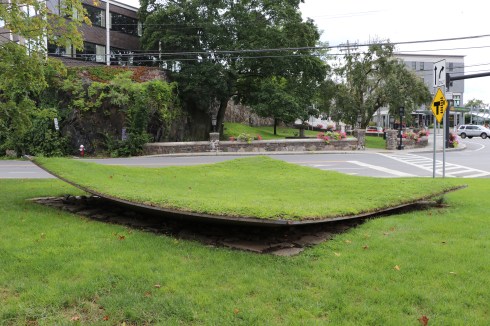
“Land Lift”, made by Vermont-based Bob Boemig, is made of turf, steel and stone.

IMG_8136Located in between the Brattleboro Museum and the Marlboro College Graduate School, the Sculpture Garden has two rock displays.  A sign on the wall of the museum indicates the garden is dedicated to the memory of Dan Freea.

Today’s featured link is a link to a post about an exhibit by Chris Page that was displayed at the museum last year called “Eyes Toward Heaven.”  I wish I could have seen this in person!


Buttonwood Farm (Griswold, CT)


Date Of Visit: July 22, 2017

Location: 473 Shetucket Turnpike, Griswold, CT

Cost: Free

Hours:

March 1 – October 30

Current Hours
Mon – Fri
 12pm–9pm
Sat – Sun 11:30am–9pm

Parking: There are about 50 parking spots in the parking lot.  When they are busy, you can park on the side of the busy street (as I had to)

Handicapped Accessible:

Dog Friendly: Yes

Highlights: ice cream shoppe, sunflowers (seasonally), family friendly, cows

Website: Buttonwood Farm

IMG_2695

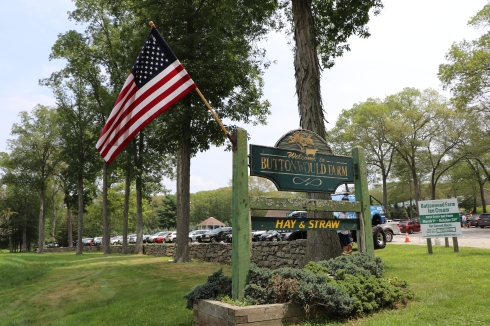
Once the site of a dairy farm, Buttonwood Farm is so much more now.  Not only do they have a sunflower garden with a maze and a famous ice cream shoppe, they also are the site of one of the more popular charity events each year.

Funny thing is I didn’t find one button the entire time I was there.

During my visit, the sunflowers were in bloom and Buttonwood Farm was holding a fundraiser for their Sunflowers For Wishes charity.


The dirt trails in the sunflower maze are easy to navigate.  The path is only about half a mile long.  Due to the showy outer ray petals of the sunflowers, bees and other insects, like this beetle, are attracted to the nectar and pollen.


In addition to the sunflowers, people (big and small) could ride their cow train or tractor tour.  All proceeds, of course, went to the charity.


At the end of the sunflower maze, there is a hill on a short incline where you can view the sunflowers.


There were also some performers at the top off the hill.  A man was playing music and there was a local painter, Jacqueline Jones, who was preparing to paint the sunflower garden.


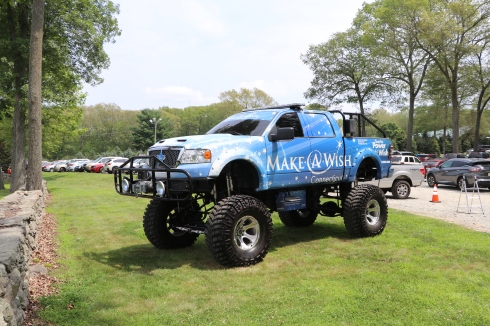
Since it was a charity event, there were charitable organizations like the “Make A Wish” foundation.  They had my dream car there!

IMG_2696

The cows at Buttonwood are so docile and beautiful.


Sunflowers aren’t just for people.  Dogs also like to walk along the sunflower maze.


Tunken (on the left) is an 8 year old Chocolate Lab mix and Duncan (On the right) is a 3 legged Harrier, fox and hound mix


Alie is a 12 year old Mini Pinscher.


Ian is a 5 month old Golden Retriever who is in training to be a service guide dog.

Below is a video of the maze at the sunflower garden.  What struck me is, despite the large crowd that was there, how peaceful and quiet the place seemed.  It seems like a wonderful place to go and just have some peace and quiet.

Today’s featured website is Jacqueline Jones’ Paintings From The Open Air.  Jackie was painting a portrait of the sunflower garden during my visit.  You can find her painting of the sunflower garden on her website.

Based out of New Haven, CT, Jackie specializes in painting the nature of the New England area.  She also enjoys painting in other areas outside of New England such as the Colorado and New York areas.  Jackie has also won a variety of awards and has studied with some of the accomplished artists in the New England area.


Tom Fiorini Sculpture Garden (Lenox, MA)

Date Of Visit: May 31, 2017

Location: Behind Joane Cornell Jewelry Store (63 Church St, Lenox, MA)

Hours: Art is available for viewing 24 hours

Cost: Free to view (unless you want to buy something)

Parking:  Free street parking is available on Church St (although it may have time limits).  There is also a parking lot on Franklin St that you may use for short term parking.

Handicapped Accessible: Yes

Dog Friendly: Yes

Highlights: Variety of unique art and decorative items made by New England artist Tom Fiorini

Website: Tom Fiorini – Sculptor

Tom Fiorini Facebook

IMG_8776

You interested in a doghouse covered with license plates?  (dogs sold separately)

How about a some carved fish? (at least you don’t need to feed them or buy a tank for them)

Perhaps you’re looking for boat?  I’m just not sure if she is sea-worthy.

IMG_8777

Tucked away behind the Joane Cornell Jewelry store at 63 Church St, Lenox, MA (at least for now), Tom Fiorino’s art, sculptures and other unique items offer an unusual brand of decorative items.

Tom Fiorini is not your orthodox artist.  He works mainly with metals and often times his choice of tool is a chainsaw.  Much of his art is made of normal, everyday materials reshaped and manufactured into a completely different.

Tom’s signs, with their offbeat slogans and designs, may be the highlight of his collection.

Tom also uses his creativity to make his art and create arrtful designs.

I don’t know about you but sometimes I could really use this really big bottle of wine.

IMG_8718

Other miscellaneous works of art are scattered around the lawn.

As you can see by his art, Tom has a great sense of humor.

Also, his prices may be negotiable based on the sign below.

IMG_8676

For now, Tom’s work can be viewed at the address listed above on Church St.  I am not sure where he stores his sculptures during the winter season.  You can contact him at his website listed above for more information.  Below is more information about him and his art.

Keeping with today’s theme of outdoor art, today’s New England featured link is the deCordova Sculpture Park & Museum in Lincoln, MA.  I’ve yet to go there.  But, it is definitely on my list.


Wonder Woman Rosey House (Lee, MA)

Date Of Visit: May 31, 2017

Location: 22 Robert St, on the corner of Center St. and Robert St, Lee, MA

Cost: Free

Hours: Accessible everyday, 24 hours a day.

Parking: You can park on Roberts St.

Handicapped Accessible: Yes

Dog Friendly: Yes

Highlights: House decorated with statues, designs and other decorative items

IMG_8783

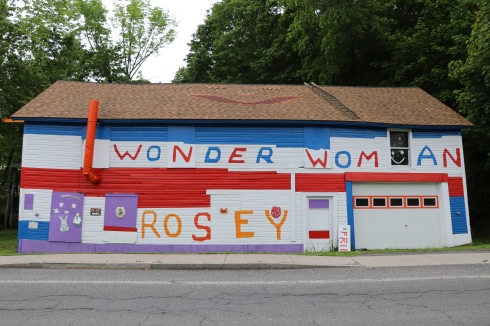
Most houses are decorated for the holidays, birthday parties or some other celebration.  But, the Wonder Woman Rosey House on the corner of East Center St and Robert St in Lee, MA is decorated all year round.

Without knowing the back story or reason for decorating the home, the house and property may seem crazy or a little bizarre.  However, it is more of a tribute and memorial than some random decorations.  Rosey (or Rosemarie) was the wife of painter and resident of the house, Bob Dupont, a professional painter.  He painted and decorated his home and property as a tribute to her.

The garage next to the house is decorated primarily in red, white and blue.


The decorations do not stop there at the garage, though.

The house and property are also decorated with decorations and statues ranging from Santa Claus to rabbits.


I would have loved living in a house like this when I was a growing up.  It looks like a real fun place to experience!

There are many randomly placed decorations scattered around the property.


The home owner doesn’t seem to mind having visitors.  I wasn’t bothered or questioned while I photographed the area.  But, it is private property.  So, visitors should be respectful of that.

The featured link of the day is another decorated home called The Crazy Christmas House in Coventry, RI.

Please follow me on Facebook


The Amazing World Of Dr. Seuss (Springfield, MA)

Date Of Visit: July 3, 2017

Location: 21 Edwards Street, Springfield, MA (2 hours west of Springfield, MA)

Hours:

Monday–Saturday: 10 am–5 pm
Sunday:
 11 am–5 pm

Holidays: Closed New Year’s Day, Easter, Memorial Day, Independence Day, Labor Day, Thanksgiving, Christmas Eve and Christmas Day.

Cost: One ticket gives you access to all 5 of the museum buildings (including the Dr. Seuss Museum).  You cannot buy one ticket for just one building.  Since it is such a popular attraction, tickets for the Dr. Seuss Museum are times for one hour and only 200 people during each hour time block are admitted at one time.  You can purchase advance tickets on their website (see below)

Adults: $25
Seniors (60+): $16.50
Youth 3–17: $13
Children Under 3: Free
Students: $16.50

Springfield Residents (with valid ID): Free – youth included

Parking: There is parking for about 50 cars in the main parking lot in front of the Springfield Museum and about 50 more in the lot across the street

Handicapped Accessible: Yes, there are elevators in the museum.

Highlights: art, statues and other items related to Dr. Seuss

Website: The Amazing World Of Dr. Seuss Museum

IMG_8324

Oh the places you’ll go and the things you will see at the Amazing World Of Dr. Seuss Museum in Springfield, MA.  The museum, which opened June 3 of this year, is like walking into a Dr. Seuss book.

The museum is a tribute to Theodor Seuss Geisel, more commonly known as Dr. Seuss, who was a Springfield, MA native.

From the moment you enter the museum, you are bombarded with vibrant colors, familiar characters and a sweeping sense of nostalgia.


The Amazing World Of Dr. Seuss is a two floors with a basement.  Each room on each floor has a theme. Fairfield St, Readingville and Oh The Places You’ll Go are a few of the rooms on the first floor.  The first floor of the museum is dedicated to many of Dr. Seuss’ characters and his books.  Children, and the occasional adult, get the opportunity to play games based on his works.


The first floor also has a section dedicated to Young Ted in Springfield which celebrates his time in Springfield, MA.


The basement floor has more Dr. Seuss memorabilia and artwork as well as an activity area where visitors can make their own Dr. Seuss works of art.


The second floor mostly has letters, mementos and photos from Dr. Seuss’ lifetime.  There must be hundreds of writings, cards, works of art and other memorabilia from his early days and from others writing to him  It’s very interesting seeing some of his early work before he became famous and hit his stride as an artist.


There is also a display that shows the process of how they make the statues located at the Dr. Seuss National Memorial Garden which is located just outside of the building on the museum’s property.


There is also a Dr. Seuss statue I missed when I first first photographed the statues at the museum.  This statue is tucked away to the side of the museum.

IMG_8671

Today’s Nomad link is Paper Clippings.  Paper Clippings is Denise Ortakale’s WordPress blog.  She recently had some of her work displayed at the Springfield (MA) Museum as part at the Cats In Hats exhibit.  I wanted to photograph this exhibit.  But, since it was the work of other artists and not their own exhibit, the museum did not permit people to photograph the exhibit.  I am glad that Denise has posted her work so I can share it with everyone else.


New England Carousel Museum (Bristol, CT)


IMG_7573

Date Of Visit: July 1, 2017

Location:95 Riverside Ave, Bristol, CT

Hours:

Monday: Closed
Tuesday: Closed
Wednesday: 10-5
Thursday: 10-5
Friday: 10-5
Saturday: 10-5
Sunday: 12-5

The Museum is available any day of the week for special tours and facility rentals; even when closed to the public. If you’re interested in visiting the Museum Monday – Friday please call (860) 585-5411

Cost:

Adults $6.00
Seniors $5.50
Children $3.50 (age 4-14)
Children $2.00 (age 1-3)

All admissions include one ride ticket for the indoor carousel.

Parking: There is parking for about 15 vehicles in front of the building.  There is also street parking available on Riverside Ave.

Handicapped Accessible: Yes

Highlights: carousel horses, working carousel, tours, family friendly

Website: New England Carousel Museum

IMG_7349

As a child, I always loved riding the Merry-Go-Round and looking at all of the beautiful horses on the carousel.  Living in the city, it was bout as close as I was going to get to a horse.  It was always the highlight of my trip to the amusement park, especially since I never was a fan of the roller coasters.

There is a place you can go so the very same kinds of carousel horses we rode on as children.  And, you might also get a chance to actually ride on a Merry-Go_Round while you’re there.  I’m not horsing around either.

The New England Carousel Museum is deceivingly big.  From the outside, you wouldn’t even notice the museum was there.  In fact, I drove by it the first time I went looking for it.  The museum features hundreds of carousel horses and other types of carousel animals in their 10,000 square feet of space and several rooms with carousel horses and other items from carnivals and amusement parks.  Most recently, they added a carousel on their second floor.


Some of the carousel horses have been donated.  Others are being held while the owners are moving or while their homes are being worked on. Yes, some people actually have carousel horses in their homes!

The carousel horses range from the traditional horse to swan, egret, giraffe and even a cat among other animals.


There are even some carousel horses in the form of mythical characters.

IMG_7367

The craftsmanship and attention to detail are incredible.  Most of the horses have placards that give a little background to their history and the artist who created the animal.  For instance, this “Irish Horse” was carved in 1917 by David Lightfoot for the Philadelphia Toboggan Company.  The Irish theme was indicative of the Irish Nationalism that was a major influence in the eastern part of the United States during that time.


This “Sweet Horse” was carved by Daniel Muller in 1895.  The horse, which is over 120 years old, is still in its original paint.  It also has all four legs in the air which is another unusual feature of the horse.

IMG_7444

This particular carousel horse was originally part of the carousel at Lake Compounce in Bristol, CT.  Lake Compounce, which opened in 1846, is the largest water park and Connecticut as well as the oldest continuously running amusement park in the United States.   This horse was taken down from the carousel at the amusement park in 1911 when the carousel was replaced with a newer, more up to date (at that time) carousel.  It now resides in the Carousel Museum.

IMG_7425

There are many more interesting stories and facts about each carousel horse.

The carousel museum just doesn’t have horses.  They also have a swan, egret, dolphin, zebra, elephant, cat and rabbit among other carousel animals


Photos of carousels and amusement parks line the walls of the New England Carousel Museum and they have other items from amusement parks as well.


I even manged to photograph a dog there!  This realistic sculpture of a Siberian Husky is located near the carousel.  You may notice how one eye is brown and the other eye is blue.


The knowledgeable and friendly staff at the Carousel Museum give guided tours and explain how the horses were made.  Some of the factoids I learned during the informational session: those tails on the carousel horses…yup they’re real.  They are actual tails from horses.  It is true that some carouse horses do have wooden, carved tails.  But, the horses with actual tails most likely got their tails from a horse that had passed on.  Also, most carousel horses were only painted on the outside because that was the only side most people would see and that would save them money.


The highlight of the museum for many people, especially the little ones, is probably the carousel ride.  And, yes, I did go on it.   The carousel is located on the second floor (there is an elevator for those who can’t or don’t want to take the stairs).  It’s a great way to end a fun visit!


Below are two videos I took at the museum.  The first video is of a motorized replica of a carousel made entirely out of paper clips.  The work of art is called “Paper Clip Fantasy” and it was created by Eugene Burnstein of Lakewood, New Jersey.

The next video is a video of the fortune telling machine at the museum.  Yes, it still works and it even gives out fortunes.

Since some of you may be wondering what the fortune said, I have included some photos of it below.  The front side of the card said to hold the fortune in front of a mirror to read it.  I was able to decipher it without looking into a mirror.  It says “love me and the world is mine.”


The Nomad’s link of the day is faye_fares.   Faye is one of the tour guides at The New England Carousel Museum and she is also a very talented artist.  She’s an artist, photographer and model.  Some of her work takes 4 to 9 hours to complete.  You can follow her Instagram account here.

Please connect with me on Facebook and Instagram


Three Sisters Sanctuary (Goshen, MA)

Date Of Visit: June 4, 2017

Location: 188 Cape St (rt112), Goshen, MA (about 45 minutes northwest of Springfield, MA and an hour and a half southeast of Albany, NY)

Hours:  Open 7 days/week, 8:00 am – Dusk

Cost: a $10 donation is suggested.  Children under 12 are admitted free

Parking: The parking area next to Three Sisters can accommodate about 15-20 cars.

Handicapped Accessible: There is limited wheelchair access.

Dog Friendly: Service pets are allowed

Highlights: unique pieces of art in a natural setting

Website: Three Sisters Sanctuary


The sign at the entrance to Three Sister Sanctuary states, “Where nature and art merge.”  That’s a pretty apt description of the sanctuary if there ever was one.

Three Sisters Sanctuary is no run of the mill art sanctuary.  Every piece of art is made of rock, plants, water, iron and other parts of the land in its composition.  In fact, sanctuary is a very good way to describe the place.  Three Sisters is more than just a place to look at art or enjoy the beautiful nature which surrounds the sanctuary.  It is a place for reflection, meditation and peace.


Richard Richardson, the owner and on site artist at Three Sisters created the pieces of art to foster a feeling of serenity, inner peace and spirituality.

IMG_1157

The name “Three Sisters” comes from Richard’s three daughters.  His three daughters gave him so much joy and happiness he wanted to give this joy and happiness to others through his art.  He says he did not find the garden.  The garden found him.  It helped fill a void in his life and it has brought him a purpose and meaning.


Richard’s use of old machines as well as other tools and spare parts is indicative of the unique style of the art at the sanctuary.


One thing you’ll notice in Richard’s works are his emphasis on people, particularly children, in his work. Looking at these works of art, you can’t help but stop and consider the effort and creativity it took to create such interesting and meaningful works of art.  It certainly does make you think about the many forms of inspiration and how we express that inspiration.


From afar, some of the statues look a little like something might see in a zombie movie.  But, they are all pretty harmless.


Keeping with his themes of spirituality and peace, you will also see angels and other spiritual figures.


Richard feels the presence of his older brother and his eldest daughter, who he tragically lost.  He says the art and nature both work to provide healing and peace while keeping the spirit of his brother and daughter with him.  Whether you are a spiritual person or not I still think you can at least find inner peace among the statues and other works of art.


Another common theme of the art at the sanctuary is the use of animals in his work.  Dogs, horses, butterflies and even a few mythical creatures are a few of the animals and wildlife


You may even run into a few real wildlife.  While walking along the sanctuary, I noticed this rather unhappy goose.  Unsure why he or she was making faces and noises at me, I went to take a closer look.  It turns out the mommy or daddy was just being protective.  It seemed appropriate that life would begin here and share in the peacefulness around them.


Some of the rocks at the sanctuary are said to give up energy and even be a source of healing.  In fact, if you stand in between some of the bigger rocks, it i said you will feel a certain energy and healing power.  One of Richard’s daughters who was helping him during my visit said she feels rejuvenated after standing next to the rocks.


Jut when you think you’re at the end of the art sanctuary, there are pretty cool statues and other works of art at the front of the sanctuary.


Richard has succeeded in making a sanctuary that is not only a place for art lovers to seek out unique pieces of work.  He has also helped create a place for people to reflect and find an inner peace.

Three Sisters Sanctuary also provides accommodations for visitors as well as ceremonies on their grounds.  The Nomad’s link of the day is a blog post by Kristin Chalmers.  She recently attended a wedding as the photographer and posted about Nicole And Kilean’s Medeival LARP Wedding At Three Sisters Sanctuary.


The Mount (Lenox,MA)

Date Of Visit: June 4, 2017

Location: 2 Plunkett St, Lenox,  MA (about 2 hours west of Boston and 1 hour northwest of Springfield, MA)

Hours: The Mount is open daily from 10:00 am to 5:00 pm through October 31st, except on early closing days (please see below). The Mount is open from 10:30 am – 3:00 pm most weekends in November through February. Please call 413-551-5100 to confirm hours.

Cost: $18 for adults, $17 for seniors (65 and older), $13 for students with id, $10 for members of the military, free for teens and children (18 and younger)

Handicapped Accessible: Yes

Dog Friendly: Service pets may be allowed

Highlights: home of author Edith Wharton, trails, fountains, flowers

Website: The Mount

IMG_0860

Once the home to one of Massachusetts’ more prominent authors, The Mount is more than just a beautiful mansion.  The Mount, once the home of Edith Wharton, has colorful gardens, fountains, art, spectacular views and history around every corner.

The Mount, which was recently restored, is an elegant house that has kept much of its original charm.  What is great about the mansion is that you can see the entire home in half an hour or so.  Yet, it isn’t so much the quantity of time and space the tour (I took a self guided tour but there may also be guided tours as well) would take.  But, rather, it is the quality of time and space the tour takes.  Around each corner is one beautiful piece of furniture and architecture.  Yeah, I think I could live here.

I couldn’t use my flash when I took photos inside of the mansion.  But, I did my best.  Sometimes the lack of lighting gives the home a mysterious feel.  Sometimes it just makes the photos look crappy.  You decide.

The two floor building has about a dozen rooms and there is a handicapped accessible entry and elevator.

Some of my favorite rooms had the old, antiquated tools and appliances we used to use.

The grounds of the Mount is as beautiful as the inside of the building.

The Beaver Loop Trail, a gentle, short trail (about half a mile) that runs along the grounds of The Mount, offers some very pretty views.

Edith Wharton was fond of animals (well, mostly she was fond of dogs not so much cats – oh well she wasn’t purrfect I guess).  Along the trail around the mansion, a side trail leads too a pet cemetery.

There are also little critters along the trail outside of the home.

The Mount is also hosting a special art exhibit called SculptureNow on its trail.  If you missed it, you can view the blog post I posted a few weeks ago bout the art exhibit here.

Please connect with me on Facebook to view more New England area related content.