Category Archives: New England

Mystic Seaport – Part II (Mystic, CT)

Date Of Visit: September 2, 2017

Location: 75 Greenmanville Ave. Mystic, CT

Hours: Open daily, 9:00 – 5:00 (hours may vary depending on the season)

Cost:

Adult – $28.95
Senior (ages 65+) – $26.95
Youth (ages 4-14) – $18.95
Children (3 and younger) – Free

Parking: there is a free parking lot across the street from the Seaport Museum.  There is also additional parking across the street from the parking lot for overflow

Handicapped Accessible: Yes, but not all of the buildings are accessible to the handicapped.  Approximately one-third of our buildings have wheelchair-accessible entrances; interior access varies. The village’s unpaved roads are generally firm and stable suitable for wheelchairs and strollers. All roads are basically level with a few slight inclines located near the Children’s Museum, Treworgy Planetarium and Membership Building.  (see link below for more info)

Mystic Seaport Accessibility Guide

Dog Friendly: Yes, but they are not allowed in the buildings

Website: Mystic Seaport

Highlights: living museum with character actors, boats, replicas of historic homes, figureheads, lighthouse replica, play area for children

Tips:

  • For an after museum viewing treat, Mystik Village, an open area shopping mall is a mere.9 miles away on Coogan Blvd
  • the museum’s main parking lot can fill up quickly if you don’t get there early.  Additional parking can be found in the lots off Rossie St on the other side of the main parking lot

In part I of my blog posts about Mystic Seaport I showed you all of the figureheads and some other decorations and statues at the Seaport Museum.  Since there were so many interesting things to see and photograph there, I decided to break the blog post into two or three installments .  In this installment I will include photos of the boats and ships from the Seaport Museum (it is a seaport museum after all).  I hope you enjoy!

The ship pictured above and the staple of the Seaport Museum is the Charles W. Morgan, the last of an American whaling fleet that once numbered more than 2,700 vessels. The Morgan, built and launched in 1841, is presently America’s oldest commercial ship still afloat.  In fact, it is only second to “Old Ironsides”, the USS Constitution, in terms of age.  It’s also very hard to fit the entire vessel in the frame of your camera’s view.

As I travel all over New England, I have become more aware of how all of the states in this region are interconnected.  Evidence of this is how the Morgan was launched in 1841 in the city of New Bedford, Massachusetts, an area that enjoys a prominent role in American fishing and whaling history.

Clocking in at 106 feet, 11 inches in length on deck and a beam measuring 27 feet, 9 inches, the Morgan was and still is one of the larger vessels in the New England area. Her main truck is 110 feet above the deck and fully-rigged, and her sail measures in at 7,134 square feet.

But, lest you think the Seaport Museum is a one trick pony, there are lots of other sea worthy watercraft at the museum.

IMG_0287

The Calypso stretches 23′ in length with a 7’4” beam with a 2’5″ centerboard up.  It is made of fiberglass in an old French wooden boat design.  Built in 2004 at Latitude 46 Yachts, Ile de Re, France, the Calypso has a 9 horsepower Yanmar diesel engine.  Yeah I don’t know what that means either.

Calypso spent a decade racing and day-sailing along the South Shrewsbury and Navesink Rivers in New Jersey.  After being damaged during Hurricane Sandy in 2012, the boat was fully restored.  The boat is on exhibit and used for museum programs.

IMG_0293

Designed by Nathanael G. Herreshoff, Aida was built in 1926 by Herreshoff Manufacturing Co in Bristol, Rhode Island.  Aida measures out to 33’6″ in length with a beam of 9’2″ and it has a draft of 3’1″.

Aida  was owned by author Maynard Bray who used it to sail the waters of Maine.  She is planked with Longleaf yellow pine and Douglas fir and is framed with white oak.  She is fastened with bronze.  She is available for charter.

While there are other boats both on exhibit and available for charter, some of them were not available for photography.  I did find this Smallboat Exhibit.

Originally launched as George Stage, the Joseph Conrad, an iron hulled sailing ship, is also docked at the Seaport Museum.  She served as a training ship for American and Denmark sailors, separately, and has been used as a yacht in the past.  She 100’8″ on her deck, her bean is 25’3″ and her draft is 12′.

They were raising her sails when I began photographing the vessel.

Speaking of figureheads and masts, check out the figurehead on the Joseph Conrad.

You never know what you’ll see at the museum.  Randomly, a man who works at the museum began singing on this boat.

IMG_0577

This boiler is from an old ship that was once sea worthy.

IMG_0749

There is also a replica of a Verande which was used in the planning of a much longer Viking longship.  The Verande would be sea tested by towing, rowing and sailing to test its seaworthiness, ease of handling, safety and speed.

IMG_0068

In the Stillman Building, there is a replica of a captain’s quarters for the 1883 ship Benjamin F. Packard.  It felt pretty cool being able to access the living quarters of a captain without actually having to go out on a boat.

It looks cozy for sure.  The articles in the last photo are the figurehead, a billethead, and some of the other items that would be on the ship.

This concludes the ships and boats installment of my blog posts from Mystic Seaport.  Next, I will post about the buildings and some of the historical items on exhibit at the museum.  Thank you for reading!

Outside of the Stillman Building, I saw these two adorable Longhaired Dachshunds.

Clair is on the left and Chloe is on the right.


Mystic Seaport – Part I (Mystic, CT)


Date Of Visit: September 2, 2017

Location: 75 Greenmanville Ave. Mystic, CT

Hours: Open daily, 9:00 – 5:00 (hours may vary depending on the season)

Cost:

Adult – $28.95
Senior (ages 65+) – $26.95
Youth (ages 4-14) – $18.95
Children (3 and younger) – Free

Parking: there is a free parking lot across the street from the Seaport Museum.  There is also additional parking across the street from the parking lot for overflow

Handicapped Accessible: Yes, but not all of the buildings are accessible to the handicapped.  Approximately one-third of our buildings have wheelchair-accessible entrances; interior access varies. The village’s unpaved roads are generally firm and stable suitable for wheelchairs and strollers. All roads are basically level with a few slight inclines located near the Children’s Museum, Treworgy Planetarium and Membership Building.  (see link below for more info)

Mystic Seaport Accessibility Guide

Dog Friendly: Yes, but they are not allowed in the buildings

Website: Mystic Seaport

Highlights: living museum with character actors, boats, replicas of historic homes, figureheads, lighthouse replica, play area for children

Tips:

  • For an after museum viewing treat, Mystik Village, an open area shopping mall is a mere.9 miles away on Coogan Blvd
  • the museum’s main parking lot can fill up quickly if you don’t get there early.  Additional parking can be found in the lots off Rossie St on the other side of the main parking lot


IMG_0274

Once a major seaport, Mystic Seaport no longer functions as the busy hub of commerce and fishing or transportation.  But, they have preserved some of the historical atmosphere while still incorporating modern technology.

Since Mystic Seaport is such a big attraction, I am posting my blog posts in three or possibly four installments.  My first installment deals with the Viking ship display which was being featured at the museum as well as the figureheads, decorations and other sculptures at the museum.

During my visit, there was a Viking ship docked at the museum.  Tours were being provided for a small charge.

By far, my favorite part of the museum is the figurehead museum.  The dimly lit room, which made photography challenging, in the Wendel Building added to the mystique of these treasured works of art.

This scroll billethead figurehead is the oldest one in the museum.  Many ships used these billetheads in lieu of figureheads because they were easier to carve and less expensive than the full sized figureheads.

There are several other figureheads in the museum which stood out to me.

IMG_0160

This scary cat timber was used while lifting the anchor and keep it away from the ship so it would not damage the vessel.

Most of the figureheads are of people, though.

IMG_0182

This figure titles Woman With A Comb.  Although it’s hard to tell when some of these figureheads were made, it appears this figurehead was made during the 1820’s.  This figurehead shows a hairstyle and clothing style that was popular during the 1820’s.  Unlike some of the figureheads you may have seen previously where the figurehead leans forward and under the bowspirit, this figurehead stands upright, which was common until the 1840’s when they changed to the design that leans forward.

IMG_0179

Woman With Roses has an interesting historical background.  This figureheads, which resembles a portrait more than an actual figurehead, was originally called Belva Lockwood when it first came to the seaport museum.  Belva Ann Bennet Lockwood, who this figurehead resembles, was a leader in the women’s suffrage movement during the late 1800’s.  She was nominated for President of the United States in 1884 and 1888.  Despite her historical significance and the likelihood that a ship would have been named after her, there are no records that show her name on any vessel.

IMG_0176

Donald McKay  is a figurehead made for the 1855 clipper ship Donald McKay.  Named and designed after the famous ship builder and designer Donald McKay, this figurehead was broken off its vessel and stood unprotected, outdoors in the Cape Verdes islands off the coast of Africa.  It was restored and repainted but it still shows the effects of being exposed to the conditions.  The first figurehead for the vessel was lost at sea and this figurehead which replaced the original one was believed to have been carved by the ship’s carpenter while the ship was out at sea.

IMG_0175

Seminole decorated the ship vessel of the same name for over 40 years.  The figurehead, which was built by Maxon Fish & Co in 1865  in Mystic, CT, is believed to have been carved by James N. Colby and James Campbell.  Colby and Campbell were prominent ship and sign carvers and decorators in the Mystic area from the 1850’s until 1877.  Seminolean offshoot of the Creek Confederation, means “separatist” or “runaway.”

Seminole carried cargo from New York to San Francisco and vice versa for over 20 years.  It was captained by another Mystic, CT, native Joseph Warren Holmes.  Holmes would go on to make 84 passes by Cape Horn, a record among captains at that time.  Eventually, the Seminole ended up in the  west coast lumber trade and was finally broken up at Port Adelaide, Australia, in 1904.  The figurehead was salvaged and, 50 years later, Mystic Seaport acquired it.

IMG_0174

Magdalena is the largest figure of the collection.  Magdalena once adorned the bow of the 421 feet long British Royal Mail steam packet Magdalena which launched in 1889 in Glasgow, Scotland.

Iolanda is considered the second figurehead for the steam yacht of the same name.  The industrialist Morton F. Plant of New York and Groton, Connecticut, had this figurehead adorned to his yacht when he made his 33,000 mile voyage to India, China, Japan and the Mediterranean.

After Plant, the figurehead had many more owners including a Russian Princess and the British Navy where she saw service in both World Wars.

The figured pictured above called Aleppo could not be identified since there are no records or photographs to match it to any vessel.  I find this makes the figureheads even more mysterious and interesting.

This figurehead once adorned the Rhine shipping vessel which was built in Scotland in 1886.  The harp and caduceus necklace are said to portray her as a classical figure rather than a portrait or national symbol.  It is typical of the British sail and steam vessels of the late 19th century.

The Rhine transported laborers from India and China, jute from Calcutta and lumber from Boston.  After being damaged by a fire after World War I, she was sold to a junk dealer for $925.  Shen then became a barge in New York.

This ghost-like carving called White Lady is not a figurehead, despite its strikingly similarities to other figureheads.  One of the reasons the museum was able to determine it is more likely a decoration or sign are because the posture is too erect.  Figureheads were carved to fit the curving shape of the vessel’s bow.  Another reason this was not a figurehead is that her outstretched arm would have been particularly vulnerable to damage at sea.  Also, her elaborate scrollwork base is very unusual for a figurehead.  Lastly, there is no evidence of the wooden or iron fastenings that would typically have held the carving to a ship’s bow.  You know, the obvious reasons.

IMG_0168

Cover your eyes!  This unidentified figurehead which has been named Women With Goblet by the museum is said to have been the victim of well intentioned but overdone restoration.  The flowers around the bae were reconstructed and the outstretched right arm with the goblet is not original.  Typically, carvers made the arms close to the body because it reduced the possibility of  damage by the sea.

This figured, The Great Admiral, was craved in the honor of and dedicated to Admiral David G. Farragut.  Farragut was an Admiral in the United States Navy during the Civil War.  In 1869, a new clipper ship, The Great Admiral, was commissioned in his honor with this figured on the bow.

The figurehead was eventually salvaged after the ship was wrecked off the coast of Oregon in 1906 and it eventually made its way all the way to Mystic.

IMG_0178

Woman With Beads was carved in the classical British figurehead style.  It is said to represent one of Victorian England’s literary or historic characters.

IMG_0177

Abigail is believed to have been carved for the vessel of the same name which was named after the ship’s owner’s wide, Abigail Chandler.  The figurehead was found after the ship crashed along the coast of Massachusetts in 1817.

Great Republic once adorned the largest American ship of its day, if only for a few weeks.  This figurehead was once on Donald McKay’s clipper ship The Great Republic.  Built in 1853, the 335 feet long The Great Republic is the largest cargo ship ever built in the United States.

The eagle, which was carved by S.W. Gleason & Sons of Boston, was on the ship for a few weeks when the ship was damaged by a fire.  The eagle was then removed and kept by Captain Nathaniel Palmer of Stonington, CT.  Captain Palmer had the burned out hull of The Great Republic removed and built into a smaller ship.  A new bow carving was replaced on The Great Republic when it was repaired.

IMG_0156

This bust of a woman is believed to be from the mid 19th century.  Although it is not clear who the woman is portrayed in this bust, it is most likely a wife, girlfriend or relative of a captain or ship builder.

IMG_0157

The Gray Man is a bust of a man from around the 1830’s.  It really isn’t a bust.  It was originally a figurehead on a ship.  However, after it was removed from its original vessel, it was painted blue-gray and the base was altered which makes it look more like a marble statue than a figureheadIMG_0151

This carved gold leafed pine eagle pictured above is believed to be carved by William Rush but this claim  has yet to be verified.  IMG_0161

While this eagle with its arms extended may have been originally intended to be posted on the flat transom at the stern of the ship, it is also very similar to the décor on public buildings during the 1800’s.  It is something that looks familiar to me as I have noticed decorations and sculptures like this on or inside older  buildings while visiting the historic homes and area of New England.

IMG_0152

This carving of a mountain sunrise, Mt Washington Lunette once adorned the steamship The Mount Washington, a steamship on Lake Winnipesaukee in New Hampshire.  This fan-shaped panel, called a lunette, was located at the center of one of the boxes that covered the steamboat’s paddle wheels.  The half round paddle boxes served two purposes.  They helped to protect the wheels from damage while shielding passengers from the turning wheels as well as the water that was thrown up by their blades.

There are other statues and decorations scattered through out the living museum.

These sculptures above, I believe of a sea mammal, were located outside one of the buildings.

This horsehead, located outside one of the historical homes, may have been used to tie the reigns of your horse.

IMG_0525

This outdated statue was located outside a cigar and supply shop.  It is displayed, I am sure, simply to give an accurate display of what the shops at that time looked like.  The craftsmanship is impressive regardless.

The Carver’s Shop is one of the shops replicated to show how statues and other carvings were made and sold.  The carving in the last photo (bottom right) may look similar to the cat carving at the figurehead museum.

These are two other cute decorations I noticed at the museum during my visit.

There were several dogs at the museum.  Who knew dogs were so fond of the sea?

Since I am posting these blog posts as a series, I will post one set of photos for each dog or group of dogs I saw there.

I saw Brandi (On the left) and Colby (on the right) sitting by a bench with their guardian before I entered the museum.  They are both 6 year old Chihuahua and Japanese Chin mix breeds.

See you soon with the next installment from my visit here!

Below is a short video of the figureheads and the restoration of figureheads from Mystic Seaport’s website.

https://www.youtube.com/watch?v=6UkyhURU_F0


Stratton Brooks State Park (Simsbury, CT)

***WordPress ate my original post (either that or I goofed up).  So, I have reposted my blog post.  Thank you for reading!***

Date Of Visit: September 9, 2017

Location: 149 Farms Village Road (Route 309), Simsbury, CT

Hours: open daily, sunrise to sunset

Cost: On weekends and holidays, admission tot he park costs $9 for residents of Simsbury and $15 for non residents.  There is no charge during weekdays and during the off season.

Parking: There are a few parking areas with ample parking

Trail Size/Difficulty: The main hiking and biking trail is 1.2 miles (2.4 round trip).  The trail is easy.

Handicapped Accessible: Yes

Dog Friendly: Yes
Website: Stratton Brooks State Park

Map: Stratton Brooks State Park Map

Highlights: trails, covered bridge, beach, lake, swimming, fishing, cycling trails

Tips:

  • admission to the park is free during the weekdays and after Labor Day (or at least it was free during my visit the week after Labor Day)
  • Stratton Brooks is considered the first “completely wheelchair accessible” park in Connecticut
  • The nature center is open on certain days (it was closed during my visit)


IMG_1743

There’s a reason why the Connecticut tourism website calls September the “second summer.”  With the last vestiges of summer lingering and the sparks of autumn blooming, this is perhaps the best time of the year to visit the parks and attractions of New England.


The trails at Stratton Brooks are easy and level with hardly any inclines.  The main trail goes past some residential homes.  So, it’s important to stay on the trail.


Brooks Stratton, originally called Massacoe State Forest, was originally used to demonstrate forest fire control adjacent to railroads. The railroad tracks have since been replaced by a biking and hiking trail.  White pines line the main hiking trail.

The covered bridge at the park was built in 1985, spans 45″.  It offers pretty views of Stratton Brook.


The beach at the park is a popular destination during hot summer days.  It has a decent sized beach area and enough room for everyone to splash around.


In 1996, this park became Connecticut’s first state park that is completely accessible by wheelchair.  But, I think some areas, such as the main hiking trail which can be rocky and the beach area, may be hard to maneuver around.

Besides hiking, cycling, running and swimming, the park also offers an area for fishing, trout is the main fish people catch.  During the winter ice fishing, cross country skiing, snow shoeing and ice skating are popular activities at the park.   Besides the trout that swim in the pond, there are other inhabitants of the pond such as ducks and a few frogs.


There is lots of room for dogs to roam around and play.  I saw quite a few cute dogs during my visit at Stratton Brooks.

Adisson is a playful one and a half year old Terrier mix,


Juju (short for Jujube) is a Chihuahua mix.  Fun fact: Juju doesn’t care for other dogs but she likes cats and people!


Sage is a rescue dog.  His guardian wasn’t sure what his breed or age is.  But, he’s a sweetheart!


Please consider following me on Facebook!


Ender’s Falls (Granby, CT)

IMG_1376

Date Of Visit: September 9, 2017

Location: Rte 219, Granby, CT (about 25 mins northwest of Hartford, CT, 30 mins southwest of Springfield, MA)

Cost: Free

Hours: Open daily, sunrise to sunset

Parking: There is a large parking area for about a couple dozens cars next to the trail

Handicapped Accessible: No

Dog Friendly: Yes

Trail Size/Difficulty: .8 miles round trip, easy

Fitbit Stats: 5,848 steps, 2.41 miles, 668 calories burned

Website: Ender’s Falls

Highlights: waterfalls, scenic, flowers

Tips:

  • When entering the park, go to the left to see the waterfalls
  • Watch for and follow the pink tags on the trees to stay on the easiest, most traveled trail
  • the rocks by the waterfall can be slippery, especially in the morning or after a rainfall
  • the best times to visit is after a rainfall or in early spring when the snow and ice on the stream are melting
  • Fishing and swimming (more on this later) are allowed at the falls

IMG_1374

Part of the 2,000 acre Ender’s Fall State Forest, the waterfalls at Ender’s Falls is one of the most photographed and highly regarded waterfalls in all of Connecticut, if not New England.  Although I enjoyed the falls at Wadsworth Park, I think I would agree.

There are 5 waterfalls at Ender’s Falls.

The hardest part of photographing Ender’s Falls is finding the waterfalls.  Some are pretty easy to find, particularly the first one at the end of the entrance to the park.

However, due to how the sound travels and the lack of ability to view some of the stream from higher ground, it’s hard to determine what may be a gushing waterfall and what is just the sound of water running along the stream.

And, let’s talk about the paths to the stream.  Due to the steep decline of the terrain and the fact it had rained the previous day, it was no joke going down the side of the trail to get to the stream.  So, while the main trail on higher ground is easy with some moderate inclines and a few downed trees, if you choose to travel closer to the stream, it can be difficult.  In fact, I stumbled upon this news story about the dangers of the trails at the park.  But, I’m a trained professional.  So, I was alright.  Follow the pink tags to stay on the trail.

The rocks and trees by the waterfalls have some amusing, interesting and heartfelt graffiti on them.

The graffiti in the first photo (top left) on a rock high above the stream refers to track number 4 on the self titled “Third Eye Blind” cd.  I’ll let you Google that for a sec.  Even the casual Third Eye Blind Fan knows what the song is.  The second and third photos (going clockwise) include a phrase that refers to a TLC song.  You get it.

Ender’s Falls is a truly beautiful place, particularly with summer quietly coming to a close and fall starting to make an entrance.  There truly is nothing more beautiful in New England than the blending of these two seasons.  I love it and I look forward to more colorful photo shoots in the upcoming weekends!

My only gripe is how the trail at Ender’s falls just seems to stop at both ends of the trail.  And, to be fair, it’s not just something that I have noticed at Ender’s Falls.  In fact, it’s fairly common.  Due to the developments in the area and the obvious barriers such as roadways that have been constructed, the trails just seem to end without warning.  I can only imagine they went on for much longer distances in the past.  At least at the end of the trail to the right of the entrance stops at the bridge, giving you some warning ahead of time.  There is a narrrow path in the brush at one end.  But, it didn’t seem to go anywhere.

When you can get down to the stream safely, I do recommend it, though.  The closer view does offer some pretty views.

Ender’s Falls is a great place to take your pooch.  But, it may be too rocky and difficult terrain for some older dogs.

Gemma is a 3 month old Black Labrador.

Below are some videos of the mighty waterfalls:

This is a video posted by YouTuber Just Living  who is clearly braver (or crazier) than I am!


The Old Drake Hill Flower Bridge (Simsbury, CT)

Date Of Visit: September 10, 2017

Location: 1 Old Bridge Rd, Simsbury, CT (about half an hour northwest of Hartford, CT)

Hours: Available 24 hours a day

Cost: Free (but donations are appreciated)

Parking: There is room for about a dozen or so cars in the parking lot off Old Bridge Rd

Handicapped Accessible: No, There are some poles at the entrance to the bridge to prevent vehicles from driving onto the bridge and I am not sure if wheelchairs could get past them (see photo below).

IMG_2292

Dog Friendly: Yes

Highlights: flowers strategically placed on a bridge, scenic, historical landmark

Website: Old Drake Hill Flower Bridge

Tips:

  • parking is located on located on Old Bridge Rd off Drake Hill Rd.  There’s no parking located at the entrance by Riverside Rd
  • popular place for weddings, engagements and portrait photography

IMG_2304

IMG_2181

There’s more than one “bridge of flowers” in New England.

Inspired by the Bridge Of Flowers in Shelburne, MA, the Old Drake Bridge Of Flowers, is by no means as long or as flowery as the Bridge Of Flowers in Shelburne, MA.  Yet, what it lacks in length and variety of flowers it makes up for in charm.

Each panel of the bridge is decorated with various flowers.  The bridge has 32 baskets and 48 boxes, some of which were built and added by an Eagle Scout, filled with flowers of an array of colors. The flowers bloom from late May to October.

During my visit, I met a woman who stops by every other day to water, trim and keep after the plants.  Clearly, she’s doing a wonderful job.

The bridge, originally built in 1892,  is an example of 19th century metal-truss bridge construction.  It spans 183 feet and includes a 12-foot roadway suspended 18 feet over Farmington River.  And it has been much traveled over the years.

The Old Drake Flower Bridge was originally built to be a one lane, one way bridge for vehicular traffic.  It was later replaced by a 2 lane bridge in 1992.  Finally, in 1995, it was restored as a pedestrian bridge.   It was added to the National Register of Historic Places in 1984

There are also plants and flowers by the sides of  each entrance to the bridge.

At the entrance to the bridge, off to the left side, there is a memorial dedicated to the original bridge (the Weatogue Bridge) that was built there before it was replaced by the Old Drake Flower Bridge.

The inscription on the historical marker reads reads:

A toll bridge was built here 
in 1734 by order of 
the General Assembly 
it was the first 
highway bridge across 
the Farmington River

The Old Flower Bridge is a popular place for weddings, portrait photography shoots and engagements.  In fact, I turned around from the parking lot the first day I went there because there was a wedding or wedding shoot taking place and I didn’t want to disrupt them.  The second day I went I ran into a couple who had just gotten engaged.  The beaming couple asked me to take their photo and went on their merry way of future bliss.

The Old Flower Bridge is dog friendly.

Lisa (on the right) is a 5 year old Havanese.  I love seeing how happy and proud dog guardians are in their photos.

Tucker Jones is a 2 year old Corgi.

Leila is a 9 year old Bernese and Beagle mix.

Below is a link to The Flash Lady Photography.  The Flash Lady Photography conducted an engagement photo shoot on the bridge in 2015.  You may notice many of the flowers are not on the bridge when these photos were taken as it was the end of October when the photos were taken.  I hope they’re both very happy now!

Please stop by my Facebook page!


Granby D.O.G.G.S. Park (Salmon Brook Park, Granby, CT)

Date Of Visit: September 10, 2017

Location: Salmon Brook Park, 215 Salmon Brook Street Granby, CT (20 minutes northwest of Hartford, CT)

Cost: Free

Hours: open daily, sunrise to sunset

Parking: There are several parking areas.  The best place to park for the dog park is behind the big soccer field at the end of the road at the main entrance.

Highlights: table, chairs and bench, 1 acre for the dogs to play in, water source, two entrances/exits, double gated entrance

Website: Granby D.O.G.G.S. Park

Tips:

  • each visitor is allowed to bring 3 dogs each visit
  • No children under 8 are allowed in the dog park
  • The dog park is located in Salmon Brook Park

IMG_2791The D.O.G.G.S. part of Granby D.O.G.G.S. Park may stand for Dog Owners of Granby Getting Social.  But, it seems like the dogs that tend to get social there!

The one acre park, which has been open since November of 2005, has tables, chairs and a bench for dog sitter and guardians to sit and lovingly watch their dogs.  The park also has toys and a water source.  While dogs are allowed off leach at the park, they must be able to follow voice commands.


The large park, which has mulch over most of the park, gives dogs of all shapes and sizes lots of room to roam and chase each other and trees to play hide and seek.


During my visit to the dog park, there was a “Canine Swim” fund raiser at the pond in Salmon Brook Park, just a short walk from the dog park.

A $10 fee was charged for each dog that wanted to play in the water at the pond.  The funds were being raised to put toward maintenance of the dog park.

The dogs loved running around and into the pond.


Some of the many beautiful dogs I met at the dog park and fundraiser are shown below:


Roxy is a 12 year old mixed breed.  She is a therapy dog who likes to visit children, the elderly and anyone else who needs a little “dog therapy.”

IMG_2389

Cooper is a 7 month old Boston Terrier.  Cooper has complete heterochromia; he has two different colored eyes (his left eye is blue, his right eye is brown).


Gabe is a Great Pyrenees.  His guardian wasn’t sure what his age was exactly.  He and his parents found him on the side of the road and decided to take him in.


Heidi is an 8 year old Golden Retriever.  She loves to “retrieve”.  Get it!?


Molly the is a 5 year old Collie.


The aptly named Bear is a one and half year old Newfoundland.


From left to right, Ruby (named after Ruby Tuesday) is a 3 year old Saint Bernard.  Her brother, Ollie (named after Olive Garden) is a 2 year old Saint Bernard.  Anybody else getting hungry for lunch?

Please follow me on Facebook!

Today’s featured link is a blog post by Out And About Mom about Salmon Brook Park, where the dog park is located.  I have featured Out And About Mom on my blog before.  She tends to blog about Connecticut attractions exclusively  and she does a great job in her posts.  Her post about the playground area at the park can be found here.


Ogunquit Dog Park (Ogunquit, ME)

Date Of Visit: August 25, 2017

Location: Spring Hill Rd, off Berwick Rd., Ogunquit, ME

Hours: Open daily, dusk to dawn

Parking: There is room for about 4 or 5 cars by the entrance with additional parking on the side of the road to the park.

Handicapped Accessible: Yes

Highlights: spacious park for dogs to play, kiddie pool, balls to throw, seating

Tips:

  • The park is located on a side road (Spring Hill Rd) with no other businesses or buildings, so there is ample parking on the side of the road if you can’t find a spot in the main parking area
  • I had some difficulty finding the park.  The website says to use this in your GPS as the address: 323 Berwick Rd. Ogunquit.  You will see a sign on Berwick Rd for the park.  It is the turn after Meadow Lane if you are coming from the east.  Or, if you are coming from the west and you see Meadow Lane you have gone too far.

Website: Ogunquit Dog Park


IMG_0667

Since its opening on January 15, 2011, Ogunquit Dog Park has been a play land for dogs of all breeds.  But, it may be it’s hidden history and a very special dog that makes the park so special.

Ogunquit Dog Park is spacious enough for lots of dogs to run around and play.  There are also benches and chairs to sit at while your dog enjoys the park.  And, of course, trees.

The one acre park is has a pool, shed, hydrant and tennis balls to throw to the dogs.  The shed at the entrance was built by the students at the local vocational high school in Wells, Maine.  The wood shavings on the ground give the park a pretty look.

Perhaps the highlight of the park is the memorial to Perkins, and all beloved dogs, that is set up inconspicuously near the center of the park by a tree.

IMG_0631 After Perkins, a golden retriever who used to frequent the park, passed away on Monday, October 26th, 2015, the pet’s guardian (Martin) and some other people came together to set up a memorial for him.  Perkins, whose “nana” worked in Perkins Cove, used to act as the “greeter” standing outside the door greeting customers and being cute.  Eventually, Perkins’ dad would decided to look into opening the park.  And, from there, the idea began to snowball.    There is also a note from the dog’s guardian and some photos of him.  I wish I could have met him.

For safety purposes during entry and exit of the park, the dog park is fully fenced with double gates.  There is a separate section for small dogs and a small trail to thee side of the park. Water that is piped in from a 3 year old, 600 foot deep well at the Transfer Station is available from April 1 to mid-November.  Also, the area is sprayed for ticks every 2 months with an organic solution.

IMG_0607

There was a steady flow of four legged visitors during my visit.

Ruby is a 7 year old Wheaton Terrier.  She also played an instrumental role in the opening of the dog park as she helped pull the yellow ribbon on the gate of the park to formally open the park.

Dice is an 11 month old Husky and Blue Heeler.  If you look closely, you may notice he has one brown eye and one blue eye.

Drisky is 7 months old.  Love his white socks!
Delaney is a mixed breed from South Carolina.

Rudy, the brown and white dog in the photos above, is a 9 year old Brittany Spaniel.

Today’s New England related link of the day is a poem dedicated to Perkins written by Richard W. Perkins:

Farewell Dear Friends

Please consider following me on Facebook to view photos, links, stories and other content not included in my blog!


Marginal Way (Oguinquit, ME)


Date Of Visit: August 26, 2017

Location: Shore Rd, Ogunquit, ME  (2 hours and 45 minutes south of Bangor, ME and 1 hour and 15 minutes northeast of Concord, NH)

Hours: daily, sunrise to sunset

Cost: Free

Parking: There are several parking lots in the area and limited street parking is also available.  I parked at a lot on School St which is directly across from the entrance to Marginal Way.  The lots usually charge by the hour.  Below is a link to the municipal parking lots in the area:

Parking Lots Near Marginal Way

Distance/Difficulty: 1.25 miles (2.5 miles round trip)/easy

Handicapped Accessible: Yes, although some areas are narrow, it is handicapped accessible

Dog Friendly: Yes, but only during certain times of the year.  Dogs are permitted on the Marginal Way from October 1st to March 31st

Fitbit Stats: 2,5 miles, 4,768 steps, 752 calories

Highlights: scenic views, easy path, steps on the trail that lead to the beach

Website: Marginal Way Preservation Fund

Trail Maps: Marginal Way Trail Maps

Tips:

IMG_0182

Located Marginal Walk is anything but.  With its scenic views along the rocky coastline, access to Ogunquit Beach and pretty flowers and trees, Marginal Way is  a must see for anyone residing in or visiting Maine.

From the beginning of the walk, Marginal Way serves up some pretty views and a wide spectrum of colorful flowers.  The flowers from Sparhawk, the hotel located next to the entrance.

There are some stunning views along the way.

The path along the walk is generally wide with some narrow areas.  Most of the path is paved and I did see people with strollers.  There is also a bridge that is wide enough for two traffic and also seems to be handicapped accessible.

One of the unique things about this cliff walk is that you can walk down to the beach.  I noticed a few surfers ( I wish I learned how to surf in my younger days – maybe next year!)and sun seekers enjoying this part of the beach.  The rocks on the beach gave the beach a more natural feel.  There are also a few sandbars which allow you to walk out pretty far in the water.

Perhaps the best part of the walk, or at least the most rewarding part, is Perkins Cove at the end of the walk.  There  are a few eateries, several shops and a bridge.  The arts and crafts shops, coffee shop and candy store (which I highly recommend) give the area a quaint feel.

Sadly, dogs were not allowed on Marginal Way during my visit since they are only allowed on the walk during the fall and winter seasons.  But, I did see lots of dogs on the way to my car and at the end of the walk.

Gus, a 5 year old English Bulldog, was dressed to the nines for his photo shoot.

Landon, a 7 year old mixed hound retriever, showed me his pearly whites.

Below are some videos from my walk.  Just listening to the surf is so soothing.

Please connect with me on Facebook!


ICA-Part II (Boston, MA)

*This is Part II of my 2 part series about the ICA Museum in Boston, MA.  To view the first part please click here*

In addition to the works of Nari Ward, the ICA displayed art exhibits from a variety of other artists.  One of these artists is Dana Shutz’s.

Dana, an American artist based out of Brooklyn, is widely known for injecting humor into her gestural paintings.  She  has studied art extensively , even studying abroad at the Norwich School of Art and Design in Norwich, England.  While not all of her work had a description of their meaning or intent, I think many of them are fairly self-explanatory or, at the least, left to our own interpretation.

IMG_0071

Elevator On Canvas, 2017, oil on canvas.  This work is part of a series of paintings of an imagined struggle between larger than life figures and giant insects glimpsed between the gleaming doors of an elevator.  Besides addressing people’s claustrophobia, the art may speak to the current heated debate, inner struggles or struggle for attention within the public arena.

IMG_0074

Conflict, 2017, oil on canvas.  This work portrays a quarrel, possibly between lovers, The couple in the painting are both embracing and fighting at the same time.

IMG_0076

To Have A Head, 2017, oil on canvas.

IMG_0081

Shame, 2017, oil on canvas.

IMG_0078

Shaking Out The Bed, 2015, oil on canvas.  This 18 foot wide canvas recalls the Western tradition of history painting.  This painting differs from most history paintings in that it does not highlight noteworthy men and women in our history.  Rather, her painting consists of everyday items that revolve around people in bed.  All of the things we use and, dare I say, rely upon on a daily basis.  A calendar, an alarm clock, day old pizza (a must) and a glass of water are some of the items Dana included in her painting.  Dana said she “wanted the whole painting to feel like a book that was being opened, like you were shaking out of bed and all of the objects contained within are falling and suspended in front of the scene.”  She went on to say she wanted to convey the feeling that “you just missed the alarm and the world is coming back to you in pieces.”

IMG_0083

IMG_0110

Flasher, 2012, oil on canvas.

In addition to Shutz’s work, there were a number of other artist’s work being displayed at the ICA.

IMG_0080

IMG_0102

Trace, 1980, by Nancy Graves made of bronze, steel, polychromed patina and paint.  Trace depicts a dynamic, wind-blown tree with its bright-green forked trunk rising from a red and brown ground and curving toward the top.  The amorphous crown of leaves is composed of layered, multicolored sheets of steel grating punctuated with geometric lines and grids.  Graves likes to inject nature and the natural world into her works.

Hidden Relief, 2001, by Sarah Sze made of a halogen work lamp on tripod stand, rulers, spring clamps, levels, plastic, styrofoam, bamboo, toothpicks, branches, bottle caps, string, artificial plants, artificial moss, T-square, Alligator clamps, T-pins, cotton swabs, pushpins, dried plants, paint and glass (or pretty much everything but the kitchen sink).

Sarah uses everyday items, like the items included in this display, to create site-specific sculptures and installations that take on the character of landscapes, architecture and improvisational systems.  She used a sample palette of white, orange, yellow, blue and black throughout the work which is brightened by work lights.  Sarah also drew diagram-like lines using pins and string in this work of art.


IMG_0104

Depose II by Keith Sonnier made of nylon sailcloth, metal.  This inflatable design balanced a ready made aesthetic with painted geometric elements.  The inflatable part of the sculpture assumes an anthropomorphic form that, when mixed with air from the blower, suggests a living being.  Initially a limp sack, the sculpture must breathe and expand to assume its final form. The title references the act of being deposed, wherein a person is required to give oral out-of-court testimony. The person being deposed is often asked exceedingly personal questions. Perhaps the pinched or pressed inflatable alludes to the feeling of duress that might arise from having to tell the truth in a compromising situation.

IMG_0100

Untitled (Topanga, CA, Umbrella 17) by Sam Falls made of nylon.  Untitled displays the fabric of an umbrella without the support and pinned to the wall.  Sam exposed some of the umbrella’s nylon panels in the California sun for a prolonged period of time.  Then, he interspersed the faded panels with panels that had been kept out of the sun causing a contrast in the colors of the sculpture.  Sam’s work of art invites speculation about the elements of time and change in art and nature.

The intermediate-Inceptive Sphere, 2016, by Haegue Yank made of artificial straw, steel stand, powder coating, artificial plants, artificial fruits, plastic twine, Indian bells and casters.

The Intermediate-Inceptive Sphere is an anthropomorphic sculpture that belongs to a series of woven straw works titled The Intermediates.  The sculpture is adorned with items such as bells that are meant to hang from the necks of cows in India and Korean bridal headpieces.  The work of art also invokes Asian folk cultures, shamanic figures and their rituals.  Haegue used plastic straw to foreground the tension between the organic and synthetic in contemporary life.

Ashes, 2017, is a video by acclaimed director Steve McQueen.

Ashes presents footage on two sides of a freestanding screen. One of the sides, originally shot on soft, grainy Super 8 film, shows a young, carefree fisherman named Ashes balancing playfully on a boat. The other side shows a second projection, shot in 16 mm film, that shows Ashes’s unexpected fate. The videos conjure an easy vitality and a vivid description of place against the darker forces of society and fate.

The last, but not least, attraction at the museum is the view.  Full length glass windows give stunning views of Boston Harbor.  I bet it must be spectacular during sunsets.

On the way to the train station, we met these dogs taking a stroll along the boardwalk at Fort Port Channel.

Emmerson, a 13 year old Shetland, was very comfortable in his stroller

Archie, a 10 year old Yorkie peeking out from behind Emmerson, decided to get out and walk around.

There were also some pretty views of Boston at night along the way.

Today’s featured blogger is The Culture Club.  The Culture Club visited the ICA recently.  I thought his post would be a good companion to my post since he may have photographed pieces I may have missed or weren’t on display when I visited the museum.  You can find his post here.  The Culture does reviews, writes about music and entertainment and he’s got a cute dog!


ICA-Part I (Boston, MA)

Date Of Visit: August 25, 2017

Location: 25 Harbor Shore Drive, Boston, MA

Hours:

Tuesday + Wednesday: 10 AM – 5 PM
Thursday + Friday*: 10 AM – 9 PM
*First Friday of every month: 10 AM – 5 PM
Saturday + Sunday: 10 AM – 5 PM

Closed Mondays, except on the following national holidays, when admission is FREE for all: Martin Luther King Jr. Day, Presidents’ Day, Memorial Day, Labor Day, and Columbus Day.

Closed on Patriot’s Day, Independence Day, Thanksgiving, Christmas, and New Year’s Day.

Cost:

General Admission: $15
Seniors: $13
Students: $10
Youth 17 and under: FREE

Admission is FREE for all eve

Parking:There are several parking options that are listed at their ICA parking info

Highlights: creative art displays, info sessions about the art

Tips:

  • parking is very limited in this area.  The museum recommends using public transportation.
  • The museum only has art on the 1st and 4th floors of the building (mostly the 4th floor)

Website: ICA

*I had to split this post into two parts, as it was too big for WordPress to save.  Part I of this post will center upon the works of the featured artist Nari Ward.  The second part of this post will focus on some of the other art at the museum.  I have also included half of the number of the cute dogs I photographed during this visit*


IMG_9998

Always at the intersection of art and social issues, he ICA (The Institute of Contemporary Art/Boston) recently highlighted the works of an artist who uses his art to make various statements about our social, economic and political climate.  Even if you may not agree with or see his points of view, I am sure you will enjoy his artistic aptitude.

During my visit, Jamaican and American Nari Ward’s work was being featured in his “Sun Splashed” exhibit at the museum.

IMG_0041

Sunsplashed, 2015, is the centerpiece of the art exhibit.  The second work of art is called, Scandal Bag: History Feeds Mistrust.

Nardi, born in 1963 in Jamaica and currently based in New York City, uses everyday items to create works of art that play on the history, economy and social issues surrounding his environment.  He also embraces cultural diversity.

Nari uses wood, metal, iron and other materials with everyday items such as soda bottles.  Nari hits on some hot button issues such as migration, citizenship and economic disparity in his works.

One of the things that struck me about these works of art is the thought and creativity that went behind all of them.

The We The People exhibit by Nari Ward was one of the main works of art at the ICA.  In fact, many of his works of art are being featured

IMG_0008

If you look very closely, you may notice it is not written in ink.  Rather, it is spelled out in artistic dangling shoelaces.  This exhibit was being displayed a block away from the museum.  It surely created a lot of interest and lured in quite a few visitors eager to learn more about Nari’s works of art.


Below are Nari’s works of art that were being displayed with a brief description and explanation of their meaning.  Sadly, his art is no longer there as the exhibit’s last day was September 3.  The first work of art is rather unconventional.  But, it was very interesting.


Jacuzzi Bed by Nari Ward is made of headboards arranged around heating lamps and fans.  The work of art is meant to produce an approximation of the Caribbean breeze.  The name is meant to conjure association with pleasure and comfort.  Nari says the work conveys his sense of nostalgic displacement.


Sky Juice, 1993, is made of an umbrella, iron fence, plastic soda bottles, photographs, Tropical Fantasy soda and sugar.  The soda bottles, hanging from the umbrella, have photos inside of them.  His goal was to create a work of art with disparate things from everyday life to create a work of art everyone can relate to.  “Sky Juice” is the name of a Bahamian drink made from coconut milk and gin (yum).

During my visit, one of the museum guides led an open discussion about the work of art where visitors and she discussed the deeper meaning of the work of art and what the work of art means to them.  She did this several different works of art during my visit.


Mango Tourist, 2011, by Nari, are “snowman-like” sculptures are made of burnt foam spheres that he decorated with mango seeds and small electrical parts.  The small capacitors bear traces of the economic and industrial history of New England and of course the snowmen are a staple of our winters.  The organic mango seeds resonate with his memories of Jamaica.


Happy Smilers: Duty Free Shopping, 1996, by Nari is made of awning, plastic soda bottles, fire hose, a fire escape, salt, sand, household elements, an audio recording, speakers and an aloe vera plant.  Party music and background conversation from the speakers gave the display a feeling of sitting on a fire escape on a hot summer night.

This exhibit was inspired by a candy store not far from where he lives in Harlem, New York.  While the store appeared to be a convenience store, it was really the site of a small scale gambling site.  This gave Nadir the idea of making an exhibit that shows you can’t judge a place, person or thing by outside appearances.

The name Happy Smilers was derived from a band that was led by Nadir’s uncle that entertained tourists in Jamaica in the 1970’s.  The fire escape and discarded furniture wrapped in fire hoses suggest an urban tableau.  The salt and sand, aloe vera plant, speakers and bright yellow walls are drawn from the cultural context of Jamaica.  The salt evokes a common Jamaican expression about the devil not being able to step over salt.  The succulent symbolizes healing.  Lastly, the soundtrack symbolizes one of the artist’s earliest childhood memories of lying in bed at night while he listened to rain fall on his tin roof in Jamaica.


The Naturalization Table is an exhibit based on Nari’s personal experience of becoming a naturalized U.S. citizen, this interactive artwork gives museum visitors a better understanding of that process. During certain days, visitors could add their photo to the display.


Radha Liquorsoul, 2010, is a metal and neon sign made of PVC tube, artificial flowers, shoelaces and shoe tips.  This was part of a work made from out of use liquor store signs that Nari removed from building facades in New York.  Ward was interested in the many uses and impact liquor has in our lives.  Nari also used shoe tips (which Nari considers a a signature material that symbolizes human presence), shoelaces and artificial flowers.  Nari was partly inspired by impromptu street or roadside memorials.


Homeland, Sweet Homeland, 2012, is made of cloth, plastic, megaphones, razor wires, feathers, chains and silver spoons.  The “Miranda Rights” which are listed on this work have appeared as a running theme on many of Nari’s works.  The combination of razor wire, megaphones, leather and gold thread with feathers were meant to evoke a kitschy domestic memento and a heraldic government edict.


Rock, Booked, Scissor, Vice, 2010, is made of book, rock, scissors and vice.  This exhibit was spawned from a mistake.  When Nari first saw the “Black’s Law Dictionary” as a child he thought there were different law dictionaries for white and black people.  Although his brother corrected, his initial thought stuck with him and inspired his work.    To create this work, Nari cinched the dictionary with a vice, pierced it with scissors and weighted it with a stone.  It is meant to symbolize a violent reenactment of the game “rock, paper, scissors.”  It is meant to represent the seemingly arbitrary application of the law experienced by people in many of the communities in America.


Savior, 1996, is made of a shopping cart, plastic garbage bags, cloth, bottles, metal fence, earth, wheel, mirror, chair and clocks.  Nari constructed the sculpture by utilizing the shopping cart, a common item, and using items to bling it up.  In the blue bag you can see clocks.  The sculpture had an accompany video titled, “Pushing Savior.”

IMG_0046

Iron Heavens, 1995, made of metal pans, cotton and wooden bats came from Nari’s observation that the holes dotting the the metal surfaces of certain baking pans look like stars.  Nari collaged pans together on a wall to evoke the night sky.

Nari used baseball bats to form a ground to the heaven above.  The bats were burned, sterilized and had cotton applied to their surfaces.  This was meant to convey violence and healing.  The materials were also used to signify the American South, especially the older south.  The cotton was used to signify slavery as that was the main crop slaves used to pick.  The baseball bats were used to signify the violence many blacks suffered.  The overall arrangement recalls the yard assemblages and sculptural folk traditions of the region.


Glory, 2004, consists of an oil barrel, fluorescent and ultraviolet tubes, computer parts, DVD audio recording, Plexiglas, fan, camera casing elements, paint cans, cement, towels and  rubber roofing membrane.

The tanning bed is made out of old oil barrels.  As this work of art was built one year after the Iraq attack, he used the oil barrels represent the political debates over the connection between oil and patriotism.

The oil barrel also signifies the issues related to identity and race.  While in some cultures, a tan is viewed as a mark of leisure and privilege.  However, “pigmentocracy” can ascribe a higher value to lighter skin tones in some societies.

As you stand by the Glory sculpture, you can hear recordings of voices and people talking in hushed tones.


Afroochase, 2010, made of ink, a found vinyl banner, cowrie shells, Afro picks and felt weatherstripping is built from a Chase Bank banner that he found mixed with various materials each of which have a symbolic meaning.

The cowrie shell has several possible meanings.  The shell has been used as a form of currency,  It is also used in divination ceremonies in African and North African and South African religious contexts.

Afro picks have been used as a symbol of black cultural identity and the shapes of the particular picks (the raised fist of the Black Power movement) refers to black nationalism and resistance.

IMG_0061

Crusader, 2006, is made of a shopping cart, chandelier, trophy elements, metals, plastic bags and plastic containers.

Crusader has been described as  a radiant poetic work that mixes the personal and political.  Nari used comedy to make a political statement about his feelings concerning the second Gulf War.  Oil plays a central theme in many of his works, evident by the oil canisters in this work.

IMG_0067

Beat Box, made of an old New York City payphone, a drum and a fire extinguisher was made as a way of showing the different ways people have communicated.  The old (the drums which have been used as nonverbal communication in some traditions ) with the modern (the payphone).  After Ward had modified the pay phone he put it back outside where it had originally came from.  Imagine the looks on the people’s faces when they tried to make phone calls!


I noticed how Nari likes to incorporate audio and videos into his exhibit.  This is only one example of this.  Those chairs look very comfortable!

IMG_0062

Den, 1999, made of wood, chain-link fence, metal pole, tacks, rug and wooden furniture legs

IMG_0063

Chrysalis, 2010, made of mirror, rope, foam, and a found paper bag

IMG_0065

Vertical Hold, 1996, made of yarn and bottles. This sculpture was made from old, used glass bottles Nari found at a dump site and some bottles he found while he was in residence at a Shaker community in Sabbathday Lake, Maine.  He wove the bottles together with string thus creating a web that he described as a quilt.  This work was inspired by bottle trees, a traditional African, Caribbean and Southern black sculptural form that was believed to protect against evil spirits.

IMG_0116

Canned Smiles, 2013, explores the intersection of art history and identity.  Nari was influenced by another artist, Piero Manzini.  Piero created Merda d’artista (Artist’s Shit) that consisted of 90 small cans labeled with the title that he sold.  The art exhibit by Piero was a sarcastic way of saying that anything that belongs to an artist is worth value.  It also was a commentary about how not all art may have merit.
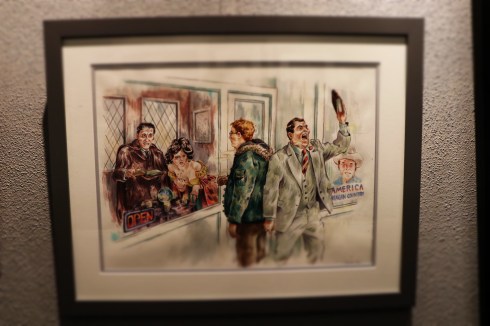
Ward’s art display aims to question people’s perceived stereotypes and the reality of constructed values.  Nari used the Black Smiles idea to play on the minstrel shows which used to be popular in America during the 19th century.  The work inspires us to ask whether the notion of a smile trapped in a can is any more or less strange than the ideas we construct around identity.

During my visit, the ere was a social gathering on the desk of the museum.  Music, food and refreshments were being served and there were a number of therapy dogs at the event.

A “cuddle zone” was created by visual artist J.R. Uretsky.  The “Cuddle Zone” featured nine therapy dogs from Dog B.O.N.E.S. There was also quilted works for people to use as comfort aids.  You will also some of the dogs wore or sat on these quilted comfort aids.

IMG_0138

Hey, we all can use this kind of therapy!

In fact, the dogs were so popular and in such high demand, I was only able to photograph two of these special dogs.

IMG_0136

Spider is a 5 year old chihuahua.

IMG_0132

Ruby Pearl is a 4 year old pitbull.

Please connect with me on Facebook to view videos, links, articles, photos and other content not included on my blog.  Thank you!