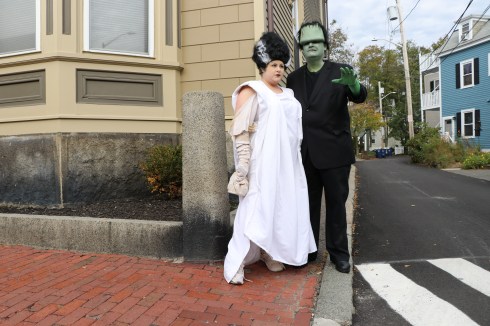
The zombies have invaded Salem, MA. And I don’t just mean the ones engrossed with their phone screens wandering through the streets.
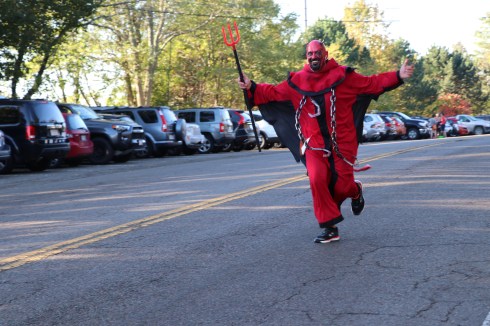
No, these zombies are participants in the annual Salem Zombie Walk.
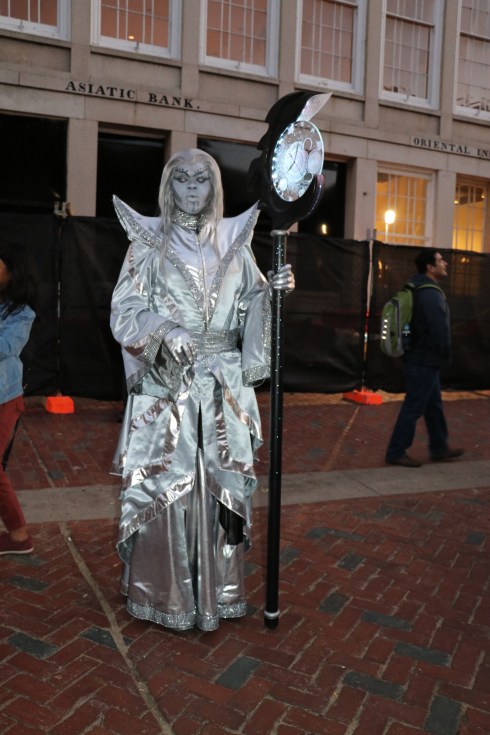
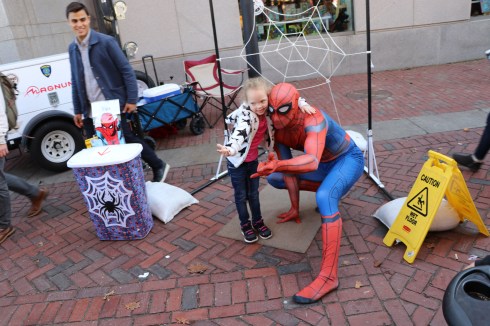
There were zombies of all ages, attire and degrees of scariness. It’s never too early to get into the Halloween spirit and these people were definitely in the spirit of the season!
But, my favorite zombies have to be the families and children who have dressed up for the walk. After all, the families that stalk together stay together.
There’s nothing cuter than “zombie kids!”
The zombies arrived in a variety of different vehicles. “Witch Taxi.” How appropriate. Was her broom broken?
After a quick game of zombie kickball, they all got lined up and began the walk.
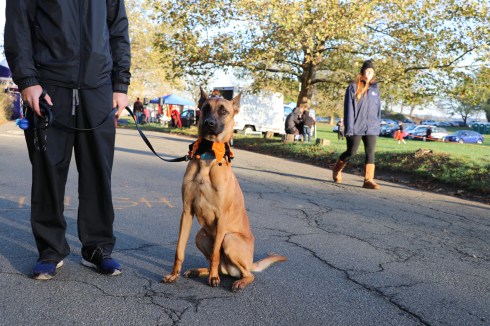
Although there weren’t any dogs in the zombie walk (although they are welcome), I did see these cute dogs on the way to the park.
Gatsby is a 1 year and 3 month old Golden Retriever.
Baloo (named after the character in The Jungle Book) is a 5 year old Pomeranian.
These two friends watched the parade from the window of their home. Perhaps I’ll see you next year…if the zombies don’t get you first!
Below are some videos from the festivities at the zombie walk.
the entrance to the park is on State St, although it is often listed as Chestnut St.
don’t forget to read the signs placed throughout the memorial for more background information about the memorials
It’s not common knowledge, or it’s a conveniently forgotten fact, that Africans and other people were brought to the northern states as slaves. It was not just something that plagued the south.
The first known slave that was sent to Portsmouth was a man from Guinea who was brought there in 1645. He was not the only either. Soon, hundreds of other slaves would follow. In fact, during the Colonial Era, Portsmouth had the largest number of slaves in the colony. Up to 4 percent of the population of the town were slaves, according to a 1767 census. By 1810, there were virtually no slaves in the area. However, rumors of the “Negro Burying Yard” persisted.
The site, referenced in town records as, “the Negro Burying Yard” was paved over, built upon and dismissed. That is, until 2015.
Years and years passed with these bodies buried unceremoniously in an unmarked gravesite until a work crew excavating the area found wooden coffins with human remains buried under the pavement. DNA analysis and other tests confirmed the individuals exhumed as being African. In 2008, 8 bodies and coffins were dug up in the area. There were roughly 200 bodies buried there. After much debate, the town decided to re-inter the bodies in their original resting place. In 2015, the remains were buried and the memorial was built and dedicated to them.
At the entrance to the park there is a memorial of two people on a slab facing opposite directions. This was meant to embody the separation and uncertainty experienced by those brought here as captives as well as their perserverance. The gap between their fingertips is meant to be a reminder of their forced separation and the divisions of past injustice.
The sculptures of the people are called The Entry Figures. The male figure in the group stands for the first enslaved Africans that were brought to Portsmouth and those that followed.
The woman on the other side of the represents Mother Africa. She is endlessly straining past the obstacles that keep her from her children of the Diaspora.
The pain etched on their faces is undeniable.
As you enter the park, you may notice words etched on the ground. These words are the “petition line.” The petition line is a collection of phrases from the Freedom Petition that 20 men who were purchased as slaves had filed with the New Hampshire legislature to gain their freedom. (see video below to see the Petition Line).
Roughly in the middle of the park is a design under which the burial vault is located. The Adinkra Figure “Sankofa” meaning “Return and Get It – Learn From The Past” forms a shield and cover for the burial vault. The re-interred bodies rest beneath this this shield never to be disturbed again.
The life-sized bronze silhouettes, known as the “community figures”, represent the collective community of Portsmouth. They are meant to symbolize the people who fought to acknowledge, pay tribute to and defend the souls whose remains were recovered there. Each of the figures has a line from a poem by the memorial’s designer and sculptor, Jerome Meadows.
Encircling the figures on the railing are designs based on African kente cloth motif. The shapes of the designs are meant to represent boat paddles. The ceramic tiles were created by students from the Portsmouth Public Schools. Having the children of the area create these decorative tiles was meant to be a gesture to those buried there. The younger generation were able to contribute to the memorial and possibly, in some small way, pay tribute to the people buried there. One of the videos below shows the tiles in their entirety.
The park is a peaceful place for reflection. I was a relief and heart warming, though, to see children (you may hear them in one of the videos), playing and enjoying their time at the park, unaware of the tragedy that occurred there. I think those buried there would be happy to know others are able to enjoy the park despite the sadness attached to it.
I also think it is important to try to find light and not only learn from these memorials but also find inspiration there.
These videos below show the railing and petition line at the park.
Adults $20, seniors (65 and over) $18, students (with ID) $12, Youth (16 and under) and Salem, Mass. residents (with ID) admitted free*. (*Does not apply to youth in student/tour groups.) For late nights, $12 after 5 pm.
*events and some exhibits may be have a separate fee*
Parking: there are several parking garages in Salem ($20 to park the entire day this time of the year), The best one to park at for this exhibit is the Museum Place Mall parking garage on Church St as it is directly across from the Essex St entrance of the mall. You may also find limited street parking if you’re lucky for .75 an hour, 4 hour max.
Highlights: collection of movie posters and memorabilia from vintage sci-fi and horror films, videos and music of Kirk Hammett and Metallica
Tips:
The entrance is on Essex St (not Charter St)
You can view the impressive Yin Yu display at the museum for an extra $6 a person charge. It is worth the extra fee (and you will see why soon)
This exhibit is running until Nov. 26, 2017
Welcome to the third, and final, installment of my photos and observations from the It’s Alive! horror and sc-fi movie collection exhibit.
In case you missed it, you can find part I here and part II here.
Welcome back to my photo blog of the It’s Alive! monster movie memorabilia collection.
AS I mentioned in the previous posts, there is so much more than just posters at this exhibit.
One of the more nostalgic parts of the exhibit are the toys, figures and books. While I never had any of these specific toys or memorabilia growing up, I had similar toys and memorabilia. I had to stop myself from playing with them.
This toy figure is a must for any fish tank.
A replica of what many of the television rooms of that day where millions of families congregated to watch the movie of the week, the late late show or the aforementioned “Creature Double Feature” is set up at the exhibit.
There are also masks from classic movie monsters.
This mask is the mask Lon Chaney wore in the film Bud Abbott & Lou Costello Meet Frankenstein (1948). The mask was made by Bud Westmore. It is made out of plaster with hair, glass, paint, sheltac and clay.
This mask is a gill-man prop head from Revenge Of The Creature (1955). It was also created by Bud Westmore. It is made from latex, rubber, paint, metal and glass. A hose was connected to the mask which supplied air to the actor’s mouth and another hose was connected to the gills to make them look as though they were opening and closing. Westmore was also credited with creating the design of the monster in The Creature From The Black Lagoon.
One of the coolest parts of the exhibit is the do-it-yourself monster movie poster machine
Last but certainly not least, there is a collection of Kirk Hammett’s guitars and guitar cases, particularly the cases that are designed in the horror motif.
Videos of Kirk being interviewed and playing the guitar are shown on a loop by his display of guitars. There are also quotes of his that are posted throughout the exhibit.
At the end of the exhibit, near the exit, there is a book visitors can sign, leave feedback and add their own art work!
Dogs aren’t the only four legged cuties in Salem during my visit. Wiggy (The Piggy) is a 1.5 year old Juliana pig. He was very friendly and he even gave his guardian kisses.
I hope you have enjoyed this tour of the It’s Alive! exhibit! Below are some videos of the video clips they show on the walls of the exhibit and one of the figurines on display.
Adults $20, seniors (65 and over) $18, students (with ID) $12, Youth (16 and under) and Salem, Mass. residents (with ID) admitted free*. (*Does not apply to youth in student/tour groups.) For late nights, $12 after 5 pm.
*events and some exhibits may be have a separate fee*
Parking: there are several parking garages in Salem ($20 to park the entire day this time of the year), The best one to park at for this exhibit is the Museum Place Mall parking garage on Church St as it is directly across from the Essex St entrance of the mall. You may also find limited street parking if you’re lucky for .75 an hour, 4 hour max.
Highlights: collection of movie posters and memorabilia from vintage sci-fi and horror films, videos and music of Kirk Hammett and Metallica
Tips:
The entrance is on Essex St (not Charter St)
You can view the impressive Yin Yu display at the museum for an extra $6 a person charge. It is worth the extra fee (and you will see why soon)
This exhibit is running until Nov. 26, 2017
Welcome to the second installment of the It’s Alive! exhibit…if you dare.
There’s no better way to get yourself in the Halloween spirit than being in Salem, MA and viewing horror/sci-fi movie memorabilia. It doesn’t hurt when you have the melodic sounds of Metallica playing in the background.
Now that we’ve covered most of the notorious movie villians (Dracula, Frankenstein, et al), let’s get to view some heroes of these film genres. Just kidding, here’s more villians! Below are some famous stories with a different twist.
In this unusual take on a Shakespeare story, Hamlet (1921) has a more violent twist.
Belle at la Bete (Beauty And The Beast) (1946).
Cats, especially black cats, play a significant role in horror movies, and not usually in a good way.
From left to right: Tomb Of Ligeia (1965) and Mysteriet Svarta Katten (“The Black Cat) (1941)
These movie posters all have a unhealthy relationship (for instance, Norman certainly loved his mom).
Clockwise from the top left: I Married A Monster From Outer Space(1958), Psycho (1960),The Horror Of Party Beach: The Curse Of The Living Corpse (1964), Island Of Lost Souls (1932), The She-Creature (1956) and The Disembodied (1957)
The following movie posters all seem to deal with the demonic or demented
From left to right: Repulsione(1966), Rosemary’s Baby (1968), The Exorcist (1973), Whatever Happened to Baby Jane (1962)
The following movie posters have to deal with sci-fi and alien monsters
Clockwise from left to right: Barbarella (1968), It Conquered The World (1956), the original art work for The Day Of The Triiffids (1963) The Day Of The Triffids (1962), Doctor X (1932)
These movie posters are for Creatures (people from New England, especially Massachusetts and New Hampshire, may remember from the Creature Double Feature movie shows on channel 56 on television) .
From left to right: King Kong (1933), Mothra (1962), Tarantula! (1955) and (of course) Godzilla, King Of The Monsters! (1956)
These zombie movies came out before the current Walking Dead craze began.
Clockwise from the top left: The Walking Dead (two movie posters from 1936), White Zombie (1932), Zombies: Dawn Of The Dead (1980), Night Of The Living Dead (1968) and I Walked With A Zombie (1943)
The remainder of the movie posters fell into a “miscellaneous” category.
Clockwise from the top left: The Cabinet Of Dr. Caligari (1920), The Beast With 1,000,000 Eyes (1955), The Crawling Eye (1958), Metropolis (1927), The Old Dark House (1932), The Whispering Shadow (1933), The Invisible Ray (1948), King Kong Vs. Godzilla (1977), Murders In The Rue Morgue (1932), Mystery Of The Wax Museum (1933), Attack Of The 50 Foot Woman (1958), I Was A Teenage Werewolf (1957), Barnum (Freaks) (1932), The The Return Of Chandu (1934) and Notre Dame de Paris (circa 1924)
Now, lest how you think that is all that is on display at the It’s Alive! exhibit, think again.
There are also a number of statues, figures and oh, well, I don’t want to give it all away straight away.
Similar to the movie posters, the prints and artwork of the movies are displayed in a separate section. Now, these, to me, are the real art of the exhibit. While the movie posters are impressive and cool, the prints have so much detail and you can see the craftsmanship involved. I loved them.
Clockwise from the top left: The Mummy by Basil Gogos, 1969, Lon Chaney as Phantom Of The Opera also by Basil Gogos, 1958, Dracula by Basil Gogos, circa 1970, Vampyr by Erik Aaes, 1932, Dead Of Night by Frank Frazetta, 1964, The Berserker by Frank Frazetta, 1967 and Dracula Meets The Wolfman by Frank Frazetta, 1966
There are also suits and clothing from these vintage movies as well as life-like, real sized statues of movie stars and characters.
The mannequin above is a statue of Bela Lugosi. The mannequin is wwearing the jacket and vest Bela wore in The White Zombie (1932). The figure of Bela Lugosi was made of silicone by Mike Hill in 2010.
What a scary suit! This prop suit was from the movie Invaders From Mars (1953). It was made by Norman Koch, Olive Koenitz and Gene Martin of the Western Costum Company. It is made of plush cotton, zippers, metal, painted papier mache and wool. It is 7 feet in length.
This “saucer-man” figure from Invasion Of The Saucer-Men (1957) was made by Monster Effects in 2011. It is made of paint, metal and fiberglass. Paul Blaisdell created this pop collar on the suit.
Mike Hill created this Boris Karloff figure in 2010 out of silicone. The suit is the same suit Karloff wore in The Black Cat (1934).
Quite a collection, huh? Well, believe it or not, there’s more! Please join for the third and final installment of this series coming soon!
Salem was teeming with dogs during my visit (you’ll soon see why). I saw Bella (on the left), a 1 and a half year old Akita, dressed as Batman and Seger (on the right), a 2 and a half year old Cattle dog mix, dressed as a prisoner after I left the museum.
Below is a video of the It’s Alive! exhibit courtesy of Derek Millen. He’s a pretty funny guy! The video portion of the It’s Alive! exhibit begins at around the 3:13 mark of the video (I have set up the video to start at the It’s Alive section of the video).
Location: 310 1/2 Essex Street, Salem, MA (about 10 minutes north of Boston, MA)
Hours: Open March 15-November 15, daily 10am-5pm
Call for Winter Hours / Extended Hours in October
Cost:
Guided House Tour
Adult $10.25 Senior $ 8.25 Child (7-14) $ 6.25 Self-guided House Tour
Adult $8.25 Senior$6.25 Child (6-14) $4.25 Children Under 6 are free
Parking: there is street parking (75 cents for a maximum of 4 hours) if you get there early. Otherwise, there are several parking lots and garages that charge $20 for the entire day of parking. Generally, I park at the Museum Place Mall at Church St since it is closest to all of the attractions in Salem and within walking distance to the Witch House
Handicapped Accessible: No
Dog Friendly: No, although service dogs may be allowed
Highlights: historical artifacts, knowledgeable staff, actual home of “with hunter” Judge Johnathan Corwin
Tips:
The entrance is in the rear of the building (off North St)
“It’s October”, a passerby yelped to a disgruntled driver as he barely squeezed his sedan into the last available street parking spot.
Yup, it’s that time of the year again in Salem, Mass.
Although Salem has proven itself to be so much more than just an autumn destination, fall is still Salem’s biggest time of the year.
It’s unfortunate much of the draw to Salem is related t the witch hunt of 1692. However, it does provide a learning opportunity and it also gives us a chance to remember the past in the hopes it won’t happen again.
One of the best places to get a no frills education about the Salem Witch Trials is the Witch House on Essex St., just one mile away from the actual hanging spot of these accused witches.
The last standing building directly related to the Salem Witch Trials, the Witch House has a dark, storied history.
As I walked around the house I couldn’t help but think of the innocent people who had been tortured into confessing and the backdoor deals that were made to avoid being accused or convicted of being a witch. In this very room, John and Elizabeth’s (his wife) parlor or best room, people’s fates were sealed. In total, 24 people would either be hung (19 in total), 1 person was pressed to death and 4 people died in prison.
The home was bought in 1675 by Corwin, a local magistrate, and his wife Elizabeth (Gibbs). Elizabeth was a wealthy widow having been previously married to Robert Gibbs. They would have 10 children together. Six of their children would die before the age of 25. Only 2 children lived long enough to have families of their own.
The other room on the first floor showcases many of the tools and herbs used during that time. As you can see in some of the photos, each historical artifact has a sign or placard next to it with an explanation or story behind the piece being displayed.
The Witch House has six rooms (if you count the foyer areas on two floors. While not all of the items in the house are directly from that time, many of the items in the building closely mimic the items of that era.
These chairs, for instance, are very similar to the chairs and tables used that time. In fact, the 5 chairs at this table are symbolic of the 5 judges (out of 9) needed to convict someone of being a witch at that time.
On the table are copies of the pages of journals, diaries and court records of the inquisitions and court proceedings.
Judge Johnathan Corwin, who resided here, was said to have questioned the accused at times using extreme measures such as tying people’s arms behind their backs to a chair similar to this one. It forced more than one innocent person to confess.
The windows and furniture featured in the house are very well crafted.
In the first room of the first floor there is a sealed off area that shows the inside of the walls. The architecture of that day may be outdated but it still holds up to this day.
Up a short, narrow, windy staircase, the second floor has two bedrooms.
In one of the rooms sits a machine for sewing or knitting.
This doll, also known as a poppet, which was found in the wall of Bridget Bishop’s home, was said to have been a voodoo doll. The catch is that most people at that time left these types of dolls in their walls as a sign of good luck. Instead, In Bridget’s case, it was said to have been used to curse others. Cute little fella, isn’t he?
Dogs are not allowed in the Witch House (exceptions may be made for service dogs). But, I met Abita, a 3 year old Lab mix, on my way to the house. Abita was adopted from the Northeast Animal Shelter in Salem, MA. What a cutie.
The video below comes courtesy of samuelaschak. It gives a more detailed historical background of the building and the historical highlights of the Corwin family and Salem.
Highlights: biggest tree in Connecticut, boat launch, bench to sit
Tips:
It may be better to see the size of the tree in the fall, winter and spring when the trees skeleton is visible to fully appreciate the size of the tree
The park is the right just before the Bataan Corregidor Memorial Bridge on Rt 185 or just after the bridge, depending upon which way you’re traveling
Despite what your GPS says the best road to take to get to the tree is probably Cobtail Way
Everyday, hundreds, if not thousands, of people pass by a historic landmark without even realizing it. It is interesting that so many people miss out on viewing the biggest tree in Connecticut and never know it.
When it was most recently measured in 2016 by the Connecticut Botanical Society, the trunk of the Pinchot Sycamore Tree was listed at 28 feet (8.5 meters) around and 100 feet (30 meters) tall. It is estimated to be at least 200 years old and could be as old as 300 years. The tree’s branches sprout in various directions. With its thick, far reaching limbs, it could easily be used in a horror movie.
The tree was named in honor of influential conservationist and Connecticut resident Gifford Pinchot in 1965. There was a re-dedication in 1975.
There are two markers located by the tree. The first marker (on the left below) is a thank you to all of the groups who have worked to make the park possible. The second marker (on the right below) is the marker from the original dedication in 1965. You’ll note the tree’s circumference was recorded as being 23 feet and 7 inches (as opposed to the 28 feet it was measured at in 2016).
To get a better sense of the size of the tree, take a look at the trunk of the this tree in proportion to this model.
There is also a bench located near the back of the tree that is dedicated to Pauline Schwartz. The note on the bench states, “Come Have A Seat By Pauline Schwartz’s Favorite Tree” with some designs and, although it is slightly worn, an image that appears to be a person’s face. Pauline, a native of Bridgeport, CT, passed away in 2013 in Las Vegas, NV. A bench was dedicated in her honor because of her love of the park.
Behind the tree, almost hidden from the park is a boat launch that offers views of the Farmington River.
The entrance to the park is a little hard to find, unless you know where. ON Rt 185 just before or after the bridge, there are two green poles that mark the entrance to the park. The road to the parking lot is short but a little narrow.
As I mentioned in the tips section, it’s probably better to fully appreciate the size of the during the fall, winter or spring when the leaves are off the tree, so you can see the full size of the tree without the leaves hiding the skeleton of the tree. Below is a photo of what the tree looks like without its leaves (from foursquare.com).
Location: Lynn Shore Dr & Prescott Rd, Lynn, MA ong Lynn Shore Drive (about 20 minutes north of Boston)
Cost: Free
Parking: metered parking along Lynn Shore Drive. IF you’re unable to find a spot along Lynn Shore, there is usually parking available on one of the side streets in the area.
Highlights: scenic views, easy walking and jogging path, walkway to the rocky water, spacious park
Tips:
During the months of July and August there are weekly concerts held along the Red Rock Park area
Try visiting during stormy weather to see some active waves
Fall has a way of sneaking up on you in New England. So, it’s important to make the best of each and every unseasonably warm day while you can. And Red Rock Park, just minutes north of Boston, seemed like the perfect place to enjoy the last gasps of our warm weather.
Despite the temptation to stay curled up in my bed on a Saturday morning, I was able to make it to Red Rock Park just after sunrise. The “golden hours” (the first 2 hours after sunset and the 2 hours before sunset) sure do make a difference when it comes to photography. In fact, some photographers won’t even take their camera out outside of those golden hours, at least not for nature photography.
When you see the sun glistening off the rocks, cement and sand during the morning sunrise, you can easily see why the park is called “Red Rock.” Red Algae which sometimes floats ashore, while giving off a pungent odor, could be the reason for the reddish hue of the rocks.
A walkway leads to the rocks along the beach that offers some nice views of the Boston skyline, Rock crabs, barnacle, mussels and sea stars inhabit the rocky waters. If you’re lucky, you may see one of these critters in the tidal pools that form between the rocks.
The walking path, which leads to is short and easy leads to Lynn Shore, a popular destination for cyclists and joggers. There are also ramps along the way.
With its easy walking path and spacious park, Red Rock is the perfect place to take your four legged friend. In fact, while I was there, I saw some dogs being trained at the park. The quarter mile marker is part of the Walking and Jogging Project launched to help promote physical activity of the Lynn, Swampscott and Nahant residents. This 1/4 mile marker is one of the medallion markers along the 3 mile stretch. Known as the Nahant, Swampscott and Lynn Good Health Partnership, the markers, placed at quarter mile spaces, go from the Tides restaurant (2B Wilson Rd) to the red Rock Bistro (141 Humphrey St).
Sampson, a friendly 12 week old Lab mix was enjoying the beautiful fall morning with his mom while I was visiting the park. He is a rescue from the North Shore Animal League.
Below is a video from the rocks along the water.
Red Rock Park is one of the more popular spots for residents of the area to visit during stormy weather. Below is a video of one of those stormy days in April, 2011. It actually gets much worse, flooding the entire Lynn Shore Drive, when we experience a tropical storm or hurricane. This video is courtesy of Steve Deveau.
Please follow me on Facebook to see videos, photos and other content not posted on my blog! Thank you for stopping by!
Location: 301 Wentworth Rd. (Route 1B), New Castle, NH, (1 hour northeast of Boston, MA, 1 hour southeast of Concord, NH)
Hours: Open daily 9 a.m. until 9 p.m.
Cost:
New Castle Residents:
– No admission charge if vehicle has current resident sticker.
– Residents may invite up to 25 guests at no charge – Over 25 guests, admission fees apply.
– Resident must be present for all guests.
Non-Residents:
– Admission charged from May to the end of September.
General Admission Fees
– Individuals:
0-5 yrs old free
6 to 65 years old $4.00
65 and older $2.00
Handicapped $1.00
Parking: There are about 50 or more parking spots available in the parking area
Handicapped Accessible: Yes
Dog Friendly: Yes, seasonally (pets are not allowed in the park or on the beach from May 15 to September 15)
Highlights: lighthouses, beach, places to grill, pavilions
Tips:
When you enter the park, you must turn right. The parking area is at the end of the circular paved road
If you want to use a pavilion, you may have to call ahead and reserve the area
No other name than Great Common Island may be more apt for this park. Except it’s not really an island. But, it is great.
The park, with attached beach, sits on the shore of New Castle ( a small town of 968 according to their 2010 census) just outside of Portsmouth, NH). The park and beach area are only 32 acres. But what it lacks in area it makes up for in beauty and charm.
The park offers some great views of the water. It is a good place to watch the waves crash against the rocks, although the waves weren’t too strong during my visit.
Great Island Common is popular with fishing enthusiasts, boaters and the occasional bird.
You can view two lighthouses from Great Island Common.
Whaleback Lighthouse was established in 1830. The granite lighthouse that stands there now was built in 1872 and it was automated in 1963.
Portsmouth Harbor Lighthouse, just down the road from the park, is also visible from Great Island Common. During the summer, there are open houses at the lighthouse on Sundays from mid May to late October from 1-5. Since I was visiting on a Saturday I was not able to attend the open house. Next to the lighthouse (to the left of the lighthouse in the photo above) is Coast Guard Station Portsmouth Harbor and Fort Constitution. In the distance, past the lighthouse, you can see the foliage has just started to begin.
Wood Island Life Saving Station in Kittery, Maine, is also visible from the park. In 1827, Wood Island was given to the federal government so the U.S. Navy could build barracks. However, it would eventually be used to quarantine Spanish-American War prisoners who had Yellow Fever. It is presently not in use.
One of the biggest attractions at the park is a sculpture of a painter by an easel working on the scenic skyline.
Pretty good painting of me. It looks so life-like.
Great Island Common is not just a park. A beach is also attached to the park.
The park is spacious for kids to play in with lots of big trees for shade.
Erected in 1984, the memorial honors all of the people of New Castle who have served the country in all wars and conflicts. Two benches sit next to the memorial, one on each side of it.
Great Island Common is dog friendly except from May 15 to September 15. Luckily, I was able to visit the week after ban ended. It was a picture perfect day with a calm breeze. So, it was a great day to bring your dog out!
Miley is a 8 year old Yorkie Poodle.
Tuck is a 6 month Cocka Poo (Cocker Spaniel & Poodle mix)
Remy (on the left) is a 10 year old Puggle and Phoebe (On the right) is a 1 and a half year old Puggle.
Jaelo (pronounced “J Lo”)is a 10 year old Puggle.
Below is a video by the shore of Great Island Common.
Posted below is a drone video of the Great Island Common area on Paul Moore’s YouTube page
There is no parking lot at the park. Parking is allowed on the side of the road at and near the trail to the tower
Don’t forget to check out the scenic views on the way up to the tower by taking the trail closest to the ledge (the trail on the right after the trail splits
The trail has a steep incline at the beginning but evens out and becomes easier about halfway to the tower
If using a GPS: Parking is located on Summit Ridge Dr. Simsbury, CT 06070
Once the home of Gilbert Heublein (pronounced “High-Bline”), Heublein Tower offers some of the most pretty views in the Connecticut River Valley.
As legend has it, during a hike of Talcott Mountain with his fiance Louise M. Gundlach, he promised her that one day he would build her a castle there. He would make good on his promise in 1914 with the Heublein Tower.
Heublein manufactured such delicacies as A1 Steak Sauce and Smirnoff Vodka. Anyone else hungry for some steak and vodka? A barbecue, perhaps?
Heublein Tower is located along a trail that begins at Talcott Mountain State Park. Parking is available along the sides of the road to the tower.
Along the trail to the tower, you can take the trail on the right to see some pretty views of the Farmington River Valley. As you can also see by some of the photos, the trail does have some inclines. There are also some benches along the trail at the beginning of the trail.
During certain days you can enter the tower and view the rooms in the tower. The at times arduous hike is worth it for the views of the tower and the self guided tower of the inside of the tower.
The views from Heublein Tower are stunning.
The trails are not too hard for man nor beast. Dogs of a variety of sizes and breeds were on the trail during my visit.
Hiro is a 7 month old Cobberdog
Monte is a 2 year old Tibetan Terrier.
Kaiser is a 2 year old Airedale.
Roscoe (on the left) is a 3 year old Rottweiler. Love his bandanna!
Hours: Open daily, 9:00 – 5:00 (hours may vary depending on the season)
Cost:
Adult – $28.95
Senior (ages 65+) – $26.95
Youth (ages 4-14) – $18.95
Children (3 and younger) – Free
Parking: there is a free parking lot across the street from the Seaport Museum. There is also additional parking across the street from the parking lot for overflow
Handicapped Accessible: Yes, but not all of the buildings are accessible to the handicapped. Approximately one-third of our buildings have wheelchair-accessible entrances; interior access varies. The village’s unpaved roads are generally firm and stable suitable for wheelchairs and strollers. All roads are basically level with a few slight inclines located near the Children’s Museum, Treworgy Planetarium and Membership Building. (see link below for more info)
Highlights: living museum with character actors, boats, replicas of historic homes, figureheads, lighthouse replica, play area for children
Tips:
For an after museum viewing treat, Mystik Village, an open area shopping mall is a mere.9 miles away on Coogan Blvd
the museum’s main parking lot can fill up quickly if you don’t get there early. Additional parking can be found in the lots off Rossie St on the other side of the main parking lot
In my previous posts about Mystic Seaport, I shown you the figureheads and the ships and boats of Mystic Seaport.
In this final installment, part three, I am going to focus on some of the buildings and historical items at the museum. I hope you enjoy!
The first exhibit room at the Thompson Exhibition Hall has many interactive exhibits and artifacts and exhibits from a bygone era.
The first interactive exhibit is called “Sea States.” At this exhibit, you can watch video of the water from calm
to blustery
and every other weather condition you can think of.
In the Thompson Building is a very large room packed with lots of historical items. And many of these exhibits and items have interactive devices that give more information and historical context to the items.
These carved etchings were made on teeth and bones of whales.
People may think captains and other sailors were not attached to their families, being away from them for so long and because of traditional family dynamics. However, nothing could be further from the truth. Sailors seemed to have a very strong connection to their families, especially their children.
Pictured below are a glove box, photo of Captain Richard Columbus Mears and his Nellie, his daughter (Nellie Goodsell Mears Van Valkenburgh) and some wood carvings he made.
Captain Mears, born in Accomack County, Virginia in 1829, was a merchant ship captain based mainly out of New York.
The black and gold item on the left is a glove box that Captain Mears sent to Nellie for her 13th birthday. Believe it or not before plastics were invented people made these objects out of turtle shell. This particular glove box was made out of a hawksbill turtle shell.
The photo next to the glove box is a photo of Captain Mears with Nellie. To the right of the display are wood carvings by Captain Mears. The napkin ring, also carved by Captain Mears has the letters N E L L I E with a heart next to it.
This crib also has turtle shell in its design. In the second photo you can see the turtle shell reflected in the mirror under the crib.
Most museums do not want you to touch their exhibits. But, the Seaport Museum has this replica of a turtle for people to touch to see what they felt like that. It was smooth and silky. I want one. A real one.
This bed from that era, pictured below, had some interesting designs on it.
These carvings are miniature figureheads. They are models of life sized figureheads that adorned ships of those days.
There are also several models of boats from the earlier days of the seaport.
Nikki McClure’s book To Market, To Market was on display at the Mallory Building. McClure, a papercut artist based out of Olympia, Washington, is an author and illustrator who mainly writes children’s books with an environmental theme. I love her art!
The were other works of art from her books Waiting For High Tide and Life In Balance.
I liked these pieces from her exhibit best.
I also loved the educational historical buildings with the re-enactors. The people in these buildings are very knowledgeable and friendly.
In this building, The Cooperage, coopers (barrel makers) were making barrels. The old fashioned way.
This is the Nautical Instruments Shop. They have many clocks and timepieces as well as nautical devices such as compasses in this building.
The Mystic Print Shop is a true to life replica of the print shops of the 1800’s. If you look closely at the photos in the corner, you will see how the template or blocks on the metal pad match up with the words on the printed sheets.
The people at the Shipsmith Shop and Hoop Shop reenact ship and mast builders.
There is also a replica of a lighthouse that you can enter. A short documentary plays on a loop in the lighthouse.
There are also several shops that are replicas of the buildings of the 1800’s.
The Geo. H. Stone & Co store is a replica of the stores of the time.
Of course no living history museum would be complete with a school house.
The drug store had some interesting remedies of the time.
The Seamen’s Friend Society was a place the seamen could go to read, learn to read or have a book read to them. Since sailors spent a lot of time at sea and began working at a very early age sometimes they were not literate. They came to places like to be tutored or just to have someone read to them.
Formerly located in Saybrook, Connecticut, the Buckingham-Hall House is a two story building with two bedrooms and several sitting and family rooms. Being self-sufficient people, there was also a sewing and quilting area with a variety of fibers. The house was owned by William Hall Jr., from the estate of Samuel Buckingham. I love how they used to design the windows in those days. They weren’t big as many windows are these days. But, they were much more fancy and, despite their small size, allowed for a good amount of light. There was also an open hearth cooking demonstration in the kitchen during my visit.
One of the other homes at the Seaport Museum is the Thomas Greenman House. The house was originally built for Thomas and Charlotte Greenman in 1942. THomas Greenman was originally from Westerly, Rhode Island but made his way to Mystic later in his life.
The kitchen and the second floor are not accessible to visitors. But the rooms on the first floor are decorated and furnished in the Victorian style of the 1870’s. I always think I want to live in these types of houses because of their ornate designs and their charm. Then I realize just how oppressive it must have been during the hot summers and frigid winters. Not to mention they didn’t even have WI-FI.
The Burrows House is a very small home, yet almost as big as my apartment, that stands as an example of many of the homes of that era. The house, which is said to have been built between 1805 and 1925, was the home of storekeeper Seth Winthrop Burrows and his milliner wife, Jane. That is some tight stairwell.
The Stillman Building has a variety of interactive displays and historical items collected over the years of the seaport’s history. My favorite part of their exhibits in this building are the notes children wrote about whales and the sea.
This timepiece, found by the children’s play area, acts like a sundial and gives precise times throughout the day. But, people seemed more interesting in using it for coat and backpack storage. I was tempted to check out that boat there.
Lastly, the walkways to the different buildings is level and handicapped accessible (although some of the older historic buildings are not). And there are lots of pretty views along the way. I love the old pumper, which had to be moved manually.
Mystic Seaport is a dog friendly museum (although they are not allowed in the buildings). These two cute curly dogs were hanging out by the bench with their guardians.
Fuzzy (the white dog on on the left) is a 4 year old female Goldendoodle.
C-Doo (short for Colossus of Doodle), on the right, is a 1 year old Goldendoodle