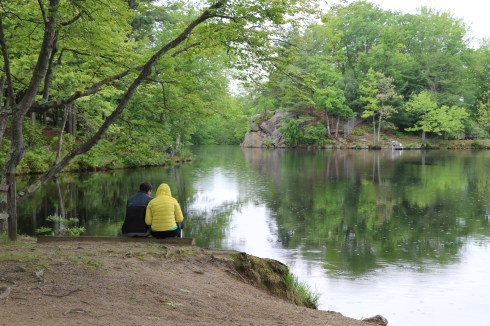
Located in the center of town inconspicuously on the side of the road, Leverett Pond (also known as Echo Lake) is a 100 plus acre pond with amazing views and abundant wildlife. In fact, the wildlife is so abundant it threatens the pond itself. Beavers, specifically, seem to be clogging the dam at the nothern end. It costs the organization $20,000 to fix this issue and they do not receive funding from the town. So, the organization relies solely on donations. But, still, the Friend of Leverett Pond are keep working to solve this problem.
Despite the ecological issues they may face, the pond still looks beautiful.
The pond is popular with boaters and fishing enthusiasts. I saw two boats in the pond during the short time I was there.
During the winter, the pond is used by skaters.
While there were signs of wildlife, I was only able to see some fish in the water and a bird.
While the lake is a gem itself, one of the hidden treasures is the poetry box located on a tree by the lake. If you weren’t looking for it you might just miss it. Just to the left of the boat launch, the box is attached to a tree.
Inside the box sits a binder with poems, stories and memories left behind by visitors. There are also a few pencils in the box for people to leave their thoughts and poems. Some of the poems dated back to 2012. It was not only nice to see this collection of art. It was also nice to see it has been preserved and no one has stolen or disturbed the poetry box.
Behind the tree is a table for people to sit and read the binder or write their own addition to the binder. The poems and other writings ranged from the comedic to the serious. Some were written by children. Others were written by older people. Sometimes you could not tell who wrote the poem or what age they were.
Whether you’re a fisherman or fisherwoman, a boater or a poet, Leverett Pond is the perfect to spend the day.
Parking: There are 15 total parking spots designated for the rail trail. There are 5 spots in the main parking lot on Friedenfels St at the entrance to the trail. There are also 10 parking spots across the street from the main parking lot. There is a larger parking lot in front of the main parking area that is a private lot. Don’t park there as your car could be towed.
Handicapped Accessible: Yes, the main trail is handicapped accessible. The side trails are not accessible due to the rocky trails and steep inclines. There is ramp to the right of the staircase to the trail at the parking area.
Dog Friendly: Yes
Highlights: scenic views, wide and easy trail, side trail, dog friendly, family friendly, benches to sit at, wildlife
Once the site of a grand railroad that ran from Boston to sections of Boston’s North Shore and New Hampshire, the Eastern Marsh Rail Trail is a true gem of the coastal section of the north shore (cities and towns north of Boston).
The railroad, which would be extended over time, began operating from Boston to Salem in 1838. It would later be extended to Salisbury and other territories in Massachusetts and New Hampshire in 1840.
Alas, the last train crossed the Merrimack River in 1965, leaving behind abandoned rail lines. Eventually, it was proposed that the rail lines should be converted to rail trails. Now, many decades later, instead of being used by noisy engines often carrying dangerous cargo, the rail lines are being used for exercise, dog walking and just enjoying nature.
The 1.4 mile Eastern Marsh Trail connects to the Clipper City Rail Trail to the south and the Ghost Trail to the north.
The Eastern Marsh Trail, which is part of a system of trails along the coastal north shore which includes Newburyport and Salisbury.
The trails at Eastern Marsh Trail are flat with no significant inclines.
The Stevens Trail is a short trail (about .4 mile) that hooks up back to the main trail. There are some views and a cute bridge along the trail. You may see a few chipmunks along the way. It has some minor inclines but I would classify it as easy. This trail is not handicapped accessible due to the rocky terrain and a bridge that only has steps and no ramp.
The views along the trail are beautiful.
There are still remnants from the original railroad at the beginning of the trail. Maybe some day they will revive the rail!
This mural from the Salisbury Art Stroll held on May 13 was still remaining along the trail. I just missed it by a week. But, I may have to drop by next year to check out the art on display. This mural was a collaborative effort worked on by a group of artists.
There were lots of little critters on and off the trail. I would hear rustling in the trees or bushes in one direction only to be distracted by some other sound of activity in another direction.
Birds
turtles
and chipmunks
are just a few of the animals you may see on the trail.
But, birds, chipmunks and turtles aren’t the only animals who frequent the trail.
The trail is a popular with dogs and their walkers.
I love the “side eye” Peter, a 14 year old Golden Retriever, was giving his human walker in the first photo. All he wanted to do was greet me and say hi.
I love how May’s white fur looked against the background. May is a 6 year old Golden Doodle.
Look at the big smiles on Mako (on the right) and Murphy (on the left)! Mako is 6.5 years old and Murphy is 7 years old. They are both Labradors.
Location: Eastern States Exposition Center, 1305 Memorial Avenue
West Springfield, MA, Coliseum Building (Gate 2) (about 2 hours west of Boston, and 10 minutes west of Springfield, MA)
Cost: Free
Parking: Ample free parking was available at the Exposition Center
Highlights: Arabian horses, horse judging contests
If it’s spring time it must be horse showing time at the “Big E.” There are several horse shows scheduled there this spring and summer. Since the weather in New England has been less than “spring-like”, I felt a nice indoor event watching beautiful horses would be the perfect event for a washed out weekend.
Hawk is an Arabian/Pinto horse.
It’s always nice seeing the horses with their riders and trainers. You can see the care they take with each horse and just how much they love their horses.
The Arabian horse show took place over the weekend of May 12-May 14. I attended the morning show on May 13. During my visit, the horses and the riders were being judged. The horses were judged on appearance in the first event.
Then, the horses and riders were judged on their riding skills.
People of all ages rode. The youngest group of riders was the 10 and under group. I am always amazed at how someone so young can control a horse and not show an ounce of fear.
Dogs also like to watch horses apparently.
The person who was dog sitting this dog didn’t know the dog’s name.
This cute little is called Gingo.
If you missed the Hudson Valley Arabian Horse Show, fear not. There are many more horse shows (specifically shows sponsored by the Arabian Horse Club of Connecticut) scheduled in the upcoming weeks and throughout the summer at the “Big E.” See below for a schedule of events at the Exposition Center.
May 3 through June 11, 2017 Days: Wednesday through Sunday
*Also, open Memorial Day, May 29
Time: 9 am – 5 pm
Cost: Free
Parking: There is a small parking lot for about 10 cars. Additional parking is available on Bridge St on the sides of the dirt road at the entrance
Handicapped Accessible: No. I did not notice an elevator to access the fishway.
Dog Friendly: No. Dogs are allowed on some of the property outside. But, they are not allowed past a certain point and they are not allowed in the building (service pets maybe allowed though)
Highlights: family friendly, educational, historical
Every year around this time of the year, thousands of shad, bass, eels and other aquatic critters make their way to the Holyoke Dam as part of their annual migration. That’s where the people at the Robert E Barrett Fishway come into the picture.
The Robert E. Barrett Fishway staff have been helping fish (mostly shad) make their migration since the mid to late 1800s when they actually had to use buckets, ropes and levers to help the fish along. Now, they used modernized technology to help thousands of fish a day make it along the dam. In 2016, they helped 422,649 by their manual count done by college interns. The interns use a clicker to count each fish. And you thought your job was tedious.
These days, the fish are carried up by a mechanical cage-like trap pictured below that collects the trapped fish about every 10 minutes. These traps can carry 500 to 700 fish at a clip.
The fish are attracted to the stream that leads to the fishway by, of all things, oxygen. Peter, our friendly tour guide, told us they add oxygen to the water and the fish, with their keen senses, are attracted to this slight change. Once they are channeled into the stream, the fish are trapped between two gate-like structures and visible behind a glass window where they are counted by the interns with clickers. They are also visible to the thousands of visitors who stop by each year.
The fishway is named Robert Barrett, the former President of Holyoke Water Power, who, in 1955, was inspired to create the first fish elevator on the east coast of the United States. Since then, the fishway has emerged as one of the busiest fishways in New England, if not the nation.
I have always thought fish were cute and resilient. A lot of people don’t seem to agree on this (at least on the “cute” part). But, think about the dangers and obstacles they face every day from predators (including people) to nature itself, the fish has withstood so much and still perseveres. In fact, we have a lot (or at least those things) in common. Think about it. Something so small and, frankly, taken for granted gives us so much and overcomes so much. Yet, we often consider them insignificant or “yucky”. Then again, the fact so many people don’t appreciate them, makes me do so all the more. In any case, I was very excited to see them all through the windows at the fishway.
After they are released from the cage, the fish make their way along the Connecticut River.
Turkey vultures and other birds of prey, perch on the various tree branches by the fishway for easy pickings.
Even if you can’t make it to the fishway for the annual fish run, you can go for a walk, observe the bird life or even take your dog along the property to enjoy the beautiful views.
On the grounds of the fishway is one of the original ways that helped power the dam. It sure has come along way from those days.
Peter was our friendly tour guide. Unfortunately, the flash didn’t go off for the photo I took of him. But, I wanted to include his photo anyway.
Unfortunately for the shad, there was the annual Shad Derby Tournament the 2nd and 3rd weekends in May. Fishing enthusiasts were bringing their catches to the parking area of the fishway to be weighed for the $1,000 cash prize.
Highlights: Verses from people’s favorites poems written in chalk on the grounds of Old Salem Town Hall
Chalk it up to Salem. Or, more accurately, chalk it up to poetry.
As part of the Massachusetts Poetry Festival, Salem gave its visitors the opportunity to write down some lines from their favorites poems. Or, to add some of their own. It’s just another example of the artistic flair of the people who flock to the artistic hub just north of Boston.
Perhaps you’re an Emily Dickinson fan, or maybe Adrienne Rich is more your speed. Or, maybe you prefer poems or words of your own. Whatever you’re tastes, last weekend (May 5-7), you had the opportunity to write your favorite lines of poetry on the paved path leading to the Old Salem Town Hall.
What was so nice about the poems written in chalk was some of the poems were not written by popular poets. So, some of the visitors may have been introduced to poets they were not aware of.
No part of the area was safe from the words of the poets, not even the walls of the old town hall.
While it is not clear if this is going to be an annual event, I am sure there will be more artistic events in Salem in the hear future.
Is there a line of poetry or work from a certain poet you would have written in chalk at Old Salem Town Hall?
Location: 481 Western Ave, Gloucester, MA (about 1 hour northwest of Boston)
Hours: Open daily, sunrise to sunset
Cost: Free
Parking: there are 10 parking spots in the lot outside of the park, parking is also available on the side of the road near the park. 10-20 cars can safely fit in the area by the side of the road
Trail Size/Difficulty: 10 miles of trails and former carriage roads. Moderate hiking. Carriage roads are covered with dense crushed stone and are generally wheelchair accessible.
Handicapped Accessible: The main trail and carriage roads are accessible at least for a while. I walked it for over 2 miles and it was an easy, wide trail. The side trails are much more rocky and challenging.
Dog Friendly: Yes
Highlights: wildlife, lakes, vernal pools, easy to moderate trails
Fitbit Stats (distance walked, steps taken and calories burned according to Fitbit watch): 7.8 miles, 17,637 steps, 1,586 calories burned)
Although it is more famous for its long stretches of shoreline and its fishing industry, Gloucester is also home to some beautiful parks. Boasting 10 miles of trails and several bodies of water, Ravenswood is teeming with wildlife.
One of the highlight of the park is Fernwood Lake. Fernwood Lake is bisected by a walking path with open areas to photograph the lake and the animals that inhabit. it.
I took the Cedar Swamp Trail and hooked up onto the blue blazed Fernwood Lake Trail. This trail is an easy 3 mile loop with many birds and trees along the path. Of course, I went off trail to get some of my photos and I had to redouble my steps since I got a little lost. So the hike was much more than 3 mile loop. I took this trail partly because I thought it would be less traveled than some of the other trails and it was. I didn’t run into many people taking these trails. It has been a very rainy spring. So there were lots of puddles and the area was very green. The trails can be extremely rocky in some places, especially along the loop I took. I did see a few runners. But, not any cyclists. As a side note, bikes are banned from March 1 until April 30 during the muddy season.
During my hike, I saw evidence of beavers
And I saw these buds which will soon become blueberries.
During my visit, I saw turtles, birds, a few dogs that were visiting as well as some other critters.
Mica is a 5 year old Australian Sheepdog.
From left to right is Masy, a 3 year old Lab, and Riley, a 9 year old Lab.
Parking: There is a lot that accommodates about 50 cars next to the reservation. It fills up quickly on nice days. I got the very last spot when I went in the morning.
Dog Friendly: Yes
Handicapped Accessible: Yes
Highlights: rocks for climbers to practice on, easy, gentle trails, graffiti, family friendly, scenic views
Once the site for swimmers and divers, Quincy Quarry is now a haven for rock climbers, dogs and graffiti artists.
Quincy Quarries Reservation (or as we used to call it “The Quarries”) was originally built in 1825 as a large scale quarry industry, Over the years, however, it has gone through some dramatic changes.
Fun fact: stones from the quarry were used to as the main source of stone for the Bunker Hill monument in Charlestown.
The grassy fields and paves walkways used to be the site of a quarry industry. And water took up most off the area that is now grass and concrete. Business deals (a golf course is located just past where the quarry industries once stood) and a slew of deaths (mostly from diving into the water and some under more mysterious circumstances) at the quarry sparked the debate to fill in the quarries and use the land for business purposes. According to the New York Times, at least 19 people have died there (and who knows how many cars and other objects lied at the bottom of the water). In fact, a post or series of posts could be dedicated to the controversial and mysterious past of the area. So, the quarry was drained in most parts and the area was made into a walking park.
So, where did all the dirt come from to fill in the once watery quarry? Remember he “Big Dig”? Yup, that dirt was used to fill in the drained quarry. There is still some water in the quarry. But, people don’t jump in it anymore. Not only is it very dirty, it is seemingly much more shallow and there is much less of it.
After the last quarry closed in 1963, the area was dormant except for the people, mostly younger kids, who enjoyed diving off the precipitous rocks.
It’s hard to believe this area was mostly just granite and water a few decades ago.
Rocks, paths and grass cover what was once water.
Boy have times changed, The very same quarry that my father used to dive in have largely been filled in and paved over or have become fields. And, instead of jumping off the quarry, people climb up them.
This particular rock was 60 feet high and the path to the top was pretty narrow. But, I made it up.
The groups of climbers all work together to ensure their ascent is a safe one and cheers erupt from the other climbers whenever anyone makes it up.
You can learn a lot when you go on photo shoots. I’ll never complain about my physical obstacles again after watching this climber.
The climbing teams, and it is a team effort, go through great efforts to ensure each climb is safe. The people go over the procedures and safety protocols before each climb. Each person has a role whether it is the person holding onto the line, the device keeping the person suspended or the climber. Still, it’s hard to believe one rope or one board could be the difference between success and failure (although there are other backup safety measures as well). It is very safe if you take the correct measures, though.
Its a long way down.
The funny thing is I am not exactly fond of heights. But, whenever I have my camera with me I get so focused on what I am doing and I don’t really think of the risks as much as getting a good photo.
The views from the rocks are impressive, the skyline of Boston being the highlight of the various views. You can also check on the traffic into Boston from that rock before you leave.
There are several rocks at Quincy Quarry that people use to climb, draw on and just rest on.
The graffiti is one of the first things you will notice upon arriving at the Quincy Quarry Reservation. In fact, it seems to be encouraged.
There was also this creative and romantic proposal scrawled against one of the rocks.
There is also abundant wildlife at Quincy Quarry Reservation. Although they weren’t there (or they were hiding) during my visit, coyotes and deer are known to inhabit the area. I only came across a frog who thought he was hiding from me
a chipmunk
and various birds
I also saw lots of dogs at Quincy Quarry.
Baxter is a 2 year old Border Collie. He may have three legs. But, he is just as beautiful and sweet, if not more, as any other dog I saw that day.
Maddie is a 9 year old mixed shepherd. But, hey, how did she get up there!?
Here is a video from YouTube to give you a sense of how different the quarry looked and just how popular of a spot it was.
Location: Norumbega Rd, Weston, MA (about 20 minutes west of Boston, MA)
Hours: Accessible every day, 24 hours a day
Cost: Free
Parking: Parking is difficult. There is no parking area and the road is pretty narrow. So, pulling over isn’t recommended. I found a parking lot around the corner from the tower on South St. There is also a parking garage on South St.
Handicapped Accessible: Yes
Dog Friendly: Yes
Highlights: 38 foot tower built as a tribute to the Norse
Once considered part of a Norse Village, Weston, MA, has a very special tribute lying just across from the winding Charles River. While the stone tribute still stands there to commemorate the suspected Norse village of Norumbega (a legendary Norse fort city), the name of the area is no longer. Weston must have been easier to pronounce. To preserve the Viking history of the area, the tower was built on that ground as a tribute to the Norse history.
Legend has it that Eben Norton Horsford, an American scientist best known for reformulating baking powder (thank goodness for that), was convinced Fort Norumbega. Horsford was convinced Leif Erikson had discovered America and this drove his interest in Norse history. He commissioned several works to commemorate the Norse explorer and the Norse people.
Erected in 1889 , Norumbega Tower is a hidden gem located just west of Boston, MA. The tower stands 38 foot tower and is made of mortared field stones with a stone spiral staircase.
A locked gate prevented access to the he tower, which has a spiral staircase inside the structure. I am not sure if it is open certain times of the year. There is also a bench near the tower and the path to the tower is paved. It is amazing how, after all of our extreme weather and other elements, the structure still stands. They just don’t make stone towers like this anymore.
The following is written in the inscription on the tower:
Location: Barney’s Joy Road, Dartmouth, MA (about 1.5 hours south of Boston and 45 minutes southeast of Providence, RI)
Hours: The park is generally open from Memorial Day to Labor Day. Park hours in season are 10 am to 6 pm weekdays and 8 am to 6 pm weekends and holidays. You can park at the entrance (a gate prevents access in the off season) and walk the roughly half a mile to the beach
Cost: $12 MA Vehicle, $14 non-MA Vehicle, see website for additional fees for boating
Parking: there is ample parking near the beach after you pay at the entrance.
Handicapped Accessible: Yes
Dog Friendly: Yes, but they are not allowed on the beach from April 1st to September 15th, unless they are service pets
Located along the southern coast of Massachusetts, Demarest Lloyd State Park has some of the prettiest views of any state park I have visited. Its abundant bird population, scenic views and sandbars make Demarest one of the truly special places to visit and get away from it all.
Demarest is a bird lovers paradise, especially during the off season when there are less people, cars and other disturbances to scare them away.
The views at Demarest are truly breath taking.
I kept thinking to myself, sometimes the world is indeed a very beautiful place. It’s important to have places like this treasure to observe and appreciate pure beauty. Demarest was easy to photograph. The hardest part was deciding which photos to post. All I had to do was check my settings and point and click. The beauty was already there, all courtesy of Mother Nature.
It was low tide during my visit. So, I was able to walk out onto some of the sandbars and get up close to some of the gulls at the park.
There were also several lobster pots and other cage-like devices that had washed up along the shore or were being stored there for safe keeping
If you do walk past the beach area, as I did, you should remember to pack or wear an extra pair of walking shoes (flip flops and sandals won’t be adequate) because the path turns from sand to pebbles and seashells. It is worth the walk, though.
One of the few creepy things at the park were these spiders. And they were everywhere. I must have seen dozens of them. So, if you do lie out there on a beach blanket, I’m just saying…but they have a purpose and place here as well.
Parking: There is a free parking area across the street from the reserve for about 50 cars. Since the daffodils are a big attraction there, it filled up by the time I left and people had to wait to get the next available spot
Handicapped Friendly: No, the dirt trails have some slight inclines and the wooden planks used to walk over the streams are very narrow
Dog Friendly: Yes
Highlights: daffodils, wildlife, family friendly, easy trails, vernal ponds
Lowlights: Parking is very difficult unless you leave early on the weekends during daffodil season or go during the weekdays. It is not as busy after the daffodil season has ended
Undoubtedly the highlight of your trip to Parson Reserve has to be the sea of yellow and white daffodils. The short daffodil season (the season usually begins the second week of April and ends the first week of May) is one of the busiest times of the year at Parson.
The entrance to parson Reserve is not easy to find if you don’t know where to look, So, keep your eyes open and use the address listed above in your GPS.
A stream empties at the entrance to Parson reserve. A nondescript entrance is located just past the rocky stream. A short walk (about half a mile) along a well defined trail with a gentle incline and signs pointing to the daffodil field as well as a bench for weary travelers leads to the daffodil field.
Rows and rows of daffodils greet you at the end of the trail.
Bunny, a 6 year old Chocolate Lab who was adopted during Easter, enjoyed the daffodils!
One of the great things about my visit to Parsons is that there are also lots of trails to explore at the reserve which I had not expected. The easy flat trails have some pretty trees and, I assume when they bloom, flowers.
There is also a vernal pool. The staff who were there handing out maps, said they are supposed to be tadpoles there this time of the year. I did not see any. But, I am sure they’re there!
There were lots of critters at Parsons. I saw this cute little guy, a garter snake, as I was leaving the reserve. This is why I always take the less used trails (or go off trail). A lot of wildlife gets scared by the crowds and noise and consequently, you have to explore a little to find the good stuff.
There were also a lot of birds at the sanctuary.
Just to re-emphasize the issue of parking. Try to arrive at Parsons by 10 on the weekends during daffodil season. I am an early riser. So, I found a spot with no problem. The parking area has room for about 50 cars and it fills up quickly on the weekends this time of the year. When I did leave around 10:30, there was already a line of cars waiting to get in to the lot.
When I drove by even later (around 3) the entire side of the road was full of cars and the lot was full. So, the best time to go is early in the morning or on a weekday. But, it’s definitely worth getting up early for!